Odo of France
King of Western Francia
Years: 852 - 898
Odo (or Eudes) (c. 852 – 1 January 898) is a King of Western Francia, reigning from 888 to 898.
He is a son of Robert the Strong, count of Anjou, whose branch of the family is known as the Robertians.
Odo is also known as the Duke of France and Count of Paris.


Related Events
Filter results
Showing 10 events out of 21 total
Atlantic West Europe (880–891): Renewed Carolingian Authority, Regional Powers, and Viking Threats
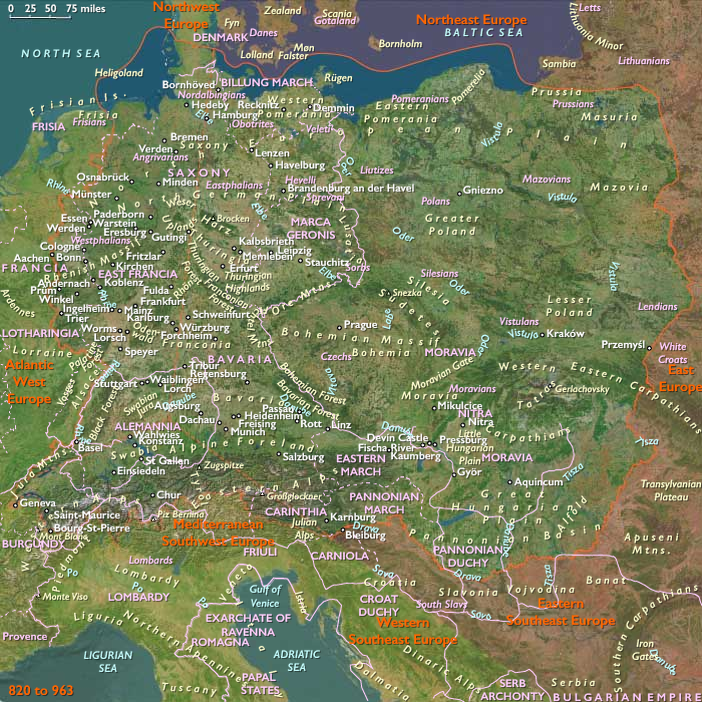
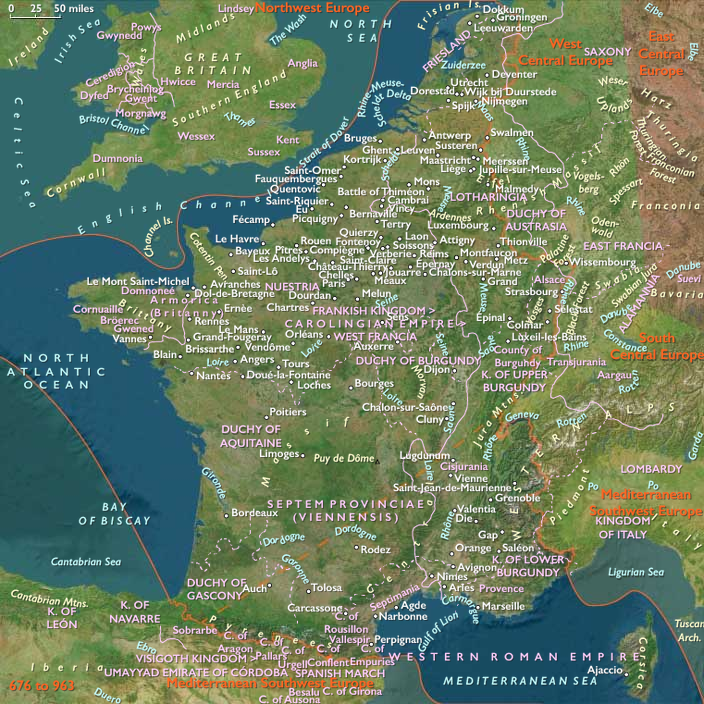
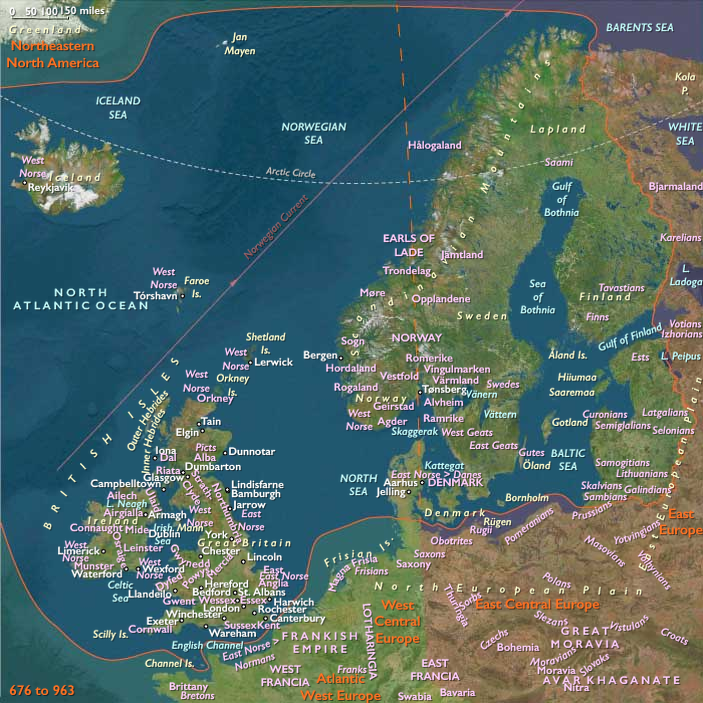
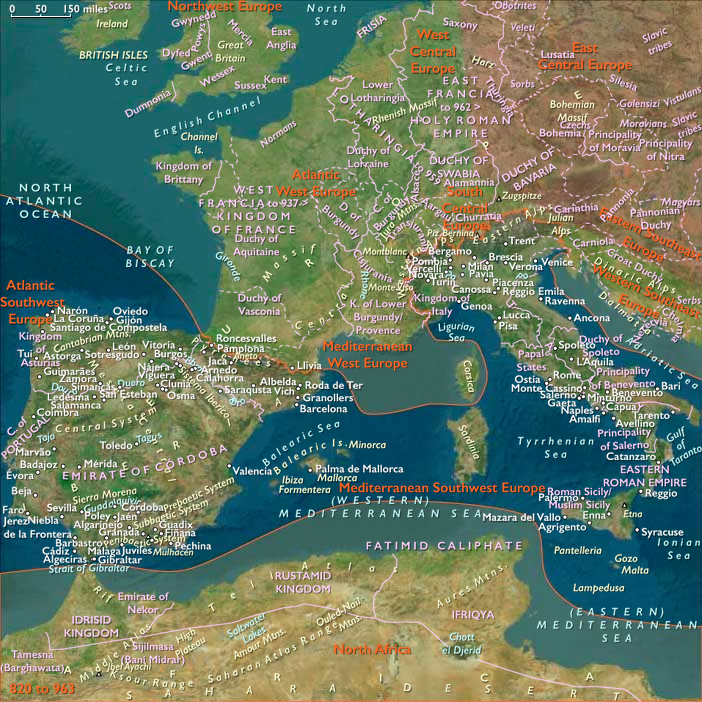
Between 880 and 891, Atlantic West Europe saw the resurgence of Carolingian power in West Francia, the ongoing fragmentation and consolidation of regional principalities like Flanders, Anjou, Aquitaine, Brittany, and Burgundy, and continued threats from Viking raids.
Political and Military Developments
-
West Francia: Restoration Under Charles the Fat
- Carolingian authority briefly consolidated under Emperor Charles the Fat (r. 881–888), who reunited Carolingian territories including West Francia.
- Charles proved largely ineffective, failing notably during the Viking siege of Paris (885–886), despite the heroic defense led by Count Odo of Paris.
-
Rise of Odo of Paris
- Odo, Count of Paris, emerged as a military hero by successfully defending Paris against the Vikings.
- Following Charles the Fat’s deposition in 887 and subsequent death in 888, West Francia's nobility elevated Odo to kingship, establishing him as the first non-Carolingian king since Charlemagne’s dynasty began.
-
Establishment of Principalities
- Flanders continued its growth under Baldwin II "the Bald," fortifying its independence by securing royal recognition and expanding its territories.
- Anjou steadily consolidated power under local counts, enhancing regional autonomy in the Loire Valley.
- Aquitaine experienced ongoing fragmentation among local nobles, though its regional identity and autonomy persisted.
- Brittany strengthened under Duke Alain I, successfully resisting Viking invasions and securing regional autonomy.
-
Upper and Lower Burgundy: Formation of Independent Kingdoms
- After the death of Charles the Fat (888), Upper Burgundy (the future Free County of Burgundy or Franche-Comté) established itself independently under Rudolph I.
- Concurrently, Lower Burgundy (later Kingdom of Provence or Cisjurane Burgundy) emerged under Boso, expanding regional autonomy.
Economic and Social Developments
-
Impact of Viking Raids
- Continued Viking raids disrupted trade routes along the Loire and Seine rivers, leading to fortified towns and castles as defensive measures.
- This further accelerated regional fragmentation and encouraged the rise of local strongholds.
-
Urbanization and Trade
- Despite disruptions, towns like Paris, Tours, and Bruges gradually enhanced their roles as centers of commerce and administrative power, especially with increasing fortifications.
Religious and Cultural Developments
- Monastic Revival and Cultural Preservation
- Monastic centers, despite Viking threats, continued intellectual preservation, notably at Saint-Martin of Tours and Saint-Bertin in Flanders.
- Manuscript illumination and Latin scholarship continued, albeit reduced by instability.
Legacy and Significance
By 891, Atlantic West Europe had experienced:
- The decisive failure and ultimate end of centralized Carolingian control, setting the stage for Odo’s accession and the eventual rise of the Robertian dynasty.
- Continued growth and regional consolidation in Flanders, Anjou, Brittany, and Burgundy, reinforcing political fragmentation into strong regional states.
- Significant cultural preservation despite ongoing disruptions, laying the foundations for regional identities and future political structures in the early medieval period.
This era firmly signaled the fragmentation of Carolingian authority, paving the way toward the feudal decentralization that characterized subsequent medieval Europe.
Baldwin II of Flanders: Defending Flanders Against the Vikings (879–884)
Baldwin II, son of Baldwin I of Flanders and Judith of West Francia (daughter of Charles the Bald), inherits a land devastated by Viking raids. As a descendant of Charlemagne, Baldwin II’s reign is shaped by his struggle to defend and consolidate Flanders, which becomes a lasting stronghold of medieval power.
Viking Devastation and Baldwin’s Strategic Retreat
- The early years of Baldwin II’s rule are marked by relentless Viking incursions, with much of Flanders north of the Somme ravaged.
- By 883, Baldwin is forced to retreat northward to the flat marshes of the pagus Flandrensis (the Flemish region).
- From this point forward, Flanders becomes the primary power base of the Counts of Flanders.
The Fortification of Flanders
- To resist further Viking attacks, Baldwin II begins constructing a network of wooden fortifications at:
- Saint-Omer
- Bruges
- Ghent
- Kortrijk
- These early citadels will later evolve into castellanies, serving as centers of:
- Local government
- Militia organization
- Judicial courts
- Baldwin also seizes lands abandoned by royal and ecclesiastical officials, expanding his territorial control in the absence of strong Carolingian authority.
The Anglo-Flemish Alliance: Baldwin’s Marriage to Ælfthryth (884)
- In 884, Baldwin marries Ælfthryth (Elfrida), daughter of King Alfred the Great of England.
- This Anglo-Flemish alliance strengthens Baldwin’s position against the Vikings, who continue to raid both England and Flanders.
- The immediate goal of the marriage is to help Baldwin control the lower Canche River valley, a region of strategic military and economic importance.
Legacy of Baldwin II’s Early Rule
- Transforms Flanders into a fortified region, securing its long-term independence.
- Establishes early structures of feudal governance, ensuring that Flemish rulers have strong regional control.
- Strengthens ties between Flanders and England, laying the foundation for future alliances between the two regions.
Despite the continuous Viking threat, Baldwin II successfully consolidates Flanders, turning a vulnerable borderland into one of the most powerful medieval principalities in Europe.
The Viking Siege of Paris (885–886): Charles the Fat’s Failure and the Rise of Odo
By 885, West Francia remains under severe Viking pressure, particularly in the Seine Valley, where Norse fleets continue to raid inland settlements. That year, a massive Viking fleet, led by Sigfred, sails up the Seine River and lays siege to Paris, marking one of the most significant and prolonged Viking attacks on the city.
The Viking Siege Begins (885)
- Sigfred’s fleet, composed of hundreds of ships and thousands of warriors, arrives at Paris, a strategically vital city on the Seine.
- This is the first major Viking attack on Paris in years, and the Norse leader demands tribute in exchange for sparing the city.
- However, unlike previous rulers, Charles the Fat refuses to pay a bribe, likely attempting to avoid further incentivizing Viking raids.
Odo of Paris and the Call for Reinforcements
- At the time of the Viking invasion, Charles the Fat is in Italy, leaving West Francia without centralized leadership.
- Odo, Count of Paris, and Bishop Gozlin organize the city’s defense, refusing to surrender to the Norsemen.
- Odo secretly sneaks a group of men through Viking lines to request military assistance from Charles.
- In response, Charles dispatches Henry of Saxony to relieve the siege.
The Siege Intensifies
- The Vikings launch multiple assaults against the fortified bridges of Paris, but the defenders hold strong, repelling attack after attack.
- The siege will last over a year, becoming one of the greatest tests of Frankish resilience against the Vikings.
Significance of the Siege of Paris
- Odo emerges as a heroic leader, rallying the defenders and proving his military competence, which will later lead to his election as King of West Francia (888).
- The Carolingian monarchy’s inability to protect its key cities further erodes Charles the Fat’s authority, contributing to his downfall in 887.
- The siege becomes legendary, symbolizing the determination of the Franks against Viking aggression and the gradual shift of power from the Carolingians to local lords.
The Siege of Paris (885–886) marks a turning point in Viking-Frankish relations, highlighting both the growing autonomy of regional rulers like Odo and the declining influence of the Carolingian emperors in the face of repeated Viking invasions.
The Siege of Paris (885–886) and Charles the Fat’s Betrayal
Between 885 and 886, Paris, heavily fortified since its sack by the Danes in 857, withstands a massive Viking siegelasting eleven months. The Norse invaders, numbering around 40,000 warriors aboard 700 ships, launch relentless attacks against the fortified city, yet the Parisian defenders, led by Count Odo and Bishop Gozlin, refuse to surrender.
Paris Under Siege: A Brutal Standoff
- The Vikings attempt multiple assaults, trying to breach the fortified bridges of the Île de la Cité, but the Parisian garrison holds firm.
- Disease and starvation begin to spread within the city, weakening the defenders.
- In early 886, Count Odo personally rides out of Paris, breaking through Viking lines to seek reinforcements from Emperor Charles the Fat.
Charles the Fat Arrives… But Refuses to Fight
- Charles the Fat finally arrives with a large army and encircles the Viking force, setting up a camp at Montmartre.
- Despite securing a strong position, Charles refuses to engage the Vikings in battle, shocking his own commanders.
- Instead of fighting, he negotiates with the Norse leaders and pays them off, allowing them to continue their raids elsewhere.
The Humiliation of West Francia
- Charles orders the Vikings to sail down the Seine and plunder Burgundy, which is already in revolt against him.
- This diplomatic maneuver further undermines Frankish authority, as Charles is seen as abandoning his own people to Viking devastation.
- The decision enrages the nobles of West Francia, who see Charles’ inaction as cowardice and betrayal.
Consequences of the Siege and Charles’ Downfall
- Despite being greatly outnumbered, Paris holds out and is never taken, solidifying its status as a center of Frankish resistance.
- Count Odo’s leadership during the siege makes him a hero among the Frankish nobility, paving the way for his later election as King of West Francia in 888.
- The humiliating settlement with the Vikings severely damages Charles the Fat’s already weak reputation, leading to his deposition in 887.
The Siege of Paris: A Turning Point in West Francia
The Siege of Paris (885–886) is a defining moment in the decline of Carolingian authority and the rise of local feudal power. While Charles the Fat’s failure to protect his kingdom leads to his downfall, the bravery of Paris’ defenders propels Odo into power, marking the beginning of the end of Carolingian rule in West Francia.
The Viking Withdrawal and the Final Decline of Charles the Fat (887)
By spring 887, the Vikings withdraw from France, taking with them the 700 pounds of silver promised by Emperor Charles the Fat. His decision to pay off the Norse invaders rather than fight them is widely seen as an act of weakness, further diminishing his already fragile prestige in West Francia.
Charles’ Actions in Paris During and After the Siege
- During and after the Siege of Paris (885–886), Charles remains in the city, issuing several charters to West Frankish recipients.
- These charters confirm previous rights and privileges granted by his predecessors, particularly in:
- Neustria, where Viking incursions remain a pressing issue.
- The Spanish March, reaffirming Frankish control over border territories.
- Provence, ensuring continued governance of the southern frontier of the empire.
- His contact with Nantes suggests that Charles recognizes the growing influence of Alan I, Duke of Brittany, in the region.
Recognition of Alan I of Brittany as “Rex”
- It is probable that Charles the Fat grants Alan I the right to be titled rex (king) of Brittany, a privilege that only an emperor could bestow.
- Alan I was already the most powerful ruler in Brittany, successfully resisting Viking invasions and expanding his control.
- His claim to the title appears legitimate, as later Breton sources acknowledge it, and a charter dating between 897 and 900 mentions prayers being said at Redon Abbey for the soul of Karolus (likely Charles the Fat), ordered by Alan.
Consequences of Charles’ Rule and the Aftermath
- Charles’ failure to protect France from Viking threats leads to his deposition in 887, marking the final collapse of Carolingian imperial unity.
- Alan I’s rise as King of Brittany reinforces Breton autonomy and weakens West Francia’s territorial control over its westernmost regions.
- The events of 887 contribute to the increasing fragmentation of the Carolingian world, paving the way for the rise of local feudal rulers and dynastic change.
The Viking withdrawal in 887 marks the end of Charles the Fat’s reign, as his failure to defend the realm leads to his downfall, while Alan I’s recognition as King of Brittany cements the region’s growing independence.
Charles the Fat had probably abandoned his plans for Bernard and instead adopted Louis of Provence as his son at an assembly at Kirchen in May.
It is possible, however, that the agreement with Louis was only designed to engender support for Bernard's subkingship in Lotharingia.
In June or July, Berengar arrived in Kirchen, probably pining to be declared Charles's heir; he may in fact have been so named in Italy, where he will be acclaimed (or make himself) king immediately after Charles's deposition in 887.
Odo, Count of Paris, may have had a similar purpose in visiting Charles at Kirchen.
On the other hand, the presence of these magnates at these two great assemblies may merely have been necessary to confirm Charles' illegitimate son as his heir (Waiblingen), a plan which failed when the pope refused to attend, and then to confirm Louis instead (Kirchen).
The Exclusion of Charles the Simple and the Rise of Odo (888)
Charles the Simple, the third and posthumous son of Louis the Stammerer, is denied the throne of West Francia as a child, despite being the legitimate Carolingian heir. His exclusion from power coincides with the decline of the Carolingian Empire and the rise of a new, non-Carolingian dynasty in West Francia.
Why Was Charles the Simple Denied the Throne?
-
His Youth and Lack of Support (884–888)
- When his half-brother Carloman II dies in 884, Charles is too young to rule.
- The Frankish nobles invite Charles the Fat, a distant Carolingian cousin, to become king instead.
- Charles the Fat’s rule ends in disgrace when he is deposed in November 887 and dies in January 888, but Charles the Simple is still not recognized as king.
-
The Rise of Odo (888)
- After Charles the Fat’s deposition, West Francia’s nobles reject Charles the Simple, turning instead to Odo, Count of Paris.
- Odo had gained immense prestige for his leadership during the Viking Siege of Paris (885–886).
- On February 29, 888, Odo is crowned king at Compiègne by Walter, Archbishop of Sens.
- His election marks the end of Carolingian rule in West Francia—at least temporarily.
-
Alternative Claimants: Guy III of Spoleto and Ranulf II of Aquitaine
- A faction of nobles opposes Odo and supports Guy III of Spoleto, an Italian noble who also claims the throne.
- Ranulf II, Duke of Aquitaine, takes Charles under his protection, possibly hoping to secure the throne for him.
- Ranulf later claims the royal title himself, but eventually makes peace with Odo, recognizing his kingship.
Significance of Odo’s Coronation in 888
- Odo is not a Carolingian, making his coronation the first true break from the dynasty of Charlemagne.
- This marks the effective end of the Carolingian Empire, as West Francia now has a non-Carolingian ruler.
- The exclusion of Charles the Simple sets up a future power struggle, as many still view the Carolingians as the legitimate rulers of West Francia.
Though Charles the Simple is denied his birthright in 888, his supporters will eventually restore him to the throne in 898, initiating a Carolingian revival—but by then, the Carolingian dynasty’s political power is already fading, paving the way for the eventual rise of the Capetians in 987.