Odo III
Duke of Burgundy
Years: 1166 - 1218
Eudes III (1166 – July 6, 1218), commonly known in English as Odo III, is duke of Burgundy between 1192 and 1218.
Odo is the eldest son of duke Hugh III and his first wife Alice, daughter of Matthias I, Duke of Lorraine.
Odo does not follow his father's aggressive policies towards France and proves a worthy ally of king Philip II of France in his wars against John Lackland and the Holy Roman Emperor Otto IV of Germany.
He fights bravely against the latter in the Battle of Bouvines, where he loses, according to contemporary chroniclers, two horses beneath him.
Odo is also an important figure in the Crusade against the Cathars.
When Philip II refuses to get involved, the Duke of Burgundy steps forward with the support of the local bishops and his vassals and organizes the campaign of 1209 against the Cathar strongholds.
From 1216 to 1218, he helps Philip II of France and Frederick II, Holy Roman Emperor to bring an end to the War of Succession in Champagne.

Related Events
Filter results
Showing 8 events out of 8 total
Atlantic West Europe (1156–1167): The Angevin Ascendancy, Royal Rivalries, and Cultural Flourishing
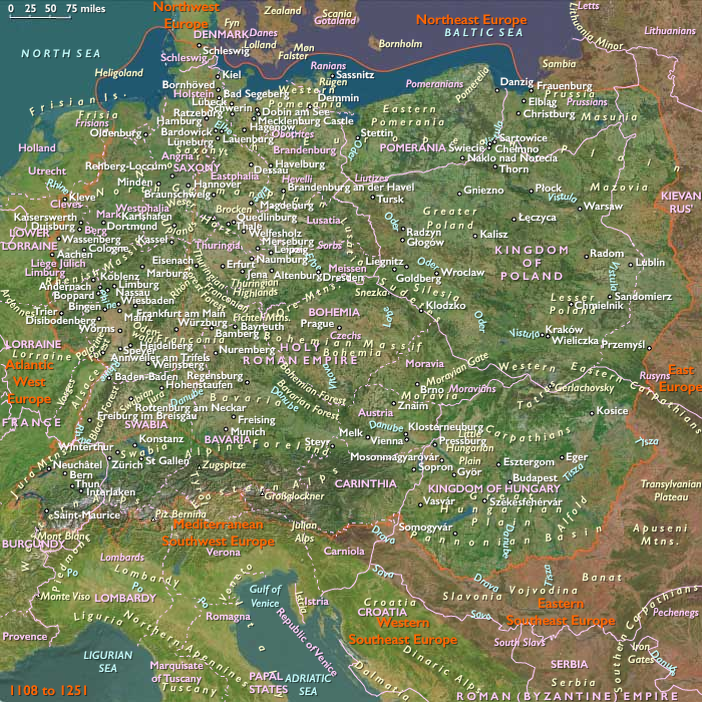
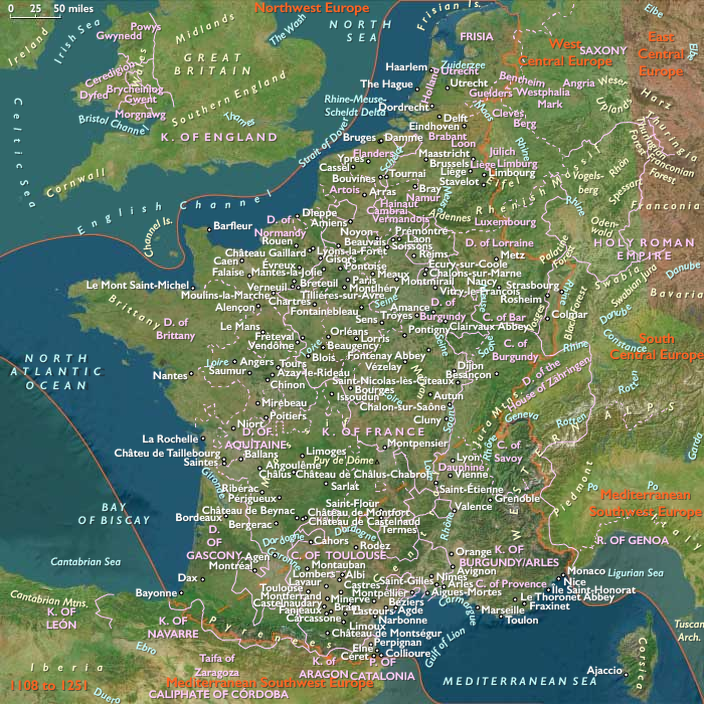
Between 1156 and 1167, Atlantic West Europe—including the Low Countries, Brittany, Normandy, Aquitaine, Burgundy, central France, Alsace, and Franche-Comté—witnessed the rise of Angevin dominance, intensifying royal rivalries, continued economic prosperity, and significant cultural and intellectual advances.
Political and Military Developments
-
The Rise of the Angevin Empire
- Henry II Plantagenet (r. 1154–1189), through his marriage to Eleanor of Aquitaine, consolidated territories from Normandy to Aquitaine, creating a vast realm rivaling France itself.
- Henry's power provoked increased tensions with Louis VII of France (r. 1137–1180), initiating decades of intermittent warfare.
-
France: Royal Authority Challenged
- Louis VII faced difficulties containing Angevin expansion, resulting in frequent conflicts aimed at limiting Henry II's growing influence in French territories.
-
Brittany: Maintaining Autonomy
- Conan IV of Brittany (r. 1156–1166) navigated political pressures from Henry II and France, ultimately compelled to acknowledge Angevin overlordship to preserve regional stability.
-
Burgundy and the Low Countries: Relative Stability
- Burgundy remained relatively stable under Duke Eudes II (r. 1143–1162) and his successor, Hugh III (r. 1162–1192), preserving autonomy amid broader regional conflicts.
- The Low Countries, especially Flanders, experienced economic prosperity, though political tension increased between local counts and external powers.
Economic and Social Developments
-
Expanding Trade and Economic Integration
- Trade through the Champagne fairs and Flemish cities (Bruges, Ghent, Ypres) flourished, further linking northern and southern European economies.
- Textile industries in Flanders and wool exports from England and Normandy strengthened regional economies.
-
Agricultural Productivity and Rural Stability
- Ongoing agricultural improvements supported population growth, urbanization, and market expansion, reinforcing economic stability.
Cultural and Intellectual Developments
-
Growth of Scholasticism and Intellectual Centers
- Paris emerged definitively as Europe's intellectual hub, driven by scholars such as Peter Lombard, whose influential theological work, the "Sentences," shaped medieval intellectual life.
-
Gothic Architecture and Artistic Expression
- Gothic architecture flourished, notably in the ongoing construction of Notre-Dame de Paris (begun in 1163), symbolizing France's cultural and spiritual influence.
Religious Developments
-
Thomas Becket and Church-State Relations
- The conflict between Henry II and Archbishop Thomas Becket (appointed 1162) of Canterbury highlighted tensions between secular authority and ecclesiastical independence, impacting church-state relations across the region.
-
Cistercian Influence and Monastic Reform
- Cistercian monasteries, particularly Clairvaux, continued expanding spiritually and economically, strengthening their influential role in religious reform.
Legacy and Significance
The period from 1156 to 1167 established the Angevin Empire as a dominant force in Atlantic West Europe, laying the foundation for prolonged conflicts between England and France. The growth of Paris as a major intellectual and cultural center, alongside advancements in architecture and scholasticism, solidified this era's lasting impact on European history.
Atlantic West Europe (1192–1203): Shifting Alliances, Angevin Decline, and Cultural Flourishing
Between 1192 and 1203, Atlantic West Europe—including the Low Countries, Brittany, Normandy, Aquitaine, Burgundy, central France, Alsace, and Franche-Comté—experienced dramatic shifts marked by the decline of Angevin power, a significant expansion of Capetian authority under Philip II Augustus, intensified economic prosperity, and remarkable cultural and intellectual growth.
Political and Military Developments
-
Decline of the Angevin Empire and Rise of Capetian France
- Richard I ("the Lionheart," r. 1189–1199), frequently absent from his continental territories due to crusading and captivity, saw Angevin authority weaken significantly.
- Upon Richard’s death (1199), his brother John Lackland (r. 1199–1216) inherited an empire in turmoil, facing immediate challenges from Philip Augustus of France.
- Philip II Augustus skillfully exploited John's vulnerabilities, gradually undermining Angevin control, particularly in Normandy, Anjou, and parts of Aquitaine.
-
Loss of Normandy and Angevin Territories
- Philip II’s military campaigns culminated in the decisive Siege of Château Gaillard (1203), significantly weakening Angevin defenses in Normandy.
- By 1203, Angevin territories were on the brink of collapse, setting the stage for Normandy’s complete loss (1204).
-
Brittany’s Ambiguous Position
- Brittany, under Duchess Constance and later her young son Arthur of Brittany, became embroiled in the Angevin-Capetian conflict, exacerbating regional instability.
- Arthur’s capture (1202) by King John further destabilized the region, ultimately benefiting Capetian ambitions.
-
Burgundy and the Low Countries: Stability Amid Conflict
- Odo III of Burgundy (r. 1192–1218) maintained stable rule, skillfully navigating alliances between France and the Empire.
- The Low Countries, particularly Flanders, continued to prosper economically and maintained relative political autonomy despite external tensions.
Economic and Social Developments
-
Trade Expansion and Urban Prosperity
- Economic activity in Flanders flourished, particularly in Bruges, Ghent, and Ypres, becoming European centers of textile manufacturing and trade.
- Continued growth of the Champagne fairs integrated markets, strengthening Atlantic West Europe's centrality in European commerce.
-
Rural Productivity and Agricultural Innovation
- Increased agricultural productivity and population growth supported further urbanization, with widespread improvements in agricultural technology and crop rotation.
Cultural and Intellectual Developments
-
Gothic Architecture Reaches New Heights
- Gothic construction reached a high point in this era, particularly at Chartres Cathedral (rebuilt after 1194), which became an influential model across Europe.
-
Courtly Literature and Intellectual Activity
- Courtly literature flourished further, notably in the works of Chrétien de Troyes’ successors, who expanded Arthurian romance and courtly poetry.
- Universities, especially the University of Paris, became dominant intellectual hubs, attracting students and scholars from across Europe.
Religious Developments
-
Crusading Zeal and the Fourth Crusade
- Atlantic West Europe actively supported crusading efforts, culminating in regional participation in preparations for the ill-fated Fourth Crusade (1202–1204).
-
Monasticism and Religious Reform
- Continued expansion of Cistercian monasticism influenced regional religious practice, economy, and education, reinforcing their societal significance.
Legacy and Significance
The era 1192–1203 marked a critical turning point in Atlantic West Europe, characterized by the dramatic weakening of Angevin rule and corresponding rise of Capetian dominance under Philip II Augustus. Combined with robust economic growth, cultural achievements, and intense crusading fervor, this era fundamentally reshaped the political and cultural landscape, establishing a clear foundation for Capetian dominance, regional prosperity, and cultural vitality throughout the thirteenth century.
Atlantic West Europe (1192–1203): Shifting Alliances, Angevin Decline, and Cultural Flourishing
Between 1192 and 1203, Atlantic West Europe—including the Low Countries, Brittany, Normandy, Aquitaine, Burgundy, central France, Alsace, and Franche-Comté—experienced dramatic shifts marked by the decline of Angevin power, a significant expansion of Capetian authority under Philip II Augustus, intensified economic prosperity, and remarkable cultural and intellectual growth.
Political and Military Developments
-
Decline of the Angevin Empire and Rise of Capetian France
- Richard I ("the Lionheart," r. 1189–1199), frequently absent from his continental territories due to crusading and captivity, saw Angevin authority weaken significantly.
- Upon Richard’s death (1199), his brother John Lackland (r. 1199–1216) inherited an empire in turmoil, facing immediate challenges from Philip Augustus of France.
- Philip II Augustus skillfully exploited John's vulnerabilities, gradually undermining Angevin control, particularly in Normandy, Anjou, and parts of Aquitaine.
-
Loss of Normandy and Angevin Territories
- Philip II’s military campaigns culminated in the decisive Siege of Château Gaillard (1203), significantly weakening Angevin defenses in Normandy.
- By 1203, Angevin territories were on the brink of collapse, setting the stage for Normandy’s complete loss (1204).
-
Brittany’s Ambiguous Position
- Brittany, under Duchess Constance and later her young son Arthur of Brittany, became embroiled in the Angevin-Capetian conflict, exacerbating regional instability.
- Arthur’s capture (1202) by King John further destabilized the region, ultimately benefiting Capetian ambitions.
-
Burgundy and the Low Countries: Stability Amid Conflict
- Odo III of Burgundy (r. 1192–1218) maintained stable rule, skillfully navigating alliances between France and the Empire.
- The Low Countries, particularly Flanders, continued to prosper economically and maintained relative political autonomy despite external tensions.
Economic and Social Developments
-
Trade Expansion and Urban Prosperity
- Economic activity in Flanders flourished, particularly in Bruges, Ghent, and Ypres, becoming European centers of textile manufacturing and trade.
- Continued growth of the Champagne fairs integrated markets, strengthening Atlantic West Europe's centrality in European commerce.
-
Rural Productivity and Agricultural Innovation
- Increased agricultural productivity and population growth supported further urbanization, with widespread improvements in agricultural technology and crop rotation.
Cultural and Intellectual Developments
-
Gothic Architecture Reaches New Heights
- Gothic construction reached a high point in this era, particularly at Chartres Cathedral (rebuilt after 1194), which became an influential model across Europe.
-
Courtly Literature and Intellectual Activity
- Courtly literature flourished further, notably in the works of Chrétien de Troyes’ successors, who expanded Arthurian romance and courtly poetry.
- Universities, especially the University of Paris, became dominant intellectual hubs, attracting students and scholars from across Europe.
Religious Developments
-
Crusading Zeal and the Fourth Crusade
- Atlantic West Europe actively supported crusading efforts, culminating in regional participation in preparations for the ill-fated Fourth Crusade (1202–1204).
-
Monasticism and Religious Reform
- Continued expansion of Cistercian monasticism influenced regional religious practice, economy, and education, reinforcing their societal significance.
Legacy and Significance
The era 1192–1203 marked a critical turning point in Atlantic West Europe, characterized by the dramatic weakening of Angevin rule and corresponding rise of Capetian dominance under Philip II Augustus. Combined with robust economic growth, cultural achievements, and intense crusading fervor, this era fundamentally reshaped the political and cultural landscape, establishing a clear foundation for Capetian dominance, regional prosperity, and cultural vitality throughout the thirteenth century.
Atlantic West Europe (1216–1227): Consolidating Royal Power, Economic Vitality, and Intellectual Progress
Between 1216 and 1227, Atlantic West Europe—including the Low Countries, Brittany, Normandy, Aquitaine, Burgundy, central France, Alsace, and Franche-Comté—experienced a period of political stabilization following significant territorial realignments, alongside sustained economic growth, dynamic urban expansion, and substantial cultural and intellectual advancements.
Political and Military Developments
-
France: Strengthening Capetian Authority
- Under Philip II Augustus (r. 1180–1223) and subsequently Louis VIII (r. 1223–1226), the French crown consolidated power in territories newly acquired from the Angevin Empire, notably Normandy and Anjou.
- Louis VIII reinforced royal control through decisive campaigns in Poitou and further weakened Angevin influence in southwestern France.
-
England and Aquitaine: Shifting Loyalties
- With the decline of Angevin power after King John's death in 1216, Aquitaine became increasingly isolated, facing internal dissent and external pressure from the Capetian monarchy.
- Henry III's accession as a child (1216–1272) left English possessions on the continent vulnerable, weakening Angevin claims.
-
Brittany: Regional Autonomy under French Influence
- The Breton duchy remained nominally independent but increasingly fell under Capetian influence due to dynastic connections and strategic pressures from neighboring French territories.
-
Burgundy and the Low Countries: Political Stability
- Burgundy, under Duke Odo III (r. 1192–1218) and his successor Hugh IV (r. 1218–1272), maintained autonomy, adeptly navigating the complex political landscape dominated by the Capetian kings and Holy Roman Empire.
- In Flanders, Countess Joan (1205–1244) maintained economic prosperity while carefully balancing French and imperial interests.
Economic and Social Developments
-
Urbanization and Commercial Expansion
- Major urban centers, including Bruges, Ghent, Rouen, and Paris, continued to flourish as economic hubs, benefiting from robust trade networks and the continued importance of the Champagne fairs.
- Increased specialization in textiles, wool, and luxury goods supported urban economic vitality, boosting regional prosperity.
-
Agricultural Innovation and Population Growth
- Ongoing agricultural advancements, including crop rotation improvements and enhanced farming techniques, drove rural productivity and sustained population increases, further supporting urban development.
Cultural and Intellectual Developments
-
Gothic Architecture’s Ascendancy
- Gothic architectural styles became widespread, notably with continued construction at cathedrals like Chartres and Reims. These structures embodied both religious devotion and urban prestige.
-
Expansion of Scholasticism
- The University of Paris gained international prominence, attracting notable scholars like William of Auvergne and Robert Grosseteste, who contributed significantly to theology and early scientific inquiry.
-
Courtly Literature and Romance
- The popularity of Arthurian legends and chivalric literature continued to rise, particularly with the works of poets like Chrétien de Troyes, enhancing cultural connections between regions.
Religious Developments
-
Albigensian Crusade (1209–1229)
- The continuation of the Albigensian Crusade in southern France intensified religious fervor throughout the region, impacting political allegiances and reinforcing the authority of the Catholic Church in combating perceived heresy.
-
Monastic Growth and Reform
- Cistercian and other monastic orders continued to expand their spiritual and economic influence, founding monasteries that enhanced both regional productivity and cultural life.
Legacy and Significance
The period 1216–1227 was characterized by a marked consolidation of Capetian power, reshaping Atlantic West Europe's political landscape after the Angevin Empire’s decline. The sustained economic growth, coupled with dynamic cultural and intellectual developments, reinforced the region’s significance and set enduring foundations for its influence throughout the High Middle Ages.
The War of Succession of Champagne (1216–1222): The Struggle Between Blanche of Navarre and Erard de Brienne
The War of Succession of Champagne (1216–1222) arose from a dispute over the rightful rule of the County of Champagne, following the deaths of Henry II of Champagne (1197) and Theobald III (1201). The claimants were:
- Theobald IV of Champagne, the posthumous son of Theobald III and Blanche of Navarre, whose mother acted as regent from his birth.
- Philippa of Champagne, daughter of Henry II of Champagne, and her husband Erard de Brienne-Ramerupt, a noble from Champagne living in the Holy Land.
While Theobald IV’s claim was direct, Erard sought to challenge his right to rule through his wife Philippa, supported by several local barons and outside nobles, including Theobald I, Duke of Lorraine. However, Blanche of Navarre’s political and diplomatic skill proved decisive, ensuring that her son’s rule was eventually secured.
Background: The Origins of the Conflict
-
Henry II of Champagne’s Death and the Succession of Theobald III (1197–1201)
- Henry II of Champagne died in 1197, leaving behind only daughters, meaning his younger brother, Theobald III, inherited the county.
- Theobald III died unexpectedly in 1201, leaving his widow, Blanche of Navarre, nine months pregnant with their son, Theobald IV.
- Theobald IV’s birth made him the rightful heir, but as an infant, his rule was vulnerable to challenges.
-
Blanche of Navarre’s Regency (1201–1216)
- Blanche acted as regent, proving herself a strong and efficient ruler.
- Many nobles who might have opposed her departed on the Fourth Crusade (1202–1204), giving her time to consolidate her position.
- She was supported by Queen Mother Adèle of Champagne (aunt of Theobald III), who guided Blanche until her death in 1206.
- Blanche secured crucial alliances with King Philip II of France and Pope Innocent III, ensuring her son’s legitimacy.
The Succession Dispute and the War (1216–1222)
-
Philippa of Champagne and Erard de Brienne’s Challenge (1215–1216)
- Philippa married Erard de Brienne-Ramerupt, a nobleman linked to the ruling house of Jerusalem.
- Encouraged by Erard, Philippa claimed Champagne as her inheritance, arguing that Theobald IV was only a posthumous heir and that her father Henry II had been the rightful count.
- Erard gathered local Champagne barons to support their claim, creating a rebellion against Blanche and Theobald IV.
-
The Role of Philip II of France and Pope Innocent III
- Philip II fully supported Blanche and Theobald IV, partly due to Theobald’s bravery at the Battle of Bouvines (1214).
- Pope Innocent III excommunicated rebel barons, further weakening Erard’s support.
-
Theobald I, Duke of Lorraine, Joins the War (1216–1217)
- Theobald I of Lorraine, recently released from captivity after fighting at Bouvines on the losing side, sided with Erard de Brienne.
- However, his suzerain, Holy Roman Emperor Frederick II, opposed this and viewed it as a felony.
- Frederick retaliated by occupying Rosheim, a city he had previously granted to Theobald’s father.
The Conclusion of the War (1218–1222)
- By 1218, Erard and Philippa’s forces were weakened by papal and royal opposition.
- In 1222, when Theobald IV reached the age of majority, their remaining supporters abandoned their claims.
- Theobald IV was officially recognized as Count of Champagne, and Erard lost his bid for power.
Impact and Legacy
-
Blanche of Navarre’s Triumph
- Blanche’s political and diplomatic skill ensured Theobald IV’s succession, making her one of the most successful medieval female rulers.
-
Capetian Influence Strengthened
- With Philip II’s intervention, Champagne remained closely tied to the French Crown, reinforcing Capetian dominance.
-
Frederick II’s Growing Power
- The war demonstrated Frederick II’s authority in the Holy Roman Empire, as he punished Theobald I of Lorraine for defying him.
The War of Succession of Champagne (1216–1222) was a pivotal moment in feudal France, showcasing the increasing power of the monarchy and the Church over rebellious nobles while securing the rule of Theobald IV.
Theobald I of Lorraine Retaliates Against Emperor Frederick II (1218 CE)
In 1218, in response to Holy Roman Emperor Frederick II’s occupation of Rosheim, Theobald I, Duke of Lorraine, launched a counteroffensive, retaking the city and ravaging Alsace. This act escalated the ongoing power struggle between the emperor and rebellious regional lords.
Background of the Conflict
- Theobald I had joined the War of Succession of Champagne (1216–1222) in support of Erard de Brienne, who was challenging Theobald IV of Champagne.
- His participation in the war defied Frederick II, who had supported Theobald IV, seeing Erard’s rebellion as a violation of feudal loyalty.
- As punishment, Frederick II occupied Rosheim, a city he had previously granted to Theobald’s father.
Theobald’s Military Response (1218)
- Theobald retook Rosheim by force, demonstrating his continued defiance of the emperor.
- He led a destructive campaign in Alsace, targeting imperial holdings to weaken Frederick’s influence in the region.
Consequences of Theobald’s Offensive
- Frederick II’s authority in Alsace was directly challenged, forcing him to redirect imperial resources to secure the region.
- Theobald’s actions further strained relations with the emperor, making him a persistent adversary of the Hohenstaufens.
- The conflict foreshadowed ongoing resistance by regional lords against Frederick’s efforts to centralize imperial power.
Theobald I’s bold response in 1218, retaking Rosheim and devastating Alsace, marked a significant act of defiance against imperial authority, intensifying the broader struggles between the Holy Roman Emperor and rebellious nobles in the early 13th century.
Frederick II's Invasion of Lorraine and the Burning of Nancy (1218 CE)
In 1218, Holy Roman Emperor Frederick II swiftly counterattacked Duke Theobald I of Lorraine, who had recently retaken Rosheim and ravaged Alsace. In retaliation, Frederick invaded Lorraine, striking directly at its capital, Nancy, which he captured and burned. This decisive response was part of Frederick’s broader campaign to assert imperial control over rebellious vassals in the Holy Roman Empire.
The Context of the Conflict
- Theobald I of Lorraine had challenged Frederick II’s authority by siding with Erard de Brienne in the War of Succession of Champagne and by attacking Alsace.
- In response, Frederick launched a punitive campaign, asserting his power over defiant German lords.
Frederick’s Invasion of Lorraine
- Frederick led an imperial army into Lorraine, advancing swiftly to Nancy, the duchy’s capital.
- Upon capturing the city, he ordered it to be burned, sending a clear message of imperial dominance.
- The destruction of Nancy weakened Theobald’s ability to resist, crippling his power base.
Consequences of the Attack on Nancy
- Theobald I suffered a major setback, losing his strongest fortress and administrative center.
- Frederick II reaffirmed his authority in Lorraine, demonstrating his capacity to suppress rebellious vassals.
- The attack on Nancy became a turning point in the regional power struggle, as it forced Theobald to reconsider his resistance to the emperor.
Frederick II’s invasion of Lorraine and the burning of Nancy in 1218 underscored his determination to maintain imperial control, crushing opposition among the German nobility and punishing those who defied his rule.
Frederick II’s Capture of Theobald I of Lorraine at Amance and His Forced Submission (1218 CE)
After burning Nancy, Holy Roman Emperor Frederick II continued his punitive campaign against Theobald I, Duke of Lorraine, pursuing him to the castle of Amance, where Theobald had taken refuge. Frederick besieged the fortress, captured it, and imprisoned Theobald, forcing him to submit to harsh terms to regain his freedom.
The Siege and Capture of Theobald I at Amance
- Frederick II’s forces besieged Amance, one of Theobald’s last strongholds in Lorraine.
- The castle eventually fell to the imperial army, and Theobald was taken prisoner.
- The defeat left Theobald in a position of extreme weakness, forcing him to negotiate for his release.
The Terms of Theobald’s Release
To regain his freedom, Theobald was forced to accept humiliating conditions, including:
-
Recognizing the suzerainty of the Count of Champagne
- This effectively made Theobald a vassal of Champagne, diminishing his independent authority.
-
Acknowledging the legitimacy of Erard de Brienne’s claim to Champagne
- This strengthened the opposition against Theobald IV of Champagne, whom Theobald I had originally supported.
-
Ceding several lordships to Frederick II
- These territorial concessions further weakened Lorraine’s autonomy and expanded imperial control over the region.
Consequences of Theobald’s Defeat
- Theobald’s loss at Amance significantly reduced his power, both within Lorraine and in Champagne.
- Frederick II demonstrated his ability to suppress rebellious vassals, reinforcing imperial dominance in the Holy Roman Empire.
- The war for Champagne’s succession continued, but Theobald I’s defeat altered the balance of power in favor of Erard de Brienne.
Frederick II’s campaign in Lorraine and his capture of Theobald I at Amance in 1218 reinforced imperial authority over rebellious German lords, while also undermining Theobald IV of Champagne’s position in the ongoing War of Succession of Champagne.