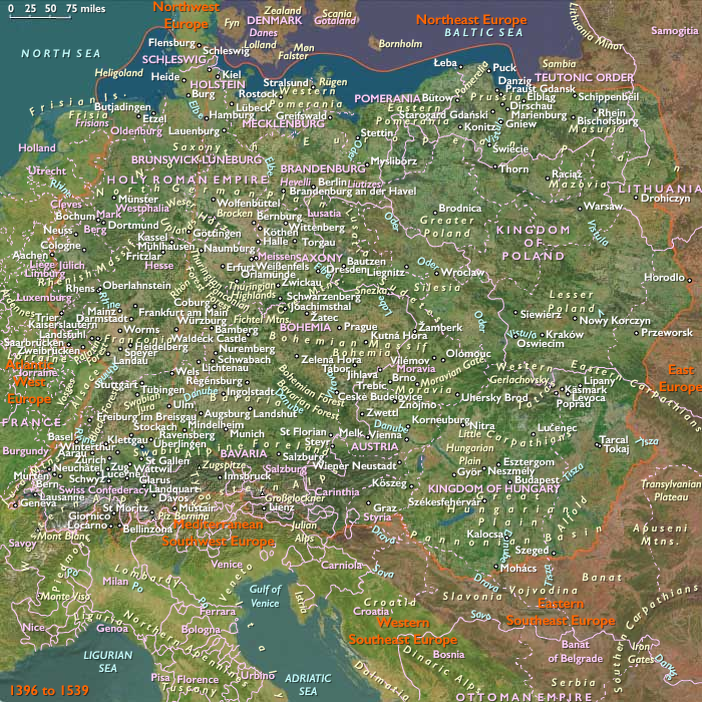
Nicholas of Cusa or Kues (Latinized as "Cusa"), the second of four children of Katherina Roemer and Johan Krebs (or Cryfftz), "a prosperous boat owner and ferryman." (Donald F. Duclow, "Life and Works", in Christopher M. Bellitto, Thomas M. Izbicki, Gerald Christianson (Eds.), Introducing Nicholas of Cusa, A Guide to a Renaissance Man, Paulist Press, 2004, p 25), had entered the University of Heidelberg in 1416 as "a cleric of the diocese of Trier" studying the liberal arts, then received his doctorate in Canon law from the University of Padua in 1423.
Afterwards, he had entered the University of Cologne in 1425 as "a doctor of canon law", which it appears he both taught and practiced there.
Following this brief period in Cologne, he had become secretary to Otto of Ziegenhain, the Archbishop of Trier, and had represented him in Rome in 1427.
After the death of Otto, during the period when the archbishopric of Trier was contested by opposing parties, he had attended the Council of Basel (1431–49), representing Ulrich von Manderscheid, one of the claimants.
While present at the council, Nicholas had written De concordantia catholica, a synthesis of ideas on church and empire balancing hierarchy with consent.
This work remained useful to critics of the papacy long after Nicholas left Basel.
Nicholas had been close to the late Cardinal Giuliano Cesarini, who had tried to reconcile pope and council, combining reform and hierarchic order.
Nicholas had supported transfer of the council to Italy to meet with the Greeks, who needed aid against the Ottoman Turks, and had supported Pope Eugenius IV in his effort to bring the Eastern churches into union with the Western at such a "council of union."
While returning from a mission to Constantinople to persuade the Greeks to attend the Council of Florence, Nicholas had a shipboard experience that led to his writing thereafter on metaphysical topics.
Nicholas then represented the pope in Germany, becoming known as the Hercules of the Eugenian cause.
After a successful career as a papal envoy, he had been made a theologian by Pope Nicholas V in 1448 or 1449, and is named Bishop of Brixen in 1450.
His role as papal legate to the German lands includes wide travels.
His local councils enacts reforms, many of which are not successful.
Pope Nicholas cancels some of Nicholas' decrees, and the effort to discourage pilgrimages to venerate the allegedly miraculous bleeding hosts of Wilsnack (the so-called Holy Blood of Wilsnack) is unsuccessful.