Napoleon III
Emperor of the French
Years: 1808 - 1873
Louis-Napoléon Bonaparte (20 April 1808 – 9 January 1873) is the first President of the French Republic and, as Napoleon III, the ruler of the Second French Empire.
He is the nephew and heir of Napoleon I.
Elected President by popular vote in 1848, he initiates a coup d'état in 1851, before ascending the throne as Napoleon III on 2 December 1852, the forty-eighth anniversary of Napoleon I's coronation.
He rules as Emperor of the French until 4 September 1870.
He is both the first titular president and the last monarch of France.
Napoleon III is primarily remembered for an energetic foreign policy which aims to jettison the limitations imposed on France since 1815 by the Concert of Europe and reassert French influence in Europe and the French colonial empire.
Napoleon stands opposed to the reactionary policies imposed at Vienna in 1815 and instead is an exponent of popular sovereignty, and a friend of nationalism A brief war against Austria in 1859 largely brings an end to the process of Italian unification.
In the Near East, Napoleon III spearheads allied action against Russia in the Crimean War and restores French presence in the Levant, claiming for France the role of protector of the Maronite Christians.
A French garrison in Rome likewise secures the Papal States against annexation by Italy, defeating the Italians at Mentana and winning the support of French Catholics for Napoleon's regime.
In the Far East, Napoleon III establishes French rule in Cochinchina and New Caledonia.
French interests in China are upheld in the Second Opium War and the Taiping Rebellion; an abortive campaign against Korea is launched in 1866 while a military mission to Japan fails to prevent the restoration of Imperial rule.
French intervention in Mexico is also unsuccessful and is terminated in 1867 due to mounting Mexican resistance and American diplomatic pressure.
Domestically, Napoleon is balanced between the conservatives and liberals, and year by year moves bit by bit toward the liberal element.
It is an era of prosperity and industrialization urban France.
This facilitates a major renovation of Paris under Haussmann that creates the outline of the modern city.
The Second French Empire is overthrown three days after Napoleon's disastrous surrender at the Battle of Sedan in 1870, which results in the proclamation of the French Third Republic and his exile in England.
Related Events
Filter results
Showing 10 events out of 217 total
West Europe (1828–1971 CE)
Industrial Democracies, Colonial Decline, and Cultural Renaissance
Geography & Environmental Context
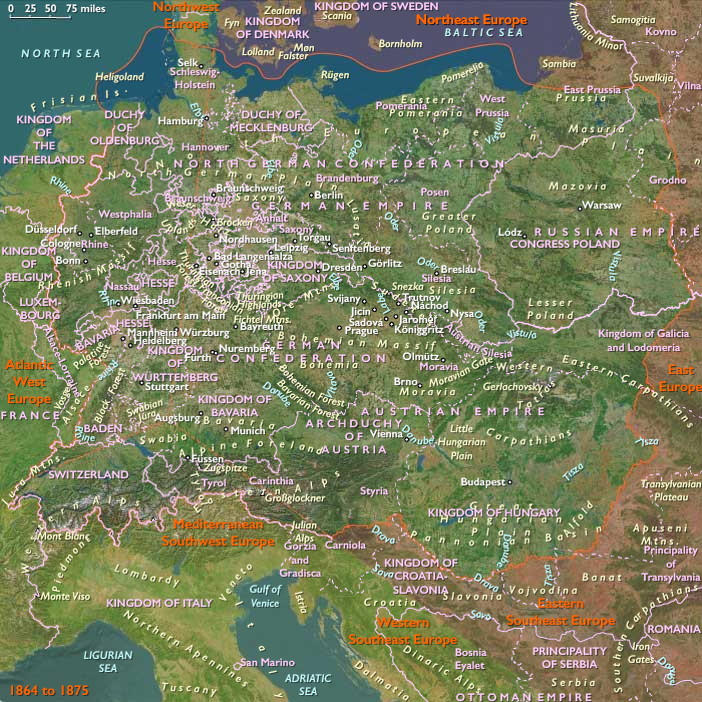
West Europe includes two fixed subregions:
-
Atlantic West Europe — the Atlantic and English Channel coasts of France, the Loire Valley, Burgundy, northern France (including Paris), and the Low Countries: Belgium, the Netherlands, and Luxembourg.
-
Mediterranean West Europe — southern France, Monaco, and Corsica, including the Rhone Valley, Marseille–Arles–Camargue corridor, and the French Pyrenees.
Anchors include the Seine, Loire, and Rhone River systems, the Pyrenees, and the North Sea and Mediterraneancoasts. Major cities—Paris, Marseille, Lyon, Bordeaux, Brussels, Amsterdam, and Rotterdam—defined the region’s economic and cultural life. Its temperate climate, fertile river basins, and extensive coastlines made it the historical heartland of European trade, innovation, and political revolution.
Climate & Environmental Shifts
The region’s moderate maritime climate supported agriculture and industry. The 19th century saw deforestation replaced by replanting and the emergence of viticulture and dairy farming as staples. Urban coal use caused heavy pollution in industrial basins until cleaner technologies spread mid-20th century. Coastal reclamation in the Netherlands expanded farmland, while the Camargue and Rhone deltas experienced seasonal flooding. Postwar modernization brought hydroelectric dams in the Alps and Pyrenees, and nuclear energy development in France by the 1960s.
Subsistence & Settlement
-
Agriculture modernized through mechanization, fertilizers, and scientific breeding. Northern France and the Low Countries became Europe’s breadbasket; southern France specialized in wine, olives, and fruits.
-
Industrialization: Belgium’s coalfields, northern France’s steel plants, and Dutch shipyards fueled 19th-century economic growth. The Industrial Revolution diffused westward from Britain, reshaping urban centers like Lille, Liège, and Rouen.
-
Urbanization: Paris remained Europe’s artistic and intellectual capital, while Marseille, Lyon, Brussels, and Amsterdam became hubs of trade and manufacturing. After WWII, suburban growth and reconstruction replaced bombed quarters with modern infrastructure.
-
Migration: Rural workers moved to cities, and later, immigrants from southern Europe and North Africa filled industrial labor demands in the 1950s–60s.
Technology & Material Culture
Steam locomotives and canal systems integrated markets by mid-19th century; telegraphs and railways linked Paris to Brussels, Amsterdam, and Marseille. The Eiffel Tower (1889) symbolized technological modernity. The 20th century brought electrification, automobiles (notably Citroën and Renault), aviation, and nuclear engineering. Architecture ranged from Haussmann’s boulevards to Le Corbusier’s modernism. Cafés, cinemas, and department stores became emblematic of urban life.
Movement & Interaction Corridors
-
Maritime networks: Le Havre, Bordeaux, Marseille, Antwerp, and Rotterdam handled global trade linking Europe to Africa, Asia, and the Americas.
-
Rail corridors: Connected industrial zones and capitals; after 1945, highways and airports redefined mobility.
-
Colonial routes: French and Dutch empires tied the region to overseas possessions in Africa and Asia until decolonization after 1945.
-
European integration: The Benelux Customs Union (1944) and founding of the European Economic Community (1957) in Treaty of Rome began the long process of continental unity.
Cultural & Symbolic Expressions
West Europe shaped modern art, philosophy, and politics.
-
Romanticism and Realism: Writers like Victor Hugo, Honoré de Balzac, and Émile Zola portrayed the industrial and moral upheavals of 19th-century France.
-
Impressionism and Modernism: Artists such as Monet, Cézanne, and Picasso (working in France) revolutionized visual art.
-
Music and thought: Composers Debussy and Ravel, philosophers Auguste Comte, Jean-Paul Sartre, and Simone de Beauvoir reflected France’s cultural reach.
-
Cinema and design: The Lumière brothers pioneered film; postwar realism and New Wave directors (Truffaut, Godard) redefined global cinema.
-
Catholicism, Protestantism, and secular republicanism coexisted, with laïcité (secularism) enshrined in French political life after 1905.
Environmental Adaptation & Resilience
Rural electrification and cooperative farming modernized villages. Coastal engineering protected the Netherlands from floods (Delta Works, initiated 1953). Postwar housing programs rebuilt cities, while reforestation and pollution controls revived industrial landscapes. Agricultural cooperatives and Common Market policies (from 1957) stabilized food supply and prices.
Political & Military Shocks
-
Revolutions and nationhood: The Revolution of 1830 and 1848 uprisings shaped French republicanism.
-
Franco-Prussian War (1870–71): Led to the fall of the Second Empire and the Third Republic.
-
World War I (1914–18): Northern France and Belgium became the Western Front’s main battlefield; millions died amid trench warfare.
-
Interwar instability: Economic crises and political polarization set the stage for World War II (1939–45), during which France was occupied and Belgium and the Netherlands invaded.
-
Liberation and reconstruction: Allied landings (1944) restored independence; the Marshall Plan (1948) fueled recovery.
-
Decolonization: The loss of Indochina (1954) and Algeria (1962) ended France’s empire; Dutch withdrawal from Indonesia (1949) reshaped global relations.
-
Cold War politics: France pursued independent nuclear policy under Charles de Gaulle; the Low Countries aligned with NATO and European integration.
Transition
Between 1828 and 1971, West Europe transitioned from monarchies and empires to democratic, industrial, and globally connected states. Revolution and war shaped political identity, while artistic innovation and social movements redefined culture. The devastation of two world wars gave way to reconstruction and unity through European institutions. From the factories of Liège and the vineyards of Provence to the docks of Marseille and the canals of Amsterdam, the region blended tradition and modernity, anchoring the cultural and economic core of postwar Western Europe.
Atlantic West Europe (1828–1971 CE)
Industrial Ports, Wars of Empire, and European Integration
Geography & Environmental Context
Atlantic West Europe includes the Atlantic and English Channel coasts of France as well as the Loire Valley, Burgundy, northern France (including Paris), and the Low Countries: Belgium, the Netherlands, and Luxembourg. Anchors include the Seine, Loire, Somme, Scheldt, Meuse, and Rhine–Meuse–Scheldt delta, the Paris Basin, the Loire vineyards, and the Dutch–Flemish polders. The region combines fertile lowlands, coastal estuaries, and riverine arteries that fed both agriculture and industrialization.
Climate & Environmental Shifts
A temperate oceanic climate prevailed. Floods along the Scheldt and Rhine–Meuse delta periodically tested Dutch and Belgian dikes; the North Sea flood of 1953 devastated the Netherlands, accelerating modern flood-control systems like the Delta Works. Wine regions (Loire, Burgundy) endured variable vintages, with phylloxera in the late 19th century destroying vineyards before recovery through grafting. Industrial coalfields in Belgium (Sillon industriel) and northern France polluted air and water, but postwar recovery programs and environmental reforms after the 1960s began to restore ecosystems.
Subsistence & Settlement
-
19th century agriculture: Wheat, rye, and sugar beet dominated the Paris Basin; vineyards thrived in Burgundy and the Loire; dairying spread in Flanders and the Netherlands.
-
Urbanization: Paris, Brussels, Antwerp, Amsterdam, Rotterdam, and Luxembourg grew as industrial and financial hubs. Coastal ports like Le Havre, Nantes, and Bordeaux tied agriculture and manufacturing to Atlantic trade.
-
Industrial regions: Belgian coal and steel, French textile towns (Roubaix, Lille), and Dutch shipping expanded dramatically after 1850.
-
20th century shifts: By mid-century, agriculture mechanized, while cities rebuilt after war. Rotterdam emerged as one of the world’s largest ports; Paris modernized with Haussmann boulevards, then postwar suburbs.
Technology & Material Culture
-
Transport: Railways spread in the 19th century; canals modernized; Paris and Brussels became railway hubs. In the 20th century, motorways and airports (Orly, Schiphol, Zaventem) extended reach.
-
Industry: Coal mining, metallurgy, and textiles dominated in the 19th century. After WWII, new industries—chemicals, automobiles, oil refining—emerged, tied to the Rhine–Scheldt delta.
-
Everyday life: Urban apartments filled with industrial textiles, ceramics, and later radios, televisions, and consumer goods by the 1950s–60s. Café culture, fashion (Paris haute couture), and newspapers flourished.
-
Architecture: Neo-classical Paris, Art Nouveau Brussels, and modernist rebuilding after WWII in Le Havre, Rotterdam, and Antwerp.
Movement & Interaction Corridors
-
Maritime trade: Rotterdam, Antwerp, and Le Havre handled coal, grain, and later oil, feeding Europe’s industrial and consumer economy.
-
Riverine corridors: Seine, Scheldt, Meuse, and Rhine–Meuse–Scheldt systems tied inland regions to Atlantic ports.
-
Colonial links: French ports (Nantes, Bordeaux, Le Havre, Marseille) and Belgian Antwerp linked Europe to Africa and Asia until decolonization after WWII.
-
Wars & occupation: Rail and river corridors were militarized during the Franco-Prussian War (1870–71), World War I (1914–18), and World War II (1940–45). German occupations devastated Belgium, Luxembourg, and northern France.
-
Postwar integration: The Benelux union (1944), the European Coal and Steel Community (1951), and the EEC (1957) tied Atlantic West Europe into continental recovery and cooperation.
Cultural & Symbolic Expressions
-
Paris: Capital of Romanticism, Impressionism, and modernism; intellectual center from Hugo and Zola to Sartre and de Beauvoir.
-
Belgium & Netherlands: Art Nouveau (Horta, van de Velde), Dutch modernist design, and Flemish Catholic festivals; strong socialist and labor movement traditions.
-
Luxembourg: Catholic and liberal traditions coexisted; financial and legal institutions grew.
-
Everyday identity: Pilgrimages (Lourdes), parish festivals, and urban cafés shaped cultural life. Football clubs, cinemas, and postwar television became mass cultural anchors.
Environmental Adaptation & Resilience
-
Agricultural reform: Mechanization, fertilizers, and crop diversification reduced famine risk.
-
Flood defenses: Dutch polders and Belgian levees were reinforced repeatedly, culminating in the Delta Works (1950s–70s).
-
Urban resilience: Rebuilding of Rotterdam, Le Havre, Antwerp, and northern French towns after WWII modernized infrastructure.
-
Social welfare: Postwar welfare states in France, Belgium, Luxembourg, and the Netherlands improved resilience against poverty, unemployment, and health crises.
Political & Military Shocks
-
Revolutions of 1830: Belgium gained independence; Paris staged the July Revolution.
-
1848 Revolutions: Paris uprisings echoed through the region.
-
Franco-Prussian War (1870–71): Loss of Alsace-Lorraine, siege of Paris.
-
World War I: Western Front scarred northern France, Belgium, and Luxembourg.
-
World War II: German blitzkrieg (1940) swept across France and the Low Countries; occupation, resistance, and liberation (1944–45) reshaped the region.
-
Post-1945: Recovery under the Marshall Plan; founding members of European integration; NATO bases tied Atlantic West Europe to the Cold War order.
Transition
Between 1828 and 1971, Atlantic West Europe moved from agrarian economies to a fully industrial and urbanized core of Europe. Paris remained its cultural capital; Belgium and Luxembourg its industrial corridor; the Netherlands its maritime giant. The scars of two world wars gave way to reconstruction and integration, with Atlantic ports and river basins anchoring one of the world’s most productive and interconnected regions. By 1971, Atlantic West Europe stood as a symbol of both the devastation of modern warfare and the promise of European cooperation, prosperity, and global connectivity.
The French missionaries in Vietnam step up their pressure on the French government to intervene militarily and to establish a French protectorate over Vietnam.
During this period, French traders become interested in Vietnam once more, and French diplomats in China begin to express the view that France is falling behind the rest of Europe in gaining a foothold in Asia.
Commanders of a French naval squadron, permanently deployed in the South China Sea after 1841, also begin to agitate for a stronger role in protecting the lives and interests of the missionaries.
Given tacit approval by Paris, naval intervention grows steadily.
In 1847 two French warships bombard Tourane (Da Nang), destroying five Vietnamese ships and killing an estimated ten thousand Vietnamese.
The purpose of the attack is to gain the release of a missionary, who had, in fact, already been released.
In the following decade, persecution of missionaries will continue under Emperor Tu Dus, who comes to the throne in 1848.
While the missionaries step up pressure on the government of Louis Napoleon (later Napoleon III), which is sympathetic to their cause, a Commission on Cochinchina makes the persuasive argument that France risks becoming a second-class power by not intervening.
He thus becomes sole ruler of France, and re-establishes universal suffrage, previously abolished by the Assembly.
His decisions are popularly endorsed by a referendum later that month that attracts an implausible ninety-two percent support.
At this same referendum, a new constitution is approved.
Atlantic West Europe (1840–1851): Industrial Acceleration, Social Unrest, and Early Liberal Reforms
From 1840 to 1851, Atlantic West Europe—including northern France, Belgium, the Netherlands, Luxembourg, and the Atlantic and Channel coasts—experienced intensified industrialization, heightened social tensions, and continued liberal reforms. This era further entrenched industrial capitalism, spurred extensive urban growth, and saw rising labor unrest, driving governments toward cautious liberal measures to address emerging socio-economic challenges.
Political and Military Developments
France: The Fall of July Monarchy and Rise of the Second Republic
-
The July Monarchy under Louis-Philippe (1830–1848) pursued moderate liberalism, but escalating social inequality and dissatisfaction culminated in the 1848 Revolution.
-
February 1848 saw widespread revolt in Paris, forcing Louis-Philippe's abdication and establishment of the short-lived Second French Republic, marking a decisive moment of liberal and democratic aspirations, though its initial reforms were soon tempered by conservative reaction under Louis-Napoléon Bonaparte.
Belgium: Consolidation of Liberal Constitutionalism
-
Belgium under King Leopold I solidified its constitutional monarchy, achieving stability and relative prosperity through balanced liberal policies and prudent economic management.
-
Despite stability, Belgium grappled with linguistic tensions between Flemish and Walloon communities and early signs of labor unrest emerging from its rapidly industrializing cities, notably Brussels, Ghent, and Liège.
Netherlands and Luxembourg: Stable Monarchical Reforms
-
The Netherlands under King William II (1840–1849) implemented cautious constitutional reforms, including the liberal Constitution of 1848, crafted by Johan Thorbecke. This reduced monarchical powers and established parliamentary governance, strengthening democratic institutions.
-
Luxembourg maintained a stable Grand Duchy under Dutch sovereignty, cautiously navigating its dual identity as part of the German Confederation, preserving autonomy through careful diplomacy and internal political stability.
Economic and Social Developments
Industrial Expansion and Technological Innovation
-
Industrial growth accelerated across Atlantic West Europe, driven by increased coal production, iron manufacturing, and expansion of railroads. Belgium and northern France, particularly around Lille and Liège, emerged as leading industrial hubs with robust coal and steel industries.
-
Technological innovation expanded dramatically, including improvements in steam-engine technology, mechanized textiles, and early telegraph communications, deeply transforming industrial productivity and economic integration.
Railroad Boom and Transportation Revolution
-
The era witnessed explosive railway expansion, dramatically improving trade, communication, and urban connectivity:
-
France constructed critical railway lines connecting Paris to northern industrial centers, significantly boosting economic integration.
-
Belgium expanded its rail network rapidly, reinforcing its centrality as a European industrial and commercial crossroads.
-
The Netherlands invested in national railway expansion, connecting Amsterdam, Rotterdam, and the industrializing south.
-
Rising Labor Unrest and Social Inequality
-
Industrial expansion exacerbated urban poverty, poor working conditions, and widening socio-economic divides. Labor unrest became frequent in northern France and Belgium, where strikes and demonstrations highlighted grievances over low wages, hazardous working environments, and inadequate housing.
-
Early socialist and labor organizations emerged, notably in industrial cities like Lille, Roubaix, Ghent, and Antwerp, articulating workers’ demands and advocating social reforms.
Cultural and Intellectual Developments
Romanticism and Early Realism
-
The Romantic movement, emphasizing national identity, individualism, and emotional expression, remained influential, though by mid-century, early Realism gained momentum, particularly in France through writers like Honoré de Balzac and Gustave Flaubert, who critically examined urban and social realities.
Intellectual Debates on Social Reforms
-
Intellectual discourse intensified on social issues such as poverty, industrial working conditions, and public education. Prominent thinkers, economists, and early socialists, including Louis Blanc in France, promoted ideas on state-sponsored employment and social welfare, reflecting growing public awareness and demand for social justice.
Religious Developments
Continued Secularization and Religious Debates
-
Secularizing trends continued, particularly in education and governance. Liberal governments enacted reforms reducing church influence, provoking resistance from conservative religious communities, particularly Catholic strongholds in Belgium and northern France.
-
In the Netherlands, Protestant liberalism encouraged progressive social policies, further distinguishing Dutch political and cultural identity from its Catholic neighbors.
Social and Urban Dynamics
Urban Expansion and Population Growth
-
Industrialization drove dramatic urban growth. Major cities—Brussels, Antwerp, Lille, Roubaix, Ghent, and Amsterdam—expanded rapidly, attracting rural migrants seeking employment, significantly reshaping urban demographics and living conditions.
-
Urban overcrowding, insufficient housing, poor sanitation, and rising poverty led to urgent demands for municipal reform, public sanitation projects, and improved social infrastructure.
Emergence of Organized Labor and Socialist Movements
-
Early socialist movements gained traction, advocating workers’ rights and state intervention to address social inequities. Belgium saw the formation of early labor groups advocating worker cooperatives and improved labor conditions.
-
France experienced early labor mobilization, notably around Paris and Lille, setting a foundation for future social-democratic and socialist politics.
Long-Term Consequences and Historical Significance
The period 1840–1851 significantly advanced Atlantic West Europe’s transformation toward modernity:
-
Politically, liberal and democratic revolutions reshaped governance structures, notably in France (Second Republic) and constitutional reforms in the Netherlands.
-
Economically, intensified industrialization dramatically increased regional prosperity but also exposed deep social inequalities, laying groundwork for labor and socialist movements.
-
Socially, this era firmly established urbanization as a central societal phenomenon, significantly transforming living conditions and highlighting the urgency of social reform.
-
Culturally and intellectually, the shift toward Realism and critical social discourse marked deeper engagement with social realities, influencing European intellectual life profoundly.
By 1851, Atlantic West Europe had solidified its position at the forefront of European industrial, political, and social modernization, setting crucial foundations for future democratic reforms, labor movements, and cultural transformations.
Louis-Napoleon, the nephew of the Emperor, has landed at Boulogne with a small force of soldiers, and has tried to spark an uprising by the army to overthrow Louis-Philippe.
The soldiers in Boulogne refuse to change sides; Louis-Napoleon is captured, taken to the Conciergerie in Paris, and put on trial.
He is sentenced to life in prison, and sent to serve his sentence to the fortress of Ham.
Prince Louis-Napoléon Bonaparte, nephew of Napoléon I, had returned from British exile in September after having successfully stood for the constituent assembly in a by-election.
He had made a poor initial impression.
Some politicians, such as Thiers, back him for the presidency because they think him too stupid to rule and thus soon to be shunted aside for an Orléanist monarch.
What he possesses, however, is a name associated by many French citizens with glory, power, and public order.
The presidential elections on December 10 give him a landslide victory with 5,327,345 votes, as against 1,879,298 for his all opponents combined.
On December 20, Louis Napoleon takes the oath as President of the Second French Republic.
He promptly appoints a ministry of Orléanists headed by Barrot, despite republican domination of the National Assembly.
The middle-class-dominated national assembly inaugurates the Second Republic with a democratically elected legislature and executive.
Louis Napoleon is elected president in December.