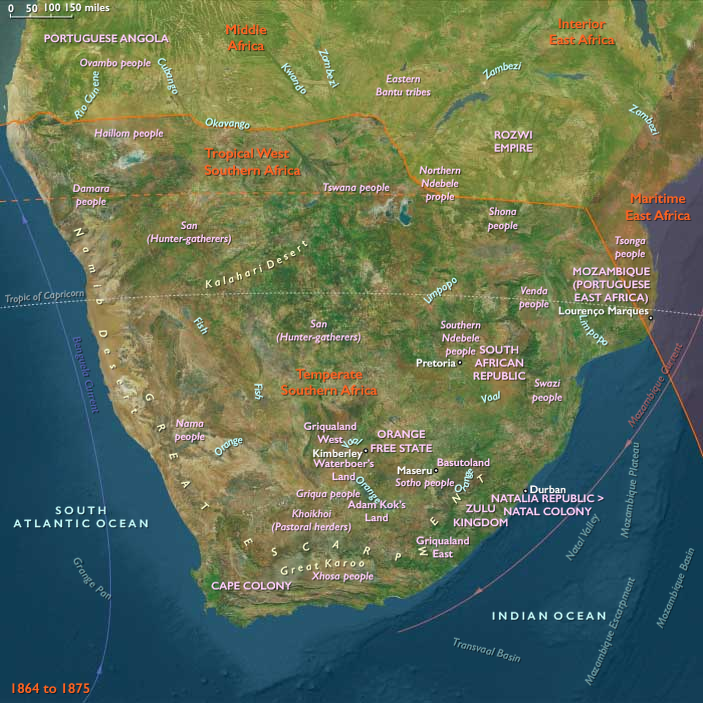
The Mfecane (the "Crushing"), as the the period of regional warfare and forced migrations in In southern Africa is known, had begun in the early nineteenth century.
Zwangendaba, king of the Ngoni people from approximately 1815, had led his people, at this time called the "Jere", on a migration of more than a thousand miles lasting more than twenty years after being driven from the eastern region of what is now South Africa, near modern Swaziland, by the Zulus during the Mfecane.
Using many of Shaka's methods of rule such as rigid discipline in military and social organization, he has knitted his tribe and the unfortunate people abducted along the way into a cohesive unit.
With his people he has migrated north into tropical Africa, in 1822 crossing into what is now southern Mozambique.
Defeated there in 1831 by other fleeing tribes, he followed the Zambezi River into what is now Zimbabwe in 1835 and helps to bring to an end the three hundred-year-old Rozwi empire.
Zwangendaba is believed to have destroyed many of the structures at Great Zimbabwe on passing through.
The Ndwandwe, a Nguni-speaking people, had been forcibly dispersed also by the Zulus.
Under the leadership of Mzilikazi, a former general in Shaka's army, armed bands of the Ndebele, (Matabele) a branch of the Zulus who had split from King Shaka in the early 1820s, had migrated northward, invading the Rozwi Empire.
The Ndwandwe armies of Nxaba and Zwangendaba devastate the empire, and in the early 1830s, the last Rozwi ruler is killed in his capital of Khame.
The Zimbabwe region comes under control of Ndebele chief Lobengula in 1834.