Murdoch Stewart
Duke of Albany
Years: 1362 - 1425
Murdoch Stewart, Duke of Albany (1362 – May 24, 1425) is a leading Scottish nobleman, the son of Robert Stewart, Duke of Albany and the grandson of King Robert II of Scotland, who founded the Stewart dynasty.
In 1389 he is Justiciar North of the Forth.
In 1402, he is captured at the Battle of Homildon Hill and will spend twelve years in captivity in England.
After his father dies in 1420, and while the future King James I of Scotland is himself held captive in England, Stewart serves as Governor of Scotland, until 1424 when James is finally ransomed and returned to Scotland.
However, in 1425, soon after James's coronation, Albany is arrested, found guilty of treason, and executed, along with two of his sons.
His only surviving heir is James the Fat, who escapes to Antrim, Ireland, where he dies in 1429.
Albany's wife Isabella of Lennox survives the destruction of her family, and will live to see the murder of James I and the restoration of her title and estates.

Related Events
Filter results
Showing 10 events out of 10 total
The Scots army defeated the English at the Battle of Otterburn in Northumberland in August 1388, but the death, without issue, of its leader James, earl of Douglas, has triggered a series of claims on his estate—Carrick backs his brother-in-law Malcolm Drummond, the husband of Douglas's sister while Carrick's brother Fife takes the side of Sir Archibald Douglas, lord of Galloway, who holds an entail on his kinsman's estates and who ultimately succeeds to the earldom.
Archibald, called the Grim, is the sixty-year-old illegitimate son of the first Sir James, the original Black Douglas.
Fife, with his powerful Douglas ally, together with those loyal to the king, ensures at the December 1388 council meeting that the lieutenancy of Scotland will pass from Carrick (who had recently been badly injured from a horse-kick) to Fife.
There is general approval of Fife's intention to properly resolve the situation of lawlessness in the north and in particular the activities of Buchan his younger brother.
Buchan is stripped of his position of justiciar, which will soon be given to Fife's son, Murdoch Stewart.
Robert Stewart, an illegitimate son of the future King Robert II of Scotland and of Elizabeth Mure of Rowallan, had been legitimated in 1349 by his parents' marriage.
Robert's grandfather was Walter Stewart, 6th High Steward of Scotland and his father was the first monarch of the House of Stewart.
His great-grandfather was Robert the Bruce, legendary victor of the Battle of Bannockburn.
Robert Stewart had been raised in a large family with many siblings.
His older brother John Stewart had become Earl of Carrick in 1368, and will later be crowned King of Scotland under the name Robert III.
Stewart in 1361 had married Margaret Graham, Countess of Menteith (1334–1380), a wealthy divorcee who took Robert as her fourth husband.
His sister-in-law's claim to the Earldoms of Menteith and Fife had allowed him to assume those titles, becoming Earl of Menteith and Earl of Fife.
The couple in 1362 had a son and heir, Murdoch Stewart, who will in time inherit his father's titles and estates.
When Stewart was created Earl of Menteith, he was granted the lands on which Doune Castle now stands.
Stewart is responsible for the construction of Doune Castle, which remains largely intact today.
Building may have started any time after this, and the castle was at least partially complete in 1381, when a charter was sealed here.
Scottish politics in the late fourteenth century is unstable and bloody, and much of Albany's career is spent acquiring territory, land and titles, often by violent means.
His son Murdoch Stewart is in 1389 appointed Justiciar North of the Forth, and father and son will now work together to expand their family interest, bringing them into violent confrontation with other members of the nobility such as Donald McDonald, 2nd Lord of the Isles.
During the reign of their infirm father as King Robert II, Robert Stewart and his older brother Lord Carrick function as regents of Scotland, kings in all but name, with Albany serving as High Chamberlain of Scotland.
He has also led several military expeditions and raids into the Kingdom of England.
Donald of Islay had spent some of his first years as Lord of the Isles suppressing a revolt by his younger brother John Mór, who resented his meagrer inheritance.
He had been recognized as heir-apparent (tànaiste) but had only received patches of land in Kintyre and Islay.
The rebellion had started in 1387 and will go on into the 1390s, and John will obtain the support of the MacLean kindred.
John and the MacLeans are eventually forced to submit to Donald, however, and by 1395 John Mór has been forced into Ireland, where he enters the service of King Richard II of England and will later establish a MacDonald lordship in Antrim.
Suppression of the revolt enables Donald to turn his attention northwards and eastwards.
Most of the area to the north and east of the Lordship, that is Skye, Ross, Badenoch and Urquhart, is under the control of Alexander Stewart, Earl of Buchan, famously known as the "Wolf of Badenoch".
The Stewarts had been building up their power in the central Highlands and north of Scotland since the death in 1346 of John Randolph, 3rd Earl of Moray.
Alexander had acquired control of the lordship of Badenoch, the earldom of Buchan and the Justiciarship of Scotia.
He had been appointed "Lieutenant of the North", giving him the flexibility to exercise total control over most of Scotland north of the Mounth, the range of hills on the southern edge of Strathdee in northeast Scotland.
Alexander is at once the de facto ruler of northern Scotland as well as the means by which the crown itself exercises control.
However, there had been complaints over the activities of his caterans (Highland war bands).
More importantly, Alexander's position has become threatening not only to the crown, but also to Euphemia I, Countess of Ross, her son Alexander and the titular Dunbar Earl of Moray.
Robert Stewart, Earl of Fife, had late in 1388, soon after becoming Guardian of the Kingdom, deprived Alexander of the Justiciarship.
The Percy family, led by the Earl of Northumberland, had supported Bolingbroke’s usurpation of the English throne.
A pillaging expedition led by Archibald, Earl of Douglas, had invaded the English county of Northumberland as far south as the River Wear, in part to avenge the killing and capture of prominent Scottish nobles in the battle of Nesbit Moor.
On their return, the Scottish force engages English forces led by Northumberland’s thirty-six-year-old son, Sir Henry “Hotspur” Percy, suffering complete defeat on September 14, 1402, at the Battle of Humbleton Hill (or Homildon Hill), where an unknown number of men die; perhaps thousands.
There is also a rich hoard in prisoners, numbering among them the Scottish Regent’s son Murdoch of Fife; the earls of Moray, Angus and Orkney; Lords Montgomery, Erskine, Seton and Abernethy; Sir Robert Logan, Sir William Graham, Sir Adam Forester, Sir David Fleming and Pierre des Essarts with a number of French knights.
The chief captive is Archibald Douglas himself who, despite his costly armor, has been wounded in five places, losing one of his eyes.
Only five Englishmen are said to have been killed; and while one is normally suspicious of claims of this kind, in the circumstances of the battle this is, perhaps, not improbable.
It had also been Archibald Douglas' first major battle and he is never to do more to justify the title he will subsequently be given-: the 'Tyneman' (the Loser).
His ill-fated raid is to be the last major invasion of England until another Scots army in the late summer of 1513 campaigns in the valley of the Till.
King Robert has Crown Prince James taken in secrecy to Dirleton Castle in February 1406 to wait for a ship to transport him to France.
James's uncle, the Duke of Albany, sends a large force after James and when a battle is fought nearby, James is put in a rowing boat and ferried to the Bass Rock in the Firth of Forth.
The eleven-year-old heir to the throne and his guardians are left for a month on the tiny, windswept, rocky island among the boiling seas, before a ship arrives trying to bring James to France.
Albany informs the English King, who arranges the ship's interception.
Thus James becomes a prisoner of the King of England, and will remain so for eighteen years.
When Robert III hears of his son's capture, he becomes even more depressed and allegedly dies from grief over the capture of James.
Robert asks to be buried under a dunghill with the epitaph: Here lies the worst of Kings and the most miserable of men.
Instead he is interred at Paisley, rather than Scone, the traditional burial ground of the Scottish kings, as he had not considered himself worthy of the honor.
Albany, who has become Regent on the death of Robert III, shows no haste in paying for his nephew's release.
He secures the release of his own son Murdoch, captured in 1402 at the Battle of Homildon Hill, but not James.
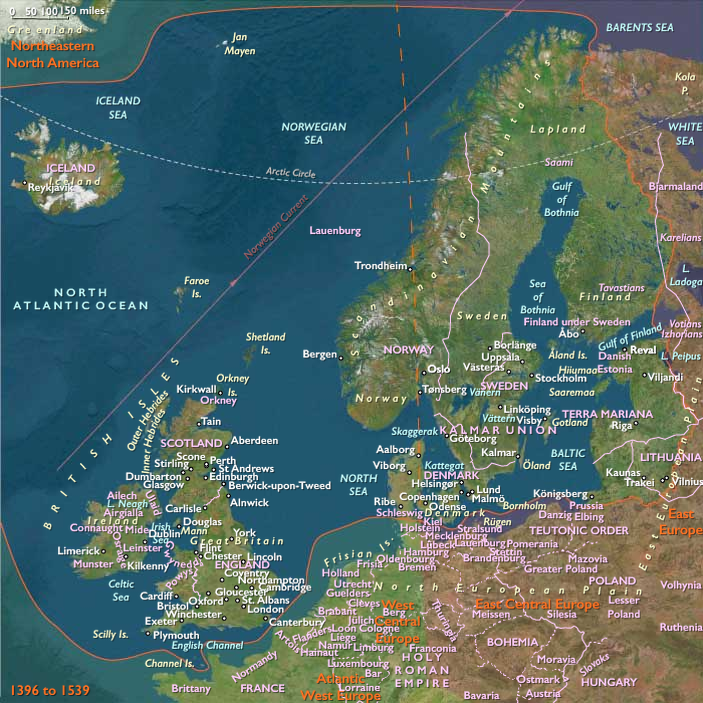
Northwest Europe (1420–1431 CE): Dynastic Ambitions and Regional Turmoil
England: Triumph and Turmoil
Following his triumph at Agincourt in 1415, Henry V of England sought to solidify English control over France through both military prowess and diplomatic strategy. The Treaty of Troyes (1420) granted Henry the French crown upon the death of the current French king, Charles VI, and arranged his marriage to Catherine of Valois, effectively disinheriting the Dauphin Charles (the future Charles VII). Henry continued military campaigns to enforce these claims until his untimely death in 1422. His infant son ascended the throne as Henry VI, with England and France plunged into further instability.
Scotland: Continued Regency and Captivity
Scotland, still suffering from internal divisions and external threats, continued under the regency of the Duke of Albany until his death in 1420, succeeded by his son, Murdoch Stewart. Meanwhile, James I remained captive in England, shaping his perspectives and ambitions from afar. James’s continued captivity fostered Scottish political uncertainty and increased factionalism among the Scottish nobility. James I is generally considered to be the author of The Kingis Quair ("The King's Book"), a long poem about his captivity and about his romance with Joan Beaufort.
Ireland: Gaelic Resurgence and English Struggles
In Ireland, Gaelic chieftains maintained their dominance and increasingly asserted autonomy from English control. The Anglo-Norman authority was restricted further, with territorial control largely limited to The Pale. Irish leaders, including powerful clans like the O’Neills and the O’Briens, solidified their influence, resisting attempts by English forces to regain lost territory.
Scandinavia: Internal Stability, External Tensions
The Kalmar Union, under the rule of King Eric of Pomerania, faced mounting internal tensions, especially in Sweden, where opposition to the centralizing policies grew. Despite these internal frictions, the union largely remained intact, preserving relative regional stability. King Eric continued to manage the delicate balance of power among the Scandinavian kingdoms, but underlying disputes hinted at future challenges.
Iceland: Preservation of Cultural Heritage
Within the Kalmar Union, Iceland preserved its distinct cultural heritage. Literary production flourished, notably through sagas, chronicles, and poetic traditions, maintaining Iceland's cultural identity amid political subordination. This period saw a sustained commitment to the transmission and preservation of Icelandic historical and literary traditions.
Cultural and Architectural Developments
Cultural life across Northwest Europe remained vibrant. Architectural projects, such as the ongoing construction and elaboration of York Minster in the Perpendicular Gothic style, demonstrated sustained artistic and technical ambition. In music, the influence of composers such as John Dunstaple continued to expand, with his innovative harmonic techniques gaining recognition across Europe. Dunstaple's compositions often featured mass-ordinary cycles, with movements unified by musical themes or a cantus firmus. His harmonic innovations were based notably on the intervals of the third and the sixth.
Legacy of the Era
By 1431 CE, Northwest Europe was characterized by dynastic ambitions intertwined with deep regional and political complexities. England grappled with securing its extensive claims in France under the weakened rule of young Henry VI; Scotland awaited the return of its captive king to restore stability; Ireland saw Gaelic dominance largely uncontested; and the Kalmar Union faced persistent internal pressures. Amid these political dynamics, cultural flourishing provided continuity, underscoring the resilience and creativity that defined this transformative era.
Robert Stuart, first duke of Albany and governor of Scotland for the imprisoned James I, dies in 1420.
His son Murdoch, who succeeds him, proves no more effective as a ruler than did his father.
Murdoch Stewart, now aged fifty-eight, had finally inherited the Dukedom of Albany on the death of his father, Robert, in 1420.
He also inherited the Earldom of Fife and the Earldom of Menteith, and at last became Governor of Scotland in his own right.
He has held this position from 1420 to 1424, while King James I is still held captive in England.
Few serious attempts appear to have been made by Duke Albany to return James to Scotland, but eventually political pressure had compelled Murdoch to agree to a general council.
It had been agreed in August 1423 that an embassy should be sent to England to negotiate James's release.
A ransom treaty of sixty thousand marks (an enormous sum) is agreed at Durham on March 28, 1424, to which James attaches his own seal—he and his queen accompanied by an escort of English and Scottish nobles proceeded to Melrose Abbey arriving on April 5, where he meets Albany to receive the governor's seal of office.
Upon the return of James I to Scotland, Albany loses his position as Regent.
James now begins to consolidate his position.
His coronation takes place on May 21, 1424, at Scone.
At his coronation parliament the king—probably with the intent of securing a cohesive political community loyal to the crown—knights eighteen prominent nobles, including Albany's son Alexander Stewart.
At this stage, it is probable that the king feels unable to move against the Albany Stewarts while Murdoch's brother, John Stewart, Earl of Buchan, and Archibald Douglas, 4th Earl of Douglas, are fighting the English in France alongside their Dauphinist French allies.
Buchan is a soldier with an international reputation, and commands the large Scottish army of around six thousand men, a formidable force.
In addition he is Constable of France, making him the effective commander of the entire French army.
However, both he and Douglas are killed at the Battle of Verneuil in August 1424 and the Scottish army is routed—the loss of these Albany allies with their fighting force leaves Murdoch politically exposed.
James moves swiftly against his Albany Stewart relatives soon afterwards.
James takes his revenge on his Albany Stewart relatives on March 21, 1425, on the ninth day of the March Parliament.
Murdoch is arrested, along with his younger son Lord Alexander Stewart.
Immediately afterwards, twenty-six of the principal nobles and barons in Scotland share the same fate.
Albany is at first confined in the castle at St. Andrews and afterwards transferred to Caerlaverock Castle.
His wife Isabella is captured in the family's fortified castle of Doune, their favorite residence, and committed to Tantallon Castle.
The King's rage at Duke Murdoch has its roots in the past.
James's older brother David Stewart, Duke of Rothesay, had died young, in Falkland Castle, while in the care of Murdoch's father, Robert Stewart, Duke of Albany.
Though Albany had been exonerated by Parliament, the suspicion of foul play had remained.
Moreover, neither Duke Robert nor his son Murdoch had greatly exerted themselves in negotiating James's release while in English captivity.
This may well have left James with the suspicion that the Albany Stewarts have personal designs on the throne of Scotland.
At this time, Albany's other son Walter is already in prison.
Only James, Murdoch's youngest son (also known as James the Fat) is able to escape James's vengeance.
He escapes into the Lennox, where he begins to organize a revolt, leading the men of Lennox and Argyll in open rebellion against the crown.
This resort to violence by Albany's youngest son may have been what the king needed to bring a charge of treason against the Albany Stewarts.
Duke Murdoch, his sons Walter and Alexander, and Duncan, Earl of Lennox are in Stirling Castle for their trial on May 18, 1425, at a prorogued parliament in the presence of the King.
An assize of seven earls and fourteen lesser nobles hears the evidence that links the prisoners to the rebellion in the Lennox—in a trial lasting just one day, the four men are found guilty of treason.
The jury that condemns them is composed of twenty-one knights and Peers, including Albany's cousin Walter Stewart, Earl of Atholl, Archibald Douglas, 5th Earl of Douglas, Alexander, Earl of Ross and Lord of the Isles, and Alexander Stewart, Earl of Mar.
Walter is condemned on May 24.
Albany and his son Alexander are tried before the same jury the following day.
All the prisoners are then publicly beheaded on Heading Hill "in front of" Stirling Castle.
Albany is attainted and all of his peerage titles are forfeited.
He is buried at Blackfriars' Church, Stirling.
In the destruction of his close family, the Albany Stewarts, James I is able to secure the substantial rents from the family's three forfeited earldoms of Fife, Menteith and Lennox, a blow from which the Albany Stewarts will never recover.
Northwest Europe (1432–1443 CE): Shifts in Power and Cultural Flourishing
England: Regency and Dynastic Strife
Following the premature death of Henry V, England found itself under the troubled regency during the minority of Henry VI, whose reign was marked by instability. Powerful nobles vied for influence, further complicated by ongoing conflicts in France. English military positions weakened, and internal factional struggles intensified, laying foundations for future strife.
Scotland: Return and Reforms of James I
In 1424, James I returned to Scotland after eighteen years of English captivity, taking active control of his kingdom. His rule focused on centralizing royal authority, reducing the power of the nobility, and reforming Scottish governance along English lines. James established a more robust legal framework and fostered economic development through support for trade and urban growth. He was generally credited with authoring The Kingis Quair ("The King's Book"), a poetic reflection on his captivity and romance with Joan Beaufort, showcasing a profound blend of personal experience and literary talent.
Ireland: Gaelic Authority Strengthens
Gaelic authority in Ireland continued to strengthen, as local chieftains like the O’Neills and the O’Briens solidified their autonomous positions. English influence remained confined primarily to The Pale, with efforts to reclaim broader authority largely ineffective. Irish cultural life thrived, fostering a distinct Gaelic identity increasingly independent of English control.
Scandinavia: Struggle within the Kalmar Union
Under King Eric of Pomerania, the Kalmar Union struggled to manage internal discord, especially from Sweden. Opposition to Eric’s centralizing policies grew, notably among the Swedish nobility, resulting in escalating tensions and occasional outbreaks of conflict. Despite this, the union endured, maintaining relative peace through fragile political compromises.
Iceland: Continued Cultural Resilience
Icelandic cultural resilience flourished within the Kalmar Union. Literary activity, especially saga-writing and historical chronicles, persisted robustly, preserving Iceland's rich heritage and distinct identity. This era witnessed significant commitment to maintaining the literary and historical legacy unique to Iceland.
Cultural Developments and Artistic Achievements
Cultural achievements across Northwest Europe remained prominent. Architectural projects such as the ongoing enhancements at York Minster, exemplifying the Perpendicular Gothic style, advanced artistic innovation. English composer John Dunstaple and contemporaries like Leonel Power shaped musical developments through their innovative mass-ordinary cycles, often based on cantus firmus techniques, and Dunstaple’s harmonic use of thirds and sixths, profoundly influencing European music.
Legacy of the Era
By 1443 CE, Northwest Europe had witnessed significant shifts in political power and vibrant cultural accomplishments. England struggled with internal factionalism and diminishing French territories; Scotland benefited from King James I’s centralizing reforms; Ireland saw continued Gaelic dominance; and the Kalmar Union grappled with persistent tensions threatening its stability. Amid these political complexities, cultural and artistic endeavors flourished, underscoring the region’s resilience and intellectual vitality during this transformative period.