Mu'in ad-Din Unur
Turkish governor of Damascus
Years: 1090 - 1149
Mu'in ad-Din Unur al-Atabeki (died August 28, 1149) is the ruler of Damascus in the mid-12th century.
Related Events
Filter results
Showing 7 events out of 7 total
Zengi’s move against Damascus sparks a recognition of their common danger and results in a Jerusalem-Damascus alliance, a kind of diplomacy by now common with the second-generation Franks.
Fulk helps the Muslims of Damascus, under the vizier Mu'in ad-Din Unur, to ward off Zengi's armies in 1140.
Altuntash, the emir of Bosra and Salkhad, squabbles in 1147 with his nominal superior, Mu'in ad-Din Unur, ruler of Damascus.
Offended, Altuntash allies himself to the Crusaders and agrees to hand over his two cities.
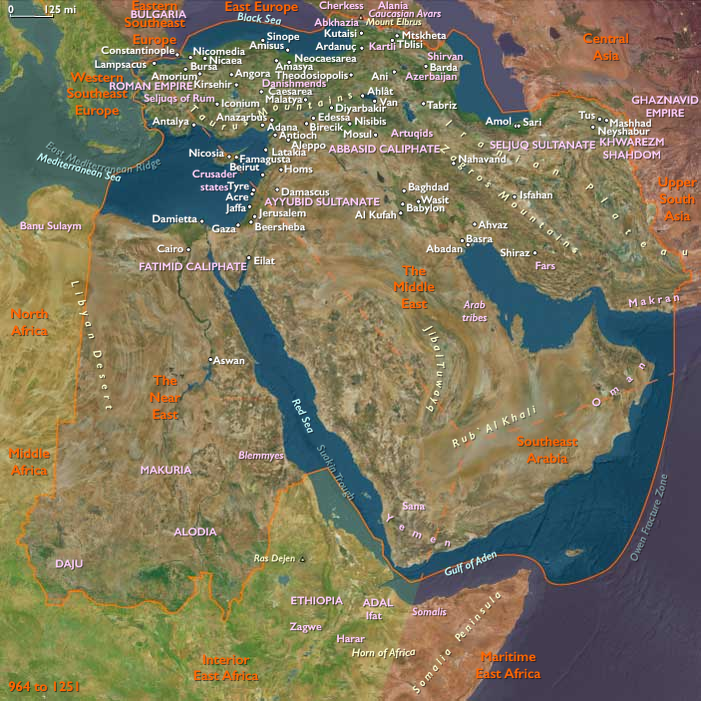
King Baldwin III concentrates his army, crosses the Jordan River and moves toward Bosra, about sixty-five miles south-southeast of Damascus and fifty miles east of the Jordan.
Soon after the Crusader march begins, the Damascene army shows up in great strength to contest their advance.
Many Latin soldiers are eager for battle, but more cautious heads prevail.
Posting extra guards to watch for a surprise attack, the Frankish army makes camp and spends the night.
After a council of war the next day, Baldwin and his officers determine to continue the expedition to Bosra in a fighting march.
The Latin army moves in the usual formation when opposed by an army of Turkish horse archers.
Provision is made to oppose attacks on the van, the flanks and the rear.
The Frankish foot soldiers march in close formation with foot archers ready to fire back at the Turkish horse archers and spearmen ready to repel a direct attack.
For four days, the Crusaders advance toward their intended goal, under constant archery and probing attacks.
Further, the soldiers are plagued by thirst in the hot summer weather.
When they arrive at Bosra, the Franks manage to obtain water and other supplies.
The Crusaders' high hopes are dashed when they discover that Altuntash's wife has introduced a Damascene garrison into Bosra's citadel.
Unwilling to chance a siege close to an enemy host, Baldwin elects to withdraw.
The Franks suffer even more on their return march from the heat, dust and constant harassment by the Turks.
At one point, the Damascenes set fire to the dry brush upwind of the Franks, adding to their misery.
The Crusaders carry their dead and wounded with them so that their enemies will not be encouraged by their losses.
Leaving the ranks without permission is forbidden, one exception being that a knight is allowed to rescue a Christian if he is about to be killed by a Muslim.
As the Franks near their own territories, the Saracens redouble their attacks on the Latin rearguard, trying to separate it from the rest of the formation.
Near the moment of crisis, a Turk fighting with the Crusaders rides out without leave and kills an opponent in personal combat, dismaying the Damascenes and encouraging the Franks; his breach will be later excused.
Ultimately, the Damascenes are unable to stop the Crusader army from recrossing the Jordan and safely returning to the Kingdom of Jerusalem.
The running battle has lasted twelve days.
Mu'in ad-Din Unur will shortly seize control of both Bosra and Salkhad.
Conrad, having taken ship from Constantinople, had eventually reached Acre in April 1148.
After Conrad’s arrival, a brilliant muster of French and German notables assembles with Queen Melisende, her nineteen-year-old son and co-ruler Baldwin III, and the barons of Jerusalem to discuss how best to proceed.
Despite the absence of the northern princes and the losses already suffered by the crusaders, it is possible to field an army of nearly fifty thousand men, the largest Crusade army so far assembled.
There are a number of choices for the target of the crusade.
In northern Syria, Edessa is firmly in the control of Nur ad-Din; its count, Joscelin II, is in captivity and there is no hope of retrieving him or the city, so the matter, so important to the original call for the crusade, is apparently not even discussed.
In Antioch, Raymond of Poitiers had tried to convince Louis to attack Aleppo, Nur ad-Din's capital and the greatest threat to that city, but Raymond and Louis have quarreled (partly over rumors of an incestual relationship between Eleanor and the prince) and Raymond is not present at the Council.
The County of Tripoli is also unrepresented, although an attack on Aleppo would benefit Tripoli as well; however, the rule of Raymond II of Tripoli is challenged by Alfonso Jordan, Count of Toulouse, his cousin, and when Alfonso is poisoned on the way to the Council, Raymond is implicated in his murder.
Conrad and Louis are, in any case, unconcerned with matters in northern Syria; for them, pilgrimage to Jerusalem is an inherent part of the crusading vow, and defense of Jerusalem is of utmost importance.
In the south, the most immediate threats to Jerusalem come from Fatimid-held Ascalon and the Burid Emirate of Damascus.
The crusade has coincidentally arrived during a political crisis in Jerusalem: King Baldwin III has ruled jointly with his mother Melisende since the death of King Fulk of Jerusalem in 1143, when Baldwin was only thirteen years old; but Baldwin is now eighteen and wishes to assert his authority.
The option of Ascalon does not suit Baldwin, since his brother Amalric, who supports their mother, is already Count of Jaffa and Ascalon would have been added to his territory.
Ascalon has also been contained by a number of castles built during the reign of Fulk and is not an immediate threat.
The capture of Damascus, on the other hand, would benefit Baldwin; despite being a sometime-ally of Jerusalem, Nur ad-Din also desires it, and capturing it would help limit the emir's power.
It would please Conrad and Louis, who are interested in capturing a city that, unlike Ascalon, is important to the history of Christianity.
After considerable debate reflecting the conflicting purposes of crusaders and Jerusalem barons, it is decided to attack Damascus.
The ruler of Damascus, Mu'in ad-Din Unur, has started making feverish preparations for war in response to the arrival of the Crusaders, strengthening the fortifications of Damascus, ordering troops to his city and having the water sources along the road to Damascus destroyed or diverted.
Also fearful of the expanding power of Nur ad-Din and the one Muslim ruler most disposed to cooperate with the Franks, is now forced to seek the aid of his former enemy, who is quick to move toward Damascus.
The forces from the Zengid states will not arrive in time to see combat outside of Damascus.
It is almost certain that the Zengid rulers delayed sending troops to Damascus out of the hope that their rival Unur might lose his city to the crusaders.
The crusaders, having reached a decision on June 24 at the Council of Acre to attack Damascus, had decided to attack the city from the west, where orchards will provide them with a constant food supply.
Having arrived outside the walls of the city, they immediately put it to siege, using wood from the orchards.
On July 27, the crusaders decide to move to the plain on the eastern side of the city, which is less heavily fortified but has much less food and water.
The crusaders' campaign is not only ill advised and mistakenly conceived but badly executed.
Nur ad-Din, together with Saif ad-Din, arrives with Muslim reinforcements and cuts off the crusader's route to their previous position.
Unur, however refuses them entrance, using the presence of Zangi's sons to convince the Franks to release the siege.
The local crusader lords refuse to carry on with the siege, and the three kings have no choice but to abandon the city.
On July 28, after a five-day siege, with Nur ad-Din's forces nearing the city, it becomes evident that the crusader army is dangerously exposed, and a retreat to Jerusalem is ordered, though for their entire retreat they will be followed by Turkish archers who constantly harass them.
This humiliating failure is attributable largely to the conflicting interests of the participants.
Each of the Christian forces feels betrayed by the other and mutual distrust will be fostered for a generation due to the defeat.
The Muslims, on the other hand, receive enormous encouragement by their triumph over another major Western expedition.
Raymond of Antioch had invaded the vulnerable province of Aleppo (part of the Seljuq Empire), which is threatened by hostile powers on all sides since the death of Nur ad-Din's father Zengi in 1146.
Nur ad-Din, after establishing his own authority in Aleppo and successfully defending Damascus in 1147, had invaded Antioch in late 1148 and besieged Afamiya.
Raymond had beat him back and captured his baggage train.
When he returned a few months later to attack Yaghra, Raymond, at the head of a small force, had forced him to retire to Aleppo.
Nur ad-Din invades Antioch in June 1149 and besieges the fortress of Inab, with aid from Unur of Damascus and a force of Turkmens.
Nur ad-Din has about six thousand troops, mostly cavalry, at his disposal.
Raymond and his Christian neighbor, Count Joscelin II of Edessa, have been enemies since Raymond had refused to send a relief army to Edessa in 1146.
Joscelin has even made a treaty of alliance with Nur ad-Din against Raymond.
For their part, Raymond II of Tripoli and the regent, Melisende of Jerusalem, refuse to aid the Prince of Antioch.
Feeling confident because he had twice defeated Nur ad-Din previously, Prince Raymond strikes out on his own with an army of four hundred knights and a thousand foot soldiers.
The situation is much darker for the Christians in the East following the failed Second Crusade, which is to have disastrous long-term consequences for Jerusalem: Damascus can no longer trust the crusader kingdom.
In August 1149, the atabeg Unur had died, at which point the amir Abu Sa'id Mujir al-Din Abaq Ibn Muhammad finally begins to rule.
The ra'is of Damascus and commander of the ahdath milita, Mu'ayad al-Dawhal Ibn al-Sufi, feels that since his ahdath had played a major role in defeating the Second Crusade that he deserves a greater share of the power, and within two months of Unur's death is leading a rebellion against Abaq.
The infighting within Damascus is to lead to the end of the Burid state within five years.