Muhammad
Islamic religious leader
Years: 570 - 632
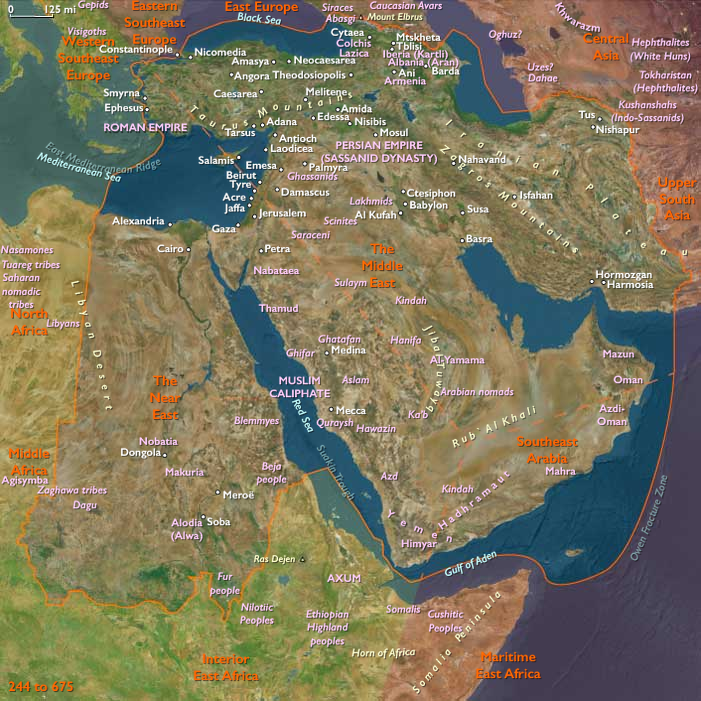
Muhammad (c. 570 – c. 8 June 632); also transliterated as Mohammad, Mohammed, or Muhammed; full name: Abū al-Qāsim Muḥammad ibn ʿAbd Allāh ibn ʿAbd al-Muṭṭalib ibn Hāshim is a leader from Mecca who unifies Arabia into a single religious polity under Islam.
He is believed by Muslims and Bahá'ís to be a messenger and prophet of God, and by most Muslims as the last prophet sent by God for mankind.
Muhammad is generally considered to be the founder of Islam, although this is a view not shared by Muslims, who consider him to be the restorer of an uncorrupted original monotheistic faith of Adam, Noah, Abraham, Moses, Jesus and other prophets.
Born in about 570 CE in the Arabian city of Mecca, he is orphaned at an early age and brought up under the care of his uncle Abu Talib.
He later works mostly as a merchant, as well as a shepherd, and is first married by age 25.
Being in the habit of periodically retreating to a cave in the surrounding mountains for several nights of seclusion and prayer, he later reports that it was there, at age 40, that he received his first revelation from God.
Three years after this event Muhammad starts preaching these revelations publicly, proclaiming that "God is One", that complete "surrender" to Him (lit.
islām) is the only way (dīn) acceptable to God, and that he himself is a prophet and messenger of God, in the same vein as other Islamic prophets.
Muhammad gains few followers early on, and is met with hostility from some Meccan tribes; he and his followers are treated harshly.
To escape persecution, Muhammad sends some of his followers to Abyssinia before he and his followers in Mecca migrate to Medina (at this time known as Yathrib) in the year 622.
This event, the Hijra, marks the beginning of the Islamic calendar, which is also known as the Hijri Calendar.
In Medina, Muhammad unites the tribes under the Constitution of Medina.
After eight years of fighting with the Meccan tribes, his followers, who by this time have grown to 10,000, conquer Mecca.
Muhammad destroys the pagan idols in Mecca, then sends his followers out to destroy all of the remaining pagan temples throughout Eastern Arabia.
In 632, a few months after returning to Medina from The Farewell Pilgrimage, Muhammad falls ill and dies.
By the time of his death, most of the Arabian Peninsula has converted to Islam, and he has united Arabia into a single Muslim religious polity.
The revelations (or Ayah, lit.
"Signs [of God]")—which Muhammad reported receiving until his death—form the verses of the Quran, regarded by Muslims as the “Word of God” and around which the religion is based.
Besides the Quran, Muhammad’s life (sira) and traditions (sunnah) are also upheld by Muslims.
They discuss Muhammad and other prophets of Islam with reverence, adding the phrase peace be upon him whenever their names are mentioned.
While conceptions of Muhammad in medieval Christendom and premodern times were largely negative, appraisals in modern history have been far less so.