Muawiya II
3rd Caliph of the Umayyad Caliphate
Years: 661 - 684
Muawiyah II (or Mu'āwiya ibn Yazīd) (28 March 661 – January/February 684) is an Umayyad caliph for about four months after the death of his father Yazīd.
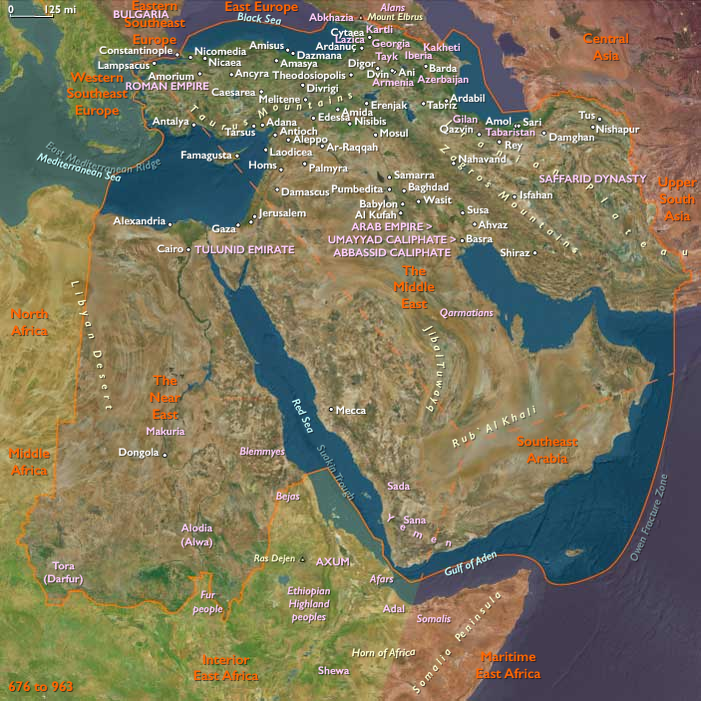
The empire he inherits is in a state of disarray with Abdullah bin Zubayr claiming to be the true caliph and holding the Hejaz as well as other areas.
Related Events
Filter results
Showing 10 events out of 10 total
Muawiyah centralizes caliphal authority in Damascus.
The Syrian army becomes the basis of Umayyad strength, enabling the creation of a united empire through greater control of the conquered provinces and of Arab tribal rivalries.
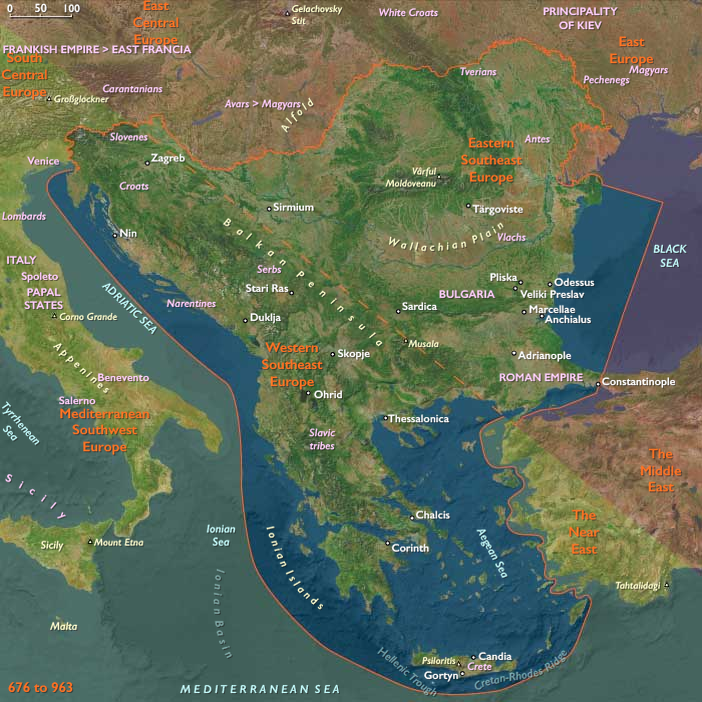
The Muslims besiege Constantinople in 674 and 675, but are again thwarted by the defenders’ use of Greek fire.
Asparukh, one of the sons of Kubrat, is followed by thirty thousand to fifty thousand Bulgars.
He reaches the Danube and, while the imperial capital, Constantinople, is besieged by Muawiyah I, Caliph of the Arabs (674–678), he and his people settle in the Danube delta, probably on the now disappeared Peuce Island.
Subsequent tradition will remember Muslim ibn 'Uqba as the "heathen incarnate" (J. Wellhausen) for his sack of Medina.
He had set out for Mecca after taking Medina but had fallen ill on the way and died at Mushallal; command had passed to his lieutenant Husayn ibn Numayr al-Sakuni.
Husayn's army arrives before Mecca in September.
Ibn al-Zubayr and his supporters refuse to surrender, and after they are defeated in a first engagement, a siege of the city begins, in which the Umayyad army employs catapults to bombard it with stones.
Ibn al-Zubayr establishes his command post on the grounds of the Grand Mosque.
On Sunday, October 31, the Kaaba, over which a wooden structure covered with mattresses had been erected to protect it, catches fire and burns down, while the sacred Black Stone bursts asunder.
Many later sources ascribe the fault to the besiegers, but more reliable accounts attribute the event to a torch borne by one of Ibn al-Zubayr's followers, which the wind had wafted onto the building.
The siege continues until November 26, when news of Yazid's death on the eleventh reaches the besiegers.
Husayn now enters into negotiations with Ibn al-Zubayr.
Although the Umayyad court at Damascus promptly declares Yazid's sickly young son, Mu'awiya II, as Caliph, Umayyad authority practically collapses in the provinces and proves shaky even in the Umayyads' home province of Syria.
Husayn is therefore willing to acknowledge Ibn al-Zubayr as Caliph, provided that he will issue a pardon and follow him to Syria.
Ibn al-Zubayr refuses the last demand, since this would place him under the control of the Syrian elites, and Husayn with his army departs for Syria.
Yazid had been succeeded by his son, Muawiya II, but he dies in early 684 later without ever having enjoyed any real authority outside the Sufyan family's traditional stronghold of Syria.
His death provokes a crisis, since his other brothers are too young to succeed.
As a result, Umayyad authority collapses across the Caliphate and Ibn al-Zubayr is accepted by most of the Muslims as their new leader: the Umayyad governor of Iraq, Ubayd Allah ibn Ziyad, is evicted from the province, coins in Ibn al-Zubayr's name are minted in Persia, and the Banu Qays of northern Syria and the Jazira go over to his cause.
Even some members of the Umayyad family consider going to Mecca and declaring their allegiance to him; in contrast, the local tribes of central and southern Syria, led by the Banu Kalb under Ibn Bahdal and Ubayd Allah ibn Ziyan, uphold the Umayyad cause.
At their initiative, a shura of the loyal tribes is held at Jabiya, where Marwan ibn al-Hakam, a cousin of Mu'awiya I who had served under the Caliph Uthman ibn Affan (r. 644–656) but had played no role in Mu'awiya's Umayyad regime, is elected as the Umayyads' caliphal candidate.
Marwan's election provokes the reaction of the Qays, who rally around the governor of Damascus, al-Dahhak ibn Qays al-Fihri.
After vacillating between the two candidates, al-Dahhak is persuaded to recognize Ibn al-Zubayr, and begins assembling his forces on the field of Marj al-Suffar near Damascus.
In response, the Umayyad coalition marches on Damascus, which is surrendered to the Umayyads by a member of the Ghassanid tribe.
The two armies first clash in mid-July 684 at the plain of Marj al-Suffar, and the Qays are pushed towards Marj Rahit.
Twenty days of skirmishing between the two camps follow, until the final battle takes place on August 18.
The numbers of the two opponents are uncertain: al-Tabari puts Marwan's forces at six thousand, another tradition at thirteen thousand and thirty thousand for Marwan and al-Dahhak respectively, while Ibn Khayyat inflates the numbers to thirty thousand and sixty thousand respectively.
The traditions agree, however, that the Umayyad forces are considerably outnumbered.
Marwan's commanders are Abbas ibn Ziyad, Amr ibn Sa'id al-As and Ubayd Allah ibn Ziyad (another tradition has Ubayd Allah commanding the cavalry and Malik ibn Hubayra al-Skauni the infantry), while only one of al-Dahhak's commanders, Ziyad ibn Amr ibn Mu'awiya al-Uqayli, is known.
A plethora of anecdotes, individual accounts and poems on the battle survives, but the details of the battle itself are not clear, except that the day resulted in a crushing Umayyad victory: the main leaders of the Qays, including al-Dahhak, fell in the field.
N. Elisséeff explains the Umayyad success by the possible defection of Qays-aligned tribes during the preceding weeks, eager to uphold the Syrian hegemony over the Caliphate.
In addition, Elisséeff points out that the Umayyads still controlled the state treasury in Damascus, allowing them to bribe tribes to join them.
The remnants of the Qays army flee to Qarqisiya under Zufar ibn Harith al-Kilabi, and Marwan is officially proclaimed as Caliph at Damascus.
The victory at Marj Rahit secures the Umayyads' position in Syria, and allows them to go into the offensive against Ibn al-Zubayr's supporters.
Egypt is recovered later in the year.

Ibn al-Zubayr initiates the rebuilding of the Kaaba after the Umayyads' departure from Mecca, but most of the people, led by Ibn Abbas, had abandoned the city fearing divine retribution; it is only when Ibn al-Zubayr himself begins to demolish the remains of the old building, that they are encouraged to return and aid him.
Ibn al-Zubayr's reconstruction changes the original plan, incorporating modifications that Muhammad himself is reported to have intended, but which had not been not carried out during Muhammad's lifetime for fear of alienating the recently converted Meccans.
The new Kaaba is built entirely of stone—the old one was of alternating layers of stone and wood—and has two doors, an entrance in the east and an exit in the west.
In addition, he includes the semicircular hatīm wall into the building proper.
The three fragments of the Black Stone are bound in a silver frame, and placed by Ibn al-Zubayr inside the new Kaaba.
After the Umayyad reconquest of the city eight years later, the hatīm will be separated again from the main building, and the western gate will be walled up, reverting to the general outlines of the pre-Islamic plan.
This is the form in which the Kaaba has survived to this day.
The retreat of the Umayyad army had left Ibn al-Zubayr in undisputed control of Mecca.
With the collapse of Umayyad authority, he is soon acknowledged as the rightful Caliph across most of the Muslim world, including northern Syria.
The Umayyads, however, under the leadership of Marwan ibn al-Hakam, had managed to consolidate their position in Syria in the Battle of Marj Rahit, and even reclaim Egypt.
Ibn al-Zubayr's brother Mus'ab defeats al-Mukhtar and gains control of all of Iraq in 687.