Montesquieu
French social commentator and political thinker
Years: 1689 - 1755
Charles-Louis de Secondat, baron de La Brède et de Montesquieu (18 January 1689 – 10 February 1755), generally referred to as simply Montesquieu, is a French social commentator and political thinker who lives during the Enlightenment.
He is famous for his articulation of the theory of separation of powers, which is taken for granted in modern discussions of government and implemented in many constitutions throughout the world.
He is largely responsible for the popularization of the terms feudalism and Byzantine Empire.
Related Events
Filter results
Showing 7 events out of 7 total
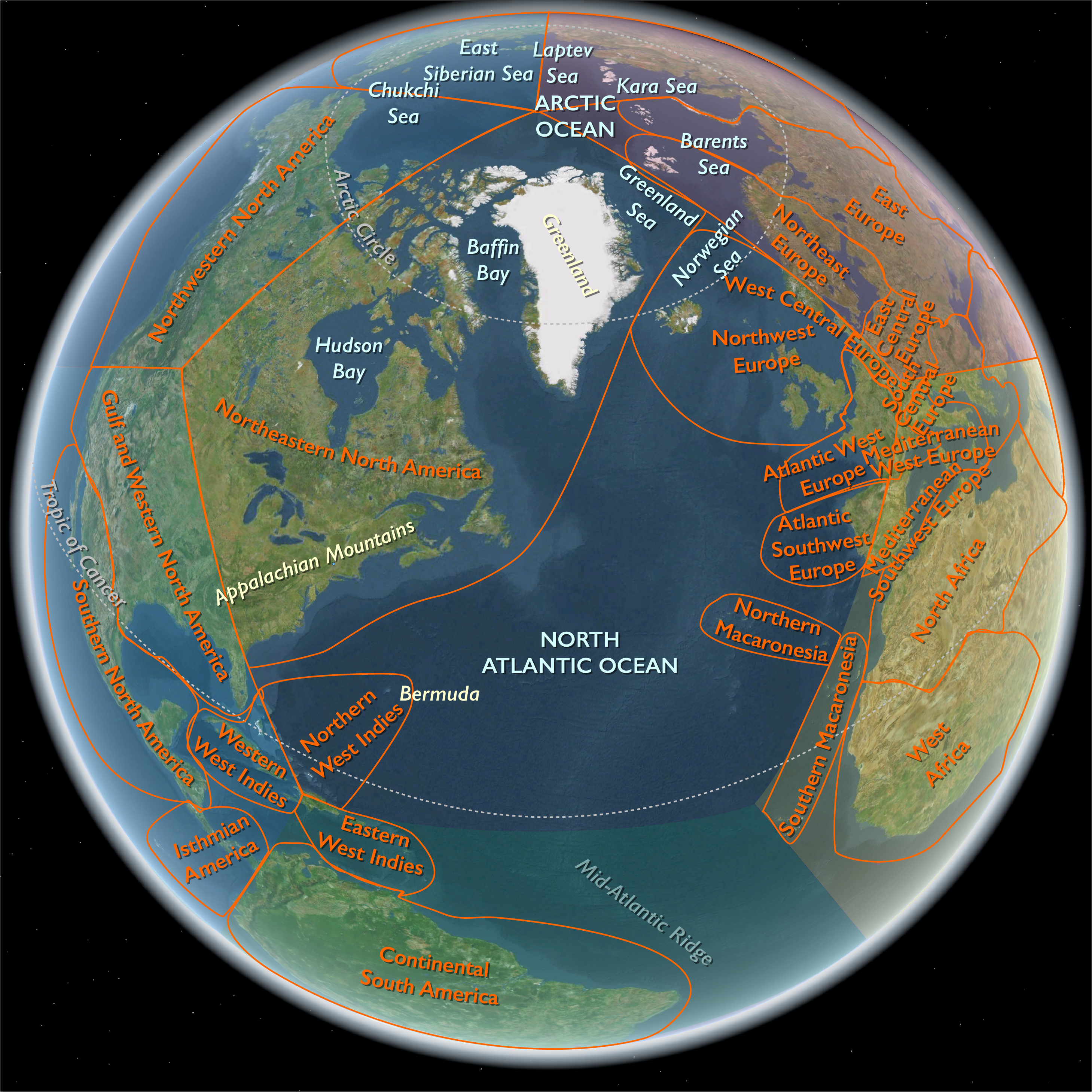
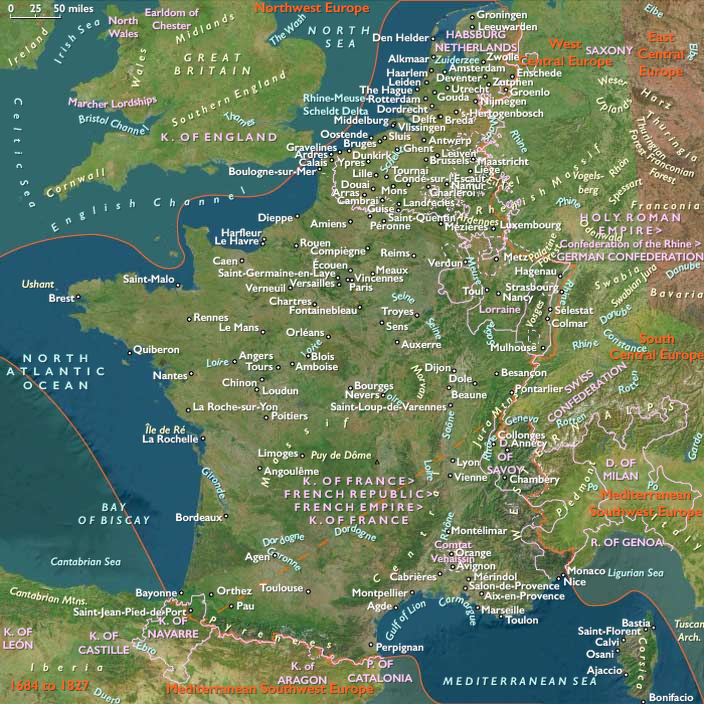
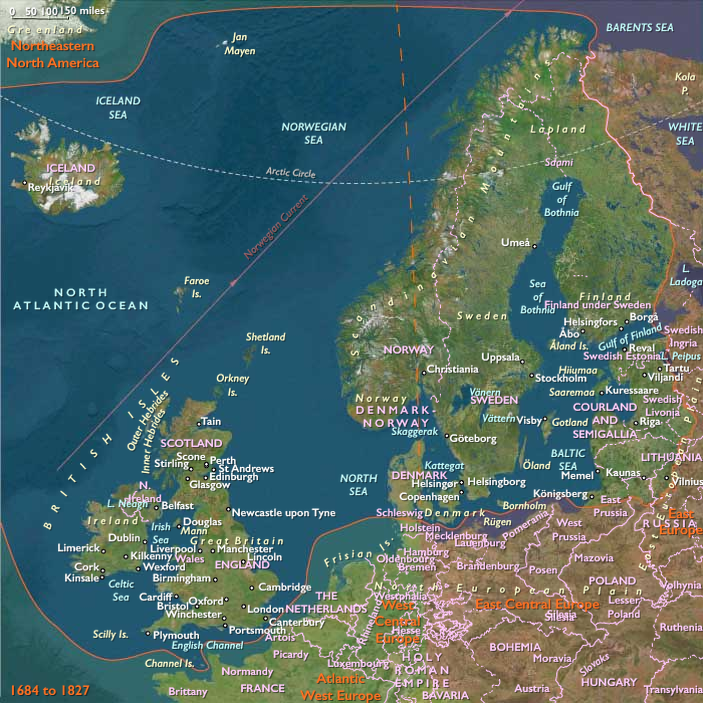
Atlantic West Europe (1684–1827 CE): Ports, Polders, and Revolutions on an Ocean Rim
Geography & Environmental Context
Atlantic West Europe includes the Atlantic and English Channel coasts of France, the Loire Valley, Burgundy, northern France (including Paris), and the Low Countries: Belgium, the Netherlands, and Luxembourg. Anchors include the Seine, Loire, Somme, Scheldt (Escaut), Meuse (Maas), and Rhine–Meuse–Scheldt delta, the Brittany and Cotentin peninsulas, and the Flemish and Dutch polders. The mix of estuaries, dunes, chalk cliffs, river basins, and reclaimed lowlands made an intensely maritime and fluvial landscape.
Climate & Environmental Shifts
In the tail of the Little Ice Age, the Great Frost (1709) and later 1816–1817 dearths (“Year Without a Summer”) hammered grain and wine. North Sea gales and storm surges tested dikes in the Low Countries; Channel tempests menaced fishing fleets and convoys. Yet temperate rains and silt-laden rivers regenerated soils, while coastal upwelling sustained rich fisheries.
Subsistence & Settlement
-
Grain & dairying: Wheat and rye dominated Paris’s provisioning basins; Flanders and Holland balanced grain with dairy, butter, and cheese.
-
Vine & orchard belts: Loire and Burgundy vineyards (Sancerre, Touraine, Côte d’Or) specialized in high-value wines; cider zones dotted Normandy and Brittany.
-
Maritime economies: Herring and cod fisheries (Channel/North Sea); salt works and oyster beds along the French Atlantic; river and coastal shipping sustained small ports and market towns.
-
Urban network: Paris concentrated administration, crafts, print, and finance; Amsterdam, Rotterdam, Antwerp, Ostend, and French ports—Le Havre, Rouen, Saint-Malo, Nantes, La Rochelle, Bordeaux, Brest, Dunkirk—linked hinterlands to Atlantic circuits.
Technology & Material Culture
Wind- and water-power drove mills, sawyers, and paper works; polder engineering (dikes, sluices, windpumps) extended arable land. Canalization—Briare, Centre, Loire–Bretagne, Saint-Quentin, Ourcq, and Dutch canal grids—knit river basins to seaports. Shipyards on the Seine, Loire, Gironde, and Dutch estuaries turned out warships and merchantmen. Textiles flourished: Flemish linens and lace; northern French woolens and printed cottons; Dutch and French faience and porcelain; urban book trades and scientific instruments fed Enlightenment cultures.
Movement & Interaction Corridors
-
Sea lanes & estuaries: Convoys moved colonial staples and manufactures through the Channel, Bay of Biscay, and Dutch delta; river barges provisioned Paris, Rouen, Nantes, Bordeaux, and the Low Countries’ ports.
-
Atlantic empires: Dutch carrying trade persisted though eclipsed by Britain; the Ostend Company briefly challenged monopolies (1720s). French ports (Nantes, Bordeaux, La Rochelle, Saint-Malo) prospered on Caribbean sugar and the triangular trade, then reeled under wartime blockades.
-
War regimes: The War of the Spanish Succession, Seven Years’ War, and Napoleonic Wars re-routed commerce; the Continental System and British blockades choked Atlantic exports, while smuggling through the North Sea and Brittany coasts proliferated.
-
Roads & canals: Turnpikes and towpaths, Dutch trekvaart passenger boats, and French royal canals shortened time–distance to market.
Cultural & Symbolic Expressions
Parisian salons, academies, and presses circulated Enlightenment ideas; the French Revolution (1789) unleashed sans-culottes politics, civic festivals, and new symbols. The Code civil (Code Napoléon) recast property and family law across annexed territories. In the Low Countries, Catholic processions and guild traditions coexisted with a vigorous print and mercantile culture; Antwerp and Amsterdam remained art and publishing hubs. Coastal ritual calendars—fishermen’s blessings, harvest fairs—endured beside neoclassical boulevards in rebuilt Le Havre and Bordeaux quays.
Environmental Adaptation & Resilience
-
Risk spreading: Mixed farming (grain–dairy–flax) and vineyard diversification buffered climate shocks; cider and beer substituted when wine failed.
-
Water management: Continuous dike raising, dune fixation, canal dredging, and bank revetments defended land and kept arteries open.
-
Provisioning systems: Parisian grain police, port granaries, and charitable confraternities cushioned bad years; Dutch urban poor relief and fish protein mitigated famine pulses.
-
Wartime elasticity: Neutral flags (at times), coastal cabotage, and river relays sustained minimal flows when ocean routes were interdicted.
Transition
Between 1684 and 1827, Atlantic West Europe moved from Dutch-led carrying trade toward a Paris-centered, French revolutionary–Napoleonic epoch and a rebalanced Low Countries. Port cities rose and fell with war and blockade; canals and polders bound sea to field; vineyards and dairying financed dense towns. By the 1820s, despite scars from blockades and dearth, the region had the infrastructure, market linkages, and legal reforms to launch nineteenth-century industrial and commercial expansion—its estuaries and capitals poised once more to meet the Atlantic winds.
It establishes a standard for the separation of powers in government between the legislative, executive, and judiciary branches, well before the publication of Montesquieu's Spirit of the Laws.
The Constitution limits the executive authority of the hetman, and establishes a democratically elected Cossack parliament called the General Council.
Atlantic West Europe (1720–1731): Financial Crisis, Economic Resilience, and Enlightenment Expansion
From 1720 to 1731, Atlantic West Europe—including northern France, the Low Countries (modern Belgium, Netherlands, Luxembourg), and the Atlantic and Channel coasts—faced significant economic turbulence exemplified by financial crises, yet continued its broader trajectory toward intellectual, cultural, and social development shaped by Enlightenment thought and stabilized political structures. The period underscored the resilience of regional economies and fostered deepening intellectual exchanges across Europe.
Political and Military Developments
Stability under Bourbon and Habsburg Rule
-
Under the regency (1715–1723) and then reign of Louis XV (r. 1715–1774), France enjoyed relative internal peace, allowing a focus on domestic economic and administrative reforms despite ongoing fiscal challenges.
-
The Austrian Netherlands (Belgium and Luxembourg), governed under Habsburg rule, enjoyed stable yet conservative administration, maintaining internal order while gradually integrating into wider European economic networks.
Diplomatic Stability and Limited Warfare
-
European diplomatic conditions were generally peaceful, guided by balance-of-power diplomacy, especially after the significant territorial realignments resulting from the Treaty of Utrecht (1713). Atlantic West Europe benefited from a respite from widespread conflict, despite occasional diplomatic friction.
Economic Developments: Crisis and Recovery
The Financial Bubble Crisis (1720)
-
The early 1720s were dominated by financial instability exemplified by the infamous Mississippi Bubble in France and the contemporaneous South Sea Bubble in Britain.
-
In France, John Law’s Mississippi Company, heavily tied to colonial speculation in North America, collapsed spectacularly in 1720, devastating public finances, eroding trust in government-backed financial schemes, and causing widespread economic disruption across France, particularly affecting Paris and the northern trading cities.
-
Amsterdam and other Dutch cities faced ripple effects from these speculative crashes, temporarily disrupting financial markets, though the robust Dutch banking system proved resilient, recovering more swiftly than France.
Regional Economic Resilience and Recovery
-
Despite initial disruption, northern French cities (Bordeaux, Nantes, and Rouen) and the Low Countries (Amsterdam, Antwerp, Brussels) demonstrated resilience, recovering through diverse trade networks, maritime commerce, and robust agricultural productivity.
-
Dutch commerce, particularly trade in luxury goods, textiles, and colonial commodities, rapidly resumed strength, maintaining Amsterdam’s position as a pivotal commercial hub and financial capital.
Industrial and Agricultural Expansion
-
The Low Countries saw continued growth in industries such as textiles (Flanders) and ceramics (Delft and Brussels), while French Atlantic ports expanded commerce with the Americas, notably in wine, sugar, tobacco, and manufactured goods.
-
Agricultural improvements continued steadily across northern France, increasing productivity and facilitating demographic growth.
Intellectual and Religious Developments
Continued Enlightenment Expansion
-
Enlightenment ideas increasingly permeated intellectual and cultural life across Atlantic West Europe, prominently through French philosophes like Montesquieu, whose seminal work Persian Letters (1721) offered critical yet engaging commentary on French society, politics, and culture, profoundly influencing political thought.
-
Universities and academies in the Low Countries, especially Leiden University and the University of Louvain, continued intellectual dynamism, attracting scholars and disseminating Enlightenment ideals broadly.
Religious Moderation and Debates
-
Religious toleration advanced modestly, notably in the Dutch Republic, where Calvinist orthodoxy gradually softened, facilitating greater intellectual openness and more liberal religious discourse, exemplified by theologians like Jean Leclerc in Amsterdam.
Cultural and Artistic Flourishing
Continued Rococo Expansion
-
Rococo style flourished, particularly in France and the Austrian Netherlands. The aesthetic reached new heights in decorative arts, architecture, and painting, emphasizing ornate elegance, pastel colors, and playful themes. Paris, Brussels, and Antwerp became vibrant centers of artistic innovation.
-
The French court under Louis XV patronized artists such as François Boucher, who began his influential career during this period, becoming emblematic of Rococo aesthetics.
Literary and Philosophical Innovations
-
Literary life thrived, reflected in the growing popularity of satirical works, social critiques, and emerging novelistic forms. Writers and satirists addressed societal issues such as corruption, wealth disparities, and moral decadence, echoing Enlightenment ideals.
-
Salons and literary circles, especially in Paris, flourished as platforms for intellectual exchange, significantly shaping public discourse and cultural production.
Social and Urban Developments
Urban Growth and Commercial Expansion
-
Atlantic port cities—Bordeaux, Nantes, La Rochelle, Amsterdam, Rotterdam—experienced notable population and commercial growth, fueled by transatlantic trade and expanding colonial markets.
-
Brussels and Antwerp stabilized economically, benefiting from peaceful governance, strengthened trade networks, and improved urban infrastructure.
Societal Shifts and Social Mobility
-
Increased commercial prosperity in port cities boosted the social status and influence of merchant and bourgeois classes, reshaping social structures and fostering greater urban civic engagement and cultural patronage.
-
Economic turbulence temporarily heightened social tensions, particularly after the financial bubble crises, fueling criticism of aristocratic privileges and governmental corruption—foreshadowing later Enlightenment and revolutionary critiques.
Legacy and Significance
The period 1720–1731 represented both vulnerability and resilience in Atlantic West Europe’s trajectory:
-
The financial crises of 1720 exposed the fragility of speculative economic schemes, reshaping European financial practices and spurring more prudent economic governance.
-
The subsequent economic recovery underscored regional resilience, emphasizing the importance of diverse trade networks, agricultural productivity, and manufacturing capabilities as foundations for lasting prosperity.
-
Enlightenment intellectuals deepened their critiques of political and social structures, laying crucial ideological groundwork for future revolutionary movements.
-
Cultural and artistic achievements during this period solidified Rococo aesthetics and literary innovations as enduring components of European cultural heritage.
Overall, this era reinforced Atlantic West Europe's enduring capacity for economic recovery and intellectual vitality, positioning it firmly on the path toward modernity and global influence.
Charles-Louis de Secondat, baron de La Brède et de Montesquieu, was born at the Château de la Brède in the southwest of France.
His father, Jacques de Secondat, was a soldier with a long noble ancestry.
His mother, Marie Françoise de Pesnel, died when Charles de Secondat was seven.
After having studied at the Catholic College of Juilly, Charles-Louis de Secondat married.
His wife, Jeanne de Lartigue, a Protestant, had rought him a substantial dowry when he was 26.
The next year, he inherited a fortune upon the death of his uncle, as well as the title Baron de Montesquieu and Président à Mortier in the Parliament of Bordeaux.
Montesquieu's early life had occurred at a time of significant governmental change.
On the nearby British Isles, England had declared itself a constitutional monarchy in the wake of its Glorious Revolution (1688–89), and had joined with Scotland in the Union of 1707 to form the Kingdom of Great Britain.
France's long-reigning Louis XIV had died in 1715 and had been succeeded by the five-year-old Louis XV.
These national transformations had impacted Montesquieu greatly; he will later refer to them repeatedly in his work.
He achieves literary success in 1721 with the publication of his Lettres persanes (Persian Letters), recounting the experiences of two Persian noblemen, Usbek and Rica, who are traveling through France.
A satire based on the imaginary correspondence of these Persian visitor to Paris, it points out the absurdities of contemporary society.
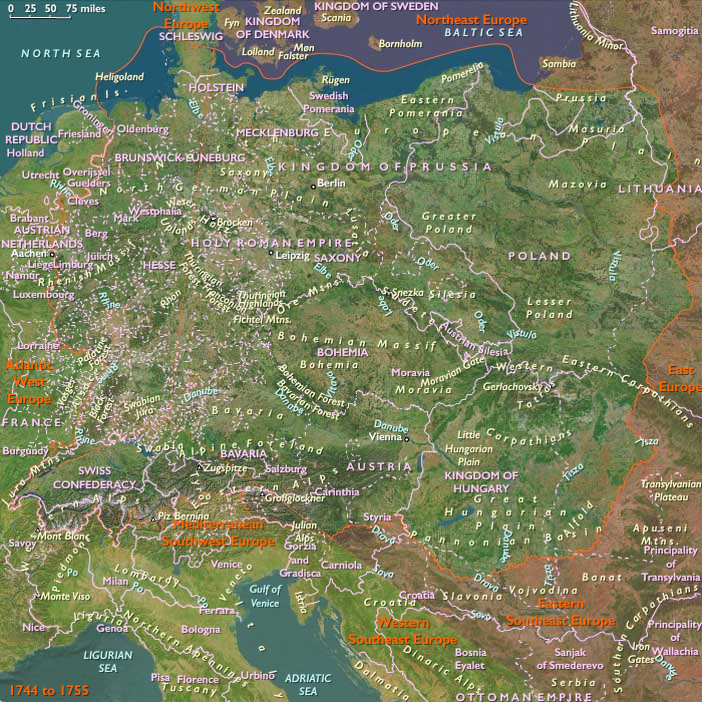
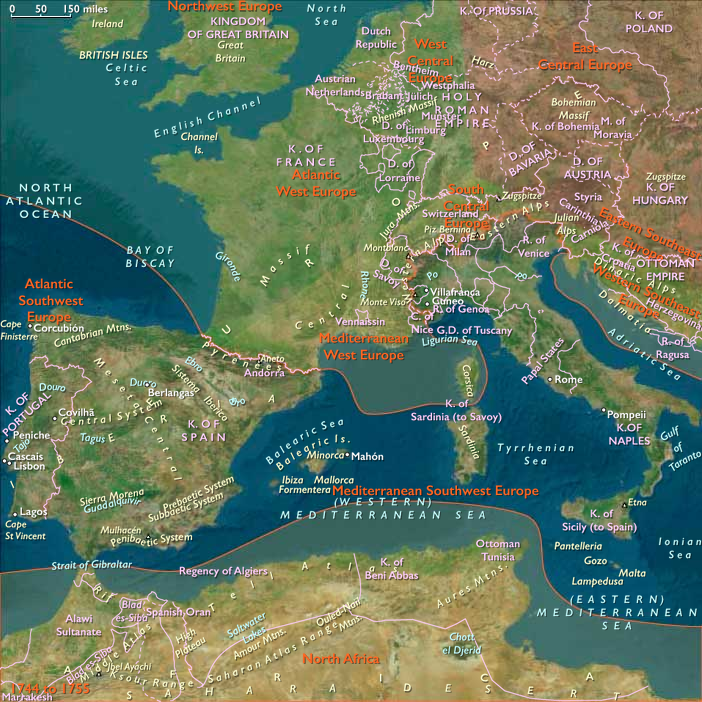
Atlantic West Europe (1744–1755): Conflict, Enlightenment Critique, and Emerging Structural Reforms
From 1744 to 1755, Atlantic West Europe—encompassing northern France, the Low Countries (modern Belgium, Netherlands, Luxembourg), and regions along the Atlantic and English Channel—experienced heightened military tensions, economic strains from ongoing warfare, robust Enlightenment critiques of governance and society, and intensified efforts at structural reform. This era was marked primarily by the latter stages of the War of the Austrian Succession and the initial developments leading into the broader global conflict of the Seven Years’ War.
Political and Military Developments
War of the Austrian Succession (1740–1748): Impact and Resolution
-
Between 1744 and 1748, Atlantic West Europe bore the brunt of escalating warfare, particularly in the Austrian Netherlands, as French armies invaded and occupied several key cities, including Brussels and Antwerp. Fighting and occupation severely disrupted regional economies and civilian life.
-
In 1745, Louis XV’s forces achieved notable victories, including the Battle of Fontenoy (1745), a major triumph over a British-Dutch-Austrian coalition. This bolstered French military prestige but exhausted national finances.
-
The war concluded with the Treaty of Aix-la-Chapelle (1748), restoring territories to their pre-war boundaries. While this treaty temporarily stabilized regional politics, underlying rivalries persisted, sowing seeds for future conflicts.
Preparations for Renewed Conflict
-
In the aftermath of peace, both France and Britain strengthened their naval capabilities and colonial military resources, anticipating further confrontation, reflecting the persistent Franco-British rivalry that would soon culminate in the Seven Years’ War (1756–1763).
-
Northern French ports such as Brest, Rochefort, and Nantes notably expanded military dockyards and naval fortifications, preparing strategically for renewed maritime confrontations.
Economic Developments: War, Recovery, and Structural Changes
Economic Strains and Postwar Recovery
-
Continuous warfare (1744–1748) severely strained the region's economies, disrupting trade routes and commerce, particularly affecting the textile and maritime industries in Flanders and Brabant.
-
After 1748, economic recovery became a priority. Ports such as Bordeaux, Nantes, Antwerp, and Amsterdam gradually resumed prosperous maritime trade, though the region faced ongoing challenges from British naval dominance and competition.
Agricultural and Industrial Reforms
-
Postwar economic reforms accelerated, particularly under French Minister of Finance, Jean-Baptiste de Machault d’Arnouville, who pursued tax and administrative reforms (1749–1754) aimed at strengthening royal finances and stimulating agricultural and industrial production.
-
Agricultural modernization efforts, inspired by Enlightenment ideals, increased productivity through crop diversification, improved farming techniques, and irrigation systems, especially evident in northern France and the southern Netherlands.
Intellectual and Cultural Developments
Enlightenment Critique and Calls for Reform
-
Intellectual critique intensified markedly during this era, with Enlightenment thinkers such as Montesquieu, whose landmark The Spirit of the Laws (1748) profoundly influenced political philosophy by advocating the separation of powers and critiquing absolute monarchy.
-
Criticism of governmental inefficiency, corruption, and excessive taxation became increasingly common in Enlightenment discourse, fostering widespread intellectual dissatisfaction with absolutist governance.
Scientific and Philosophical Progress
-
Scientific advancements continued apace. The French mathematician and astronomer Pierre-Louis Maupertuis famously published findings from the Arctic geodesic expedition, solidifying Enlightenment principles of empirical inquiry and global scientific collaboration.
-
Universities and scientific societies across Paris, Amsterdam, Brussels, and Antwerp maintained vibrant intellectual activity, nurturing an atmosphere of rigorous scholarly debate and innovation.
Religious and Social Developments
Continued Religious Moderation and Secularization
-
Gradual religious moderation and secularization deepened, particularly evident in urban centers like Amsterdam and Brussels, where Calvinist orthodoxy became more tolerant of intellectual dissent and religious plurality.
-
In France, although Catholicism remained dominant, critical Enlightenment perspectives increasingly questioned the church's influence over education, governance, and social policy.
Growing Social Critique and Calls for Justice
-
Enlightenment intellectuals vigorously attacked aristocratic privilege, corruption, and social injustice, reflecting growing dissatisfaction among urban merchant classes and educated bourgeoisie in cities like Paris, Brussels, Antwerp, and Amsterdam.
-
Salons and cafés throughout Atlantic West Europe served as influential platforms for spreading Enlightenment ideas, fostering civic debate, and encouraging public critique of established authority.
Cultural and Artistic Flourishing
Rococo and Early Neoclassical Transitions
-
Rococo style continued its cultural dominance, though signs of an emerging Neoclassical aesthetic began to appear, emphasizing clarity, rationality, and classical forms, particularly in French and Low Countries' architecture and painting.
-
Artistic patronage by affluent merchant elites and royal courts facilitated a vibrant cultural atmosphere, exemplified by artists like François Boucher and early works of Jean-Baptiste Greuze.
Literary and Musical Developments
-
Literary production flourished, particularly influenced by Enlightenment writers such as Montesquieu and Voltaire, whose philosophical novels and critiques of society significantly impacted intellectual life.
-
Musical life in the region thrived, with significant activity in cities like Paris and Brussels, where composers and musicians contributed to an expanding European musical tradition, bridging Baroque styles toward early Classical forms.
Urban and Social Transformations
Urban Growth and Commercial Vitality
-
Despite wartime disruptions, urban centers in Atlantic West Europe, including Amsterdam, Brussels, Bordeaux, and Nantes, continued urban expansion and infrastructure improvements. Economic recovery efforts significantly enhanced commercial vitality and trade activity.
-
Urban merchant elites further consolidated their social influence, supporting public works, cultural patronage, and civic improvements, creating a foundation for sustained urban prosperity.
Increased Social Tensions and Emerging Reform Movements
-
Social tensions escalated amid critiques of social inequities, aristocratic privileges, and tax burdens. Emerging reform movements advocated for fiscal fairness, government accountability, and enhanced civic participation, particularly among educated urban populations.
Legacy and Historical Significance
The period 1744–1755 proved critical in shaping the trajectory of Atlantic West Europe toward modernity:
-
Politically, the conclusion of the War of the Austrian Succession temporarily stabilized the region yet intensified preparations for future global conflicts, setting the stage for the Seven Years’ War.
-
Economically, postwar recovery, structural reforms, and agricultural modernization laid the groundwork for future growth and industrial development.
-
Intellectually, Enlightenment ideals profoundly impacted governance, philosophy, and scientific inquiry, fueling demands for political and social reform that anticipated later revolutionary movements.
-
Culturally and socially, heightened artistic production, intellectual critique, and urban transformation strengthened civic identities and broadened public participation in political discourse.
Ultimately, this era reinforced Atlantic West Europe's dynamic role as a leading economic, cultural, and intellectual hub, preparing the ground for the transformative challenges of the late 18th and early 19th centuries.
The Spirit of the Laws (French: De l'esprit des lois, originally spelled De l'esprit des loix; also sometimes called The Spirit of Laws) is a treatise on political theory first published anonymously by Charles de Secondat, Baron de Montesquieu, in 1748 with the help of Claudine Guérin de Tencin.
Montesquieu has spent around twenty-one years researching and writing De l'esprit des lois, covering such topics as law, social life, and the study of anthropology and providing more than three thousand commendations.
In this political treatise Montesquieu pleads in favor of a constitutional system of government and the separation of powers, the ending of slavery, the preservation of civil liberties and the law, and the idea that political institutions ought to reflect the social and geographical aspects of each community.
In his classification of political systems, Montesquieu defines three main kinds: republican, monarchical, and despotic.
As he defines them, Republican political systems vary depending on how broadly they extend citizenship rights—those that extend citizenship relatively broadly are termed democratic republics, while those that restrict citizenship more narrowly are termed aristocratic republics.
The distinction between monarchy and despotism hinges on whether or not a fixed set of laws exists that can restrain the authority of the ruler: if so, the regime counts as a monarchy; if not, it counts as despotism.
A second major theme in De l'esprit des lois concerns political liberty and the best means of preserving it.
"Political liberty" is Montesquieu's concept of what we might call today personal security, especially insofar as this is provided for through a system of dependable and moderate laws.
He distinguishes this view of liberty from two other, misleading views of political liberty.
The first is the view that liberty consists in collective self-government—i.e. that liberty and democracy are the same.
The second is the view that liberty consists in being able to do whatever one wants without constraint.
Not only are these latter two not genuine political liberty, he thinks, they can both be hostile to it.
Generally speaking, establishing political liberty on a sound footing requires two things: The separation of the powers of government, and the appropriate framing of civil and criminal laws so as to ensure personal security.
The third major contribution of De l'esprit des lois is to the field of political sociology, which Montesquieu is often credited with more or less inventing.
The bulk of the treatise, in fact, concerns how geography and climate interact with particular cultures to produce the spirit of a people.
This spirit, in turn, inclines that people toward certain sorts of political and social institutions, and away from others.
Originally published anonymously partly because Montesquieu's works are subject to censorship, its influence outside France will be aided by its rapid translation into other languages.
The first partition of Poland in 1772 does not directly threaten the viability of Poland-Lithuania.
Poland retains extensive territory that includes the Polish heartland.
In fact, the shock of the annexations makes clear the dangers of decay in government institutions, creating a body of opinion favorable to reform along the lines of the European Enlightenment.
King Stanislaw August supports the progressive elements in the government and promotes the ideas of foreign political figures such as Edmund Burke and George Washington.
At the same time, Polish intellectuals discuss Enlightenment philosophers such as Montesquieu and Rousseau.
During this period, the concept of democratic institutions for all classes is accepted in Polish society.
Education reform includes establishment of the first ministry of education in Europe.
Taxation and the army undergo thorough reform, and government again is centralized in the Permanent Council.
Landholders emancipate large numbers of peasants, although there is no official government decree.
Polish cities, in decline for many decades, are revived by the influence of the Industrial Revolution, especially in mining and textiles.