Mohandas Karamchand Gandhi
leader of Indian nationalism in British-ruled India
Years: 1876 - 1948
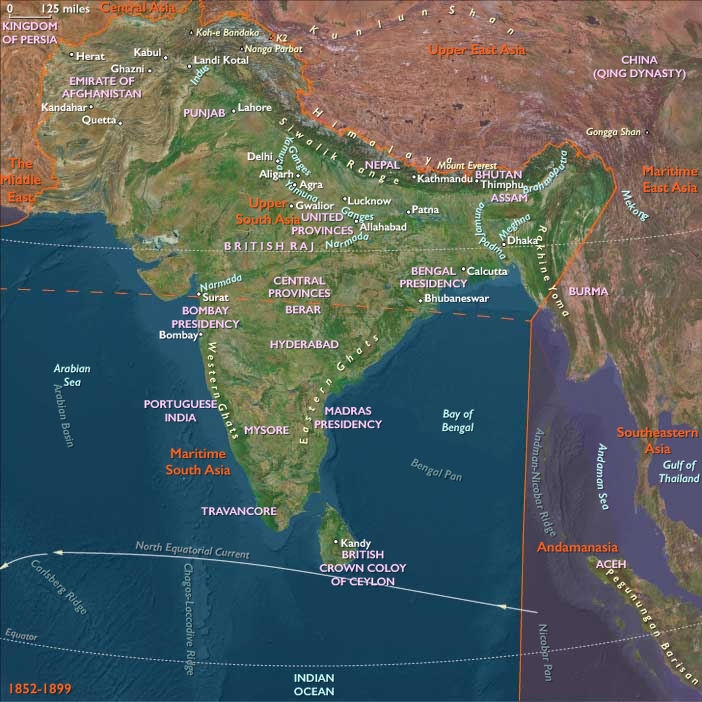
Mohandas Karamchand Gandhi (2 October 1869 – 30 January 1948), commonly known as Mahatma Gandhi, is the preeminent leader of Indian nationalism in British-ruled India.
Employing non-violent civil disobedience, Gandhi leads India to independence and inspires movements for non-violence, civil rights and freedom across the world.
The son of a senior government official, Gandhi was born and raised in a Hindu Bania community in coastal Gujarat, and trains in law in London.
Gandhi becomes famous by fighting for the civil rights of Muslim and Hindu Indians in South Africa, using new techniques of non-violent civil disobedience that he develops.
Returning to India in 1915, he sets about organizing peasants to protest excessive land-taxes.
A lifelong opponent of "communalism" (i.e.
basing politics on religion) he reaches out widely to all religious groups.
He becomes a leader of Muslims protesting the declining status of the Caliphate.
Assuming leadership of the Indian National Congress in 1921, Gandhi leads nationwide campaigns for easing poverty, expanding women's rights, building religious and ethnic amity, ending untouchability, increasing economic self-reliance, and above all for achieving Swaraj—the independence of India from British domination.
Gandhi leads Indians in protesting the national salt tax with the 400 km (250 mi) Dandi Salt March in 1930, and later in demanding the British to immediately Quit India in 1942, during the Second World War.
He is imprisoned for that and for numerous other political offenses over the years.
Gandhi seeks to practice non-violence and truth in all situations, and advocates that others do the same.
He sees the villages as the core of the true India and promotes self-sufficiency; he does not support the industrialization programs of his disciple Jawaharlal Nehru.
He lives modestly in a self-sufficient residential community and wears the traditional Indian dhoti and shawl, woven with yarn he had hand spun on a charkha.
His chief political enemy in Britain is Winston Churchill, who ridicules him as a "half-naked fakir."
He is a dedicated vegetarian, and undertakes long fasts as means of both self-purification and political mobilization.
In his last year, unhappy at the partition of India, Gandhi works to stop the carnage between Muslims and Hindus and Sikhs that rages in the border area between India and Pakistan.
He is assassinated on 30 January 1948 by a Hindu nationalist who thinks Gandhi is too sympathetic to India's Muslims.
30 January is observed as Martyrs' Day in India.
The honorific Mahatma ("Great Soul"), is applied to him by 1914.
In India he is also called Bapu ("Father").
He is known in India as the Father of the Nation; his birthday, 2 October, is commemorated there as Gandhi Jayanti, a national holiday, and worldwide as the International Day of Non-Violence.
Gandhi's philosophy is not theoretical but one of pragmatism, that is, practicing his principles in real time.
Asked to give a message to the people, he responds, "My life is my message."