Miguel de Cervantes
Spanish novelist, poet, and playwright
Years: 1547 - 1616
Miguel de Cervantes Saavedra (29 September 1547 – 23 April 1616) is a Spanish novelist, poet, and playwright.
His magnum opus Don Quixote, often considered the first modern novel, is a classic of Western literature, and is regarded amongst the best works of fiction ever written.
His work is often considered amongst the most important works in all of Western literature.
His influence on the Spanish language has been so great that Spanish is often called la lengua de Cervantes, Spanish for the language of Cervantes.
He has been dubbed ˆ – The Prince of Wits.
Related Events
Filter results
Showing 7 events out of 7 total
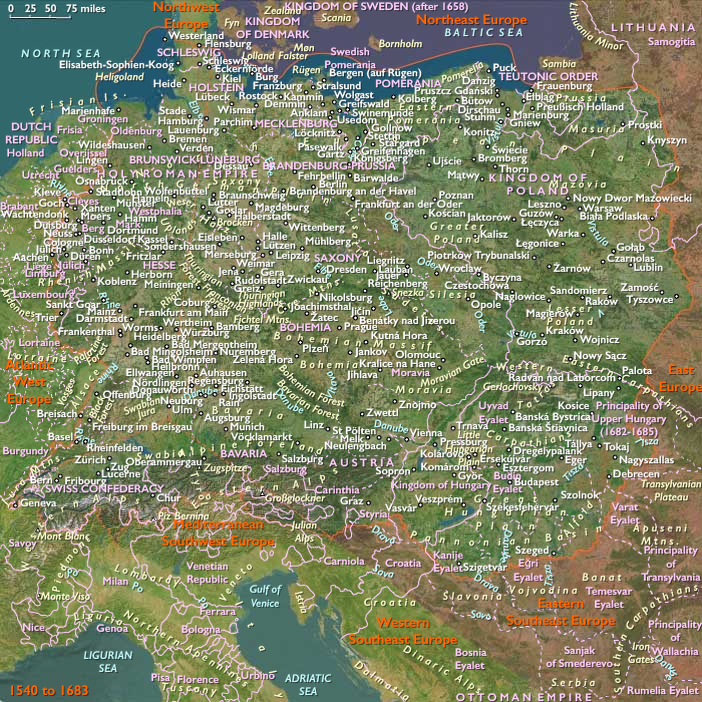
Atlantic Southwest Europe (1540–1683 CE): Political Transformation, Maritime Expansion, and Cultural Flourishing
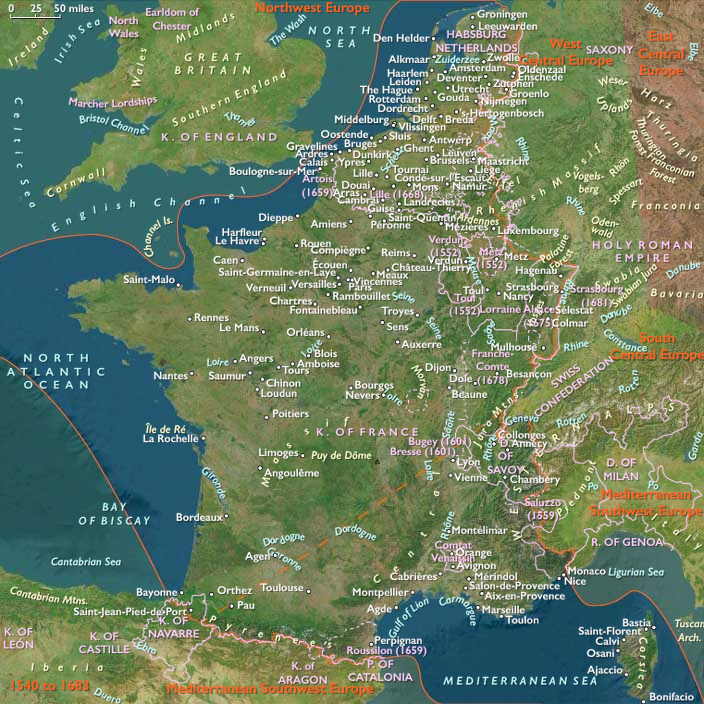
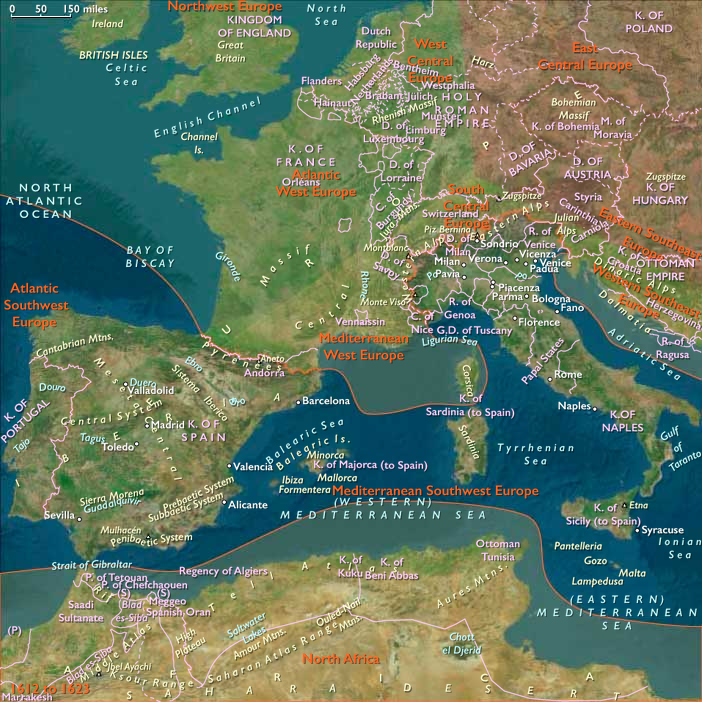
Between 1540 and 1683, Atlantic Southwest Europe—including northern and central Portugal (Lisbon and Porto), Galicia, Asturias, Cantabria, northern León and Castile, northern Navarre, northern Rioja, and the Basque Country—underwent a transformative era marked by political upheaval, economic prosperity through maritime commerce, intense religious reform, and dynamic cultural expression. The region developed distinctive identities deeply influenced by the Renaissance and later the Baroque era, significantly shaping its trajectory toward modernity.
Political and Military Developments
The Iberian Union and Portuguese Restoration
In 1580, Portugal’s succession crisis resulted in the Iberian Union (1580–1640) under the Spanish Habsburg monarchy. This union initially strained the economies of northern Portuguese cities, notably Porto and Lisbon, which experienced intensified taxation and restrictions on trade. Dissatisfaction intensified, culminating in Portugal’s successful Restoration of Independence (1640) led by King João IV (House of Braganza). This pivotal moment restored political autonomy and stability, revitalizing regional governance structures and economic dynamism.
Autonomy and Fueros in Northern Spain
Throughout this period, regions such as the Basque Country and Navarre staunchly defended their traditional fueros, which guaranteed local autonomy, taxation privileges, and self-governance. These institutions effectively insulated the northern territories from the Spanish Crown's centralizing policies, sustaining political stability even as Spain faced broader imperial challenges.
In contrast, Galicia, Asturias, and Cantabria were more integrated within Castilian governance yet retained significant local autonomy. Their administrative flexibility enabled them to balance central demands and local interests effectively.
Military Pressures and Regional Stability
Atlantic Southwest Europe occasionally found itself at the forefront of broader military conflicts, notably during England’s maritime confrontations with Spain and Portugal. Despite such external pressures—including the disastrous defeat of the Spanish Armada (1588), which deeply impacted Basque and Cantabrian ports—the region largely maintained internal stability, enabling sustained economic recovery and growth in subsequent decades.
Economic Developments: Maritime and Commercial Expansion
Portuguese Maritime and Commercial Prosperity
Northern and central Portugal, especially cities like Lisbon, Porto, and Viana do Castelo, benefited enormously from maritime trade expansion. Porto, in particular, flourished as international demand surged for Port wine from the Douro Valley, becoming a key commercial hub for exports to England and the Low Countries. Shipbuilding along the northern Portuguese coast simultaneously expanded, driven by this booming maritime economy.
Northern Spain’s Industrial and Maritime Growth
The Basque provinces and Cantabria witnessed substantial economic prosperity driven by industrial growth, particularly shipbuilding, iron production, fisheries, and robust maritime commerce. The city of Bilbao became a major iron exporter, enhancing its economic importance within European trade networks. Santander similarly prospered through increased transatlantic and northern European maritime trade.
Galicia notably revitalized its maritime economy with strengthened fishing industries and expanded commercial ties through ports like Vigo and A Coruña, reinforcing regional economic resilience.
Religious Developments: Counter-Reformation and Local Identity
Counter-Reformation Orthodoxy
Following the Council of Trent (1545–1563), Atlantic Southwest Europe firmly embraced Counter-Reformation Catholicism, reinforced by inquisitorial tribunals and revitalized ecclesiastical institutions. Cities such as Valladolid, Braga, Coimbra, Santiago de Compostela, and Pamplona became prominent centers of religious orthodoxy, significantly shaping local educational, cultural, and spiritual life.
Pilgrimage routes, notably the Camino de Santiago, experienced renewed popularity, underscoring regional religious identity and promoting cultural cohesion, especially in Galicia.
Influence of the Jesuits
The establishment of Jesuit colleges significantly impacted regional intellectual life, fostering robust Catholic education in cities like Lisbon, Coimbra, Porto, and Valladolid. These institutions contributed significantly to the region’s intellectual vitality, while simultaneously ensuring adherence to Counter-Reformation doctrine.
Cultural and Artistic Flourishing
Transition from Renaissance to Baroque
Initially influenced by Renaissance humanism, cities like Braga, Santiago de Compostela, Burgos, Bilbao, and Lisbon sponsored art and architecture that reflected classical ideals and humanist values. By the late sixteenth century, the Baroque aesthetic profoundly reshaped the region, with elaborate cathedrals, palaces, and public buildings adorning urban landscapes, exemplified by iconic structures in Braga, Lisbon, and Santiago.
Literary and Linguistic Vibrancy
The period witnessed a notable literary flourishing across languages—Portuguese, Castilian, and Galician—strengthening regional identities and promoting linguistic diversity. Literature often subtly asserted local pride, reflecting broader political and cultural autonomy movements emerging across the region.
Social and Urban Developments
Urban Expansion and Merchant Ascendancy
Significant urban growth characterized this era, driven by maritime commerce, industrial expansion, and the increasing wealth of merchant classes. Cities like Porto, Lisbon, Bilbao, Santander, and Vitoria-Gasteiz expanded substantially, providing enhanced infrastructure, vibrant marketplaces, and burgeoning civic institutions.
The rising merchant and artisan classes became influential in urban governance, shifting social structures toward increased social mobility, prosperity, and localized political power.
Strengthened Regional Autonomy and Identity
Throughout Atlantic Southwest Europe, particularly in the Basque Country, Navarre, Galicia, and northern Portugal, traditional rights (fueros) were persistently reaffirmed. These protections solidified local identities, empowering regional governance against centralized imposition from Madrid, ensuring sustained political resilience and autonomy.
Notable Regional Groups and Settlements
-
Portuguese (Central and Northern): Experienced political restoration, maritime prosperity, and cultural renaissance in cities like Lisbon and Porto.
-
Galicians and Asturians: Balanced maritime economic prosperity with persistent rural challenges, fostering strong regional identities.
-
Basques, Navarrese, and Cantabrians: Leveraged local autonomy for economic growth, maintaining distinctive political and cultural identities despite imperial pressures.
-
Northern Castilians and Riojans: Maintained effective local governance, contributing to regional stability despite broader Spanish imperial decline.
Long-Term Significance and Legacy
From 1540 to 1683, Atlantic Southwest Europe:
-
Achieved critical political transformations, notably Portugal’s restoration of independence and northern Spain’s affirmation of regional autonomy.
-
Experienced significant maritime and economic prosperity, firmly integrating the region into European and global trade networks.
-
Fostered vibrant cultural expressions through Renaissance humanism and Baroque aesthetics, enriching regional identities and artistic legacies.
-
Strengthened local governance structures, particularly via the preservation of fueros, ensuring lasting political stability and regional resilience.
This formative period profoundly influenced Atlantic Southwest Europe's historical trajectory, embedding a legacy of economic vibrancy, cultural distinctiveness, and enduring regional autonomy that would persist well beyond the seventeenth century.
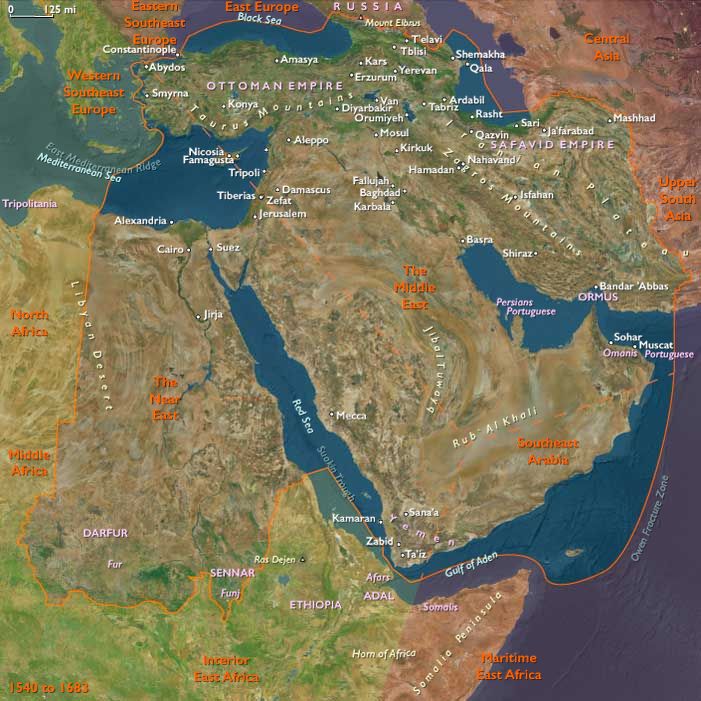
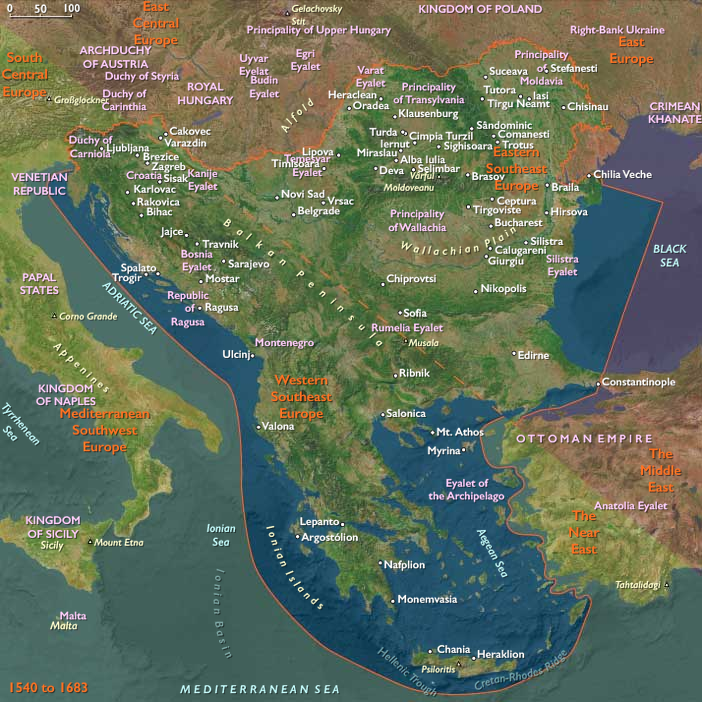
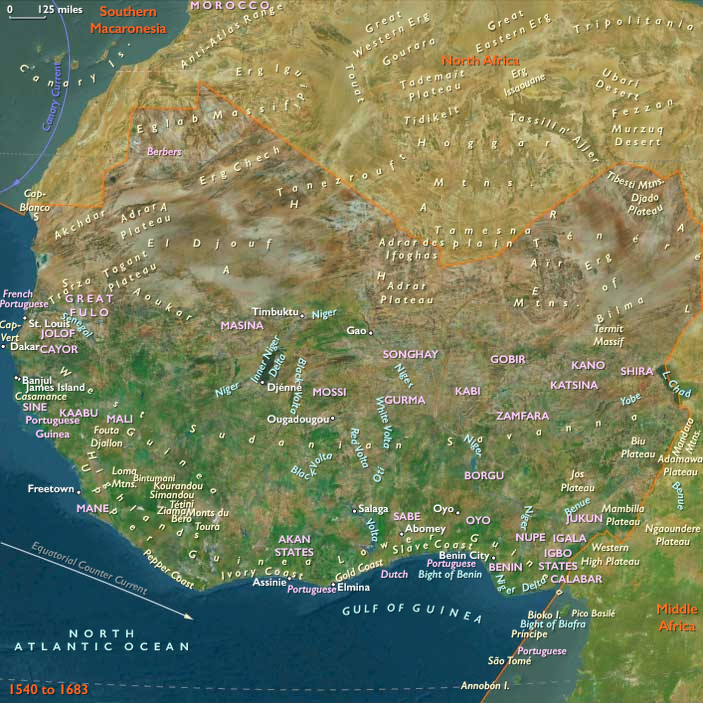
The Ottoman fleet, commanded by Ali Pasa, Muhammad Saulak (governor of Alexandria), and Uluj Ali (dey of Algiers), enters the Adriatic, and lies in the Gulf of Patras, near Lepanto (Návpaktos), Greece.
The combined Spanish, Venetian, and papal fleets—in alliance the numerical equals of the Turks—of more than two hundred ships sails for Corfu on September 15 and ...
...advances on October 7 in four squadrons against the Ottoman fleet.
Some galleys carry over two hundred oarsmen in what will prove to be the final naval engagement in which galleys are the principal vessels used.
Spanish admiral Don Álvaro de Bazán, marquis de Santa Cruz and the son of a naval officer, had in 1564 aided in the capture of Peñón de Vélez de la Gomera in Morocco and commanded the division of galleys employed to blockade Tetuan, and to suppress the piracy carried on from that port.
Bazán had earned the confidence of Philip II, who had appointed him to command the galleys of Naples in 1568 and in 1569 created him the Marqués de Santa Cruz in 1569.
During the Lepanto operations, Santa Cruz, always favoring the more energetic course, commands the reserve division, and his prompt energy averts a disaster when Uluj Ali, who commands the Turks’ left wing, outmaneuvers the commander of the Christian right, Giovanni Andrea Doria, and breaks the allied line.
Alessandro Farnese, raised at the Spanish court as the son of Ottavio Farnese, second duke of Parma, and Margaret of Austria, fights at Lepanto, as does twenty-four-year-old Spanish writer Miguel de Cervantes, who, born to a poor family in the university town of Alcalá de Henares and lacking the means for much formal education, has become a soldier: he loses the use of his left hand in the battle.
After about four hours of bloody fighting, the allies are victorious, capturing 117 galleys and thousands of men, and handing the Ottoman empire its first major defeat.
Although of little practical value, the battle has a great impact on Western European morale (and will become the subject of paintings by Titian, Tintoretto, and Veronese).
It confirms the Spaniards in their chosen role as champions of Christendom and explains much of their continued willingness to support their king's religious and imperial policies, even in the face of ruinous costs and mounting disasters.
Selim II had sent his support through a messenger, who had endeavored to put the Dutch in contact with the rebellious Moriscos of Spain and the pirates of Algiers.
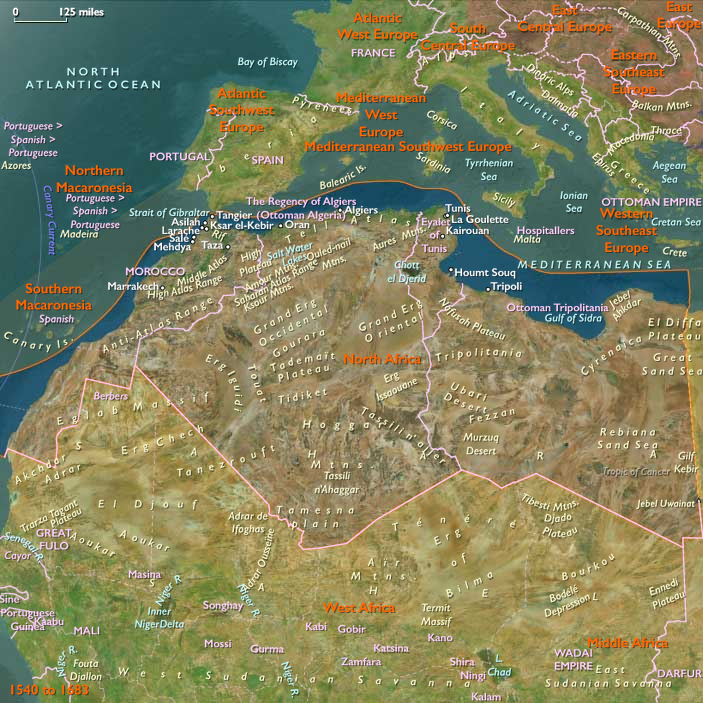
Selim also sends a great fleet to attack Tunis in the autumn of 1574, thus succeeding in reducing Spanish pressure on the Dutch.
In the Battle of La Goleta, Selim II musters a fleet of between two hundred and fifty and three hundred warships, with about seventy-five thousand men.
The Ottoman fleet is commanded by Sinan Pasha and Alūj Ali.
The Ottoman fleet combined, with troops sent by the governors of Algiers, Tripoli and Tunis, makes for a total force of about one hundred thousand.
The army attacks Tunis and La Goleta.
The presidio of La Goleta, defended by seven thousand men, falls on August 24. The last Christian troops in a small fort opposite Tunis surrender on September 3.
John of Austria attempts to relieve the siege with a fleet of galleys from Naples and Sicily but failed due to storms.
The Spanish crown, being heavily involved in the Netherlands and short of funds, is unable to offer significant help.
Sinan Pasha, an Italian Muslim, leads the Ottoman capture of Tunis.
Cervantes participates in these events as a soldier, and is among the troops of Don Juan of Austria that try to rescue the city.
He will claim that the Ottomans led twenty-two assaults against the fort of Tunis, losing twenty-five thousand men, while only three hundred Christians survived.
Abd al-Malik, the future Moroccan King, participates in the conquest on the side of the Ottomans.
Gabrio Serbelloni is the commander of the fort of Tunis.
The general of La Goleta, Don Pedro Portocarerro, is taken as a captive to Constantinople, but dies on the way.
The captured soldiers are employed as slaves on galleys.
The capture of Tunis gives the territories of the Hafsid dynasty to the Ottoman Empire.
The battle marks the final establishment of Ottoman rule in Tunis, putting an end to the Hafsid dynasty and the Spanish presence in Tunis.
Mediterranean Southwest Europe (1588–1599 CE): Conflicts, Cultural Innovation, and Maritime Influence
The era 1588–1599 CE in Mediterranean Southwest Europe is characterized by significant geopolitical tensions, cultural innovation, and maritime influence. The Iberian Peninsula sees notable conflicts, particularly involving Spain's naval ambitions, while Italy continues to be a vibrant hub of cultural and artistic developments. Concurrently, Malta, under the Knights Hospitaller, solidifies its role as a critical Mediterranean stronghold.
Iberian Geopolitical Tensions and Maritime Conflicts
This period begins dramatically with the Spanish Armada (1588), a fleet dispatched by King Philip II of Spain against England, which ends disastrously, severely impacting Spain’s maritime supremacy. Despite this setback, Spain remains an influential power, deeply involved in European politics and maintaining control over its Mediterranean territories, including Sicily, Sardinia, and the Balearic Islands. The failed Armada expedition reshapes naval strategies and alliances across Europe, prompting greater attention to maritime defenses throughout the Mediterranean region.
Cultural Flourishing and Literary Golden Age in Spain
In Spain, despite political and military setbacks, the cultural environment remains vibrant. This era sees the continued rise of the Spanish Golden Age, with significant literary contributions by prominent authors like Miguel de Cervantes, whose early literary works set the stage for his masterpiece, Don Quixote, in subsequent years. Spanish theater flourishes under playwrights such as Lope de Vega, who becomes known for his prolific output and innovations in dramatic form and character complexity, further enriching the Spanish cultural landscape.
Artistic and Scientific Advancements in Italy
In Italy, cultural innovation continues unabated, particularly in the arts and sciences. This era sees notable advancements in both visual arts and music, with developments influenced by the late Renaissance and early Baroque transitions. Artists like Caravaggio begin to rise in prominence with their innovative use of chiaroscuro and realistic portrayal of human figures. In music, Italian composers continue to refine vocal and instrumental forms, laying foundations that will soon blossom into the Baroque style.
The scientific community, inspired by Renaissance humanism, sees continued growth. The University of Padua remains a leading institution for scientific inquiry, notably in medicine and anatomy, attracting scholars from across Europe and reinforcing Italy’s central role in the European scientific community.
Malta’s Strategic Importance and Fortification Efforts
Malta under the Knights Hospitaller continues to strengthen its strategic importance in the Mediterranean. The fortified city of Valletta, completed earlier in 1571, now fully operational, becomes increasingly vital for maritime defense. The Knights significantly enhance the island’s military capabilities, constructing additional fortifications and watchtowers along the coastline. Malta’s reputation as a cultural and scientific center grows, particularly with the expansion of the Sacra Infermeria, renowned across Europe for its medical advancements and sophisticated healthcare.
Trans-Mediterranean Cultural and Commercial Exchanges
Venice maintains its role as a critical commercial and cultural hub, sustaining vibrant trade links with the Ottoman Empire and North Africa. This trade continues to introduce new goods and ideas into Europe, influencing tastes and habits, particularly through the spread of coffee and other exotic commodities. Such exchanges further entrench Venice’s position as a center for cultural fusion, diplomacy, and commerce in the Mediterranean.
Legacy of the Era
The period 1588–1599 CE encapsulates a dynamic era of political tensions, cultural vibrancy, and maritime strategy. Despite setbacks like the failure of the Spanish Armada, Iberia’s cultural influence grows, while Italy and Malta continue to innovate and solidify their significance within the broader European context. These developments profoundly influence the Mediterranean’s cultural and geopolitical landscape, setting the stage for the complexities of the seventeenth century.
Mediterranean Southwest Europe (1600–1611 CE): Sovereign Adjustments, Cultural Refinements, and Strategic Developments
The era 1600–1611 CE in Mediterranean Southwest Europe witnesses important adjustments in sovereignty, ongoing cultural refinements, and significant strategic developments across the region. The Iberian Peninsula sees crucial political developments regarding Andorra’s unique governance structure, Italy maintains its cultural and scientific advancements, and Malta continues to strengthen its maritime and defensive significance.
Andorra’s Sovereignty Formalized
Andorra’s distinct co-sovereignty arrangement, long shared between the Count of Foix and the Bishop of Urgell in Catalonia, undergoes formal clarification. Historically, the French claim to Andorra had passed to the kings of Navarre. In 1607, King Henry IV of France (formerly Henry of Navarre) formally recognizes and codifies this arrangement through an edict, establishing the French head of state and the Bishop of Urgell as co-princes. This unique political settlement solidifies Andorra's territorial and governance structure, laying the foundations for its enduring political stability and identity.
Continuing Literary and Cultural Achievements in Spain
Spain continues to experience the heights of its literary Golden Age, despite ongoing geopolitical pressures and challenges. The early 1600s mark the publication of Miguel de Cervantes’ iconic Don Quixote (first part published in 1605), a literary masterpiece that profoundly influences European literature and culture. Cervantes' work symbolizes Spain’s vibrant intellectual life, reflecting both humanist ideals and critical social commentary. At the same time, playwrights such as Lope de Vega remain prolific, further enriching Spanish drama and solidifying Spain's position as a cultural powerhouse in Europe.
Italian Artistic and Scientific Flourishing
In Italy, artistic innovations continue, characterized by further development of Baroque aesthetics. Artists such as Caravaggio continue to profoundly influence European art through dramatic chiaroscuro techniques and intensely realistic portrayals of human emotion and physicality. In music, Italian composers advance vocal and instrumental forms, enhancing the complexity and emotive power of the emerging Baroque style.
Scientifically, Italy maintains its leading role in Europe, with the University of Padua at the forefront of anatomical and medical studies. The era sees continued refinement and expansion of scientific inquiry, bolstering Italy’s academic prestige and drawing scholars from across the continent.
Malta’s Expanding Defensive Capabilities
Under the Knights Hospitaller, Malta further develops its strategic defensive infrastructure. Following the completion of the fortified city of Valletta in 1571, the Knights continue to reinforce the island’s military strength through the construction of coastal watchtowers and fortifications. These strategic enhancements ensure Malta remains a formidable Mediterranean stronghold, crucial for protecting European interests against Ottoman and North African threats. Additionally, Malta's Sacra Infermeria enhances its reputation across Europe, known for pioneering medical practices and superior healthcare services.
Venetian Trade and Cultural Exchange
Venice sustains its influential role as a Mediterranean commercial hub, continuing robust trade with the Ottoman Empire and North Africa. This commerce introduces Europeans to an expanding range of commodities, notably coffee, significantly shaping European tastes and habits. Venice’s position as a vital cultural crossroads remains secure, facilitating cultural fusion and diplomatic exchanges that enhance its strategic economic importance.
Legacy of the Era
The years 1600–1611 CE in Mediterranean Southwest Europe are marked by political consolidations, cultural brilliance, and strategic preparedness. Andorra's governance stabilization, Spain's literary and cultural zenith, Italy’s ongoing artistic and scientific excellence, Malta's fortification, and Venice’s thriving trade all combine to define a dynamic era, setting a complex yet vibrant stage for subsequent European historical developments.
Miguel de Cervantes, born in Alcalá de Henares in 1547, had in 1569 moved to Italy, where he served as a valet to Giulio Acquaviva, a wealthy priest who was elevated to cardinal the next year.
By then, Cervantes had enlisted as a soldier in a Spanish Navy infantry regiment and continued his military life until 1575, when he was captured by Algerian corsairs.
He was then released on ransom from his captors by his parents and the Trinitarians, a Catholic religious order.
He subsequently returned to his family in Madrid.
Cervantes had in 1585 published a pastoral novel named La Galatea.
Because of financial problems, Cervantes had worked as a purveyor for the Spanish Armada, and later as a tax collector.
Discrepancies in his accounts of three years previous had landed him in the Crown Jail of Seville in 1597.
He is in Valladolid in 1605, just when the immediate success of the first part of his Don Quixote, published in Madrid, signals his return to the literary world.
No sooner is it in the hands of the public than preparations are made to issue derivative ("pirated") editions.
"Don Quixote" has been growing in favor, and its author's name is now known beyond the Pyrenees.
By August 1605, there are two Madrid editions, two published in Lisbon, and one in Valencia.
A second edition is produced with additional copyrights for Aragon and Portugal, which publisher Francisco de Robles secures.
Sale of these publishing rights deprives Cervantes of further financial profit on Part One.