Mieszko I
Duke of Poland
Years: 930 - 992
Mieszko I (ca.
930 – 25 May 992), is the ruler of the Polans from about 960 until his death.
A member of the Piast dynasty, he is the son of Siemomysł; grandchild of Lestek; father of Bolesław I the Brave, the first crowned King of Poland; likely father of Świętosława (Sigrid), a Nordic Queen; and grandfather of her son, Cnut the Great.
The first historical ruler of Poland, Mieszko I is considered the de facto creator of the Polish state.
He continues the policy of both his father and grandfather, who were rulers of the pagan tribes located in the area of present Greater Poland.
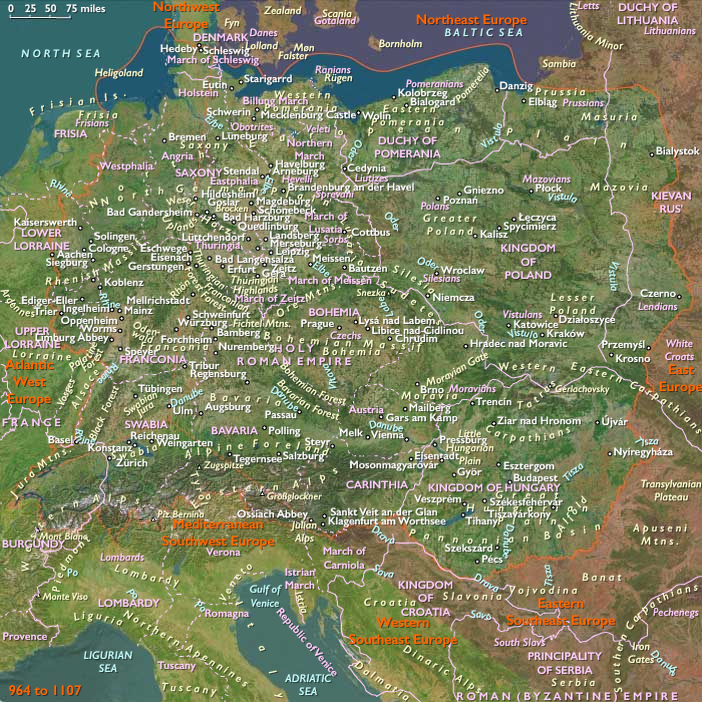
Either through alliances or by use of military force, Mieszko extends the ongoing conquests and early in his reign subordinates Kuyavia and probably Gdańsk Pomerania and Masovia.
For most of his reign, Mieszko I is involved in warfare for the control of Western Pomerania, eventually conquering it up to the vicinity of the lower Oder.
During the last years of his life he fights the Bohemian state, winning Silesia and probably Lesser Poland.
Mieszko I's marriage in 965 to the Czech Přemyslid princess Dobrawa and his baptism in 966 put him and his country in the cultural sphere of Western Christianity.
Apart from the great conquests accomplished during his reign (which prove to be fundamental for the future of Poland), Mieszko I is renowned for his internal reforms, aimed at expanding and improving the so-called war monarchy system.
According to existing sources, Mieszko I is a wise politician, a talented military leader and charismatic ruler.
He successfully uses diplomacy, concluding an alliance with Bohemia first, and then with Sweden and the Holy Roman Empire.
In foreign policy, he places the interests of his country foremost, even entering into agreements with former enemies.
On his death, he leaves to his sons a country of greatly expanded territory, with a well-established position in Europe.
Mieszko I also enigmatically appears as "Dagome" in a papal document dating to about 1085, called Dagome iudex, which mentions a gift or dedication of Mieszko's land to the Pope (the act took place almost a hundred years earlier).
Related Events
Filter results
Showing 10 events out of 29 total
Central Europe (820 – 963 CE): Carolingian Frontiers, River Kingdoms, and the Alpine Arteries
Geographic and Environmental Context
Central Europe spanned the Baltic lowlands of Poland and Germany, the Bohemian Massif and Carpathian arc, and the Danube–Morava corridor down into the Pannonian Plain, while the Rhine–Moselle–Main system and the Alpine passes tied the region to Burgundy and Italy.
-
Northern arteries: Elbe, Oder, Vistula.
-
Southern spine: Danube–Morava–Pannonian corridor.
-
Alpine hinges: Brenner, Reschen, Septimer, Julier, Splügen, Great St. Bernard.
A cool–temperate regime prevailed; by mid-10th century, onset of the Medieval Warm Period modestly lengthened growing seasons on loess uplands and improved Carpathian pastures. Flood pulses on the Elbe, Oder, Danube structured transport, milling, and settlement.
Societies and Political Developments
East Central Europe: Carolingian Legacy, Great Moravia, and the Magyar Ingress
-
East Francia → Ottonian Germany (Germany/Austria): After Carolingian partitions, East Francia stabilized as the Kingdom of Germany (Saxony, Franconia, Bavaria, Swabia). Henry I (919–936) and Otto I (936–973)consolidated power, pushing marches eastward against Polabian Slavs and laying the basis for the Holy Roman Empire.
-
Great Moravia (833–c. 906): At its height under Svatopluk I (870–894), it spanned Moravia, western Slovakia, and parts of Bohemia and Pannonia. Cyril and Methodius (863) introduced Slavonic liturgy and Glagolitic, rooting Christianity in local tongues. Collapse followed Magyar raids and Frankish pressure after 894.
-
Magyars (Carpathian Basin): Entered c. 895–907 under Árpád, occupied the Pannonian Plain, and crushed East Frankish–Bavarian armies at Pressburg (907). Through the 10th century, cavalry raids reached Bavaria, Saxony, Italy, and France until later checked at Lechfeld (955).
-
Bohemia: The Přemyslids in Prague balanced Moravian precedent and German suzerainty. Wenceslas (r. c. 921–935) advanced Christianization and tribute ties to Saxony; Boleslaus I expanded Bohemian power after Wenceslas’s murder.
-
Poland: Fortified grody anchored Polans, Vistulans, Pomeranians. By c. 960, Mieszko I began unifying the Polans and neighboring tribes—prelude to baptism (966, next age).
South Central Europe: Alpine Marches and Episcopal Road-Keeping
-
Post-Verdun (843), the zone split between East Francia (Tyrol, Carinthia, Swabian/Bavarian forelands, Swiss Plateau) and Upper Burgundy (Geneva–Valais).
-
The Inn and Carinthian marches guarded the Brenner approach; bishops of Trento and Brixen administered tolls and estates along the Tyrolean routes.
-
Monasteries—St. Gall, Disentis, Einsiedeln (934)—managed alpine estates, kept passes open, and provisioned travelers.
-
Otto I’s consolidation and victory at Lechfeld (955) ended Magyar pressure on Bavaria/Carinthia and secured the Alpine corridors.
West Central Europe: Lotharingian Marches and the Rhineland Core
-
Verdun (843) fractured the Carolingian world; Lotharingia oscillated between East and West, with Aachen, Cologne, Mainz mediating border defense and royal claims (Meerssen 870, Ribbemont 880).
-
Under the Ottonians (919–963), episcopal princes—Mainz, Trier, Cologne—and great abbeys stabilized governance as comital lordship proliferated.
-
Lechfeld (955) secured hinterlands; Otto’s imperial coronation (962/963) reaffirmed the Rhineland’s role in ceremony, law, and church politics. Aachen remained symbolic capital; Worms, Speyer rose as royal centers; Basel guarded the Upper Rhine/Jura hinge.
Economy and Trade
-
Agrarian base: rye, barley, oats, millet, wheat on river terraces and loess soils; viticulture along Rhine/Moselle, Moravia, Bavaria; cattle/swine in forest and meadow belts.
-
Resources & crafts: Kraków and alpine salt, Baltic amber, iron in Thuringia/Silesia; smithing and pottery spread with market towns.
-
River & road systems:
-
Rhine served as Europe’s main north–south artery; Moselle/Main fed Rhineland markets.
-
Elbe/Oder/Vistula linked Saxony and Poland to the Baltic; Vistula connected to Prussia and Rus’.
-
Danube funneled Bavarian–Moravian–Magyar exchange toward the Adriatic/Balkans; Morava–Danube corridor carried Christian missions and Frankish influence.
-
-
Money & flows: Islamic dirhams reached Poland/Germany via Rus’ and Volga Bulgar routes; Carolingian deniers and Ottonian denarii spread from Rhineland and Bavarian mints into Bohemia and Moravia.
-
Alpine commerce: northbound wine, oil, spices, silks; southbound timber, hides, cheese, iron, horses; fairs at Zürich, Geneva, Chur knit Burgundian/German merchants to Lombardy.
Subsistence and Technology
-
Heavy plow (carruca) and horse/ox traction expanded deep tillage on heavy soils; three-field rotations appeared on richer estates.
-
Fortifications: timber–earth grody and hillforts dominated tribal centers; in Alpine and Rhineland nodes, episcopal burgs and royal pfalzen guarded crossings.
-
Mills & fisheries: water-mills multiplied on tributaries; river fish weirs provisioned towns.
-
River craft & winter haulage: planked barges and dugouts on major rivers; sledges moved salt, grain, and timber over ice in winter.
-
Military systems: Magyar steppe cavalry (stirrups, composite bows) reshaped defense; Ottonian armored retinues evolved in response, culminating in Lechfeld.
Movement and Interaction Corridors
-
Elbe–Saale front: Ottonian marches facing Polabian Slavs.
-
Oder–Vistula–Baltic: fur, amber, and slave trades northward to the sea.
-
Morava–Danube: mission and commerce into Moravia and Hungary.
-
Carpathian passes: vectors for Magyar migration and later raiding.
-
Rhine–Moselle–Main: wine, salt, timber, millstones; Alsace–Basel gate to the Alps; trans-Meuse roads to Flanders/North Sea.
-
Alpine passes: Brenner, Septimer/Julier, Splügen, Great St. Bernard—redundant routes ensuring continuity despite storms or war.
Belief and Symbolism
-
Christianization:
-
Great Moravia pioneered Slavonic liturgy; after its fall, Bohemia and Poland leaned toward Latin-riteChristianity via Saxony/Bavaria.
-
Ottonian Germany deepened monastic–episcopal structures; sees at Magdeburg and Brandenburgadvanced missions eastward.
-
-
Pagan traditions: Slavic polytheism (Perun, Veles, Svantovit) persisted among Poles, Pomeranians; Magyarsmaintained Tengrist and shamanic rites.
-
Burials: hybrid zones reveal cremation in pagan districts, Christian inhumation in Moravia, Bohemia, Saxony; reliquaries and saints’ cults reinforced urban prestige in the Rhineland and Alpine valleys.
-
Monastic charisma: St. Gall, Disentis, Einsiedeln anchored piety, hospitality, and safe passage along alpine roads.
Adaptation and Resilience
-
Military adaptation: Ottonians forged armored cavalry retinues to counter Magyar tactics; Lechfeld (955)stabilized East Francia and opened recovery in Bavaria/Carinthia.
-
Agrarian buffers: mixed cropping (rye + millet), stock herding, and valley fruit/wine moderated climate variability.
-
Jurisdictional layering: bishops, abbots, counts, and royal pfalzen spread risk and ensured continuity amid dynastic flux.
-
Route redundancy: when upland war or storms disrupted roads, merchants shifted to river corridors or alternate passes; fairs re-routed exchange.
Long-Term Significance
By 963 CE, Central Europe had become a crucible of state formation and connectivity:
-
Otto I’s consolidation stabilized the German kingdom, checked the Magyars, and restored long-distance commerce.
-
Great Moravia had dissolved, but its Slavonic Christian legacy endured in Bohemia and Poland’s emerging dynasties.
-
Magyars controlled the Carpathian Basin, raiding while adapting to a settled frontier that would soon pivot toward Christian kingship.
-
Alpine marches and monastic road-keepers secured the north–south arteries linking the Rhine and Danube to Italy.
-
The Rhineland reemerged as imperial–commercial core, while Piast Poland and Přemyslid Bohemiacrystallized into durable realms.
These arrangements—river logistics, alpine gateways, armored retinues, and monastic–episcopal governance—forged the steppe–agrarian and Christian–pagan frontier dynamics that would define Central Europe’s integration into Latin Christendom in the next age.
East Central Europe (820 – 963 CE): Carolingian Frontiers, Great Moravia, and the Magyar Ingress
Geographic and Environmental Context
East Central Europe includes Poland, Czechia (Bohemia and Moravia), Slovakia, Hungary (the Carpathian Basin), northeastern Austria, and the greater part of Germany (including Berlin, Munich, Hamburg).
-
The region stretches from the Baltic lowlands of Poland and Germany to the Danube basin of Austria, Slovakia, and Hungary, bounded by the Carpathians and the Bohemian Massif.
-
Key arteries: the Elbe, Oder, and Vistula rivers northward, and the Danube–Morava corridor southward, connecting central Germany to the Pannonian Plain.
Climate and Environmental Shifts
-
A cool–temperate regime with seasonal rainfall.
-
By the mid-10th century the onset of the Medieval Warm Period (c. 950) slightly lengthened growing seasons, aiding cereal expansion on the loess soils of Poland, Moravia, and Bavaria, and improving pastures in the Carpathian Basin.
-
Flood pulses on the Elbe, Oder, and Danube structured transport and settlement.
Societies and Political Developments
-
Carolingian Legacy and Ottonians (Germany, Austria):
-
After the division of the Carolingian Empire, East Francia evolved into the Kingdom of Germany, with Saxony, Franconia, Bavaria, and Swabia as key stem duchies.
-
Henry the Fowler (919–936) and Otto I (r. 936–973) consolidated power, extending marches eastward against Slavic tribes. Otto’s reforms laid the basis for the Holy Roman Empire.
-
-
Great Moravia (833–c. 906):
-
Spanning Moravia, western Slovakia, and parts of Bohemia and Hungary, Great Moravia under Svatopluk I (870–894) was the strongest Slavic polity.
-
Missionaries Cyril and Methodius (863) introduced Slavonic liturgy and the Glagolitic script, rooting Christianity in local languages.
-
Collapse followed Magyar raids and Frankish pressure after 894.
-
-
Magyars (Hungary/Carpathian Basin):
-
Entered c. 895–907 under Árpád, occupying the Pannonian Plain.
-
At the Battle of Pressburg (907), Magyars defeated East Frankish and Bavarian armies, securing dominance over Hungary.
-
Throughout the 10th century, Magyar cavalry raided Bavaria, Saxony, Italy, and even France before being checked later at Lechfeld (955).
-
-
Bohemia (Czech lands):
-
The Přemyslid dynasty emerged in Prague, balancing between Frankish/German suzerainty and Moravian precedents.
-
Duke Wenceslas (r. c. 921–935) promoted Christianity and tribute ties with Saxony; murdered by his brother Boleslaus I, who expanded Bohemian power.
-
-
Poland:
-
Slavic tribes (Polans, Vistulans, Pomeranians) built fortified strongholds (grody).
-
By c. 960, Mieszko I of the Piasts began unifying the Polans and surrounding tribes, setting foundations for Poland’s baptism in 966 (just after this age).
-
Economy and Trade
-
Agriculture: rye, barley, oats, millet, and wheat grown in river valleys and loess uplands; cattle and swine in forest zones; viticulture in Moravia and Bavaria.
-
Crafts & resources: salt from Kraków and alpine mines, amber from the Baltic, iron smelting in Thuringia and Silesia.
-
Trade routes:
-
Elbe and Oder connected Saxony and Poland to the Baltic;
-
Vistula linked Poland to Prussia and Rus’;
-
Danube funneled Bavarian, Moravian, and Magyar exchanges into the Adriatic and Balkans.
-
-
Monetary flows: Islamic silver dirhams reached Poland and Germany via Rus’ and Volga Bulgar routes; Ottonian denarii spread from Saxony and Bavaria into Bohemia and Moravia.
Subsistence and Technology
-
Heavy plow (carruca) spread gradually into loess zones, expanding arable land.
-
Horse and ox traction supported deeper plowing and transport.
-
Fortified grody and hillforts dominated tribal centers, built of timber–earth ramparts.
-
River craft: planked boats and dugouts moved salt, grain, and amber; sledges carried goods across frozen rivers in winter.
-
Military technology: Magyar steppe cavalry (stirrups, composite bows) outmatched early Frankish infantry, reshaping frontier defense.
Movement and Interaction Corridors
-
Elbe–Saale frontier: the line of Ottonian marches facing Polabian Slavs.
-
Morava–Danube route: conduit for Christianity and Frankish influence into Moravia and Hungary.
-
Carpathian passes: vectors for Magyar migrations and later raids into Bavaria and Italy.
-
Oder–Vistula–Baltic corridors: facilitated fur, amber, and slave trades northward.
Belief and Symbolism
-
Christianization:
-
Great Moravia pioneered Slavic liturgy; after its fall, Bohemia and Poland increasingly looked to Latin-rite Christianity from Saxony and Bavaria.
-
Ottonian Germany deepened monastic and episcopal structures, founding bishoprics in Magdeburg and Brandenburg.
-
-
Pagan traditions: Slavic polytheism (Perun, Veles, Svantovit) endured among Poles and Pomeranians; Magyars maintained Tengrist and shamanic cults.
-
Burial customs reveal hybrid practices: cremation persisted in pagan zones, while Christian inhumation advanced in Moravia, Bohemia, and Saxony.
Adaptation and Resilience
-
Military adaptation: Ottonians forged armored cavalry retinues to counter Magyars, culminating in victory at Lechfeld (955), securing East Francia and Bavaria.
-
Agricultural resilience: mixed cropping (rye + millet) and stock herding buffered climate variability; river valleys stabilized surpluses.
-
Political flexibility: polities used tribute, alliances, and intermarriage (e.g., Přemyslids with Ottonians; Piasts with German nobles) to survive between stronger powers.
Long-Term Significance
By 963 CE, East Central Europe was a crucible of state formation and frontier contest:
-
Otto I’s consolidation stabilized the German kingdom and checked the Magyars.
-
Great Moravia had dissolved, but its Christian–Slavic legacy lived on.
-
Magyars controlled the Carpathian Basin, staging raids while adapting to a settled frontier.
-
Bohemia and the Piast realm in Poland were crystallizing into durable dynasties.
This period forged the Christian–pagan, steppe–agrarian frontier dynamics that would define the region until its full integration into Christendom in the following age.
East Central Europe (952–963 CE): Ottonian Imperial Ambitions, Magyar Stabilization, and Formation of Early Polish Polities
Between 952 and 963 CE, East Central Europe—encompassing modern-day Poland, Czechia, Slovakia, Hungary, and eastern regions of Germany and Austria east of 10°E and north of a line from approximately 48.2°N at 10°E to the Austro-Slovenian border near 46.7°N, 15.4°E—underwent significant political consolidation marked by Otto I’s imperial ambitions, the continued stabilization of the Magyar principality, and the emergence of early Polish political structures under the Piast dynasty. These transformative developments solidified medieval political frameworks, clearly defined cultural identities, and laid critical foundations for the region’s subsequent historical trajectory.
Political and Military Developments
Ottonian Imperial Consolidation
-
Otto I the Great (r. 936–973) significantly extended Saxon political and military authority, culminating in his imperial coronation as Holy Roman Emperor in 962 CE. His reign strengthened German dominance across Saxony, Bavaria, Thuringia, and significantly influenced Bohemian and Polish territories.
Magyar Transition from Raiding to Statehood
-
The Magyar principality continued its transition from aggressive raiding to stable state formation, building fortified towns, improving internal governance, and stabilizing frontiers, preparing the foundations for the later medieval Kingdom of Hungary.
Formation of Early Polish States under the Piast Dynasty
-
In the territories of modern-day Poland, the Piast dynasty began consolidating smaller Slavic tribal entities under leaders such as Mieszko I (c. 960–992), marking the early stages of organized Polish statehood and political centralization.
Economic and Technological Developments
Expanded Economic Stability and Trade
-
Regional political stability fostered by Ottonian dominance, Magyar settlement, and emergent Polish entities facilitated expanding trade routes, leading to increased commerce in textiles, metals, agricultural products, and luxury goods, significantly boosting regional economies.
Development of Defensive Infrastructure and Urbanization
-
Otto’s reign led to the expansion of fortified urban centers along Saxony’s eastern frontiers and in Bavarian territories. Similarly, Magyar and early Polish polities invested in fortified settlements, enhancing security and economic vitality across the region.
Cultural and Artistic Developments
Ottonian Cultural and Ecclesiastical Flourishing
-
Otto I’s imperial court fostered significant cultural achievements through ecclesiastical patronage, artistic innovations, manuscript illumination, and architectural projects, solidifying Saxon cultural influence throughout East Central Europe.
Magyar Cultural Synthesis and Christian Influence
-
Magyar rulers increasingly adopted cultural and religious influences from neighboring Christian polities, initiating gradual Christianization and integration into broader European cultural traditions, setting crucial foundations for Hungarian medieval culture.
Early Polish Cultural Identity and Piast Patronage
-
Under the emerging Piast dynasty, early Polish polities fostered distinct cultural and artistic traditions, including Slavic-Christian syncretism, settlement organization, and artisanal production, which established enduring foundations for medieval Polish identity.
Settlement and Urban Development
Saxon and Bavarian Fortified Towns
-
Otto significantly expanded and improved fortified towns along Saxony’s eastern frontier and within Bavaria, creating critical administrative and economic centers that became integral to medieval urban life.
Magyar Administrative Centers and Settlements
-
Magyar urban centers like Esztergom, Székesfehérvár, and other fortified towns continued expanding, becoming focal points of administration, commerce, and emerging Hungarian cultural identity.
Early Polish Tribal Centers and Settlement Growth
-
Tribal centers associated with the Piast dynasty began consolidating into early urban settlements, notably around Gniezno and Poznań, laying critical foundations for future Polish urban and administrative development.
Social and Religious Developments
Expansion and Consolidation of Christianity
-
Christianity continued to expand under Ottonian influence, profoundly shaping Saxon, Magyar, and Polish social structures. Ecclesiastical institutions became increasingly integral to governance and cultural life, defining regional identities and societal norms.
Formation of Dynastic and Aristocratic Structures
-
Saxony under the Ottonians, Magyar Hungary, and early Piast Poland witnessed the strengthening of hierarchical aristocratic and dynastic structures, defining patterns of medieval governance, administration, and social cohesion.
Long-Term Consequences and Historical Significance
The era 952–963 CE decisively influenced East Central Europe's historical trajectory, characterized by Otto I’s imperial ascension, the solidification of Magyar state structures, and the emergence of organized Polish political entities. These significant developments established foundational medieval political and cultural frameworks, profoundly shaping regional identities, state formations, and geopolitical dynamics that endured throughout the subsequent medieval period.
Central Europe (964 – 1107 CE): Christian Kings, Alpine Gateways, and the Imperial Heartland
Geographic and Environmental Context
Central Europe stretched from the Baltic and Elbe plains through the Carpathian and Alpine basins to the Rhine and Moselle corridors.
It comprised Poland, Czechia, Slovakia, Hungary, Austria, Germany, Switzerland, and Liechtenstein, forming a vast zone where northern forests, central uplands, and southern passes met.
The Carpathian Basin linked the steppe world with Christendom, while the Alpine and Rhine valleys served as Europe’s main north–south arteries between the North Sea and Italy.
Danube, Elbe, Oder, Rhine, and Moselle rivers provided transport routes that shaped settlement, pilgrimage, and trade.
Climate and Environmental Shifts
During the Medieval Warm Period (c. 950–1250 CE), milder temperatures and reliable rainfall supported longer growing seasons, especially on the loess soils of Saxony, Bohemia, and Poland.
Forest clearance and three-field rotation expanded cultivation, while navigable rivers lengthened trading seasons.
In the south, Alpine pastures and vineyards flourished, and snow-line retreat eased passage over the Brenner, St. Bernard, and Julier Passes, binding the northern and Mediterranean economies more tightly than before.
Societies and Political Developments
East Central Europe: Christian Monarchies and Frontiers
After the defeat of the Magyars at Lechfeld (955), the Ottonian Empire consolidated control across Germany and radiated eastward influence.
-
Otto I (r. 936–973) crowned Holy Roman Emperor (962), anchored his rule in Saxony and Bavaria, and launched missionary bishoprics such as Magdeburg.
-
Successors Otto II, Otto III, Henry II, and Henry IV balanced ducal and ecclesiastical powers, strengthening imperial institutions.
In the Carpathian Basin, the Árpád dynasty converted nomadic Magyar power into a Christian monarchy.
Géza (r. 972–997) initiated baptism and diplomacy with the empire; Stephen I (r. 997–1038) received a royal crown (1000/1001), founding the Kingdom of Hungary and embedding Latin law, counties, and bishoprics.
Poland’s Piasts followed similar paths:
Mieszko I (baptized 966) bound Poland to Latin Christendom; Bolesław I Chrobry (r. 992–1025) crowned king, hosted the Congress of Gniezno (1000) with Otto III, and created an archbishopric.
After dynastic turbulence, Casimir I the Restorer (r. 1034–1058) revived the realm.
Bohemia’s Přemyslids alternated between autonomy and imperial vassalage; Prague’s bishopric (973) anchored Christianization.
Slovakia and the Vienna basin formed shifting borderlands between Magyar and German rule, the latter organized as the Ostmark (Austria).
South Central Europe: Alpine Gateways and Imperial Leverage
Across the Alps, Carinthia, Tyrol, and Switzerland became vital corridors of imperial power.
Ottonian and Salian emperors relied on bishoprics and abbeys—Chur, Sion, Brixen, Trento, Geneva, and Sion—to police roads and collect tolls.
Carinthia guarded the Drava–Inn passes as a marcher duchy, while local lords in the Inn Valley (forerunners of the Counts of Tyrol) gained prominence.
Zürich and Geneva grew as markets; Bern began under the Zähringers.
Monastic reform (Cluny) invigorated Einsiedeln, St. Gall, Disentis, and Pfäfers, which offered pilgrim hospitality and maintained bridges and shelters.
Castles multiplied, marking the rise of a feudal–ecclesiastical order that kept the high routes open for merchants and armies.
West Central Europe: Imperial Core and Rhineland Cities
West of 10° E, the Rhine–Moselle basin became the empire’s political and economic center.
Ottonian and Salian rulers—Conrad II, Henry III, Henry IV—built palaces and cathedrals at Speyer, Mainz, Worms, and Trier.
The Investiture Controversy (1070s–1080s) between Henry IV and Pope Gregory VII turned the Rhineland into a crucible of imperial–papal politics; bishops of Cologne, Mainz, and Trier emerged as territorial princes.
The urban clergy and lay guilds of Cologne and Mainz financed cathedral construction and trade, while Basel tied Burgundy and Swabia into the imperial web.
Economy and Trade
Agriculture expanded across all three zones.
-
In the north and east, adoption of the heavy plow, horse collar, and three-field rotation boosted yields.
-
Alpine and Rhine regions thrived on dairy, wine, and timber; Valais and Rheintal produced export cheese and wine.
-
Mining centers in the Harz, Kraków, and Moravia supplied silver for imperial and regional mints.
-
Transit trade through Alpine passes brought spices, silk, and papyrus north, while salt, metals, and livestock flowed south.
-
Rhine shipping connected Cologne and Mainz to Flanders and England; Danube routes joined Vienna, Buda, and Byzantium.
Coinage proliferated—denarii from Cologne, Regensburg, and Zürich circulated beside early Hungarian and Polish issues—while fairs at cathedral towns regularized exchange.
Subsistence and Technology
Technological diffusion underpinned prosperity:
-
The carruca heavy plow transformed loess cultivation.
-
Water-mills spread along Rhineland and Alpine streams; proto-windmills appeared.
-
Stone fortifications replaced timber gords; Romanesque churches rose from Poland to Burgundy.
-
Alpine engineers improved stone causeways, culverts, and bridge towers to secure mountain travel.
Movement and Interaction Corridors
-
Elbe–Oder marches advanced imperial settlement and Christian missions among the Polabian Slavs.
-
Morava–Danube corridor linked imperial centers with Pannonian diplomacy.
-
Carpathian passes tied Hungary to Poland and the Balkans.
-
Brenner, Reschen, Julier, Splügen, and Great St. Bernard carried imperial and Venetian trade.
-
Rhine–Moselle axis funneled goods from Alpine Italy to the North Sea ports.
These arteries made Central Europe both a crossroads of empires and a unified economic organism.
Belief and Symbolism
Christianization unified the region culturally.
-
Baptisms of Mieszko I (966) and Stephen I (1000) symbolized entry into Latin Christendom.
-
Archbishoprics at Gniezno, Prague, and Esztergom institutionalized the faith; monastic reform spread Cluniac ideals.
-
Cathedrals at Speyer, Mainz, and Worms, and pilgrimage shrines at Aachen and Trier, expressed the sacred authority of emperors and bishops.
-
Pagan enclaves—Lutici, Obodrites, and Baltic tribes—persisted beyond the Elbe, preserving frontier contrast.
-
In the Alps, devotion to St. Bernard and local hermit saints protected travelers through perilous cols.
Adaptation and Resilience
-
Dynastic alliances among Ottonians, Salians, Piasts, Přemyslids, and Árpáds stabilized borders through marriage and shared Christianity.
-
Agrarian and mining growth buffered against famine and financed armies and churches.
-
Feudal and monastic networks secured alpine and river corridors, ensuring passage despite wars or avalanches.
-
Urban resilience grew through guilds, tolls, and self-governance; cathedrals anchored civic identity.
-
Cultural adaptation—Latin literacy, Romanesque art, canon law—embedded local societies within a continental Christian order.
Long-Term Significance
By 1107 CE, Central Europe had completed its transformation from a frontier of pagans and raiders to the Christian and commercial heartland of the continent.
-
The Holy Roman Empire radiated authority from the Rhine–Danube core, linking imperial kingship, episcopal wealth, and monastic reform.
-
Poland, Bohemia, and Hungary stood as enduring monarchies, mediating between Latin Christendom and the Slavic East.
-
The Alpine corridors became Europe’s indispensable north–south hinge, and the Rhine axis its busiest artery.
-
Across valleys and passes, cathedrals, monasteries, and castles symbolized a civilization knit together by faith, commerce, and imperial law.
Central Europe thus entered the twelfth century as the pivotal bridge between Western Europe and the Eurasian frontiers—a realm of kings and abbots, merchants and pilgrims, whose rivers and mountains defined the very structure of medieval Europe itself.
East Central Europe (964 – 1107 CE): Christian Monarchies, Ottonian Frontiers, and Magyar Transformation
Geographic and Environmental Context
East Central Europe includes Poland, Czechia (Bohemia and Moravia), Slovakia, Hungary (the Carpathian Basin), northeastern Austria, and the greater part of Germany (including Berlin, Munich, and Hamburg).
-
Northern plains (Poland, Brandenburg, Saxony) opened into Baltic trade routes.
-
Bohemian Massif and Morava corridor tied Prague and Olomouc to Bavaria and the Danube.
-
The Carpathian Basin (Hungary) formed a steppe–agrarian arena linking to Byzantium and the Balkans.
-
The Danube–Vienna basin integrated northeastern Austria with German and Hungarian frontiers.
-
German lands east of the Rhine consolidated under Ottonian rule, anchoring expansion eastward.
Climate and Environmental Shifts
-
The Medieval Warm Period (c. 950–1250 CE) lengthened growing seasons and improved cereal yields, encouraging settlement expansion in loess uplands and forest clearings.
-
Extended navigability of rivers (Elbe, Oder, Danube) enhanced trade.
-
Steppe droughts occasionally spurred Magyar raids and nomadic unrest in the Carpathian frontier.
Societies and Political Developments
-
Germany (Ottonians → Salians):
-
Otto I (r. 936–973) crowned Holy Roman Emperor (962), after defeating the Magyars at the Battle of Lechfeld (955), ending their raids.
-
Saxony, Bavaria, and Franconia became stabilized duchies; bishoprics like Magdeburg expanded missionary work eastward.
-
Successors Otto II, Otto III, Henry II, and Henry IV built imperial authority, balancing duchies and papacy.
-
-
Hungary (Magyars → Christian Kingdom):
-
After Lechfeld, the Árpád dynasty turned toward state-building.
-
Grand Prince Géza (r. 972–997) initiated Christianization, forging alliances with the empire.
-
His son Stephen I (r. 997–1038) converted formally, crowned with the Holy Crown (1000/1001), founding the Christian Kingdom of Hungary.
-
The Árpád realm expanded bishoprics, counties, and fortresses, integrating the Carpathian Basin into Latin Christendom.
-
-
Bohemia and Moravia:
-
The Přemyslid dukes alternated between autonomy and imperial suzerainty.
-
Boleslaus II (r. 972–999) expanded Prague’s influence; in 973, a bishopric was established there.
-
After conflicts with Poland, Bohemia secured its position as an imperial duchy.
-
-
Poland (Piast dynasty):
-
Mieszko I (r. 960–992) consolidated Polans, baptized in 966, linking Poland to the Latin Church and Otto I’s empire.
-
His son Bolesław I Chrobry (r. 992–1025) crowned king in 1025, expanded into Lusatia, Bohemia, and Kiev; hosted the Congress of Gniezno (1000) with Otto III, elevating Gniezno’s archbishopric.
-
After his death, succession disputes weakened Piast power until restoration under Casimir I (r. 1034–1058).
-
-
Slovakia and Northeastern Austria:
-
Incorporated into shifting frontiers: early Magyar domain, later divided between Hungary, Bohemia, and Ottonian influence.
-
The Vienna basin became a frontier march, the Ostmark, evolving into medieval Austria.
-
Economy and Trade
-
Agriculture: rye, wheat, oats, barley expanded; three-field rotation spread in Germany and Bohemia.
-
Livestock: cattle and swine herding enriched manorial economies.
-
Salt & silver mining: Kraków and Moravian mines fueled regional wealth; Harz silver powered Ottonian coinage.
-
Trade routes:
-
Baltic corridor: amber, furs, and slaves exchanged at markets (Wolin, Gdańsk, Hamburg).
-
Elbe–Oder corridor: linked Saxony to Poland.
-
Danube corridor: Vienna–Pressburg–Buda connected Bavaria to Hungary and Byzantium.
-
-
Monetization: denarii minted in Regensburg, Cologne, and Magdeburg circulated widely; Polish and Hungarian mints developed by the 11th century.
Subsistence and Technology
-
Heavy plow (carruca): spread widely, supporting deeper tillage of heavy loess soils.
-
Horse collar & shoes: improved field traction and cavalry logistics.
-
Fortifications: stone castles began to appear beside older timber–earth gords.
-
Ecclesiastical architecture: stone Romanesque churches replaced wooden chapels in Poland, Bohemia, and Hungary.
-
River craft: larger planked vessels supplemented dugouts; alpine passes carried mule trains.
Movement and Interaction Corridors
-
Elbe–Oder frontier: Ottonian marches pressed against Polabian Slavs.
-
Morava–Danube route: corridor for Christian missions and Magyar–imperial diplomacy.
-
Carpathian passes: strategic channels for Magyar and Piast campaigns.
-
Baltic routes: connected Poland and Denmark to Norse and Rus’ markets.
Belief and Symbolism
-
Christianization:
-
Ottonian emperors promoted bishoprics and monasteries across Saxony, Thuringia, and Bohemia.
-
Poland (966), Hungary (1000), and Bohemia became Christian monarchies, with archbishoprics at Gniezno, Esztergom, and Prague.
-
-
Paganism: Baltic and Polabian Slavs (Lutici, Obodrites) and residual Magyar clans retained traditional cults into the 11th c.
-
Symbolism: Romanesque churches, reliquaries, and royal seals displayed integration into Christian Europe.
Adaptation and Resilience
-
Dynastic alliances: Piast, Přemyslid, and Árpád rulers used marriage with Ottonian and Salian houses to secure legitimacy.
-
Military adaptation: Magyars transformed from raiders to defenders, adopting armored cavalry and fortresses.
-
Economic resilience: silver mining and agricultural intensification stabilized revenues.
-
Cultural adaptation: adoption of Latin literacy, diocesan structures, and royal coronation rituals embedded local dynasties in European Christendom.
Long-Term Significance
By 1107 CE, East Central Europe was integrated into Latin Christendom as a region of Christian monarchies and imperial frontiers:
-
Germany emerged as the Holy Roman Empire’s core, projecting power eastward.
-
Hungary stood as a stable Christian kingdom under the Árpád dynasty.
-
Poland and Bohemia had secured monarchic legitimacy within the Christian order.
-
Pagan Polabian Slavs and Baltic tribes remained outside, setting the stage for future crusades.
This period transformed East Central Europe from a pagan–steppe frontier into a Christian heartland, aligned with Western Europe yet retaining its role as a frontier between empires, faiths, and cultures.
Polish national custom identifies the starting date of Polish history as 966, when Prince Mieszko (r. 963-92) accepts Christianity in the name of the people he rules, in spite of convincing fragmentary evidence in Poland of prior political and social organization.
In return, Poland receives acknowledgment as a separate principality owing some degree of tribute to the German Empire (later officially known as the Holy Roman Empire).
Under Otto I, the German Empire is an expansionist force to the West in the mid-tenth century.
Mieszko accepts baptism directly from Rome in preference to conversion by the German church and subsequent annexation of Poland by the German Empire.
This strategy inaugurates the intimate connection between the Polish national identity and Roman Catholicism that will become a prominent theme in the history of the Poles.
Mieszko is considered the first ruler of Poland's Piast Dynasty (named for the legendary peasant founder of the family), which will endure for four centuries.
Between 967 and 990, Mieszko conquers substantial territory along the Baltic Sea and in the region known as Little Poland to the south.
By the time he officially submits to the authority of the Holy See in Rome in 990, Mieszko has transformed his country into one of the strongest powers in Eastern Europe.
Mieszko's son and successor Boleslaw I (r. 992-1025), known as the Brave, builds on his father's achievements and becomes the most successful Polish monarch of the early medieval era.
Boleslaw continues the policy of appeasing the Germans while taking advantage of their political situation to gain territory wherever possible.
Frustrated in his efforts to form an equal partnership with the Holy Roman Empire, Boleslaw gains some non-Polish territory in a series of wars against his imperial overlord in 1003 and 1004.
The Polish conqueror then turns eastward, extending the boundaries of his realm into present-day Ukraine.
Shortly before his death in 1025, Boleslaw wins international recognition as the first king of a fully sovereign Poland.
East Central Europe (964–975 CE): Ottonian Imperial Expansion, Christianization of Poland under Mieszko I, and the Formation of the Hungarian Principality
Between 964 and 975 CE, East Central Europe—comprising present-day Poland, Czechia, Slovakia, Hungary, and the eastern regions of Germany and Austria east of 10°E and north of the defined southeastern boundary—underwent significant political consolidation and cultural transformation. The period was marked by the continued ascendancy of the Ottonian Empire under Otto I and Otto II, the pivotal Christianization and early state formation in Poland under Mieszko I, and the final political consolidation of the Hungarian Principality under Géza, father of the future King Stephen I. These developments defined a clear political order, facilitating the region's integration into the broader medieval European world.
Political and Military Developments
Ottonian Imperial Expansion and Influence
-
After his imperial coronation (962 CE), Otto I (r. 936–973) solidified his dominance over East Central Europe, asserting control and influence across Bohemia and deeper into Slavic territories through diplomacy, military campaigns, and ecclesiastical influence.
-
His son Otto II (r. 973–983) continued this policy of eastward expansion and consolidation, establishing and reinforcing political alliances and dependencies across Bohemia, Bavaria, and eastern frontier regions.
Christianization and Consolidation of Poland
-
Mieszko I (r. c. 960–992), ruler of the emerging Polish state, was baptized in 966 CE, marking Poland’s formal adoption of Christianity. This act significantly enhanced Poland’s political legitimacy, integrated it into European Christian diplomatic circles, and firmly laid the foundations for future Polish statehood.
Formation of the Hungarian Principality
-
Under Prince Géza (r. c. 972–997), the Magyars transitioned decisively from nomadic raiding toward settled governance. Géza centralized power, fortified settlements, and embraced Christianity strategically, setting the stage for the future Kingdom of Hungary.
Economic and Technological Developments
Expanded and Stabilized Trade Routes
-
Ottonian stability, Polish consolidation, and Magyar settlement enabled a flourishing of commerce. Robust trade networks linked East Central Europe to the rest of the continent, exchanging metals, agricultural products, amber, textiles, and luxury goods, boosting regional prosperity.
Growth of Fortified Settlements and Infrastructure
-
Significant investment in fortified urban centers and improved defensive infrastructure occurred throughout the region, notably in Polish towns (Gniezno, Poznań), Hungarian centers (Esztergom, Székesfehérvár), and along the Ottonian frontiers, strengthening security and supporting economic expansion.
Cultural and Artistic Developments
Ottonian Ecclesiastical and Cultural Patronage
-
The Ottonian emperors fostered a vibrant ecclesiastical culture, demonstrated through architectural achievements, richly illuminated manuscripts, and artistic patronage, significantly influencing regional aesthetics and religious practices.
Early Polish Christian Culture
-
Under Mieszko I’s patronage, Christianity spread rapidly throughout Poland, developing distinct Polish ecclesiastical institutions, liturgical traditions, and artistic styles, laying firm cultural foundations for future Polish identity.
Magyar Cultural and Religious Integration
-
Géza actively promoted Christianity within the Hungarian principality, facilitating a blending of Magyar traditions with Christian practices, thus forming a distinctive Hungarian cultural synthesis.
Settlement and Urban Development
Development of Polish Urban and Religious Centers
-
Early Polish cities, notably Gniezno and Poznań, expanded as major political, religious, and commercial hubs under Piast leadership, facilitating early urbanization and administrative centralization.
Consolidation of Hungarian Settlements
-
Géza established significant administrative and ecclesiastical centers, particularly at Esztergom, laying foundations for the future Hungarian capital and reinforcing political stability and cultural integration.
Expansion of Ottonian Urban Centers
-
Ottonian rule further developed fortified towns and administrative centers throughout Saxony and eastern Bavaria, consolidating regional authority and promoting sustained urban growth.
Social and Religious Developments
Firm Establishment of Christianity
-
The formal Christianization of Poland (966 CE) and Hungary under Géza deeply transformed regional societies. Ecclesiastical institutions became cornerstones of governance, education, and social structure, integrating these areas into broader European Christendom.
Strengthening Dynastic Leadership
-
The Ottonian dynasty, Piast Poland, and the Hungarian principality solidified dynastic authority, enhancing hierarchical governance structures that would dominate regional political and social organization throughout the medieval era.
Long-Term Consequences and Historical Significance
The era 964–975 CE marked a pivotal period in East Central Europe’s integration into medieval Europe, characterized by significant Ottonian influence, the Christianization of Poland under Mieszko I, and the political consolidation of Hungary under Géza. These decisive developments reshaped regional identities, strengthened state structures, and established enduring cultural and religious legacies, fundamentally defining East Central Europe’s trajectory into the high medieval period.
Gero, called the Great, had ruled an initially modest march centered on Merseburg, created probably for Thietmar (in the 920s) and passed to his two sons consecutively: Siegfried and Gero, who has expanded it into a vast territory named after him the marca Geronis.
During the mid-tenth century, he has been the leader of the Saxon Drang nach Osten, participating in general Saxon campaigns against the Slavs in 957, 959, and 960, as well as campaigning against the Wends and forcing Mieszko I of the Polans to pay tribute, grant land lien, and recognize German sovereignty during Otto's absence in Italy (962–963).
Lusatia, according to Widukind, had been subjected "to the last degree of servitude."
Gero is responsible for subjecting the Liutizi and Milzini (or Milciani) and extending German suzerainty over the whole territory between the Elbe and the Bober, reducing the native Slavic populace to serfdom and converting "tribute-paying peoples" into "census-paying peasants."
After his death in May, 965, the huge territory he had conquered is divided by the Emperor Otto into several different marches: the Northern March (under Dietrich of Haldensleben), the Eastern March (under Odo I), the March of Meissen (under Wigbert), the March of Merseburg (under Günther) and the March of Zeitz (under Wigger I).
Later, the Northern March will be subdivided into the marches of Landsberg, Lusatia, and Brandenburg.