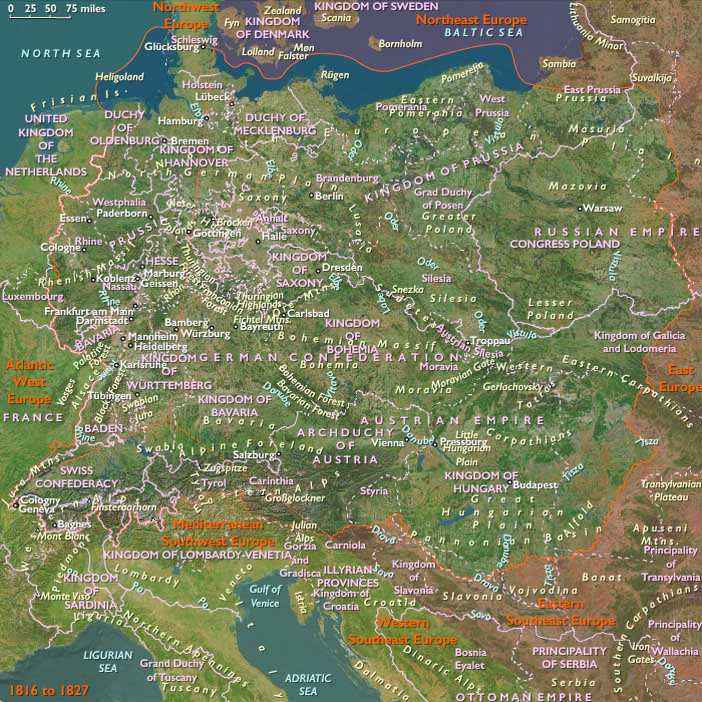
The French occupation (1794–1801) and annexation (1801) of Jülich (French: Juliers) during the French revolutionary wars had separated the two duchies of Jülich and Berg, which since 1614 had both been ruled in personal union by the Wittelsbach dukes of Palatinate-Neuburg.
In 1803 the heir of Palatinate-Neuburg, the Bavarian elector Maximilian Joseph, had separated the remaining Duchy of Berg from his other Bavarian territories and granted it to his cousin William of Palatinate-Zweibrücken-Birkenfeld-Gelnhausen as administrator, whereby it had come under the rule of a junior branch of the Wittelsbachs.
In 1806, in the reorganization of Germany occasioned by the dissolution of the Holy Roman Empire of the German Nation, Maximilian I Joseph, now King of Bavaria, cedes Berg to Napoleon in return for the Principality of Ansbach.
On March 15, 1806 the French Emperor had put Berg under the rule of his brother-in-law Joachim Murat, including territories of the former Prussian Duchy of Cleves east of the Rhine river.
Murat's arms combine the red lion of Berg with the arms of the duchy of Cleves.
The anchor and the batons had come to the party due to Murat's positions as Grand Admiral and as Marshal of the Empire.
As the husband of Napoleon's sister Caroline Bonaparte, Murat also has the right to use the imperial eagle.
On July 12, 1806, Murat joins the Confederation of the Rhine and assumes the title of a grand duke.
His lands are further enlarged by the annexation of the County of Mark, the Prince-Bishopric of Münster, the Imperial city of Dortmund and numerous minor territories of the Lower Rhenish-Westphalian Circle.