Matthias Corvinus
King of Hungary and Croatia; King of Bohemia, Duke of Austria
Years: 1443 - 1490
Matthias Corvinus, also called Matthias I (February 23, 1443 – April 6, 1490), is King of Hungary and Croatia from 1458.
After conducting several military campaigns, he is elected King of Bohemia in 1469 and adopts the title Duke of Austria in 1487.
He is the son of John Hunyadi, Regent of Hungary, who dies in 1456.
In 1457, Matthias is imprisoned along with his older brother, Ladislaus Hunyadi, on the orders of King Ladislaus V of Hungary.
Ladislaus Hunyadi is executed, causing a rebellion that forces King Ladislaus to flee Hungary.
After the King dies unexpectedly, Matthias's uncle Michael Szilágyi persuades the Estates to unanimously proclaim Matthias king on January 24, 1458.
He begins his rule under his uncle's guardianship but takes effective control of government within two weeks.
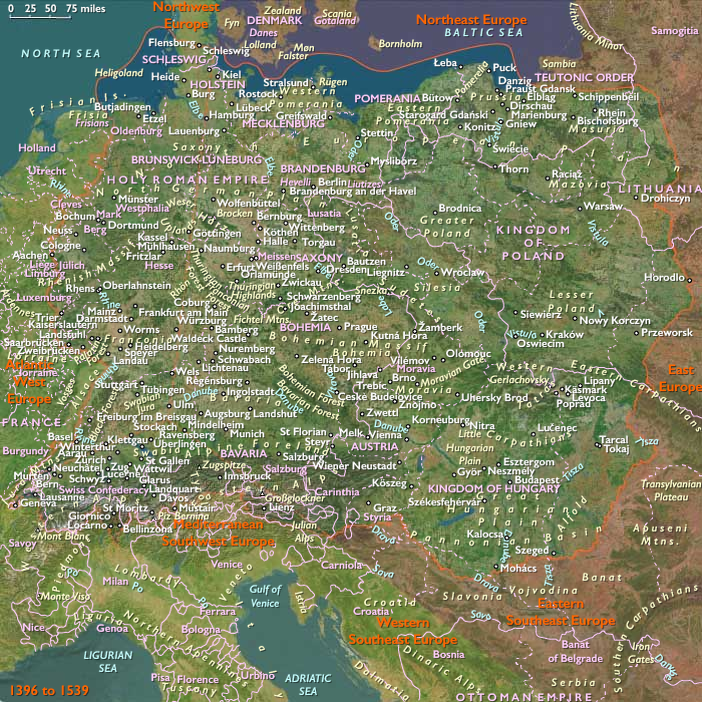
As king, Matthias wages wars against the Czech mercenaries who dominate Upper Hungary (today parts of Slovakia and Northern Hungary) and against Frederick III, Holy Roman Emperor, who claims Hungary for himself.
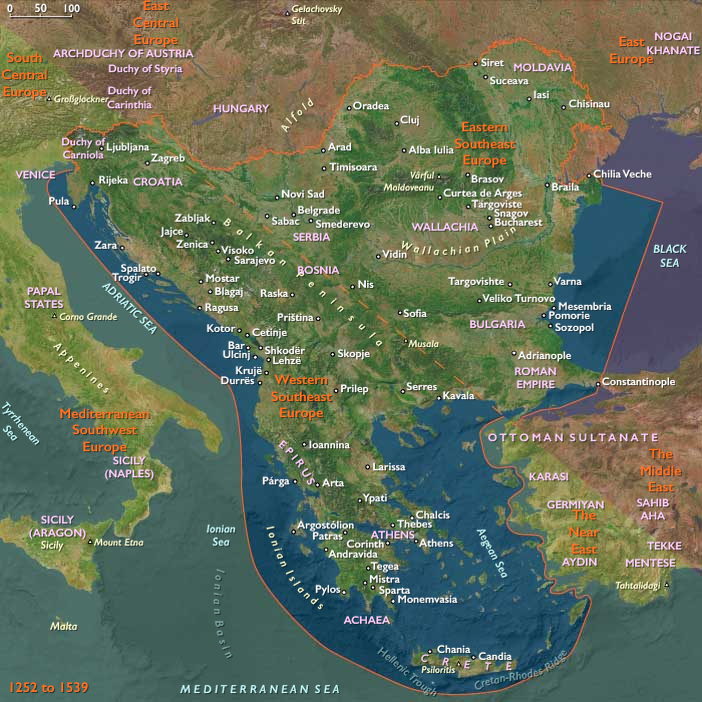
In this period, the Ottoman Empire conquers Serbia and Bosnia, terminating the zone of buffer states along the southern frontiers of the Kingdom of Hungary.
Matthias signs a peace treaty with Frederick III in 1463, acknowledging the Emperor's right to style himself King of Hungary.
The Emperor returns the Holy Crown of Hungary with which Matthias is crowned on April 29, 1464.
In this year, Matthias invades the territories that had recently been occupied by the Ottomans and seizes fortresses in Bosnia.
He soon realizes he can expect no substantial aid from the Christian powers and gives up his anti-Ottoman policy.
Matthias introduces new taxes and regularly collects extraordinary taxes.
These measures caus a rebellion in Transylvania in 1467, but he subdues the rebels.
The next year, Matthias declares war on George of Poděbrady, the Hussite King of Bohemia, and conquers Moravia, Silesia, and Lausitz, but he cannot occupy Bohemia proper.
The Catholic Estates proclaim him King of Bohemia on May 3, 1469, but the Hussite lords refuse to yield to him even after the death of George of Poděbrady in 1471.
Instead, they elect Vladislaus Jagiellon, the eldest son of Casimir IV of Poland.
A group of Hungarian prelates and lords offer the throne to Vladislaus's younger brother Casimir, but Matthias overomes their rebellion.
Having routed the united troops of Casimir IV and Vladislaus at Breslau in Silesia (now Wrocław in Poland) in late 1474, Matthias turns against the Ottomans, who have devastated the eastern parts of Hungary.
He sens reinforcements to Stephen the Great, Prince of Moldavia, enabling Stephen to repel a series of Ottoman invasions in the late 1470s.
In 1476, Matthias besieges and seizes Šabac, an important Ottoman border fort.
He concludes a peace treaty with Vladislaus Jagiellon in 1478, confirming the division of the Lands of the Bohemian Crown between them.
Matthias wages a war against Emperor Frederick and occupies Lower Austria between 1482 and 1487.
Matthias establishes a professional army (the Black Army of Hungary), reforms the administration of justice, reduces the power of the barons, and promotes the careers of talented individuals chosen for their abilities rather than their social status.
Matthias patronizes art and science; his royal library, the Bibliotheca Corviniana, ias one of the largest collections of books in Europe.
With his patronage, Hungary becomes the first country to embrace the Renaissance from Italy.
As Matthias the Just, the monarch who wanders among his subjects in disguise, he remains a popular hero of Hungarian folk tales.