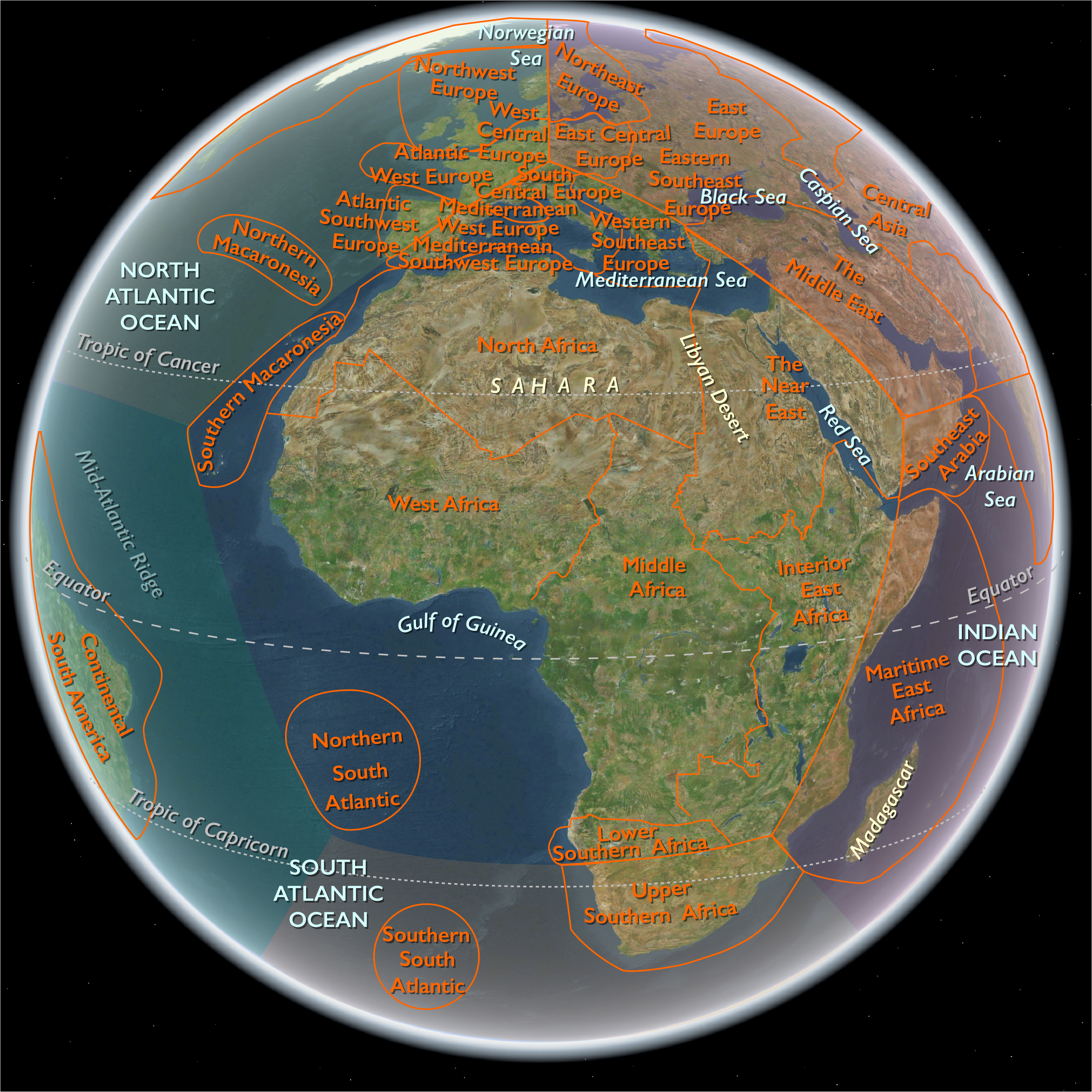
Northwest Europe (1372–1383 CE): Political Realignments and Cultural Vitality
England and France: Escalation of Hostilities
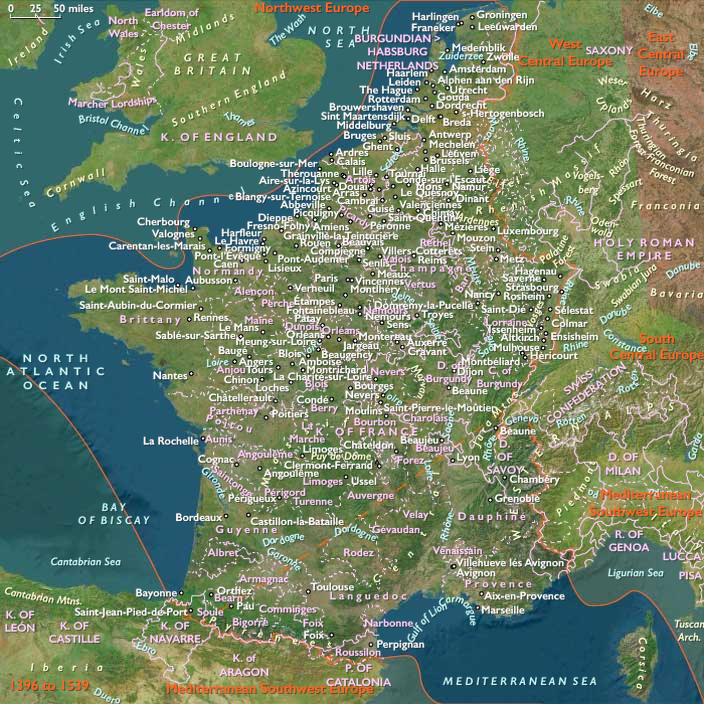
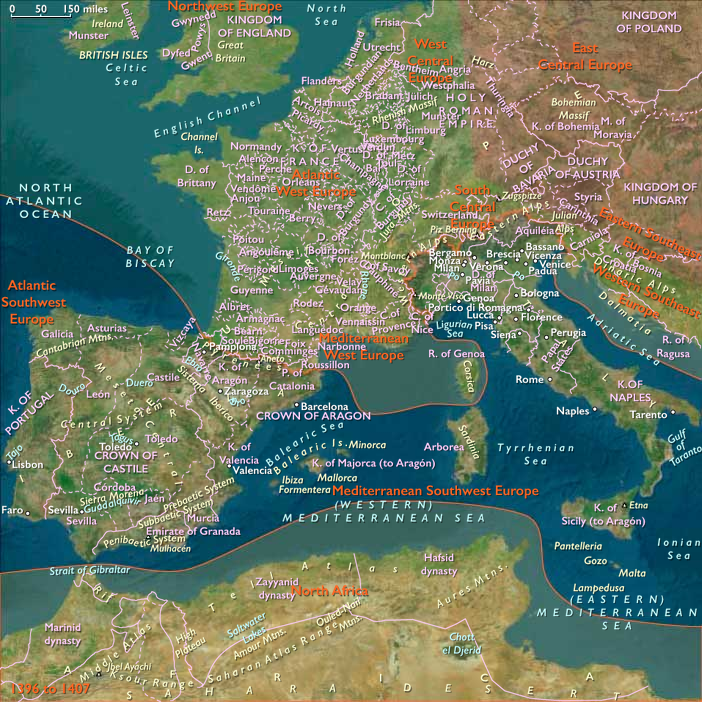
The uneasy peace established by the Treaty of Brétigny broke down completely as hostilities reignited in the Hundred Years' War. By 1372, English territorial gains in France began to diminish as French forces, under the strategic leadership of Charles V, successfully retook key territories such as Poitou and Saintonge. The English faced notable defeats, including the significant naval setback at the Battle of La Rochelle (1372), weakening their continental foothold.
Scotland: Succession and Political Stability
Scotland experienced significant political change with the death of David II in 1371, succeeded by Robert II, marking the beginning of the Stuart Dynasty. Robert II’s ascension brought about increased stability and internal consolidation, as the new royal line worked to strengthen Scottish national identity and resolve longstanding internal rivalries.
Ireland: Continued Gaelic Expansion
In Ireland, Gaelic resurgence intensified, further reducing Norman influence beyond the shrinking confines of the Pale. Indigenous Gaelic dynasties, including the powerful O’Neill and O’Brien clans, solidified their territorial control. This period saw a marked retreat of English rule, with Gaelic law and culture reasserting dominance across much of Ireland.
Denmark: Valdemar IV’s Reign and Territorial Consolidation
Under Valdemar IV Atterdag, Denmark continued to recover economically and politically. Valdemar pursued aggressive territorial expansion, successfully reintegrating lost provinces and significantly strengthening the monarchy. However, his death in 1375 ushered in uncertainty, setting the stage for subsequent succession struggles and political instability.
Norway and Sweden: Fragmentation and Dynastic Struggles
The weakening reign of Magnus IV finally ended in 1374, giving rise to intensified political fragmentation between Norway and Sweden. Internal struggles and succession disputes significantly diminished centralized power, as regional nobles increasingly asserted their independence. Norway particularly began drifting under the influence of Danish monarchy, laying groundwork for later dynastic unions.
Iceland: Continued Cultural Productivity
Despite its political incorporation into Norway, Iceland maintained a vibrant cultural and literary tradition. The ongoing composition and circulation of sagas and poetic works, such as adaptations and expansions of earlier legendary and historical narratives, illustrated Iceland’s continued intellectual and literary vitality, reinforcing its cultural resilience amidst political shifts.
Socio-Economic Transformations Post-Black Death
Northwest Europe continued to grapple with the demographic and economic consequences of the Black Death, as labor scarcity profoundly reshaped rural and urban societies. Peasants increasingly asserted their rights, securing improved conditions and wages, while landholders struggled to adapt to new economic realities, creating tension and occasional unrest.
Religious Movements and Reformist Critiques
Religious fervor intensified, further inspired by socio-economic upheavals. Reformist critiques, exemplified by emerging figures such as John Wycliffe in England, began challenging traditional ecclesiastical structures and advocating for religious and social reforms. These critiques would profoundly influence future religious transformations, notably foreshadowing the later Protestant Reformation.
Architectural and Artistic Developments
Cultural production flourished amid political uncertainty, with significant progress in architectural projects. The expansion of York Minster in the ambitious Perpendicular Gothic style continued, symbolizing resilience and cultural pride. Artistic endeavors, including manuscript illumination and church decoration, underscored an ongoing appreciation for sophisticated artistry and cultural expression.
Geoffrey Chaucer: Literary Maturity
Geoffrey Chaucer continued his literary ascent, producing works that enriched English vernacular literature. His poem “House of Fame,” composed after his diplomatic missions to Italy in 1372–1373, showcases both overt and subtle influences from Dante’s "Divine Comedy" and the works of Petrarch and Boccaccio. In 1374, King Edward III appointed Chaucer controller of customs and subsidies on wool, skins, and hides for the port of London. Chaucer’s diplomatic roles frequently took him abroad, notably to France in 1377 to negotiate the marriage of Princess Marie of France and Prince Richard, the future Richard II. By 1380, he had translated significant philosophical and theological texts, including Boethius's “Consolation of Philosophy”, Pope Innocent III's “On the Misery of the Human Condition,” and “Life of Saint Cecilia” from the “Golden Legend.” Chaucer’s literary contributions significantly developed narrative poetry, drawing from continental influences while fostering distinctly English sensibilities, exemplifying the cultural vibrancy and intellectual curiosity of this era.
Legacy of the Era
By 1383 CE, Northwest Europe experienced significant political realignments, economic shifts, and cultural developments. The era's socio-political uncertainties coexisted with vibrant cultural productivity, setting the stage for enduring transformations in governance, society, religion, and artistic expression in subsequent decades.