Marie Curie
Polish and naturalized-French physicist and chemist
Years: 1867 - 1934
Marie Skłodowska Curie (born Maria Salomea Skłodowska; November 7, 1867 – July 4, 1934) is a Polish and naturalized-French physicist and chemist who conducts pioneering research on radioactivity.
She is the first woman to win a Nobel Prize, is the only woman to win the Nobel prize twice, and is the only person to win the Nobel Prize in two different scientific fields.
She is part of the Curie family legacy of five Nobel Prizes.
She is also the first woman to become a professor at the University of Paris, and in 1995 becomes the first woman to be entombed on her own merits in the Panthéon in Paris.
She is born in Warsaw, in what was then the Kingdom of Poland, part of the Russian Empire.
She studies at Warsaw's clandestine Flying University and begins her practical scientific training in Warsaw.
In 1891, aged twenty-four, she follows her older sister Bronisława to study in Paris, where she earns her higher degrees and conducts her subsequent scientific work.
She shares the 1903 Nobel Prize in Physics with her husband Pierre Curie and physicist Henri Becquerel.
She wins the 1911 Nobel Prize in Chemistry.
Her achievements includes the development of the theory of radioactivity (a term she coins), techniques for isolating radioactive isotopes, and the discovery of two elements, polonium and radium.
Under her direction, the world's first studies are conducted into the treatment of neoplasms using radioactive isotopes.
She founds the Curie Institutes in Paris and in Warsaw, which remain major centers of medical research today.
During the Great War she develops mobile radiography units to provide X-ray services to field hospitals.
While a French citizen, Marie Skłodowska Curie, who uses both surnames, never loses her sense of Polish identity.
She teaches her daughters the Polish language and takes them on visits to Poland.
She names the first chemical element she discovers polonium, after her native country.
Marie Curie dies in 1934, aged sixty-six, at a sanatorium in Sancellemoz (Haute-Savoie), France, of aplastic anemia from exposure to radiation in the course of her scientific research and in the course of her radiological work at field hospitals during the war.
Related Events
Filter results
Showing 8 events out of 8 total
West Europe (1828–1971 CE)
Industrial Democracies, Colonial Decline, and Cultural Renaissance
Geography & Environmental Context
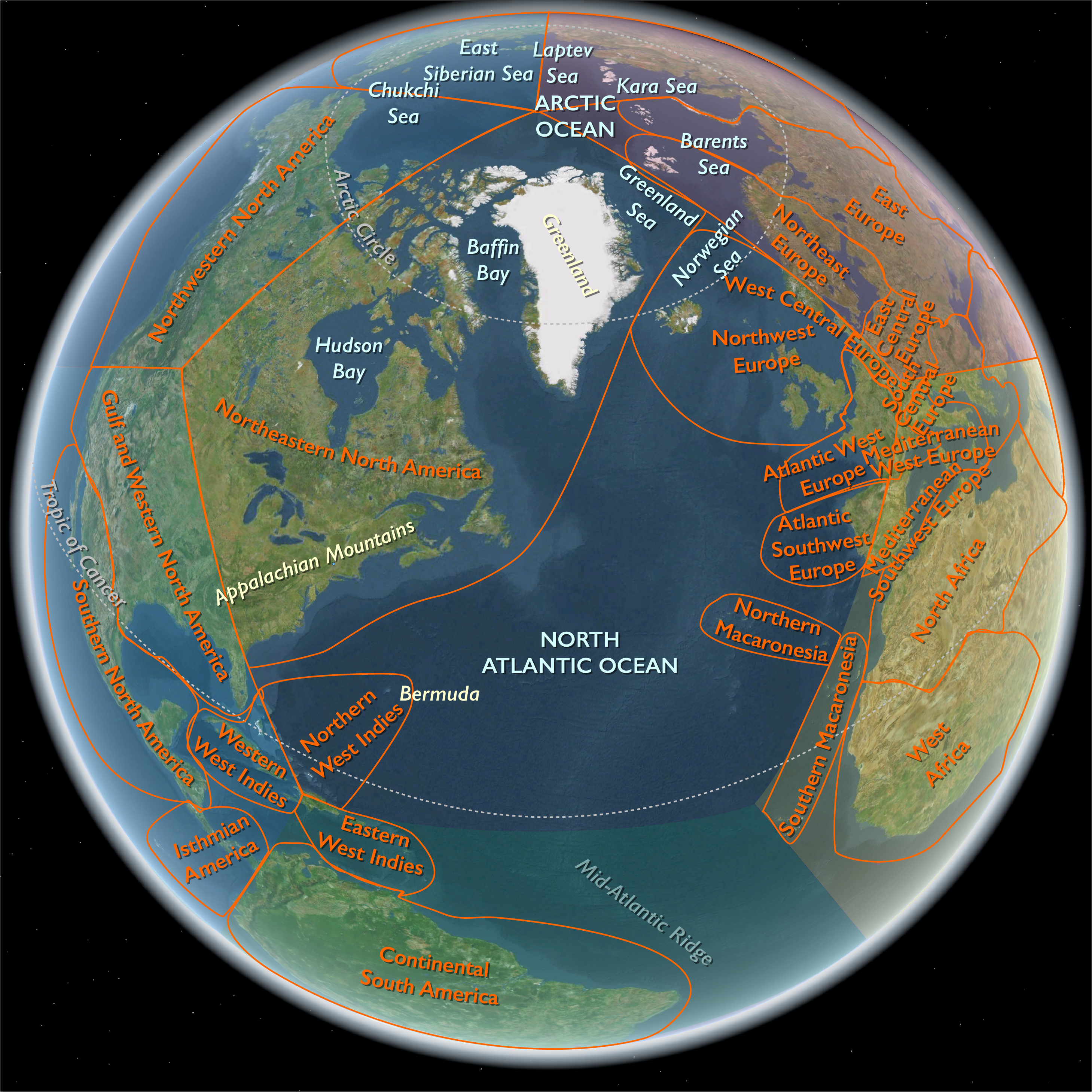
West Europe includes two fixed subregions:
-
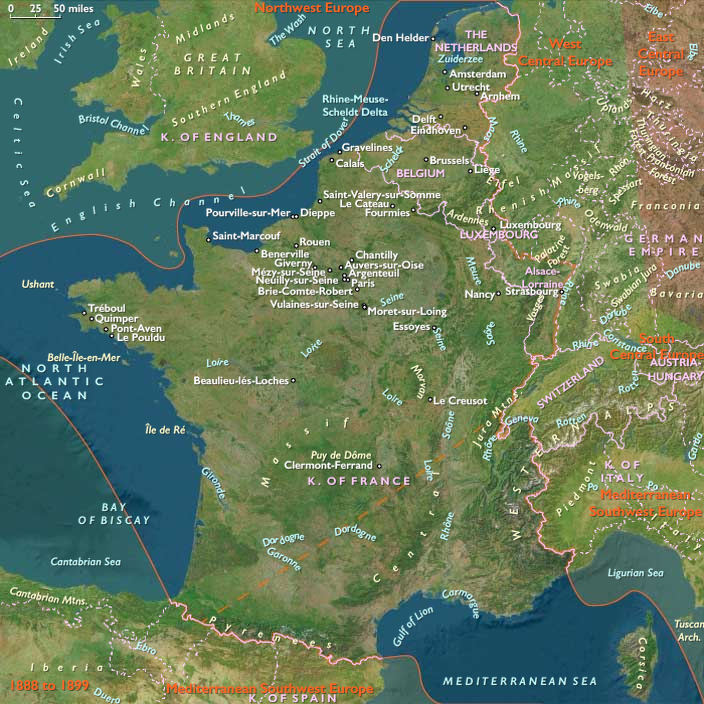
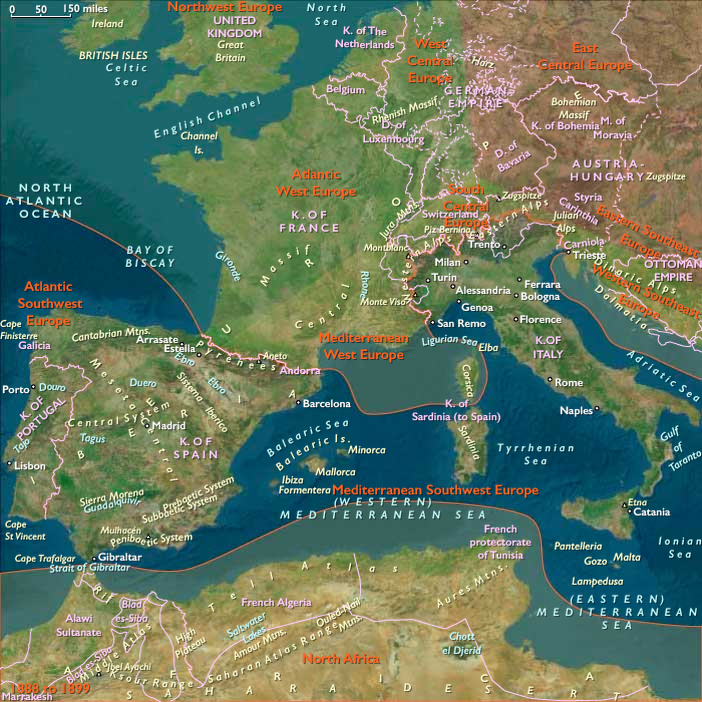
Atlantic West Europe — the Atlantic and English Channel coasts of France, the Loire Valley, Burgundy, northern France (including Paris), and the Low Countries: Belgium, the Netherlands, and Luxembourg.
-
Mediterranean West Europe — southern France, Monaco, and Corsica, including the Rhone Valley, Marseille–Arles–Camargue corridor, and the French Pyrenees.
Anchors include the Seine, Loire, and Rhone River systems, the Pyrenees, and the North Sea and Mediterraneancoasts. Major cities—Paris, Marseille, Lyon, Bordeaux, Brussels, Amsterdam, and Rotterdam—defined the region’s economic and cultural life. Its temperate climate, fertile river basins, and extensive coastlines made it the historical heartland of European trade, innovation, and political revolution.
Climate & Environmental Shifts
The region’s moderate maritime climate supported agriculture and industry. The 19th century saw deforestation replaced by replanting and the emergence of viticulture and dairy farming as staples. Urban coal use caused heavy pollution in industrial basins until cleaner technologies spread mid-20th century. Coastal reclamation in the Netherlands expanded farmland, while the Camargue and Rhone deltas experienced seasonal flooding. Postwar modernization brought hydroelectric dams in the Alps and Pyrenees, and nuclear energy development in France by the 1960s.
Subsistence & Settlement
-
Agriculture modernized through mechanization, fertilizers, and scientific breeding. Northern France and the Low Countries became Europe’s breadbasket; southern France specialized in wine, olives, and fruits.
-
Industrialization: Belgium’s coalfields, northern France’s steel plants, and Dutch shipyards fueled 19th-century economic growth. The Industrial Revolution diffused westward from Britain, reshaping urban centers like Lille, Liège, and Rouen.
-
Urbanization: Paris remained Europe’s artistic and intellectual capital, while Marseille, Lyon, Brussels, and Amsterdam became hubs of trade and manufacturing. After WWII, suburban growth and reconstruction replaced bombed quarters with modern infrastructure.
-
Migration: Rural workers moved to cities, and later, immigrants from southern Europe and North Africa filled industrial labor demands in the 1950s–60s.
Technology & Material Culture
Steam locomotives and canal systems integrated markets by mid-19th century; telegraphs and railways linked Paris to Brussels, Amsterdam, and Marseille. The Eiffel Tower (1889) symbolized technological modernity. The 20th century brought electrification, automobiles (notably Citroën and Renault), aviation, and nuclear engineering. Architecture ranged from Haussmann’s boulevards to Le Corbusier’s modernism. Cafés, cinemas, and department stores became emblematic of urban life.
Movement & Interaction Corridors
-
Maritime networks: Le Havre, Bordeaux, Marseille, Antwerp, and Rotterdam handled global trade linking Europe to Africa, Asia, and the Americas.
-
Rail corridors: Connected industrial zones and capitals; after 1945, highways and airports redefined mobility.
-
Colonial routes: French and Dutch empires tied the region to overseas possessions in Africa and Asia until decolonization after 1945.
-
European integration: The Benelux Customs Union (1944) and founding of the European Economic Community (1957) in Treaty of Rome began the long process of continental unity.
Cultural & Symbolic Expressions
West Europe shaped modern art, philosophy, and politics.
-
Romanticism and Realism: Writers like Victor Hugo, Honoré de Balzac, and Émile Zola portrayed the industrial and moral upheavals of 19th-century France.
-
Impressionism and Modernism: Artists such as Monet, Cézanne, and Picasso (working in France) revolutionized visual art.
-
Music and thought: Composers Debussy and Ravel, philosophers Auguste Comte, Jean-Paul Sartre, and Simone de Beauvoir reflected France’s cultural reach.
-
Cinema and design: The Lumière brothers pioneered film; postwar realism and New Wave directors (Truffaut, Godard) redefined global cinema.
-
Catholicism, Protestantism, and secular republicanism coexisted, with laïcité (secularism) enshrined in French political life after 1905.
Environmental Adaptation & Resilience
Rural electrification and cooperative farming modernized villages. Coastal engineering protected the Netherlands from floods (Delta Works, initiated 1953). Postwar housing programs rebuilt cities, while reforestation and pollution controls revived industrial landscapes. Agricultural cooperatives and Common Market policies (from 1957) stabilized food supply and prices.
Political & Military Shocks
-
Revolutions and nationhood: The Revolution of 1830 and 1848 uprisings shaped French republicanism.
-
Franco-Prussian War (1870–71): Led to the fall of the Second Empire and the Third Republic.
-
World War I (1914–18): Northern France and Belgium became the Western Front’s main battlefield; millions died amid trench warfare.
-
Interwar instability: Economic crises and political polarization set the stage for World War II (1939–45), during which France was occupied and Belgium and the Netherlands invaded.
-
Liberation and reconstruction: Allied landings (1944) restored independence; the Marshall Plan (1948) fueled recovery.
-
Decolonization: The loss of Indochina (1954) and Algeria (1962) ended France’s empire; Dutch withdrawal from Indonesia (1949) reshaped global relations.
-
Cold War politics: France pursued independent nuclear policy under Charles de Gaulle; the Low Countries aligned with NATO and European integration.
Transition
Between 1828 and 1971, West Europe transitioned from monarchies and empires to democratic, industrial, and globally connected states. Revolution and war shaped political identity, while artistic innovation and social movements redefined culture. The devastation of two world wars gave way to reconstruction and unity through European institutions. From the factories of Liège and the vineyards of Provence to the docks of Marseille and the canals of Amsterdam, the region blended tradition and modernity, anchoring the cultural and economic core of postwar Western Europe.
Atlantic West Europe (1828–1971 CE)
Industrial Ports, Wars of Empire, and European Integration
Geography & Environmental Context
Atlantic West Europe includes the Atlantic and English Channel coasts of France as well as the Loire Valley, Burgundy, northern France (including Paris), and the Low Countries: Belgium, the Netherlands, and Luxembourg. Anchors include the Seine, Loire, Somme, Scheldt, Meuse, and Rhine–Meuse–Scheldt delta, the Paris Basin, the Loire vineyards, and the Dutch–Flemish polders. The region combines fertile lowlands, coastal estuaries, and riverine arteries that fed both agriculture and industrialization.
Climate & Environmental Shifts
A temperate oceanic climate prevailed. Floods along the Scheldt and Rhine–Meuse delta periodically tested Dutch and Belgian dikes; the North Sea flood of 1953 devastated the Netherlands, accelerating modern flood-control systems like the Delta Works. Wine regions (Loire, Burgundy) endured variable vintages, with phylloxera in the late 19th century destroying vineyards before recovery through grafting. Industrial coalfields in Belgium (Sillon industriel) and northern France polluted air and water, but postwar recovery programs and environmental reforms after the 1960s began to restore ecosystems.
Subsistence & Settlement
-
19th century agriculture: Wheat, rye, and sugar beet dominated the Paris Basin; vineyards thrived in Burgundy and the Loire; dairying spread in Flanders and the Netherlands.
-
Urbanization: Paris, Brussels, Antwerp, Amsterdam, Rotterdam, and Luxembourg grew as industrial and financial hubs. Coastal ports like Le Havre, Nantes, and Bordeaux tied agriculture and manufacturing to Atlantic trade.
-
Industrial regions: Belgian coal and steel, French textile towns (Roubaix, Lille), and Dutch shipping expanded dramatically after 1850.
-
20th century shifts: By mid-century, agriculture mechanized, while cities rebuilt after war. Rotterdam emerged as one of the world’s largest ports; Paris modernized with Haussmann boulevards, then postwar suburbs.
Technology & Material Culture
-
Transport: Railways spread in the 19th century; canals modernized; Paris and Brussels became railway hubs. In the 20th century, motorways and airports (Orly, Schiphol, Zaventem) extended reach.
-
Industry: Coal mining, metallurgy, and textiles dominated in the 19th century. After WWII, new industries—chemicals, automobiles, oil refining—emerged, tied to the Rhine–Scheldt delta.
-
Everyday life: Urban apartments filled with industrial textiles, ceramics, and later radios, televisions, and consumer goods by the 1950s–60s. Café culture, fashion (Paris haute couture), and newspapers flourished.
-
Architecture: Neo-classical Paris, Art Nouveau Brussels, and modernist rebuilding after WWII in Le Havre, Rotterdam, and Antwerp.
Movement & Interaction Corridors
-
Maritime trade: Rotterdam, Antwerp, and Le Havre handled coal, grain, and later oil, feeding Europe’s industrial and consumer economy.
-
Riverine corridors: Seine, Scheldt, Meuse, and Rhine–Meuse–Scheldt systems tied inland regions to Atlantic ports.
-
Colonial links: French ports (Nantes, Bordeaux, Le Havre, Marseille) and Belgian Antwerp linked Europe to Africa and Asia until decolonization after WWII.
-
Wars & occupation: Rail and river corridors were militarized during the Franco-Prussian War (1870–71), World War I (1914–18), and World War II (1940–45). German occupations devastated Belgium, Luxembourg, and northern France.
-
Postwar integration: The Benelux union (1944), the European Coal and Steel Community (1951), and the EEC (1957) tied Atlantic West Europe into continental recovery and cooperation.
Cultural & Symbolic Expressions
-
Paris: Capital of Romanticism, Impressionism, and modernism; intellectual center from Hugo and Zola to Sartre and de Beauvoir.
-
Belgium & Netherlands: Art Nouveau (Horta, van de Velde), Dutch modernist design, and Flemish Catholic festivals; strong socialist and labor movement traditions.
-
Luxembourg: Catholic and liberal traditions coexisted; financial and legal institutions grew.
-
Everyday identity: Pilgrimages (Lourdes), parish festivals, and urban cafés shaped cultural life. Football clubs, cinemas, and postwar television became mass cultural anchors.
Environmental Adaptation & Resilience
-
Agricultural reform: Mechanization, fertilizers, and crop diversification reduced famine risk.
-
Flood defenses: Dutch polders and Belgian levees were reinforced repeatedly, culminating in the Delta Works (1950s–70s).
-
Urban resilience: Rebuilding of Rotterdam, Le Havre, Antwerp, and northern French towns after WWII modernized infrastructure.
-
Social welfare: Postwar welfare states in France, Belgium, Luxembourg, and the Netherlands improved resilience against poverty, unemployment, and health crises.
Political & Military Shocks
-
Revolutions of 1830: Belgium gained independence; Paris staged the July Revolution.
-
1848 Revolutions: Paris uprisings echoed through the region.
-
Franco-Prussian War (1870–71): Loss of Alsace-Lorraine, siege of Paris.
-
World War I: Western Front scarred northern France, Belgium, and Luxembourg.
-
World War II: German blitzkrieg (1940) swept across France and the Low Countries; occupation, resistance, and liberation (1944–45) reshaped the region.
-
Post-1945: Recovery under the Marshall Plan; founding members of European integration; NATO bases tied Atlantic West Europe to the Cold War order.
Transition
Between 1828 and 1971, Atlantic West Europe moved from agrarian economies to a fully industrial and urbanized core of Europe. Paris remained its cultural capital; Belgium and Luxembourg its industrial corridor; the Netherlands its maritime giant. The scars of two world wars gave way to reconstruction and integration, with Atlantic ports and river basins anchoring one of the world’s most productive and interconnected regions. By 1971, Atlantic West Europe stood as a symbol of both the devastation of modern warfare and the promise of European cooperation, prosperity, and global connectivity.
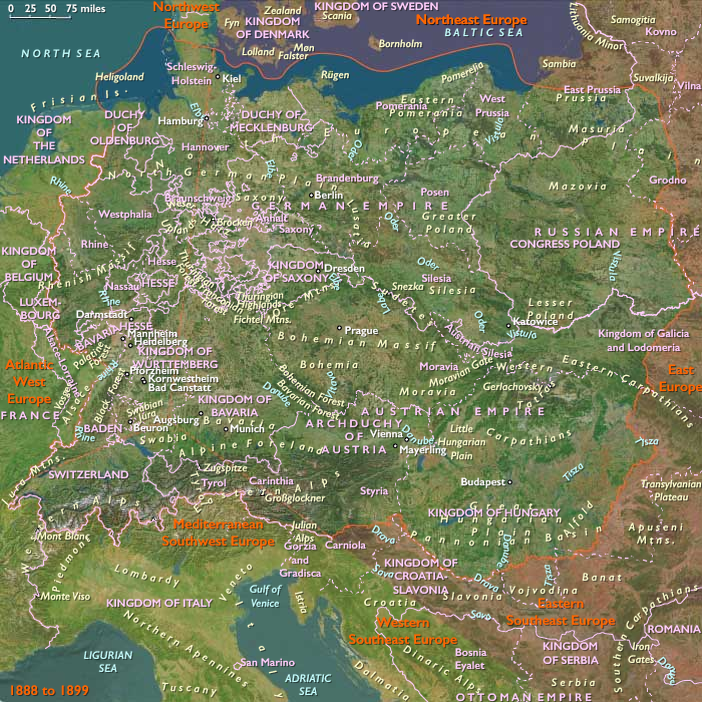
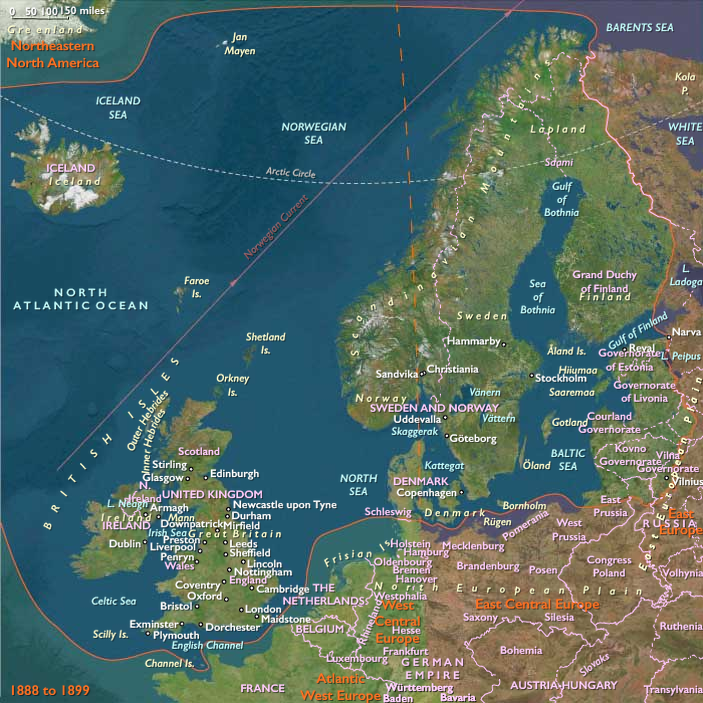
Atlantic West Europe (1888–1899): Industrial Peak, Social Reform, and Cultural Shifts
From 1888 to 1899, Atlantic West Europe—encompassing northern France, Belgium, the Netherlands, Luxembourg, and regions along the Atlantic and English Channel coasts—experienced continued industrial growth, deepening colonial engagements, significant social reforms, and dynamic cultural shifts. This era was marked by the heightening of class tensions, major advances in science and technology, intensified colonial rivalries, and profound cultural innovation at the turn of the century.
Political and Military Developments
Stability and Dreyfus Affair in France
-
France’s Third Republic enjoyed relative stability under presidents Sadi Carnot (1887–1894) and Félix Faure(1895–1899), but internal divisions intensified dramatically with the Dreyfus Affair (1894–1899), which polarized French society, exacerbating political and social tensions between republicans, conservatives, and anti-Semitic factions.
Belgian Colonial Consolidation
-
Under King Leopold II, Belgium intensified its exploitation of the Congo Free State, extracting vast resources (rubber, ivory, minerals) through brutal forced labor, leading to international criticism and humanitarian condemnation by the decade’s end.
-
Domestically, Belgium maintained parliamentary stability, balancing liberal reforms with conservative interests amid growing demands for social change.
Continued Parliamentary Stability in the Netherlands and Luxembourg
-
The Netherlands, under Queen Wilhelmina (from 1890), sustained political stability, with progressive social reforms gradually addressing labor conditions and expanding democratic participation.
-
Luxembourg remained politically tranquil and economically prosperous, leveraging its strategic neutrality and banking sector to strengthen its economy.
Economic Developments: Industrial Peak and Technological Innovation
Industrial Dominance and Technological Progress
-
Northern France solidified its industrial leadership, particularly in textiles, coal, and metallurgy. Cities like Lille, Roubaix, and Dunkirk expanded significantly, driven by advances in steel manufacturing and chemical industries.
-
Belgium’s coalfields in Wallonia, steel industries in Liège, and expanding infrastructure sustained rapid industrial growth, despite underlying social inequalities and labor tensions.
Expansion of Maritime Commerce
-
The ports of Antwerp, Rotterdam, Amsterdam, Dunkirk, and Le Havre flourished, dramatically expanding trade capacity. Rotterdam's harbor expansion notably established it as Europe's most significant maritime trade hub by the century's end.
-
Maritime infrastructure improvements facilitated growing international trade, reinforcing Atlantic West Europe's economic integration within global markets.
Technological Innovations and Infrastructure
-
Significant advancements in electricity, telecommunications, railways, and manufacturing technology boosted productivity. The Netherlands and Belgium notably pioneered electrical infrastructure projects, lighting urban centers and powering industrial expansion.
-
Rapid railroad expansion facilitated internal trade, labor mobility, and urbanization across the region.
Social Developments: Rising Labor Movements and Social Legislation
Labor Unrest and Socialist Advocacy
-
Industrial workers in France and Belgium increasingly mobilized, demanding better working conditions, higher wages, and political rights. Significant strikes, notably the Belgian general strikes (1886, 1893), pressured governments into granting incremental reforms.
-
Socialist parties in France (POF, led by Jules Guesde and Jean Jaurès), Belgium (Belgian Workers’ Party, founded in 1885), and the Netherlands gained political influence, pushing progressive agendas in national parliaments.
Expansion of Social Legislation
-
Influenced by persistent labor unrest and socialist advocacy, Belgium and the Netherlands introduced significant social legislation: improved factory safety laws, reduced working hours, and early social insurance schemes for accidents and illness.
Women’s Rights Movements
-
Growing feminist activism emerged prominently in France, Belgium, and the Netherlands, advocating women's suffrage, education reform, and greater economic independence. Notable figures such as Hubertine Auclert (France) actively promoted women’s rights, laying foundations for later suffrage successes.
Cultural and Intellectual Developments
Artistic Movements: Post-Impressionism and Symbolism
-
The artistic scene transitioned from Impressionism to Post-Impressionism and Symbolism, profoundly reshaping European visual culture. Artists like Vincent van Gogh, active in France and the Netherlands during this decade, and Paul Gauguin transformed painting, exploring emotional depth, bold colors, and symbolic imagery.
-
Belgium became a center of Symbolist art, particularly through artists like Fernand Khnopff and James Ensor, who captured modern anxieties and mystical themes.
Literary and Philosophical Innovations
-
Literary movements reflected deeper psychological introspection and social critique. In France, writers such as Émile Zola and Guy de Maupassant produced works that vividly portrayed contemporary social realities, while Symbolist poets like Stéphane Mallarmé and Paul Verlaine explored new literary aesthetics and emotional expression.
Advances in Science and Technology
-
Scientific advancements flourished, notably the discoveries of Henri Becquerel in radioactivity (1896), followed by research from Marie and Pierre Curie, fundamentally reshaping physics and chemistry.
-
Technological breakthroughs in electricity, communications (telephone and telegraph networks), and early automotive engineering positioned Atlantic West Europe at the forefront of innovation.
Religious and Educational Developments
Secularization and Church-State Conflicts
-
Secularization deepened, particularly in France, where ongoing struggles between the Catholic Church and secular republicans intensified with the Dreyfus Affair, fueling political polarization and reinforcing secular education and civil institutions.
Education and Literacy Expansion
-
France, Belgium, and the Netherlands continued investing in universal primary education, significantly increasing literacy rates, promoting social mobility, and stimulating vibrant intellectual discourse.
Urbanization and Social Dynamics
Rapid Urbanization and Infrastructure
-
Major cities such as Paris, Brussels, Antwerp, Amsterdam, and Rotterdam rapidly expanded infrastructure, including transportation networks (tramways, railways), sanitation systems, and public services, reflecting significant municipal investment in urban planning and public health.
Persistent Social Inequalities
-
Despite economic prosperity, stark inequalities persisted. Wealth concentrated among industrialists, merchants, and financial elites contrasted sharply with urban working-class poverty, fueling continued social activism and political tension.
Long-Term Consequences and Historical Significance
The period 1888–1899 represented a crucial phase in Atlantic West Europe’s transition to modernity:
-
Politically, the Dreyfus Affair highlighted profound ideological and social divisions, foreshadowing future political and social conflicts within France.
-
Economically, the region reached a peak in industrial and maritime expansion, integrating deeply into global trade networks, while technological innovation laid groundwork for 20th-century modernity.
-
Socially, the growth of labor, socialist, and women’s movements fostered incremental social reforms, setting important precedents for the welfare states of the 20th century.
-
Culturally, artistic and literary innovation significantly influenced European aesthetics, ushering in modernist sensibilities, while scientific discoveries established new paradigms in global thought.
By 1899, Atlantic West Europe stood as a culturally dynamic, economically prosperous, yet socially divided region—poised on the threshold of dramatic social, political, and technological transformations that would characterize the tumultuous early decades of the 20th century.
Henri Becquerel, a French physicist, discovers radioactivity in 1896.
In Becquerel's early career, he became the third in his family to occupy the physics chair at the Muséum National d'Histoire Naturelle in 1892.
Later on in 1894, Becquerel became chief engineer in the Department of Bridges and Highways before he started with his early experiments.
Becquerel's earliest works centered on the subject of his doctoral thesis: the plane polarization of light, with the phenomenon of phosphorescence and absorption of light by crystals.
Early in his career, Becquerel also studied the Earth's magnetic fields.
Becquerel's discovery of spontaneous radioactivity is a famous example of serendipity, of how chance favors the prepared mind.
Becquerel had long been interested in phosphorescence, the emission of light of one color following a body's exposure to light of another color.
In early 1896, there had been a wave of excitement following Wilhelm Conrad Röntgen's discovery of X-rays on January 5.
Learning of Röntgen's discovery from earlier that year during a meeting of the French Academy of Sciences had caused Becquerel to be interested, and he soon "began looking for a connection between the phosphorescence he had already been investigating and the newly discovered x-rays" of Röntgen, and thought that phosphorescent materials, such as some uranium salts, might emit penetrating X-ray-like radiation when illuminated by bright sunlight.
By May 1896, after other experiments involving non-phosphorescent uranium salts, he arrived at the correct explanation, namely that the penetrating radiation comes from the uranium itself, without any need for excitation by an external energy source.
There follows a period of intense research into radioactivity, including the determination that the element thorium is also radioactive and the discovery of additional radioactive elements polonium and radium by Marie Skłodowska-Curie and her husband Pierre Curie.
The intensive research of radioactivity leads to Becquerel publishing seven papers on the subject in 1896.
His other experiments allow him to research more into radioactivity and figure out different aspects of the magnetic field when radiation is introduced into the magnetic field.
The French chemists, carrying out radiochemical analysis on a ton of pitchblende, a uranium ore from Joachimsthal, Bohemia, ascribe to a new element the very intense radioactivity not attributable to uranium.
Mme. Curie names the new element, the discovery of which is announced in July 1898, polonium for her native Poland.
It is the first element to be discovered by radiochemical analysis.
The Curies, and an assistant, G. Bélmont, discover radium in 1898 in the pitchblende, given them by Austria after the uranium salts have been removed for use in glass manufacture.
They have earlier found polonium in a similar sample.
Mme. Curie has earlier observed that the radioactivity of pitchblende is four or five times greater than that of the uranium it contains and not fully explained by the presence of radioactive polonium.
The new substance, powerfully radioactive, follows the behavior of barium, but because its chloride is slightly more insoluble, it can be concentrated by fractional crystallization.
Gerhard Carl Schmidt and, independently, Marie Curie, find the radioactivity of thorium in 1898.
André-Louis Debierne discovers actinium in 1899 in pitchblende residues left after Pierre and Marie Curie have extracted the radium.
Atlantic West Europe (1900–1911): Belle Époque, Social Reform, and Rising Tensions
Between 1900 and 1911, Atlantic West Europe—encompassing northern France, Belgium, the Netherlands, Luxembourg, and coastal regions along the Atlantic and English Channel—experienced an era of remarkable cultural vibrancy, significant social reforms, rapid technological advancement, and intensifying political tensions. The period, often referred to as the Belle Époque, was characterized by optimism and prosperity, juxtaposed with deepening divisions that foreshadowed the upheavals soon to come.
Political and Military Developments
Stability and Polarization in France
-
France maintained relative political stability under the Third Republic, with presidents Émile Loubet (1899–1906) and Armand Fallières (1906–1913), but the lingering divisions from the Dreyfus Affair continued to polarize public opinion.
-
The formation of the socialist SFIO (Section Française de l'Internationale Ouvrière) in 1905, led by Jean Jaurès, signaled the increasing influence of socialist politics in France.
Belgium: Social Reform and Colonial Criticism
-
Belgium, under King Leopold II (until 1909), faced intensified international condemnation for atrocities in the Congo Free State, leading to its transfer to Belgian parliamentary control in 1908, becoming the Belgian Congo.
-
Belgium enacted progressive social reforms, including the introduction of proportional representation (1899) and growing support for workers’ rights and universal suffrage demands.
Stable Constitutional Monarchy in the Netherlands
-
The Netherlands, under Queen Wilhelmina, experienced political stability and gradual democratic reforms. Social legislation improved labor conditions, pensions, and insurance systems.
-
The Dutch parliament maintained neutrality and balanced relations among European powers, bolstering economic prosperity.
Luxembourg: Economic Prosperity and Neutrality
-
Luxembourg enjoyed continued economic stability, benefiting from its position as a neutral state and banking center, maintaining steady growth and avoiding political upheaval.
Economic and Technological Developments
Industrial Expansion and Technological Innovation
-
Northern France’s heavy industries, especially in metallurgy, coal mining, and textiles, continued thriving. Major industrial cities such as Lille, Roubaix, Tourcoing, and Dunkirk expanded, supported by technological advancements in manufacturing processes.
-
Belgium's industrial sectors, particularly steel and chemicals in Wallonia, and textile and maritime trade in Flanders (Antwerp, Ghent), flourished, contributing significantly to economic growth.
Maritime and Commercial Growth
-
Rotterdam and Antwerp further solidified their positions as major global ports. Rotterdam expanded its harbor and infrastructure, becoming one of the largest ports worldwide by the decade's end.
-
Maritime trade connected the region deeply with global markets, enhancing economic prosperity and fostering cultural exchanges.
Advances in Infrastructure and Transportation
-
Rail networks and electrified tramways greatly improved connectivity, facilitating regional trade and mobility. Belgium and the Netherlands extensively developed their transportation infrastructure, strengthening urban economies.
Social Developments: Labor Movements and Reforms
Rise of Organized Labor and Socialist Movements
-
Socialist parties and labor unions significantly strengthened their political influence across France, Belgium, and the Netherlands. Notably, Belgium’s Belgian Workers’ Party (POB/BWP), and the French SFIO, pushed for extensive labor reforms, improved working conditions, and broader suffrage rights.
-
Labor unrest, exemplified by major strikes such as the French miners' strikes (1902, 1906), underscored continuing social tensions and compelled governments to implement meaningful reforms.
Expansion of Social Legislation
-
Belgium and the Netherlands pioneered important social legislation: improved workers’ protections, reduction of working hours, establishment of pension systems, and early welfare state policies.
-
France introduced labor laws improving conditions and safety in factories, though progress on social welfare lagged compared to its neighbors.
Women’s Rights Movements
-
Feminist activism surged, particularly in France and the Netherlands, where movements for women’s suffrage, educational opportunities, and legal equality gained momentum. Notable figures like Aletta Jacobs (Netherlands) led campaigns for women's suffrage and social reform.
Cultural and Intellectual Developments: Belle Époque Flourishing
Artistic Innovation and Modernism
-
The period witnessed an explosion of artistic innovation. Paris solidified its reputation as Europe's cultural capital, with artists such as Henri Matisse, Pablo Picasso, and Georges Braque developing revolutionary new styles—Fauvism and early Cubism.
-
Belgium's artistic movements flourished, especially through Art Nouveau architecture and design exemplified by architects Victor Horta and Henry van de Velde, whose distinctive buildings transformed urban aesthetics.
Literary and Intellectual Vibrancy
-
French literary life was enriched by figures such as Marcel Proust, whose introspective modernist writings would redefine narrative forms. Symbolist and modernist literature flourished throughout the Low Countries as well.
-
The intellectual climate was marked by optimism about progress and a belief in rationality, reflected in widespread engagement with scientific and philosophical discussions.
Advances in Science and Technology
-
Atlantic West Europe remained a center of groundbreaking scientific research. The discoveries of Marie Curie (awarded Nobel Prizes in 1903 and 1911), alongside rapid innovations in transportation technology (early automobiles and aircraft), positioned the region at the forefront of global innovation.
Religious and Educational Developments
Secularization and Educational Reform
-
Secularization advanced significantly in France with the 1905 law establishing the separation of Church and State, reinforcing secular republicanism in public life and education.
-
Educational systems in Belgium, France, and the Netherlands continued expanding, emphasizing universal primary education, scientific curricula, and vocational training, thus increasing literacy and social mobility.
Urbanization and Social Change
Urban Growth and Infrastructure Development
-
Urban centers like Paris, Brussels, Antwerp, Rotterdam, and Amsterdam expanded rapidly, improving public amenities (water supply, sanitation, public parks), transportation networks, and infrastructure, facilitating vibrant urban life and social interaction.
-
The rise of consumer culture, leisure activities (cafés, theaters, sports), and improved urban living standards defined the Belle Époque experience for many urban dwellers.
Persistent Social Inequalities
-
Despite overall prosperity, stark disparities persisted, particularly in industrial regions and among urban working classes. Conditions in coal mining and textile industries remained challenging, fueling labor unrest and socialist activism.
Long-Term Consequences and Historical Significance
The period 1900–1911 profoundly shaped Atlantic West Europe, blending optimism, cultural dynamism, and prosperity with underlying tensions:
-
Politically, the era saw deepening divisions and the rise of organized socialism, foreshadowing future political conflicts and ideological battles.
-
Economically, industrial prosperity and technological advancements laid a foundation for future economic strength, while unresolved social inequalities set the stage for future labor activism and reform movements.
-
Socially, advancements in labor rights, social welfare, and women’s rights movements made significant progress, shaping future societal developments.
-
Culturally, the artistic and intellectual vibrancy of the Belle Époque profoundly influenced global modernist movements, leaving a lasting legacy on Western art and culture.
By 1911, Atlantic West Europe had become a region of extraordinary cultural achievements and economic strength, yet tensions beneath the surface hinted at the dramatic upheavals soon to come, notably the devastating conflict of World War I.
F. W. Taylor and P. White present the first molybdenum-based high-speed steels at the Exposition Universelle in Paris in 1900.
Simultaneous with the presentation by the two American engineers, chemists Marie Curie in France and J. A. Mathews in the United States use molybdenum to prepare permanent magnets.
Tungsten is brought to public attention in 1900 by the Bethlehem Steel Company with its tungsten-containing high-speed tool steel products at the Exposition.