Manuel I of Portugal
King of Portugal and the Algarves
Years: 1469 - 1521
Manuel I (May 31, 1469 – December 13, 1521), the Fortunate (Port.
o Afortunado), King of Portugal and the Algarves, is the son of Infante Ferdinand, Duke of Viseu (1433–70) by his wife, Infanta Beatrice of Portugal.
His name is associated with a period of Portuguese civilization distinguished by significant achievements both in political affairs and the arts.
In spite of its small size and population in comparison to the great land powers of Europe, it is able to acquire an overseas empire of vast proportions and with a global dimension, for the first time in history, during Manuel's reign.
Related Events
Filter results
Showing 10 events out of 230 total
The Portuguese continue after the death of Prince Henry to explore the coast of Africa, but without their earlier singleness of purpose.
A dispute has arisen among the military aristocracy over whether Portugal can best achieve its strategic objectives by conquering Morocco or by seeking a sea route to India.
Duarte had continued his father's Moroccan policy and had undertaken a military campaign against Tangiers but was unsuccessful. Afonso V orders several expeditionary forces to Morocco.
In 1458 he conquers Alcazarquivir; in 1471 he takes Arzila, followed by Tangiers and Larache.
Afonso's successors continue this policy of expansion in Morocco, especially Manuel I (r. 1495-1521), who conqueras Safim and Azamor.
The Moroccan empire is expensive because it keeps Portugal in a constant state of war; therefore, it is abandoned by João III (r. 1521-57), except for Ceuta and Tangiers.
The growth of Portuguese interests in the Americas is slow, the king being absorbed with establishing Portuguese hegemony in Asia.
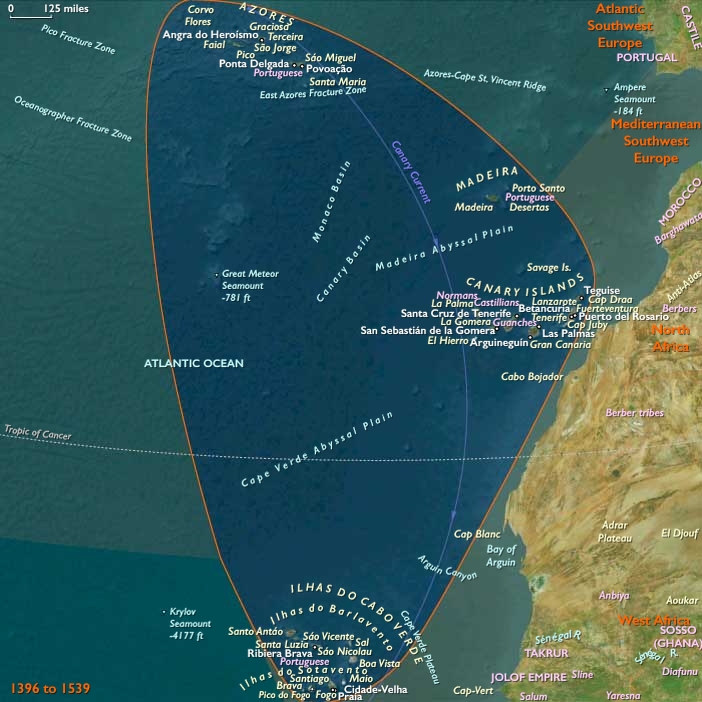
In addition, the Treaty of Tordesillas of 1494, arranged by Pope Alexander VI, had divided the unexplored world between Spain and Portugal and forbids Portugal from exploring beyond a meridian drawn three hundred and seventy leagues (2,193 kilometers, 1,362 statute miles, or 1,184 nautical miles) west of the Cape Verde Islands.
In 1502 Fernão de Loronha is given a three-year commercial monopoly on dyewood in return for exploring three hundred leagues (about fifteen hundred kilometers) of the Brazilian coast each year.
During the last years of Manuel I's reign, the first colonists are sent to Brazil to establish a sugar industry.
Additional colonists are sent during the reign of Joao III, and, in 1530, Martim Afonso de Sousa is named major captain of Brazil and invested with the power to distribute land among captains or donatários, much as had been done in Madeira when it was colonized a century before.
These captaincies are large strips of land that extend from the coast into the interior.
The captains settle colonists in their respective captaincies and are required to provide them protection and justice.
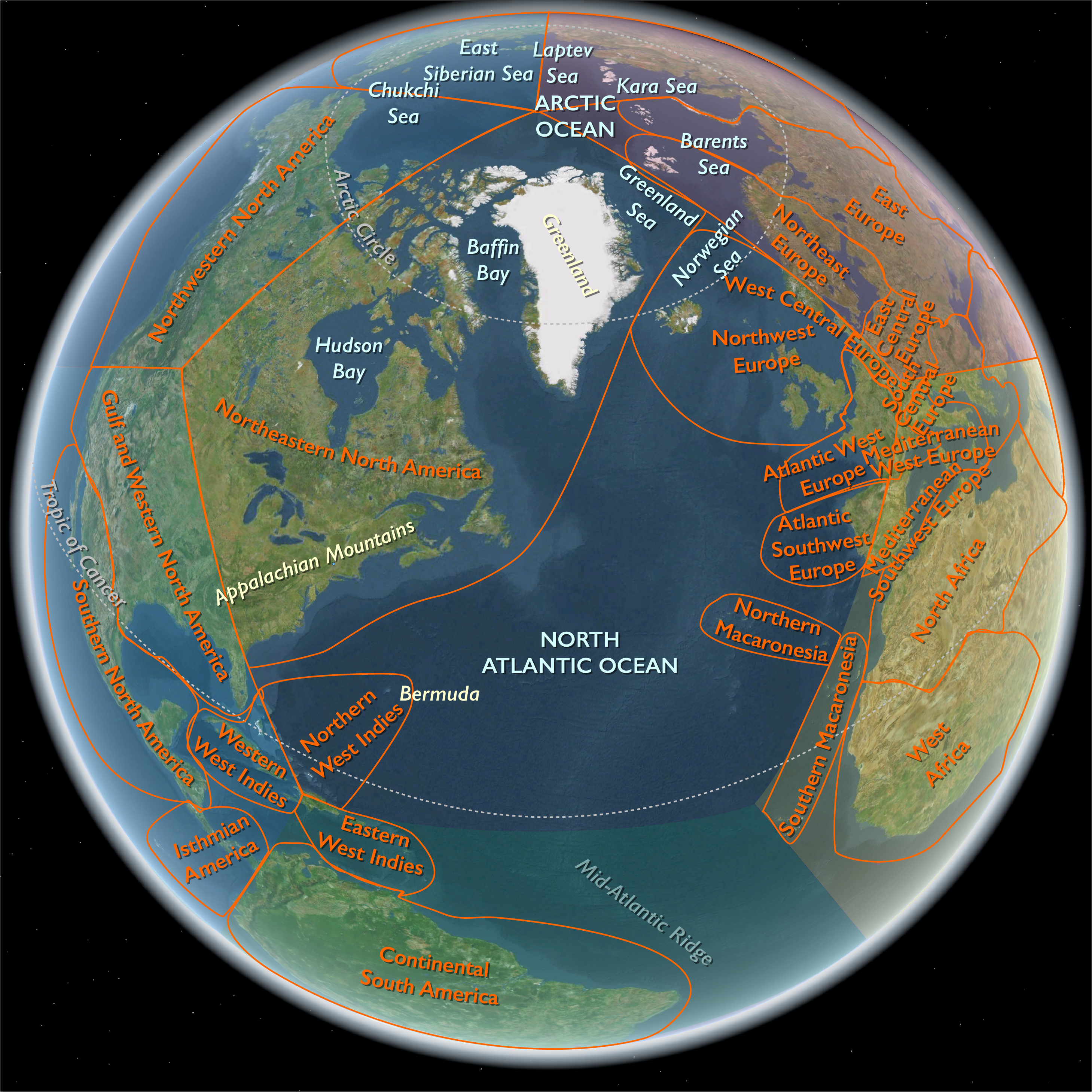
Atlantic Southwest Europe (1396–1539 CE): Estuaries, Shipyards, and the First Oceanic Empires
Geographic & Environmental Context
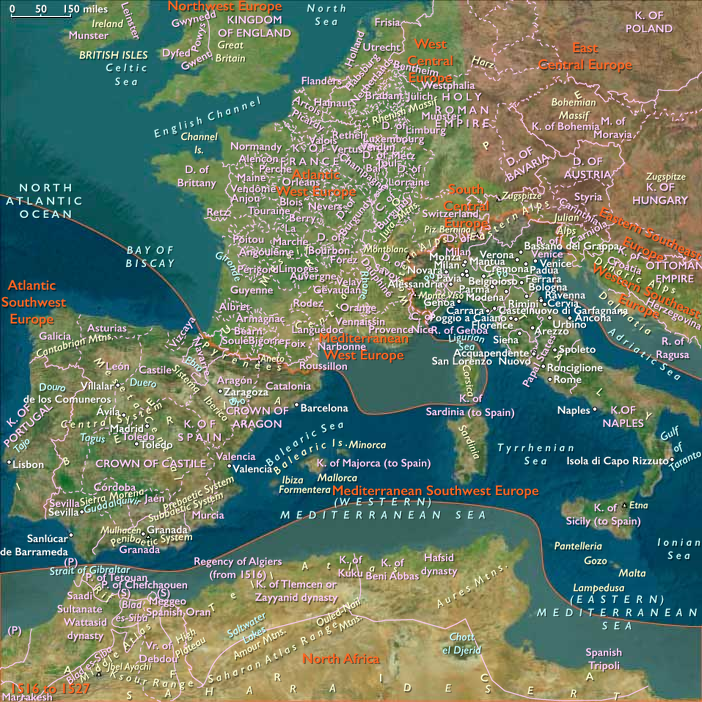
The subregion of Atlantic Southwest Europe includes continental Portugal and Spain’s Atlantic façade from the Gulf of Cádiz to the Bay of Biscay—the Tagus, Sado, Mondego, Douro, and Minho estuaries; Portugal’s Alentejo and Algarve coasts; Spain’s Guadalquivir–Cádiz seaboard; and the Cantabrian–Galician rías (A Coruña, Vigo, Gijón, Santander) and Basque capes (Bilbao–San Sebastián). These shorelines and river corridors bound maritime towns to grain-and-vine interiors and iron-rich uplands.
Climate & Environmental Shifts
The Little Ice Age brought cooler winters, stormier seas, and variable rains:
-
Iberian west & south coasts: more frequent Atlantic gales and bar shifts at estuary mouths (Douro, Tagus, Guadalquivir), alternately silting and scouring channels.
-
Northwest (Galicia–Asturias–Cantabria): heavy rainfall and rough seas; rich upwelling sustained fisheries.
-
Interior hinterlands: periodic droughts hit Alentejo and Andalusian cereal zones; frosts checked vines and olives in bad years; good years yielded ample wheat, wine, and oil.
Subsistence & Settlement
-
Rural belts: Wheat, rye, barley, olives, and vines; cork oak montado in Alentejo; gardens and orchards along river terraces.
-
Fisheries: Sardine and tunny on the Portuguese and Andalusian shelves; cod and whale began to matter for Basque fleets in the early 16th century. Saltworks (Aveiro, Setúbal, Cádiz) underwrote fish preservation and trade.
-
Ports & river towns: Lisbon (Tagus) and Porto (Douro); Seville and Cádiz (Guadalquivir–Cádiz); A Coruña–Vigo (rías), Santander, Bilbao and San Sebastián on the Bay of Biscay; Viana do Castelo, Figueira da Foz, Setúbal along Portugal’s coast. Urban workshops produced sails, rope, barrels, and victuals for ocean-going fleets.
Technology & Material Culture
-
Shipbuilding & navigation: The caravel (lateen rig, shoal-draft) matured on Portugal’s south coast; rounder naos carried freight across oceans. Magnetic compass, sternpost rudder, astrolabe, cross-staff, portolan charts, and toleta de marteloio tables improved blue-water navigation.
-
Maritime institutions: In Portugal, the Order of Christ’s revenues (successor to the Templars) and the crown’s Casa da Guiné and later Casa da Índia in Lisbon centralized Atlantic/Indian trade. Basque iron and timber supported Biscayan yards.
-
Urban & courtly arts: Manueline architecture (rope, coral, armillary motifs) crowned Lisbon/Belém; Mudéjar–Plateresque blended in Andalusia; guild crafts (textiles, leather, ceramics) supplied ships and cities.
Movement & Interaction Corridors
-
Estuary arteries: The Tagus, Douro, and Guadalquivir funneled grain, wine, oil, salt fish, and hides from interior plains to oceanic convoys; return flows brought spices, gold, and slaves by the early 1500s.
-
Atlantic lanes: Portugal’s Volta do Mar looped down the African coast and home via mid-ocean westerlies; Andalusian–Cantabrian coasting linked Biscay iron and salt fish to southern shipyards and markets.
-
Pilgrimage & fairs: Santiago de Compostela drew pilgrims through Galician ports; Lisbon and Seville fairs knit merchants from Italy, Flanders, and the Maghreb.
-
Imperial routes (first phase): After 1498, spice fleets sailed India–Lisbon; after 1492, Castilian fleets used the Guadalquivir–Seville corridor to the Caribbean.
Cultural & Symbolic Expressions
-
Religious life: Cathedrals and confraternities structured urban devotion; seafarers’ brotherhoods honored Our Lady of Good Voyage; shrines dotted headlands and capes (e.g., Cape St. Vincent).
-
Court and chronicle: Portuguese chronicles (Gomes Eanes de Zurara) celebrated exploration; Iberian courts patronized cartography and cosmography.
-
Communal identities: Fisher guilds, ship carpenters, ropewalkers, coopers, and salt-pan communities developed strong customs and saints’ days; Basque whalers forged distinctive sea rituals.
Environmental Adaptation & Resilience
-
Risk-spreading portfolios: Mixed farming (cereal–vine–olive), stock-raising, and salt-fish curing buffered bad harvests; riverine mills and terraces stabilized yields.
-
Harbor works: Jetties and dredging (Lisbon, Porto, Seville) fought bar siltation; salt granaries and fish warehouses bridged lean seasons.
-
Maritime provisioning: Biscayan and Portuguese fleets salted fish and whale meat; victualing yards stockpiled biscuit, wine, oil, and salted pork for oceanic voyages.
Technology & Power Shifts (Conflict Dynamics)
-
Iberian realignments: The Conquest of Ceuta (1415) opened Portugal’s North African gateway and Atlantic thrust; the War of the Castilian Succession (1475–1479)—including the Battle of Toro (1476)—ended with the Treaty of Alcáçovas (1479), fixing early Atlantic spheres between Castile and Portugal. The Treaty of Tordesillas (1494) divided extra-European worlds meridionally.
-
Oceanic breakout: Vasco da Gama’s voyage (1497–1499) linked the Tagus to India; Pedro Álvares Cabral (1500) reached Brazil; Portugal’s Estado da Índia took shape after the Battle of Diu (1509) and the Capture of Malacca (1511), routing Eastern spices to Lisbon.
-
Castile’s Atlantic: From 1492, Columbus’s voyages (out of Palos/Cádiz) opened Caribbean routes; Seville’s Casa de la Contratación (from 1503) regulated fleets.
-
Privateering & defense: Biscay–Galician coasts armed against English, Breton, and Norman raiders; corsair warfare flickered in the Bay of Biscay and off the Algarve.
Transition
By 1539 CE, Atlantic Southwest Europe had transformed from a cluster of estuarine towns into the launchpad of two oceanic empires. Lisbon and Seville–Cádiz rose as global entrepôts; Biscayan and Galician ports provisioned fleets and pioneered whaling and Atlantic cod. Inland cereals, vines, and olives still fed the system, but caravel and nao had redrawn horizons—binding Iberian estuaries to Africa, Asia, and the Americas, and setting the stage for a sixteenth century of maritime hegemony and imperial rivalry.
John II’s Ruthless Purge of the Nobility: The Fall of the House of Braganza (1483–1484)
After securing his throne in 1481, King John II of Portugal launched a systematic campaign to weaken the nobility, targeting the two most powerful noble houses:
- The House of Braganza (Fernando II, Duke of Braganza)
- The House of Viseu and Beja (Diogo, Duke of Viseu and Beja)
These houses had become too powerful under Afonso V, and John II, determined to establish absolute royal authority, moved against them ruthlessly and decisively.
The Execution of Fernando II, Duke of Braganza (1483)
- Fernando II of Braganza (b. 1430) had been a loyal supporter of Afonso V, participating in the Moroccan campaigns and the War of the Castilian Succession (1475–1479).
- After Afonso V’s failed attempt to claim Castile, John II came to power and saw Braganza as a direct threatdue to his vast landholdings and Castilian connections.
- The Duke of Braganza was accused of high treason, with John II presenting forged letters as evidence that Braganza was conspiring with Isabella I of Castile.
- In 1483, John II had Fernando II executed in Évora, marking the beginning of his brutal crackdown on the nobility.
Confiscation of Braganza Estates and the Family’s Exile
- After the execution of Fernando II, John II confiscated all Braganza estates, stripping the family of its wealth and power.
- The remaining members of the House of Braganza fled to Castile, seeking refuge under Queen Isabella and King Ferdinand.
- This was a major victory for John II, as he had successfully neutralized the most powerful noble house in Portugal.
The Execution of Diogo, Duke of Viseu (1484)
- Not satisfied with eliminating one major noble house, John II turned against Diogo, Duke of Viseu, the leader of the House of Viseu and Beja.
- In 1484, John II personally stabbed and killed Diogo in the palace, further demonstrating his absolute authority.
- He then confiscated Diogo’s vast estates, ensuring that no noble family could rival the Crown.
Consequences of John II’s Actions
-
End of Noble Resistance
- With Braganza exiled and Viseu eliminated, John II destroyed Portugal’s feudal aristocracy, making the monarchy unquestionably supreme.
-
Royal Wealth and Power
- The confiscated Braganza and Viseu estates provided massive financial resources for the Crown.
-
Focus on Maritime Expansion
- With internal threats crushed, John II invested in Portuguese exploration, leading to:
- Bartolomeu Dias rounding the Cape of Good Hope (1488).
- Vasco da Gama reaching India (1498, under Manuel I).
- With internal threats crushed, John II invested in Portuguese exploration, leading to:
-
The Braganza Family’s Future Rise
- The Braganzas remained in exile until 1498, when King Manuel I pardoned them.
- In 1640, the House of Braganza overthrew Spanish rule, and Duke João IV of Braganza became King of Portugal, establishing the Braganza dynasty (1640–1910).
John II: The Perfect Prince and Absolute Monarch
By eliminating the feudal power of the nobility, John II secured absolute royal control, shaping Portugal into a centralized and efficient monarchy, paving the way for its Golden Age of Exploration and Empire.
King John II’s Campaign Against the Nobility: The Fall of the Dukes of Braganza and Viseu
Upon his succession in 1477 and full assumption of power in 1481, King John II of Portugal launched a determined effort to weaken the Portuguese nobility, particularly the two most powerful noble houses:
- House of Braganza (Fernando II, Duke of Braganza)
- House of Beja and Viseu (Diogo, Duke of Viseu and Beja)
These houses had amassed immense wealth and influence under Afonso V’s reign, leading John II to view them as threats to the Crown’s authority.
The Downfall of Fernando II, Duke of Braganza (1483)
- Fernando II of Braganza (b. 1430) had been a loyal companion to Afonso V, participating in the Moroccan campaigns and the War of the Castilian Succession (1475–1479).
- After the Portuguese defeat in the Castilian War, Fernando maintained correspondence with Isabella I of Castile, which John II saw as treasonous.
- In 1483, John II arrested and charged Fernando with treason, using forged letters as evidence.
- Fernando II was executed in Évora, and his vast lands and estates were confiscated, destroying the power of the House of Braganza for the next century.
The Assassination of Diogo, Duke of Viseu and Beja (1484)
- Diogo, Duke of Viseu and Beja, had inherited great power in 1472 and became a popular court figure.
- Unlike Fernando II, Diogo believed he was safe due to his sister Eleanor’s marriage to King John II (since 1470).
- However, he was suspected of conspiring against the king, particularly after two assassination attempts on John II’s life.
- In 1484, John II accused Diogo of high treason.
- The king personally stabbed and killed Diogo himself, sending a powerful message to the nobility.
The Rise of Manuel I, Duke of Beja and Viseu (1484)
- After Diogo’s execution, John II summoned his younger brother, Infante Manuel of Viseu.
- Showing him Diogo’s body, the king declared he would treat Manuel as his own son.
- Manuel inherited his brother’s titles and estates, becoming Duke of Beja and Viseu, but he remained loyal to John II, avoiding his brother’s fate.
Consequences of John II’s Purge of the Nobility
- Complete Suppression of the Aristocracy – The executions of Fernando II of Braganza (1483) and Diogo of Viseu (1484) ensured that no noble family could challenge the Crown’s power.
- Royal Centralization – John II seized vast noble estates, making the monarchy the wealthiest power in Portugal.
- Military and Economic Strengthening – With noble resistance crushed, John II refocused resources on maritime expansion, leading to Bartolomeu Dias’s voyage around the Cape of Good Hope (1488).
- The Future Rise of Manuel I – Though spared by John II, Infante Manuel would later become King of Portugal (1495–1521), beginning the Portuguese Golden Age.
John II: The Perfect Prince and Absolute Monarch
By crushing the nobility, John II transformed Portugal into a centralized state, where the king ruled without aristocratic interference. His reign paved the way for Portugal’s dominance in global exploration, ensuring that the Crown, and not the nobility, controlled the vast wealth of the Portuguese Empire.
Manuel I assumes the throne in 1495 and completes the preparations for the voyage to India.
On July 8, 1497, a fleet of four ships commanded by Vasco da Gama sets sail from Belem on the outskirts of Lisbon.
The expedition is very carefully organized, each ship having the best captains and pilots, as well as handpicked crews.
They carry the most up-to-date nautical charts and navigational instruments.
Vasco da Gama's fleet rounds the Cape of Good Hope on November 27, 1497, and makes landfall at Natal in present-day South Africa on December 25.
The fleet then proceeds along the east coast of Africa and lands at Quelimane in present-day Mozambique in January 1498, followed by Mombasa in present-day Kenya.
An Arab pilot directs the fleet to India.
After sailing for a month, the fleet reaches Calicut on the Malabar coast in southwest India.
In August, after sailing to Goa, the fleet leaves for Portugal, arriving in September 1499, two years and two days after the departure.
This fleet is commanded by Pedro Álvares Cabral and includes Bartolomeu Dias, various nobles, priests, and some twelve hundred men of Portugal.
The fleet sails southwest for a month, and on April 22 sights land, the coast of present-day Brazil.
Cabral sends a ship back to Lisbon to report to Manuel his discovery, which he calls Vera Cruz.
The fleet recrosses the Atlantic and sails to India around Africa, where it arrives on September 13, 1500.
After four months in India, Cabral sails for Lisbon in January 1501, having left a contingent of Portuguese to maintain a factory at Cochin on the Malabar coast.
Atlantic Southwest Europe (1492–1503 CE): Global Explorations, Cultural Renaissance, and Iberian Unification under the Catholic Monarchs
Between 1492 and 1503 CE, Atlantic Southwest Europe—including Galicia, northern and central Portugal, Asturias, Cantabria, and northern Spain south of the Franco-Spanish border (43.05548° N, 1.22924° W)—entered one of the most historically pivotal and culturally vibrant periods in Iberian history. Portugal reached unprecedented maritime prominence, epitomized by Vasco da Gama's voyage to India (1497–1499), while Castile and Aragón decisively unified under the Catholic Monarchs, Isabella and Ferdinand. The conquest of Granada (1492), Columbus’s first transatlantic voyages (beginning 1492), and increased humanist exchanges catalyzed profound transformations, decisively shaping regional identities, economic prosperity, and intellectual foundations of the Iberian Renaissance.
Political and Military Developments
Castilian-Aragonese Unification and Territorial Expansion
The Catholic Monarchs, Isabella I of Castile (1474–1504 CE) and Ferdinand II of Aragón (1479–1516 CE), decisively completed the Reconquista by capturing Granada in January 1492, marking the end of Islamic rule in Iberia. Their unified rule strengthened centralized governance, implemented administrative reforms, and enhanced judicial systems, decisively consolidating territorial integrity and political stability. The discovery of the Americas in 1492, under their patronage of Christopher Columbus, significantly expanded Castile's global ambitions and territorial claims.
Portugal’s Maritime Empire under João II and Manuel I
Following King João II’s (1481–1495 CE) ambitious reign, King Manuel I (1495–1521 CE) decisively advanced Portugal's maritime empire and global ambitions. The landmark voyage of Vasco da Gama (1497–1499) around Africa to India opened lucrative trade routes to Asia, significantly enhancing Portugal’s global economic and geopolitical influence. Manuel I’s reign marked a golden age of maritime exploration, empire-building, and robust cultural patronage.
Navarrese Diplomatic Prudence under Catherine I
Navarre, under Queen Catherine I (1483–1517 CE), decisively navigated increasingly complex diplomatic tensions amid Castilian and French interests. Catherine maintained Navarre’s territorial autonomy, regional stability, and diplomatic neutrality through careful governance, despite rising external pressures and competing dynastic claims.
Economic Developments
Agricultural Prosperity and Demographic Stability
Agricultural productivity decisively remained strong, supported by diversified crops—including grain, vineyards, olives, citrus fruits, almonds—and extensive livestock production. Regional mining of precious metals, notably gold and silver from Galicia and Asturias, significantly bolstered economic prosperity and demographic stability.
Portuguese Maritime Trade and Asian Expansion
Portugal decisively expanded global commerce under Manuel I, with Lisbon emerging as a major hub for maritime trade between Europe, Africa, and newly accessed Asian markets. Vasco da Gama’s voyages established vital spice and luxury trade networks, dramatically enhancing Portugal’s economic power and maritime dominance. Ports in Galicia, especially A Coruña, benefitted economically from increased maritime activity and global trade.
Castilian Economic Expansion and New World Resources
Following Columbus’s voyages, Castile decisively initiated economic expansion through the burgeoning trade and extraction of resources from newly discovered American territories. Gold, silver, and agricultural products significantly enhanced Castilian economic resilience and prosperity, fundamentally transforming the Iberian economy in subsequent decades.
Cultural and Religious Developments
Portuguese Renaissance under Manuel I
Under King Manuel I, Portugal decisively experienced a vibrant cultural renaissance. Increased humanist exchanges with Italy, northern Europe, and Asia significantly enriched Portuguese intellectual, artistic, literary, and scientific achievements. The lavish Manueline architectural style flourished, celebrating maritime themes and imperial grandeur. Portuguese culture thrived, profoundly influencing European Renaissance humanism through global maritime connections.
Castilian Renaissance Flourishing
Castilian culture decisively entered a period of robust Renaissance humanist scholarship under Isabella and Ferdinand. The publication of Antonio de Nebrija’s "Gramática Castellana" (1492) symbolized humanist linguistic refinement. Castilian intellectual life, enriched by interactions with Italian scholars, flourished through courtly patronage, educational reforms, literary revival, artistic innovation, and vibrant scientific exploration.
Galician Cultural Vitality and Ecclesiastical Patronage
Galicia decisively maintained cultural prominence, significantly reinforced by Santiago de Compostela’s ecclesiastical institutions and pilgrimage routes. Scholarly initiatives, manuscript preservation, artistic patronage, and extensive architectural projects continued, enhancing Galicia’s cultural identity, regional resilience, and international prominence.
Persistent Cultural Syncretism and Local Traditions
Orthodox Christianity consistently integrated indigenous Iberian and Celtic traditions, notably in rural Galicia and northern Portugal. Persistent cultural syncretism decisively reinforced regional identities, social cohesion, and cultural resilience amid global exploration and intellectual innovation.
Civic Identity and Governance
Portuguese Civic Unity and Global Ambitions
Portugal decisively reinforced civic unity, national identity, and governance stability under João II and Manuel I. Maritime exploration significantly shaped Portuguese collective ambitions, laying essential foundations for global empire-building, economic prosperity, and cultural flourishing.
Castilian Civic Identity and Administrative Consolidation
Under Isabella and Ferdinand, Castile decisively solidified civic identity, territorial integrity, and administrative coherence. Centralized governance, judicial reforms, and global exploration significantly shaped Castilian political stability, regional identity, and Renaissance cultural renewal.
Navarrese Regional Autonomy and Diplomatic Stability
Navarre decisively preserved regional autonomy, diplomatic neutrality, and internal coherence under Catherine I. Her pragmatic governance significantly maintained territorial integrity, regional stability, and northern Iberian geopolitical balance despite rising external pressures.
Notable Regional Groups and Settlements
-
Portuguese: Achieved decisive maritime expansion, global economic prosperity, and Renaissance cultural flourishing under João II and Manuel I, significantly shaping Portugal’s historical trajectory and global influence.
-
Castilians: Consolidated territorial integrity, political stability, cultural renewal, and global ambitions under Isabella and Ferdinand, significantly influencing Iberian political, intellectual, and cultural developments.
-
Galicians: Sustained vibrant economic prosperity, cultural vitality, and ecclesiastical prominence, significantly reinforced by pilgrimage activity and global maritime trade.
-
Basques (Navarre): Maintained regional autonomy, diplomatic neutrality, and stable governance under Catherine I, significantly influencing northern Iberian political coherence.
Long-Term Significance and Legacy
Between 1492 and 1503 CE, Atlantic Southwest Europe:
-
Achieved unprecedented Portuguese maritime dominance, global economic expansion, and vibrant Renaissance cultural flourishing, decisively establishing Portugal’s subsequent global empire and intellectual prominence.
-
Completed Castilian-Aragonese unification, territorial consolidation, and cultural revival under Isabella and Ferdinand, fundamentally transforming Iberian unity, governance structures, and Renaissance intellectual identity.
-
Navigated diplomatic complexities in Navarre, maintaining territorial autonomy, regional stability, and northern Iberian geopolitical coherence.
-
Experienced sustained agricultural prosperity, dramatically expanded global commerce, pilgrimage-driven economic vitality, and vibrant cultural innovation, significantly influencing regional historical trajectories.
This transformative era decisively shaped regional identities, governance structures, economic continuity, cultural resilience, and intellectual foundations, profoundly influencing Atlantic Southwest Europe’s trajectory toward global prominence and the mature Iberian Renaissance.
Atlantic Southwest Europe: Maritime Ambition, Imperial Expansion, and Political Consolidation (1492–1503)
Between 1492 and 1503, Atlantic Southwest Europe entered an era of dramatic maritime discovery, imperial ambition, and political consolidation. Spain's unification under Ferdinand and Isabella culminated in the momentous voyage of Christopher Columbus, while Portugal, under King João II and his successor Manuel I, expanded maritime exploration significantly, solidifying its global commercial presence. Navarre, facing persistent threats, sought survival amidst growing Spanish and French dominance.
Political and Military Developments
-
Spain (Castile, León, and Northern Provinces):
- The reign of Ferdinand II of Aragon and Isabella I of Castile (joint rule 1479–1504) reached its zenith with the completion of the Reconquista, marked by the fall of Granada (1492), ending Muslim rule in Iberia.
- In northern Spain, including Basque Country and northern Rioja, the Catholic Monarchs pursued centralization, yet respected regional fueros (local laws), thus maintaining a delicate balance between royal authority and regional autonomy.
-
Portugal:
- Following the death of João II (1495), King Manuel I (r. 1495–1521) ascended to the throne, intensifying Portugal’s maritime and imperial ambitions.
- Manuel strengthened royal authority, significantly curtailed noble privileges, and secured Portugal’s commercial interests through diplomatic means, notably the Treaty of Tordesillas (1494) with Spain, which divided newly discovered territories in the Atlantic between the two powers.
-
Navarre:
- Queen Catherine of Foix continued her delicate diplomacy to maintain Navarrese independence, negotiating carefully between powerful neighbors.
- Increasingly isolated, Navarre faced mounting external threats, setting the stage for future conflicts over its sovereignty.
Economic and Maritime Expansion
-
Spanish Maritime and Imperial Expansion:
- The most momentous event of the era was Columbus's voyage (1492), financed by Ferdinand and Isabella. The discovery of the Americas opened vast territories for colonization, dramatically expanding Spain’s wealth, influence, and maritime ambitions.
- Northern ports, particularly those in Galicia and Basque Country, experienced a surge in shipbuilding and trade, fueled by transatlantic commerce and fisheries, notably the cod trade from Newfoundland.
-
Portuguese Exploration and Commerce:
- Portugal’s maritime exploration reached unprecedented heights: Vasco da Gama’s expedition (1497–1499) established a direct sea route to India, profoundly reshaping global trade.
- Lisbon emerged as Europe's premier commercial port, benefiting immensely from spice trade profits, dramatically transforming Portugal’s economy.
-
Navarre’s Economic Challenges:
- Navarre remained economically dependent on regional trade, agriculture, and cross-border commerce with France and northern Spain, though increasingly vulnerable politically.
Cultural and Social Developments
-
Spanish Religious and Cultural Uniformity:
- Ferdinand and Isabella intensified religious centralization, notably through the Alhambra Decree (1492), which expelled Jews who refused conversion, profoundly reshaping Spain’s demographic and cultural landscape.
- Cultural patronage flourished, exemplified by the support of artists, scholars, and writers, notably the humanist scholar Antonio de Nebrija, whose grammar (1492) standardized Castilian Spanish.
-
Portuguese Cultural Renaissance:
- Under Manuel I, Portugal experienced a vibrant cultural renaissance. Architectural projects such as the Jerónimos Monastery and the expansion of the University of Coimbra reflected prosperity and artistic creativity.
- The Portuguese court attracted renowned intellectuals, scientists, and navigators, reinforcing Lisbon as a center of European learning and innovation.
-
Navarre’s Cultural Autonomy:
- Despite pressures, Navarre sustained its unique traditions, laws, and institutions, demonstrating cultural resilience even as political autonomy diminished.
Significance and Legacy
The years 1492–1503 represented a watershed moment for Atlantic Southwest Europe, fundamentally altering its global position. Spain’s initiation of transatlantic colonization transformed European geopolitics and economics. Portugal’s maritime empire reached new heights, establishing Lisbon as a leading global commercial and cultural hub. Navarre’s fragile independence underscored the challenges faced by smaller states amid rising European powers. The era’s legacy persisted in the global colonial systems, economic transformations, and cultural shifts that characterized the dawn of early modern Europe.
The Expulsion and Forced Conversion of Jews in Portugal (1492–1497)
The Spanish expulsion of Jews in 1492 triggered a wave of Jewish migration to Portugal, where King John II initially allowed temporary asylum in exchange for payment. However, four years later, King Manuel I, pressured by Spain, ordered the expulsion or forced conversion of Jews and Muslims from Portugal, marking a dramatic shift in policy.
John II’s Admission of Spanish Jews (1492)
- Following the Alhambra Decree (May 1492) issued by Ferdinand and Isabella, which expelled all unconverted Jews from Spain, many Jewish families sought refuge in Portugal.
- A delegation of Spanish Jews offered 60,000 cruzados for the permanent admission of 600 wealthy familiesand a fee of 8 cruzados per head for others, who would be allowed to stay for eight months.
- John II agreed to these terms but imposed harsh conditions:
- The wealthy families were admitted permanently.
- The rest were allowed to stay temporarily, after which ships were to be provided for their departure.
- However, ships were arranged only to Tangier and Arzila (in Morocco), forcing many to remain stranded.
- Some Jewish children were taken from their families and sent to settle São Tomé, an island in the Gulf of Guinea, where many died from disease and harsh conditions.
The Expulsion and Forced Conversion Under Manuel I (1496–1497)
- John II died in 1495, and his successor, King Manuel I, initially welcomed Jews, valuing their skills and economic contributions.
- However, his marriage negotiations with Isabella and Ferdinand’s daughter, Isabella of Aragon, required him to expel all Jews and Muslims from Portugal as a condition.
- In 1496, Manuel I issued an edict of expulsion, ordering all unconverted Jews and Muslims to leave Portugal.
- Rather than allowing them to emigrate freely, Manuel sought to force conversions, leading to:
- Mass forced baptisms, particularly of Jewish children.
- Restrictions on emigration, with many Jews being trapped in Portugal.
- The creation of "New Christians" (Conversos or Marranos)—Jews who converted under pressure but often continued practicing Judaism in secret.
- Manuel promised that the Inquisition would not be established for 20 years, offering nominal protection to New Christians, though many faced persecution in later decades.
Consequences of the Expulsion and Forced Conversion
-
Portugal Lost a Highly Educated and Skilled Community
- Jewish communities had contributed significantly to finance, medicine, science, and trade.
- Their expulsion weakened Portugal’s intellectual and economic resources.
-
Conversos Became an Important Social Group
- Many Jews converted outwardly but continued to practice Judaism in secret.
- This led to the rise of crypto-Judaism in Portugal, which later became a target of the Portuguese Inquisition (established in 1536).
-
Mass Jewish Migration to the Ottoman Empire and North Africa
- Many Portuguese and Spanish Jews found refuge in the Ottoman Empire, where Sultan Bayezid II welcomed them.
- Others fled to Italy, the Netherlands, and the Middle East, forming Sephardic Jewish communities.
Conclusion: The End of Jewish Life in Medieval Portugal
The Jewish expulsions and forced conversions of 1492–1497 marked the end of open Jewish life in Portugal, despite centuries of flourishing Jewish culture and scholarship. Although many Jews remained as New Christians, Portugal’s policies ultimately mirrored those of Spain, aligning the two Iberian kingdoms in their pursuit of religious uniformity at the cost of diversity and economic prosperity.