Malcolm IV of Sotland
King of Scots
Years: 1141 - 1165
Malcolm IV, nicknamed Virgo, "the Maiden" (between 23 April and 24 May 1141 – 9 December 1165), King of Scots, is the eldest son of Henry, Earl of Huntingdon and Northumbria (died 1152) and Ada de Warenne.
The original Malcolm Canmore, a name now associated with his great-grandfather Malcolm III (Máel Coluim mac Donnchada), he succeeds his grandfather David I, and shares David's Anglo-Norman tastes.
Called Malcolm the Maiden by later chroniclers, a name which may incorrectly suggest weakness or effeminacy to modern readers, he is noted for his religious zeal and interest in knighthood and warfare.
For much of his reign he is in poor health and dies unmarried at the age of twenty-four.
Related Events
Filter results
Showing 10 events out of 11 total
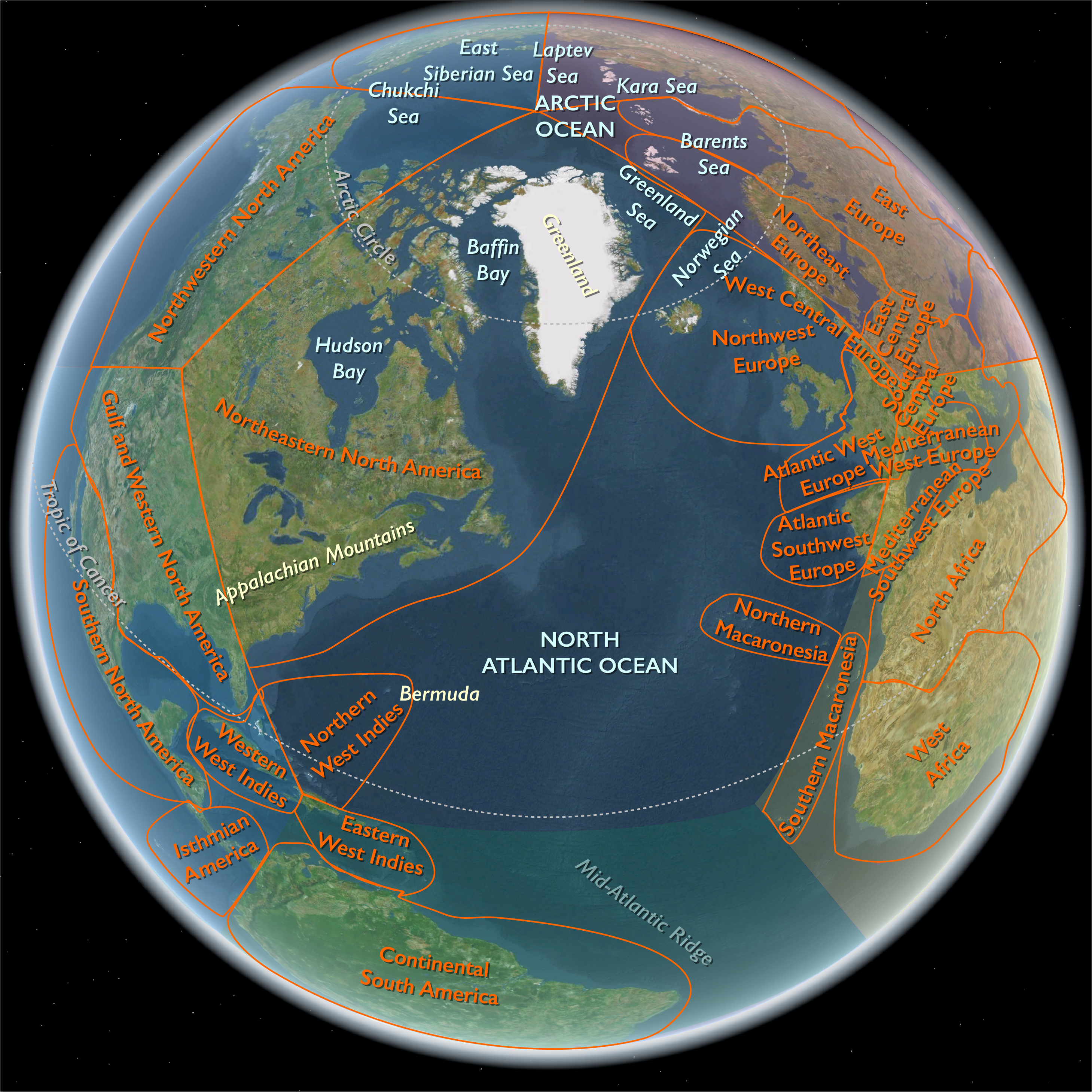
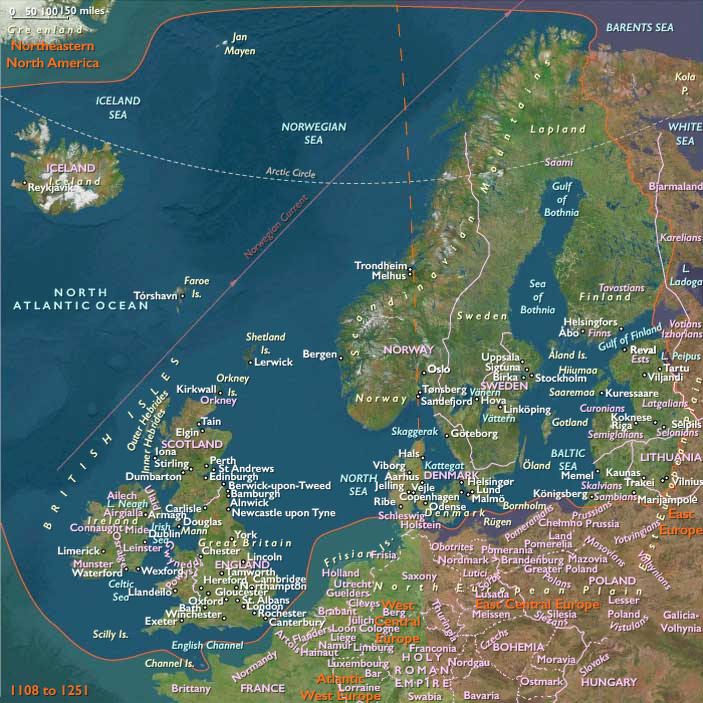
Northwest Europe (1144–1155 CE): Intensified Conflict and Emerging Stability
England: Height of the Anarchy
The period 1144–1155 saw the peak of turmoil during The Anarchy (1135–1153), the ongoing civil conflict between King Stephen of Blois and Matilda, daughter of Henry I. England suffered from continuous warfare, exacerbated by shifting loyalties among barons who constructed numerous castles to assert their autonomy. In 1147, Matilda departed England permanently, leaving her son, Henry Plantagenet, to continue the struggle. The prolonged stalemate prompted fatigue among the nobility, leading to the eventual Treaty of Wallingford in 1153, under which Stephen agreed to name Henry Plantagenet as his successor.
Scotland: Continued Growth and Influence
David I (r. 1124–1153) continued his transformative rule until his death in 1153, further developing Scotland's feudal framework and urban infrastructure. His administration saw the establishment of additional monasteries and burghs, enhancing trade and economic stability. David supported his niece, Empress Matilda, in the English succession conflicts, frequently campaigning in Northern England, which consolidated Scotland’s territorial claims and bolstered its influence beyond the border. Upon David’s death, his grandson, Malcolm IV (r. 1153–1165), inherited a relatively stable kingdom.
Ireland: Increased Norman Influence
Ireland remained fragmented politically, yet Norman influence gradually increased. The coastal cities, particularly Dublin and Waterford, prospered through trade and served as gateways for Norman customs and commercial practices. While Ireland was still politically divided, these urban centers became focal points for greater economic and cultural integration with continental Europe and England.
Denmark: Internal Discord and Leadership Changes
Denmark continued to endure internal strife throughout this era. The instability following Eric II Emune's assassination in 1137 extended through successive reigns. Eric III Lamb assumed power in 1137 but struggled to maintain control amid powerful aristocratic factions and eventually abdicated in 1146, paving the way for yet another succession conflict between Sweyn III Grathe, Canute V, and Valdemar the Great, plunging Denmark further into civil war.
Norway: Continued Civil Wars
Norway remained embroiled in civil conflict. The strife initiated by the death of Sigurd I Jorsalfar continued with shifting allegiances and intermittent violence. Battles for the throne between rival claimants marked the decade, reinforcing regional factionalism. Norway’s internal strife weakened central authority and prolonged instability throughout the period.
Iceland and the North Atlantic: Cultural Continuity
Iceland remained largely insulated from mainland conflicts, preserving political stability through its traditional assembly, the Althing. Icelandic culture continued to flourish, as literary and historical works, such as sagas and skaldic poetry, were increasingly documented, thereby enriching cultural heritage and historical preservation.
Religious Expansion and Consolidation
Monastic expansion continued across Northwest Europe, significantly shaping cultural and economic landscapes. The Cistercian order established additional abbeys, playing a critical role in the religious and agricultural development of Scotland and northern England. The influence of monastic institutions reinforced ecclesiastical authority and helped stabilize regions ravaged by warfare.
Legacy of the Era
By 1155 CE, Northwest Europe began transitioning from intense conflict toward emerging stability. England approached the end of its civil war, with Henry Plantagenet poised to ascend the throne, promising restoration of royal authority. Scotland’s political reforms under David I left a stable foundation for his successors. Denmark and Norway, however, continued grappling with internal divisions, delaying lasting peace and unity. Ireland saw steady cultural and economic advancement, facilitated by Norman influence, and Iceland maintained its cultural integrity, largely unaffected by the continental upheaval.
Henry, Third Earl of Huntingdon, a Prince of Scotland, of the House of Dunkeld, and an English peer, is the son of King David I of Scotland and Maud, daughter of Waltheof, Earl of Northumbria and Huntingdon, (beheaded 1075), by his spouse Judith of Normandy.
It is said that Henry had been named after his uncle, King Henry I of England.
Earl Henry, who had perhaps been seriously ill in the 1140s, dies unexpectedly at Newcastle or Roxburgh on June 12, 1152, in the Northumbrian domain which David and he had done much to attach to the Scots crown in the decades of English weakness after the death of Henry of England.
Unlike the death of William Adelin in the White Ship, which had left Henry I without male heirs, Earl Henry has three surviving sons.
Thus, although his death damages David's plans, and makes disorders after his death very likely indeed, it is not a disaster.
Eleven-year-old Malcolm, as the eldest of Earl Henry's sons, is sent by his grandfather on a circuit of the kingdom, accompanied by Donnchad, Mormaer of Fife, styled rector, perhaps indicating that he is to hold the regency for Malcolm on David's death.
Donnchad and Malcolm are accompanied by a large army.
William, Henry’s second son, inherits the earldom of Northumberland.
David, as ruler of Cumbria, has taken Anglo-Normans into his service, and during his kingship many others have settled in Scotland, founding important families and intermarrying with the older Scottish aristocracy.
Bruce, Stewart, Comyn, and Oliphant are among the noted names whose bearers had gone from northern France to England during the Norman Conquest in 1066 and now to Scotland in the reign of David.
To these and other French-speaking immigrants, David has granted land in return for specified military service or contributions of money, as had been done in England from the time of the Conquest.
A devoted son of the church, he has also reorganized Scottish Christianity to conform with continental European and English usages and founded many religious communities, mostly for Cistercian monks and Augustinian canons, earning himself the posthumous title of David the Saint (although he has never been formally canonized.
He dies at Carlisle on May 24 1153; …
…his twelve-year-old grandson Malcolm, who shares David's Anglo-Norman tastes, is inaugurated three days later as Malcolm IV.
The hasty ceremony takes place before the old king is buried; Malcolm is not without rivals for the kingship.
The Orkneyinga Saga claims William son of William fitz Duncan, calling him "William the Noble", was the man whom "every Scotsman wanted for his king".
As William fitz Duncan married Alice de Rumilly in about 1137, young William can only have been a youth, perhaps a child.
There is no sign that William made any claims to the throne.
Of William's other sons, Bishop Wimund had already been blinded, emasculated and imprisoned at Byland Abbey before David's death, but Domnall mac Uilleim, first of the Meic Uilleim, had considerable support in the former mormaerdom of Moray.
Another would-be king, imprisoned at Roxburgh since about 1130, is Máel Coluim mac Alisdair, an illegitimate son of Alexander I.
Máel Coluim's sons, who are free men in 1153, can be expected to contest the succession, and do so.
As a new king, and especially as a young one, Malcolm can also expect challenges from his neighbors, foremost among who are Somerled, King of Argyll, Fergus, Lord of Galloway, and Henry II, King of England.
Another, Rognvald Kali Kolsson, Earl of Orkney, is otherwise occupied with crusading.
The first opposition to Malcolm comes in November of 1153, from the combination of Somerled of Argyll and family rivals, the "sons of Malcolm", that is of Máel Coluim mac Alisdair.
This comes to little as Somerled soon has more pressing concerns, firstly his war with Goraidh mac Amhlaibh and secondly, perhaps, a conflict with Gille Críst, Mormaer of Menteith, over Cowal.
Support for the sons of Máel Coluim mac Alisdair may also have come from areas closer to the core of the kingdom, for two conspirators are named by chroniclers, one of whom in February 1154 dies in trial by combat.
Donnchad, meanwhile, does not long survive David, holding the regency for a year before his death in this year.
Northwest Europe (1156–1157 CE): Brief Consolidation Amidst Lingering Uncertainty
England: Restoration Under Henry II
Following the resolution of The Anarchy, Henry II (r. 1154–1189) embarked on a swift consolidation of royal authority. By 1156, Henry had significantly reduced the number of unauthorized castles built during the civil conflict, reasserting centralized control. He reformed legal institutions and initiated measures to restore economic stability, marking a clear shift away from the turbulence of previous decades.
Scotland: Early Reign of Malcolm IV
Malcolm IV (r. 1153–1165) faced immediate challenges following the stable reign of his grandfather, David I. Young and inexperienced, Malcolm struggled to maintain the expansive territorial holdings secured by David, particularly those south of the border. Nonetheless, his initial reign focused on consolidating royal authority within Scotland and preserving the internal stability fostered during David’s rule.
Ireland: Continued Norman Influence and Fragmentation
Ireland remained politically fragmented but economically vibrant, particularly within Norse-Gaelic coastal settlements such as Dublin and Waterford. These towns continued to integrate Norman customs and economic practices, serving as key points of cultural and economic exchange with England and the continent. However, the island’s broader political unity remained elusive.
Denmark: Unstable Truce and Violent Power Struggle
The Danish civil war saw a brief lull in 1157, when a temporary peace agreement was forged among Sweyn III Grathe, Canute V, and Valdemar the Great, dividing the kingdom between them. However, during a celebration marking this accord, Sweyn treacherously ordered the assassination of his co-rulers. Canute was killed, but Valdemar managed to escape. Valdemar subsequently conducted a successful campaign against Sweyn, defeating and killing him near Viborg. This victory allowed Valdemar to consolidate his rule and become the sole king of the Danes, temporarily restoring some stability to Denmark.
Norway: Persistent Factionalism
Norway continued to endure civil unrest and rivalry among claimants to the throne. These internal struggles further fragmented royal authority, perpetuating regional instability and ongoing conflict as competing factions persisted in their attempts to dominate the kingdom.
Iceland and the North Atlantic: Stability and Cultural Flourishing
Iceland and surrounding North Atlantic communities maintained their stability and cultural continuity, insulated from the wider political upheavals. The traditional Althing continued to function effectively, while the literary and historical traditions flourished, capturing and preserving regional narratives and cultural identity.
Religious Influence and Cultural Expansion
Monastic institutions continued their expansion across Northwest Europe, further solidifying ecclesiastical and cultural networks. Cistercian monasteries proliferated, enhancing agricultural production and reinforcing economic stability, particularly in Scotland and Northern England.
Legacy of the Era
By the close of 1157 CE, Northwest Europe presented a mixed picture of recovery and uncertainty. England under Henry II exhibited clear signs of restored stability, while Scotland sought to preserve its recent gains. In contrast, Denmark and Norway grappled with ongoing internal conflicts, and Ireland continued its fragmented yet economically dynamic existence. Iceland remained a culturally rich enclave of stability amidst broader regional volatility.
Henry II in 1157 annexes the Scottish earldom of Northumberland inherited by William, the grandson of Scottish king David I.
Somerled is recorded to have participated in a coup d'état against his brother-in-law, as the Chronicle of Mann relates that Thorfinn Ottarsson, one of the leading men of the Isles, produced Somerled's son, Dugald (d. after 1175), as a replacement to Godred's rule.
As a grandson of Olaf, and the son of a man of with the enterprise and power to confront Mac Lochlainn, Dugald was evidently favored by a significant number of leading Islesmen, disillusioned with Godred's rule; Somerled, therefore, appears to have taken full advantage of the situation in order to secure his eldest son a share in the kingdom.
Be that as it may, Somerled's stratagem does not appear to have received unanimous support, since the chronicle relates that, as Dugald was conducted throughout the Isles, the leading Islesmen were made to render pledges and surrender hostages unto him.
Following an inclusive but bloody sea-battle, possibly fought off Mann in the following January, the chronicle records that Somerled and Godred divided the kingdom between themselves.
According to the History of the MacDonalds, Somerled had previously aided Godred's father in military operations (otherwise unrecorded in contemporary sources) against the "ancient Danes north of Ardnamurchan".
Together with its claim that Olaf had also campaigned on North Uist, this source may be evidence that the partitioning of the Isles between Godred and Somerled can be viewed in the context of Somerled taking back territories that he had helped secure into Olaf's kingdom.
There is reason to suspect that portions of the Isles had previously fallen under the influence of the Earls of Orkney, before being reclaimed by the Kings of Isles during this period.
Following the partitioning, Somerled and Godred appear to have agreed to a truce.
However, about two years later in 1158, the chronicle records that Somerled launched a second assault upon Godred, and drove him from the kingdom altogether.
From this date until his death, Somerled will rule the entire Kingdom of the Isles, and may well have exerted some degree of influence into Galloway.
Scotland consolidates authority in the maritime region between the Lennox and Cowal, and along the eastern coast of the Firth of Clyde towards Galloway, in the early 1160s.
David may well have begun the infeftment and settlement of this coastal district decades earlier, in order to counter the sea borne threat that the rulers of Argyll had posed during the dynastic challenges of the 1130s.
Some of the greatest Scottish magnates have taken root in the region by the 1160s, and it is not impossible that some of them may have begun to extend their influence into southern Argyll and the Islands of the Clyde.
The catalyst for Somerled's invasion may therefore be the encroachment of Scottish influence into his own sphere of hegemony.
The target of his invasion appears to have been Renfrew, the center of the family of Walter FitzAlan, Steward of Scotland, and Somerled's forces may well have engaged those of Walter—possibly even led by the steward himself.
When the Anarchy took hold in England and civil war between Empress Matilda and Stephen, Walter FitzAllan, the third son of a Breton knight, had rallied to the support of the Empress.
When her cause was lost, Walter had befriended David I who was an uncle of Matilda, and became David's dapifer or Steward.
Accompanied by his brother Simon, Walter had come to Scotland about 1136 and fought for Scotland at the Battle of the Standard at Northallerton in 1138 under the command of David I's son, Prince Henry.
Subsequently he had been appointed Steward of Scotland by King David I; in 1157 the appointment as Steward had been confirmed as a hereditary office.
In return for the service of five knights, David had also granted him what will eventually comprise Renfrewshire: the lands of Paisley, Pollok, Cathcart, and Ayrshire; this grant had been reconfirmed in a charter in 1157 from Malcolm IV.
The two belligerents, after landing and marching towards Renfrew, meet near Paisley and battle begins.
The Scottish royal army, commanded by the High Steward, Walter FitzAllan, consists of Scoto-Norman knights and armored men-at-arms, and Somerled's Gaelic and Norse warriors are no match against them.
Somerled is wounded in the leg by a javelin and then killed by the sword of his opponents.
Somerled's eldest son Gillecallum, from his first marriage, dies by his side.
With Somerled's death, the Norse-Gaelic army takes flight and many are slain before the survivors escape back to the ships.
Walter FitzAlan had in 1163 founded at Renfrew a house of monks of the Cluniac order drawn from the priory of Much Wenlock, in his native county of Shropshire.
Upon acquired directly from the Crown the Berwickshire estates of Birkenside and Legerwood on the eastern or left bank of the Leader Water, Walter presents to the monks the church of Legerwood, which they will hold from 1164 until the Reformation in 1560.
The monastery will steadily grow and by 1219 become Paisley Abbey.