Northwest Europe (1060–1071 CE): The Norman Conquest and Political Transformation
England: The Norman Conquest
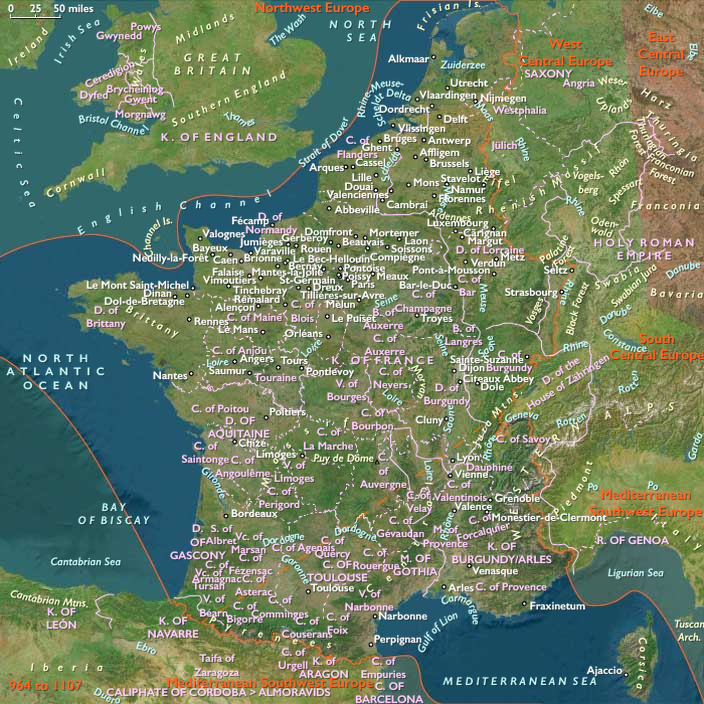
The defining event of this era was the Norman Conquest of England (1066). The claim of William II, Duke of Normandy, to the English throne derived from his familial relationship with the childless Anglo-Saxon king, Edward the Confessor, who may have encouraged William’s royal hopes.
Edward died in January 1066, and was succeeded by his powerful brother-in-law, Harold Godwinson, crowned as Harold II. Almost immediately, Harold faced two simultaneous invasions:
In September, the Norwegian king Harald Hardrada invaded northern England, achieving a significant victory at the Battle of Fulford (September 20). However, Harold II swiftly marched north, confronting and decisively defeating Hardrada at the Battle of Stamford Bridge (September 25, 1066), where both Hardrada and Harold’s estranged brother Tostig Godwinson were slain.
Within days, William of Normandy—later called William the Conqueror—landed near Pevensey in southern England, commanding a substantial army comprising Norman, Breton, and other Continental soldiers. Harold quickly marched south to meet William, though a significant portion of his exhausted army remained behind in the north. The armies clashed at the pivotal Battle of Hastings (October 14, 1066). William's forces triumphed; Harold II was killed during the engagement, dramatically shifting the course of English history. William was crowned as King William I of England on Christmas Day, 1066.
William’s reign (1066–1087) transformed England’s political, social, and cultural landscape. Norman-French language, feudal customs, and continental ecclesiastical reforms reshaped English society. Resistance persisted, notably during the brutal Harrying of the North (1069–1070), when William suppressed widespread rebellions with devastating severity.
Scotland: Consolidation Under Malcolm III
In Scotland, Malcolm III Canmore (r. 1058–1093) solidified his power after the defeat of Macbeth. Malcolm offered refuge to Anglo-Saxon exiles fleeing Norman rule, notably through his marriage in 1070 to Margaret of Wessex, sister of Edgar Ætheling, Edward the Confessor’s closest blood relative. Margaret’s arrival significantly shaped Scottish culture and religious practice, reinforcing ties between Scotland and England and bringing Scottish Christianity closer to continental Roman traditions.
Malcolm III supported English rebellions against Norman rule, maintaining Scotland’s distinct political identity and complicating Norman attempts to dominate all of Britain.
Ireland: Fragmentation and Norse-Gaelic Settlements
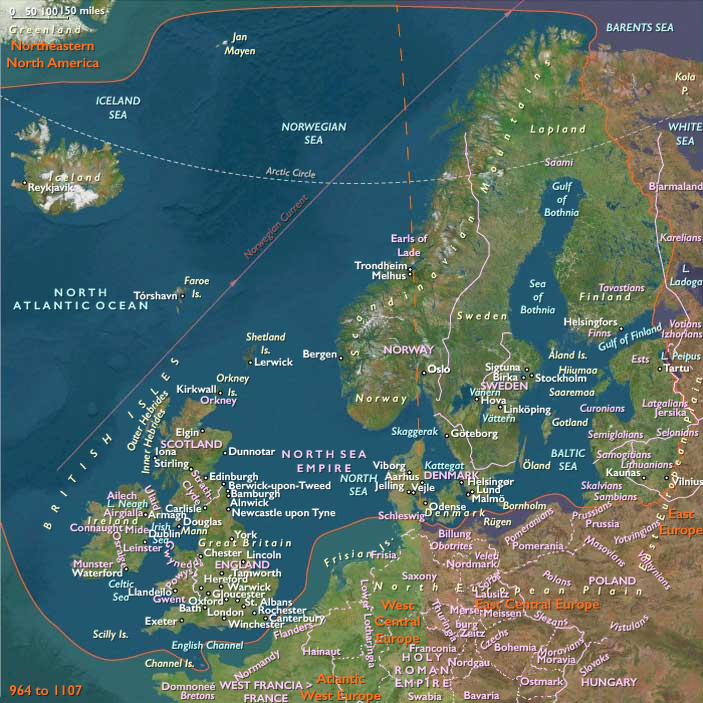
Ireland remained politically fragmented through this era. Regional kingdoms maintained frequent rivalries and conflicts. Norse-Gaelic towns, such as Dublin, Waterford, Wexford, and Limerick, prospered as independent mercantile hubs. Integration between the Norse settlers and native Irish elites laid foundations for Ireland’s complex socio-political future.
Denmark and Norway: Shifting Power Dynamics
Scandinavia experienced significant changes following Harald Hardrada’s death in 1066. His sons, Magnus II and Olaf III (Olaf Kyrre), inherited a divided Norway, initiating a period of internal stability and reduced foreign military ventures. Olaf III notably established Bergen as a major trading port, enhancing Norway’s commercial prominence.
In Denmark, Sweyn II Estridsson (r. 1047–1076) consolidated his rule through internal administrative and ecclesiastical reforms. He supported repeated, though ultimately unsuccessful, invasions of England (1069–1070) in alliance with Anglo-Saxon rebels against William’s regime.
Iceland and Norse Atlantic Settlements
Iceland maintained stable governance via the Althing, and its cultural and religious life flourished. The era saw increased manuscript production, preserving sagas, histories, and genealogies. The Norse settlements in the Faroe Islands, Orkney, and Shetland likewise thrived as crucial maritime centers facilitating trade and cultural exchange across Northwest Europe.
Religious and Cultural Transformations
The Norman Conquest profoundly reshaped England’s ecclesiastical structures. Norman bishops and abbots promoted continental monastic reforms, aligning English Christianity more closely with broader Gregorian reform movements.
In Scotland, Queen Margaret’s influence enhanced ecclesiastical connections to Rome, initiating significant religious renewal and reform in Scottish churches and monastic foundations.
Legacy of the Era
By 1071 CE, Northwest Europe had undergone profound political and cultural transformations. The Norman Conquest reshaped England, introducing lasting linguistic and social changes. Scotland under Malcolm III embraced both indigenous and Anglo-Saxon influences, strengthening its distinct cultural and political identity. Norway and Denmark experienced a shift toward internal stability and commercial prosperity, while Ireland continued its fragmented yet culturally vibrant existence. Iceland and the Norse Atlantic communities preserved robust trade networks and cultural traditions.
This critical period established foundations that would profoundly shape medieval Europe’s political, cultural, and religious landscape.