Magnentius
usurper of the Roman Empire
Years: 303 - 353
Flavius Magnus Magnentius (303 – August 11, 353) is a usurper of the Roman Empire (January 18, 350 – August 11, 353).
Related Events
Filter results
Showing 10 events out of 25 total
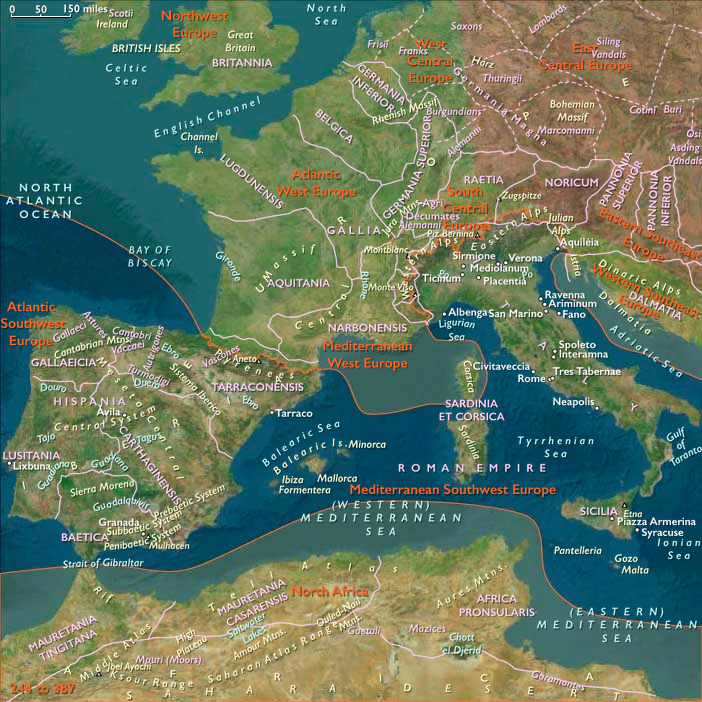
Mediterranean Southwest Europe (244–387 CE): Crisis, Reform, and Transformation
The age 244–387 CE in Mediterranean Southwest Europe encompasses a critical period marked by profound imperial instability, extensive administrative and economic reforms, significant cultural and religious developments, and major transformations within the Roman Empire.
Military Anarchy and Imperial Fragmentation (244–267 CE)
Following the collapse of the Severan dynasty, Rome descends into military anarchy, characterized by frequent changes in imperial leadership, widespread economic disruption, and intensified external pressures from Germanic and Persian incursions. Economic decline and provincial autonomy grow as centralized authority weakens.
Aurelian's Restoration and Economic Reforms (268–279 CE)
Emperor Aurelian (270–275 CE) briefly restores imperial unity, reconquering breakaway territories and initiating critical economic reforms. He constructs defensive fortifications such as Rome's Aurelian Walls, revitalizing stability and temporarily reversing economic deterioration.
Diocletian's Reforms and the Tetrarchy (280–303 CE)
Diocletian ascends in 284 CE, significantly reforming administrative, military, and economic structures through the establishment of the Tetrarchy—a system designed to stabilize governance by dividing power among four emperors. His policies include provincial restructuring, fortified frontiers, currency stabilization, and the Edict on Maximum Prices.
Collapse of the Tetrarchy and Constantine’s Rise (304–315 CE)
The Tetrarchy disintegrates following Diocletian’s retirement in 305 CE, leading to intense civil wars. Constantine the Great emerges victorious at the Battle of Milvian Bridge (312 CE), issuing the landmark Edict of Milan (313 CE), which grants religious tolerance to Christianity and reshapes imperial religious policy.
Constantine's Consolidation and the Council of Nicaea (316–327 CE)
Constantine consolidates imperial authority, establishing the new imperial capital, Constantinople, in 324 CE. His reign sees the First Council of Nicaea (325 CE), decisively shaping Christian doctrine through the Nicene Creed, significantly impacting religious uniformity and ecclesiastical structures.
Dynastic Rivalries and Imperial Instability (328–351 CE)
Following Constantine’s death, dynastic rivalries erupt among his sons—Constantine II, Constantius II, and Constans—leading to internal conflict, division of the empire, and instability. The assassination of Constans (350 CE) by the usurper Magnentius further destabilizes the empire, underscoring deep-seated political vulnerabilities.
Cultural Flourishing and Christian Symbolism (352–363 CE)
Cultural life thrives despite political uncertainties, notably illustrated by the sarcophagus of Junius Bassus (359 CE). Christian symbolism increasingly permeates artistic and intellectual expression, transforming classical Roman traditions through integration with Christian narratives and iconography.
Imperial Division and Valentinian Dynasty (364–375 CE)
Valentinian I divides imperial responsibilities with his brother Valens in 364 CE, establishing a precedent for administrative separation between Western and Eastern empires. His reign sustains regional prosperity, fortifies frontier defenses, and navigates religious tensions, reflecting complex internal dynamics.
Gothic Crisis and Imperial Struggles (376–387 CE)
The Gothic influx of 376 CE triggers severe crises, culminating in the catastrophic Battle of Adrianople (378 CE), where Emperor Valens perishes. Theodosius I’s subsequent rule attempts imperial recovery, notably through treaties integrating Gothic tribes as federate allies, and the Edict of Thessalonica (380 CE), which declares Nicene Christianity the empire’s official faith.
Legacy of the Age
The age 244–387 CE profoundly reshapes Mediterranean Southwest Europe through cycles of crisis, reform, and transformation. Among its enduring legacies are the restructuring of imperial governance, the rise and consolidation of Christianity as the official religion, and resilient cultural developments. The Roman influence deeply shapes Western civilization, evident in the widespread adoption of Romance languages derived from Latin, the numerical system, the modern Western alphabet and calendar, and the establishment of Christianity as a major world religion. Christianity, introduced into Spain in the first century, becomes widespread in urban centers by the second century but gains significant influence in rural areas only by the late fourth century. Despite the emergence of heretical sects, the Spanish Church remains subordinate to the Bishop of Rome, shaping the region’s religious identity for centuries.
The Revolt of Magnentius and the Battle for the Western Roman Empire (350–353 CE)
In 350 CE, Emperor Constans, the unpopular ruler of the Western Roman Empire, was overthrown and killed in a military conspiracy. His death led to the rise of Magnentius, a barbarian officer of Frankish descent, who was proclaimed emperor by the legions. This triggered a civil war with Constantius II, the last surviving son of Constantine the Great, who sought to avenge his brother’s murder and reclaim control of the West.
1. The Rise of Magnentius and His Early Successes (350 CE)
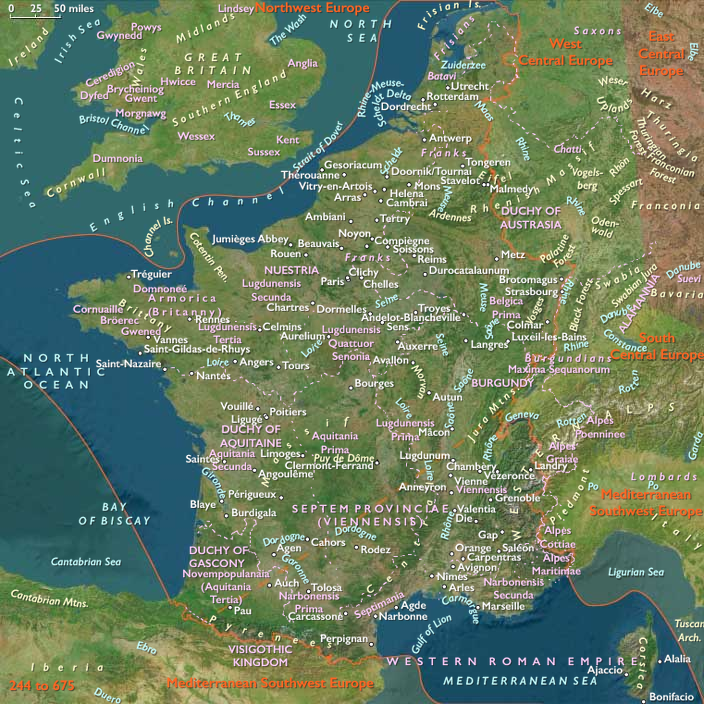
- Magnentius, commander of the Roman forces in Gaul, was proclaimed Augustus in Autun (modern France)after his soldiers assassinated Constans.
- His rule was widely accepted in the West, gaining the support of Britannia, Gaul, Hispania, and North Africa.
- Constantius II, who ruled the Eastern Roman Empire, refused to recognize Magnentius and prepared for war to avenge his brother.
2. The Civil War Begins: Magnentius Invades Illyricum (351 CE)
- In an attempt to strike first, Magnentius invaded Illyricum, a strategically important region connecting the Eastern and Western Empires.
- His army initially performed well, winning battles against Constantius' generals.
- However, his forces soon faced a major challenge—the cataphract cavalry of the Eastern Roman army.
3. The Turning Point: The Battle of Mursa (351 CE)
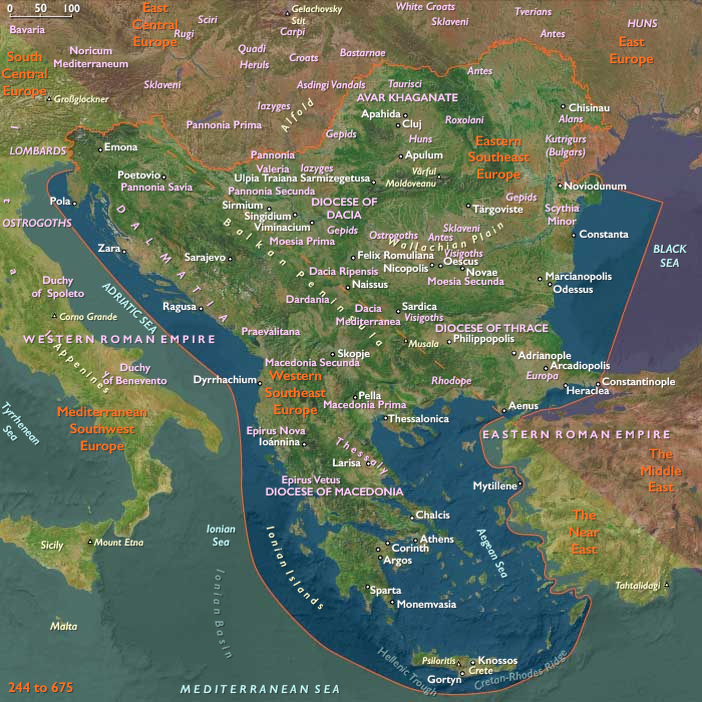
- The decisive battle took place at Mursa (modern Osijek, Croatia), where Constantius II’s army and Magnentius' forces clashed.
- Constantius’ heavily armored cataphract cavalry proved devastating against Magnentius' legions and Germanic auxiliaries.
- The battle resulted in one of the bloodiest defeats in Roman history, with both sides suffering massive casualties.
- Despite the heavy losses, Constantius emerged victorious, forcing Magnentius to retreat to northern Italy.
4. The Fall of Magnentius and the End of the Civil War (353 CE)
- After the defeat at Mursa, Magnentius’ control over the Western provinces began to unravel.
- Constantius methodically reclaimed Africa, Spain, and southern Italy, cutting off Magnentius' resources and reinforcements.
- In 353 CE, Constantius marched north to finally crush Magnentius, forcing him to retreat into Gaul.
- Facing rising opposition from both his army and the local population, Magnentius committed suicide, effectively ending the civil war.
5. Aftermath and Consequences
- Constantius II became sole ruler of the Roman Empire, the first time since the death of Constantine the Great that the empire was reunited under a single emperor.
- The civil war had devastated the Roman military, especially at Mursa, where the losses were so high that Rome struggled to recover its manpower.
- Constantius purged the remnants of Magnentius’ supporters and reinforced his autocratic rule, solidifying his position until his death in 361 CE.
Conclusion: The Lasting Impact of the Conflict
The revolt of Magnentius and the Battle of Mursa demonstrated the military and political instability of the mid-4th century. Though Constantius II reunited the empire, the heavy losses from the civil war weakened Rome’s ability to resist external threats, setting the stage for future Germanic and Persian pressures on the empire.
Mediterranean Southwest Europe (340–351 CE): Dynastic Rivalries and Shifts in Imperial Authority
The era 340–351 CE in Mediterranean Southwest Europe marks a period of significant political instability, characterized by dynastic rivalries among Constantine’s sons, continued religious developments, and evolving imperial structures. This turbulent period follows Constantine’s death, highlighting the challenges of maintaining unity in a vast empire.
Dynastic Conflict and Division of Power
Following Constantine’s death in 337 CE, his sons—Constantine II, Constantius II, and Constans—inherit a divided empire, quickly leading to internal conflicts. Rivalries among the brothers intensify, culminating in Constantine II’s invasion of Italy and subsequent defeat and death in 340 CE. This event leaves Constans and Constantius II in control of the western and eastern parts of the empire, respectively.
Consolidation under Constans
Constans emerges as the ruler of the western territories, including Mediterranean Southwest Europe. His reign initially maintains stability, enforcing imperial authority and sustaining regional prosperity through continued administrative oversight and economic policies inherited from Constantine.
Religious Policies and Arian Controversies
Religious tensions persist, especially concerning the ongoing Arian controversy. Constans supports Nicene Christianity against the Arians, reinforcing the Nicene Creed's theological dominance throughout the western provinces. Ecclesiastical disputes continue to shape religious politics, significantly influencing imperial governance and social cohesion.
Economic Stability Amid Political Uncertainty
Despite internal dynastic tensions, economic stability and regional prosperity endure, benefiting from Constantine’s earlier economic reforms. Trade and commerce remain resilient, supported by maintained infrastructure, effective taxation systems, and stable currency.
Cultural Continuity and Christian Influence
Cultural and intellectual life continues to flourish, increasingly shaped by Christian thought and ecclesiastical patronage. Artistic and literary activities thrive, reflecting the growing integration of Christian themes within traditional Roman cultural frameworks.
Military Defense and Frontier Challenges
Constans strengthens frontier defenses, particularly along vulnerable regions. Continued military vigilance and fortifications maintain relative stability, despite ongoing external threats from Germanic tribes and other frontier pressures.
Assassination of Constans and New Instability
In 350 CE, Constans is assassinated during a rebellion led by the usurper Magnentius, plunging the empire into renewed turmoil. Magnentius swiftly gains control over the western provinces, marking a brief but significant period of instability and civil conflict.
Legacy of the Era
The era 340–351 CE underscores the difficulties in maintaining imperial unity following Constantine’s centralized rule. Dynastic rivalries, religious controversies, and internal rebellions illustrate the complex dynamics shaping the Roman Empire’s political landscape. Despite temporary stability under Constans, his assassination signals deeper structural challenges that continue to impact Mediterranean Southwest Europe.
Magnentius' Rise to Power and the Overthrow of Constans (350 CE)
Magnus Magnentius, a pagan of German descent, was born in Samarobriva (modern Amiens, Gaul) and rose to prominence as a distinguished soldier. By 350 CE, he commanded the Herculians and Iovians, two elite imperial guard units, giving him significant military influence (Zosimus, ii.58).
1. Growing Discontent with Constans
- Emperor Constans, ruler of the Western Roman Empire, had become increasingly unpopular among the legions.
- His arbitrary rule and favoritism alienated both the army and the Roman elite.
- By 350 CE, discontent in the ranks of the military had reached a breaking point.
2. The Army Proclaims Magnentius Emperor (January 18, 350 CE)
- On January 18, 350 CE, in Autun (modern France), the army elevated Magnentius to the rank of Augustus, openly declaring rebellion against Constans.
- Magnentius, a capable general and popular leader, quickly gained support from the military and key western provinces.
3. The Fall of Constans and the Beginning of Civil War
- Upon learning of Magnentius’ usurpation, Constans fled southward toward Spain, seeking refuge.
- He was caught and executed by Magnentius' forces in early 350 CE, leaving Magnentius in control of the Western Roman Empire.
- This triggered a civil war with Constantius II, who, as the last surviving son of Constantine the Great, vowed to avenge his brother’s death.
4. The Struggle for the Empire
- The civil war between Magnentius and Constantius II lasted from 350 to 353 CE, culminating in:
- The Battle of Mursa (351 CE)—one of the bloodiest battles in Roman history, where Magnentius was defeated.
- The final Roman campaign in Gaul (353 CE), where Magnentius, losing support, fled into exile and committed suicide.
5. Conclusion: A Failed Bid for Power
- Though Magnentius successfully overthrew Constans, he was ultimately unable to defeat Constantius II, leading to his downfall in 353 CE.
- His pagan beliefs and anti-Christian stance may have also contributed to his loss of elite and imperial support.
- The civil war significantly weakened the Western Roman military, paving the way for future instability and external invasions.
Magnentius' brief rule and ultimate defeat exemplified the power struggles and fragmentation that plagued the Roman Empire in the 4th century, foreshadowing further internal conflicts and the eventual fall of the Western Roman Empire.
Constans, abandoned by all except a handful of retainers, is slain shortly afterwards by a troop of light cavalry near the Pyrenees.
Magnentius quickly attracts the loyalty of the provinces in Britannia, Gaul, and Hispania, in part because he proves to be far more tolerant towards both Christians and Pagans.
He applies his control on Italia and Africa through the election of his men to the most important offices.
Nepotianus is the son of Eutropia, half-sister of Emperor Constantine I, and of Virius Nepotianus; on his mother's part, he is grandson of Emperor Constantius Chlorus and Flavia Maximiana Theodora.
He proclaims himself emperor and enters Rome with a band of gladiators on June 3, 350, which causes the Praefectus urbi Titianus (or Anicius, or Anicetus), allied to Magnentius, to flee, after being defeated at the head of an undisciplined force of Roman citizens.
Magnentius quickly deals with the situation by sending his trusted magister officiorum Marcellinus to Rome.
Nepotianus is killed in the resulting struggle (June 30, 350), his head put on a lance and brought around the city (Eutropius).
In the following days, Eutropia too is killed, within the persecution of the supporters of Nepotianus, most of whom are senators.
Magnentius fails, however, to win failing to win recognition from Constantius.
Magnentius moves toward the Danube, where he allies himself with the commander of the Danubian troops, Vetranio, who at the behest of Constantia, the sister of Constantius II, had stood successfully for election by his troops as Augustus on March 1, 350 and taken power in Illyricum.
Constantia’s brother Constans had been killed by Magnentius earlier this year and she probably thinks Vetranio can protect her family and herself against the usurper.
Vetranio accepts and coins are minted in his name, showing the title of Augustus (full emperor), rather than Caesar.
This revolt has a loyalist mark, since Constantina supports Vetranio and Constantius II himself had recognized him, sending Vetranio the imperial diadem as well as money to raise an army.
This arrangement ends quickly with the abrupt overthrow of Vetranio by Constantius, who has broken off his war in Syria with Persia, and marched west.
Despite Magnentius’s effort to gain Vetranio to his cause, the old general reaches Constantius with his army, first meeting with Constantius at Serdica; …
…the combined forces then move on to Naissus in Pannonia.
On December 25, 350, both men mount a platform before the assembled troops; Constantius manages, by means of a strong speech, to have the soldiers acclaim him emperor.
He then takes the purple away from Vetranio, leads the old man down the stairs of the platform, calls him father, and escorts him to the dinner table. (Constantius will allow Vetranio to live as a private citizen at Prusa on the equivalent of a state pension for six years until his death.)
Magnentius Proclaims Magnus Decentius as Caesar (Winter 350/351 CE)
Following his usurpation of the Western Roman Empire in 350 CE, Magnentius faced the looming threat of Constantius II, who ruled the Eastern Roman Empire and sought to avenge the murder of his brother, Constans. To strengthen his rule and secure the northern frontier, Magnentius proclaimed Magnus Decentius, likely his brother, as Caesar, probably during the winter of 350/351 CE.
1. The Role of Magnus Decentius
- Decentius was entrusted with the defense of Gaul and the Rhine frontier, a critical region vulnerable to Germanic invasions.
- By appointing a Caesar, Magnentius sought to consolidate his power in the West, allowing him to focus on fighting Constantius II in the East.
- The move also served to legitimize his rule, mirroring the Tetrarchic system established under Diocletian, where emperors had junior co-rulers.
2. The Struggle Against Constantius II
- Despite these strategic moves, Magnentius suffered a crippling defeat at the Battle of Mursa (351 CE) against Constantius II, greatly weakening his position.
- As Magnentius’ power declined, so too did Decentius’ authority in Gaul.
- By 353 CE, after Constantius' final victory, both Magnentius and Decentius faced collapse.
3. The End of the Usurpers (353 CE)
- Magnentius, seeing no path to victory, committed suicide in August 353 CE.
- Decentius, realizing his position was hopeless, also took his own life shortly after.
- With their deaths, Constantius II became the sole ruler of the Roman Empire, ending the last major civil war of the mid-4th century.
4. Conclusion: A Short-Lived Attempt at Stability
- The appointment of Magnus Decentius as Caesar was a practical move to protect Gaul and the Rhine frontier, but it ultimately failed to stop Constantius II's advance.
- Their defeat marked the reunification of the empire under Constantius II, but the losses suffered in the civil war severely weakened the Western Roman military, making it more vulnerable to future external invasions.
Magnentius’ attempt to maintain a breakaway empire ultimately collapsed, demonstrating the chronic instability of the late Roman Empire, where military usurpations frequently led to destructive civil wars.