Madeleine of Valois
Queen consort of Scots
Years: 1520 - 1537
Madeleine of Valois (10 August 1520 – 7 July 1537), also known as Magdalene of Valois, is a French princess who becomes Queen consort of Scots as the first spouse of James V of Scotland.

Related Events
Filter results
Showing 5 events out of 5 total
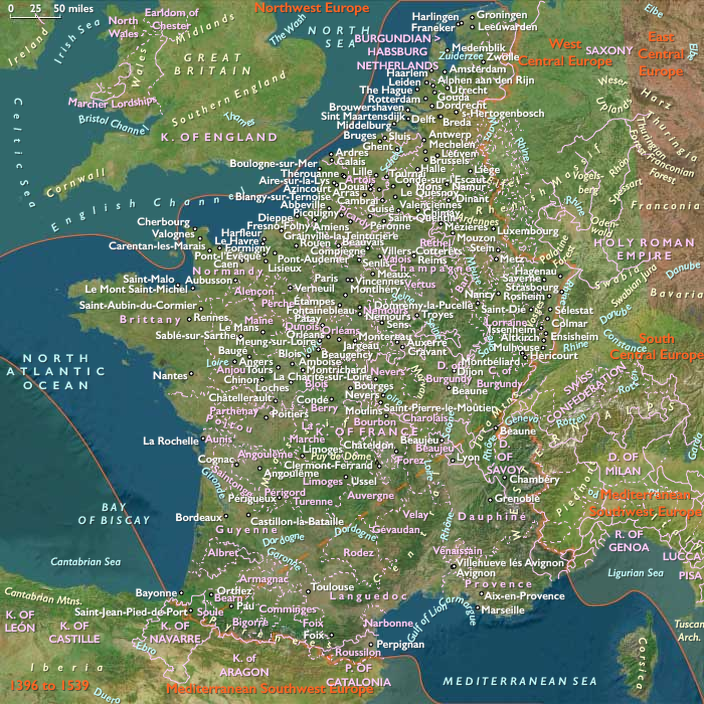
Atlantic West Europe: Renaissance Consolidation, Shifting Alliances, and Deepening Religious Conflict (1528–1539)
The era from 1528 to 1539 marks a period of diplomatic consolidation, intensifying religious divisions, expanded royal authority, cultural sophistication, and increasingly ambitious exploration in Atlantic West Europe. It represents the concluding phase of the Upper Late Medieval Age, highlighting how the transformative currents of the Renaissance and the Reformation shape the region’s political, social, and cultural landscape.
Political and Military Developments
The prolonged rivalry between the Valois (France) and Habsburg (Holy Roman Empire/Spain) dynasties continues, although open warfare briefly subsides after the Treaty of Cambrai (1529), known as the “Ladies’ Peace,” negotiated between Louise of Savoy (Francis I's mother) and Margaret of Austria (Charles V's aunt). While temporarily stabilizing borders and releasing Francis’s sons from captivity, the treaty resolves few fundamental differences, ensuring continued geopolitical tensions.
Scotland’s King James V reaffirms the “Auld Alliance” with France by marrying Madeleine de Valois (1537), demonstrating the region’s enduring diplomatic significance. Madeleine’s early death, however, limits the marriage's political impact.
English diplomacy under Henry VIII, influenced by his contentious marriage controversies and break with Rome (1534), significantly reshapes Atlantic West Europe’s diplomatic alignments. England’s internal religious upheaval indirectly emboldens Protestant movements elsewhere, increasing geopolitical instability.
Economic Developments
The region continues its vibrant commercial and financial growth, with Antwerp reinforcing its status as Europe’s preeminent trade and finance hub. Antwerp’s stock exchange, founded in 1531, becomes crucial to European financial infrastructure, facilitating increased international investment and trade flows.
France’s economic strategies evolve under Francis I, who seeks to consolidate royal authority and control state finances through administrative reforms such as the Ordinance of Villers-Cotterêts (1539). This crucial ordinance mandates the use of French instead of Latin in legal and administrative affairs, strengthening central governance.
Cultural and Artistic Flourishing
The French Renaissance reaches new heights of sophistication under Francis I. He attracts Italian Mannerist artists—Rosso Fiorentino (1530) and Francesco Primaticcio (1531)—to decorate the royal palace at Fontainebleau, initiating what becomes known as the “First School of Fontainebleau.” This profoundly influential style combines Italian Renaissance aesthetics with distinctly French refinement, creating an enduring artistic legacy.
French humanism blossoms with the founding of the Collège Royal (later Collège de France) in 1530 under Francis’s patronage, promoting study in Greek, Hebrew, and Latin and fostering intellectual openness. The influential poet Clément Marot embodies courtly literary culture, blending humanist ideas with vernacular elegance.
In the Low Countries, painters such as Jan van Scorel and Jan Mabuse integrate Italian Renaissance motifs with Netherlandish traditions, producing distinctive Mannerist works. Glass painter Jean Cousin père emerges as a significant French Renaissance artist.
Religious and Intellectual Developments
This period sees the deepening and entrenchment of religious divisions sparked by the Protestant Reformation. Despite Francis I’s earlier tolerance, the explosive “Affair of the Placards” (1534)—in which Protestant notices attacking Catholic Mass appear in Paris, including at the royal palace—dramatically shifts royal policy towards persecution. This marks intensified repression of Protestantism throughout France, driving many reformers, including young theologian John Calvin, into exile.
Protestantism grows significantly in the Netherlands, though increasingly harsh countermeasures under Charles V, including the establishment of the Inquisition, set the stage for prolonged religious and political conflict. Menno Simons, leader of moderate Anabaptism from 1536, promotes pacifism and communal living, but faces intense persecution.
The Catholic Church begins its own internal reforms (Counter-Reformation), notably through Ignatius Loyola, who founds the Jesuit Order (1534), committed to reforming the Church, combating Protestantism, and spreading Catholicism globally.
Technological and Societal Shifts
Increased sophistication in print culture helps disseminate Renaissance humanist thought and Protestant ideas, profoundly impacting literacy and cultural discourse. Advances in shipbuilding, navigational technologies, and mapmaking support ambitious exploratory ventures, positioning Atlantic West Europe as a launching point for global maritime exploration.
In medicine and alchemy, the groundbreaking Swiss-German figure Paracelsus (active around 1530) promotes chemical medicines and new conceptions of disease, influencing future developments in medical science.
Exploration and Global Influence
French transatlantic exploration accelerates significantly. Navigator Jacques Cartier conducts voyages in 1534 and subsequent years, exploring and claiming territories along the Saint Lawrence River, laying foundations for future French settlement in North America and broadening French ambitions to compete with Spanish and Portuguese colonial enterprises.
Long-term Consequences and Significance
The era from 1528 to 1539 decisively shapes Atlantic West Europe’s subsequent historical trajectory. While the temporary peace between Francis and Charles brings brief respite, unresolved tensions set the stage for future conflicts. Religious divisions, solidified during this period, persistently affect European politics and culture, leading to decades of religious wars and persecutions.
Culturally, the period sees the flourishing of the French Renaissance, profoundly influencing European art, architecture, and humanism. The establishment of French as a formal administrative language under Francis I enhances national identity, reflecting increased royal centralization. Finally, intensified transatlantic exploration signals Atlantic West Europe’s expanding role in global exploration and colonization, foreshadowing profound changes to Europe’s geopolitical landscape.
King James V of Scotland firmly aligned himself with the pro-French, Catholic faction, resisting English influence during a critical phase of diplomatic realignments in Europe. His commitment to France was deeply rooted in the historic Auld Alliance, which bound Scotland and France against their mutual adversary, England.
Diplomatic Maneuvering and the Treaty of Rouen (1517)
As early as August 1517, under the terms of the Treaty of Rouen, France had pledged a royal bride for the Scottish king if the traditional Franco-Scottish alliance was upheld. However, fulfilling this promise proved complicated. The daughters of Francis I were either committed elsewhere or suffering from poor health, leaving the marriage issue unresolved.
James’s Marriage Negotiations Elsewhere (1529–1533)
Impatient and perhaps aiming to remind Francis of his obligations, James's diplomats, beginning in the summer of 1529, explored other potential marital alliances, notably with Catherine de' Medici, Duchess of Urbino (who later married the future French king Henry II), and Mary of Austria, Queen of Hungary and sister of Emperor Charles V.
Yet, these explorations also proved inconclusive. By February 1533, two French ambassadors, Guillaume du Bellay, sieur de Langes, and Etienne de Laigue, sieur de Beauvais, freshly returned from Scotland, informed the Venetian ambassador in London that James had shifted interest toward Christina of Denmark—again without reaching an agreement.
The Final Marriage Agreement: Mary of Bourbon (1536)
Ultimately, after prolonged diplomatic uncertainty and Francis I’s refusal due to concerns over his daughter Madeleine’s fragile health, an agreement was finalized on March 6, 1536, for James V to marry Mary of Bourbon, daughter of the Duke of Vendôme, a prominent branch of French nobility. Although Mary was not a princess of royal blood, Francis ensured she would receive a dowry equivalent to that of a French princess, reaffirming Scotland’s elevated standing in French diplomacy.
The marriage arrangement reinforced the diplomatic bonds underpinning the Auld Alliance, reflecting Scotland’s ongoing strategic commitment to France, while underscoring the intricate diplomatic landscape of European alliances during this period.
King James V Visits France (1536): Diplomacy and the Search for a Royal Bride
In pursuit of strengthening the Auld Alliance and securing a French royal marriage, Scotland's King James V embarks on a diplomatic mission to France. Departing from Kirkcaldy on September 1, 1536, James travels aboard the flagship Mary Willoughby, accompanied by a distinguished entourage of Scottish nobility and officials, including the Earl of Argyll, the Earl of Rothes, Lord Fleming, David Beaton (future cardinal), the Prior of Pittenweem, and the Laird of Drumlanrig, along with approximately five hundred attendants.
James first stops in Saint-Quentin in Picardy to visit Mary of Bourbon, daughter of the Duke of Vendôme, who had been formally contracted as his bride earlier in the year. However, James quickly moves southward, shifting his focus to direct negotiations with King Francis I himself, indicating that his intentions and preferences regarding a royal marriage may have evolved.
Diplomatic and Political Context
James's visit is more than ceremonial; it is politically charged and diplomatically sensitive. France and Scotland share historical ties through the Auld Alliance, a strategic partnership intended as mutual protection against England. By reaffirming this alliance in person and securing a royal marriage, James aims to solidify his position both domestically and internationally, aligning Scotland more closely with French interests and support.
Long-term Consequences
The visit results in a change of marriage plans. Rather than proceeding with Mary of Bourbon, James eventually marries Madeleine of Valois, King Francis's daughter, despite earlier concerns over her fragile health. This marriage reaffirms the strength of Franco-Scottish ties, even though Madeleine’s premature death shortly thereafter forces James to seek another French marriage, ultimately wedding Mary of Guise in 1538. This further deepens French influence in Scotland, setting the stage for the political and religious turmoil of subsequent decades.
King James V’s Diplomatic Visit: Hunting at Loches (October 1536)
During his extended diplomatic stay in France, King James V of Scotland strengthens personal and political bonds with the French royal family and prominent nobility. In October 1536, as part of this effort, James participates in a boar hunt at Loches, hosted by King Francis I. Accompanying them on this distinguished hunt are Francis, the Dauphin (the king’s eldest son and heir), Henry II d'Albret, King of Navarre, and the Italian cardinal and nobleman Ippolito II d'Este.
This hunting excursion, far more than mere recreation, serves as a symbol of camaraderie, trust, and mutual respect, strengthening the diplomatic bonds underlying the Auld Alliance between Scotland and France. It emphasizes the informal yet crucial role that social gatherings and leisure activities play in European diplomacy, allowing political leaders to negotiate sensitive matters in a relaxed and amicable atmosphere.
Broader Historical Context
The participation of such high-ranking individuals demonstrates the importance of James’s visit, highlighting his growing status in European politics and underlining the strategic partnership between France and Scotland. Additionally, the presence of Ippolito II d'Este, a prominent figure in European diplomacy and church politics, underscores the wider European significance of this seemingly casual event.
Long-term Significance
These personal interactions and relationships formed during the 1536 visit solidify James’s commitment to France, influencing subsequent Scottish policy, especially in the context of rivalry with England. The bonds forged at Loches contribute significantly to deepening French influence in Scotland, with profound implications for both Scottish internal affairs and international relations throughout the mid-sixteenth century.
King Francis I as Patron of Letters (1537)
King Francis I of France earns a distinguished reputation as a patron and man of letters, widely celebrated across Europe for his commitment to fostering culture and intellectual advancement. His stature in this regard is vividly highlighted in the Italian humanist Baldassare Castiglione’s celebrated work, The Book of the Courtier, wherein Francis is portrayed as the great hope who might introduce humanistic culture to a France consumed by warfare.
Francis does not merely support literary achievement—he actively participates as a poet himself, although his poetic talent remains modest compared to his enthusiasm for literature. His deeper legacy lies in his commitment to scholarly pursuits, most notably his vigorous expansion and reorganization of the royal library. To oversee this ambitious cultural project, Francis appoints the renowned humanist Guillaume Budé as the royal librarian. He also dispatches specialized agents to Italy, paralleling his systematic acquisition of artworks, to locate rare books and ancient manuscripts.
In 1537, Francis enhances this commitment by issuing the Ordonnance de Montpellier, a groundbreaking decree mandating that a copy of every book published and sold in France must be deposited in the royal library. This ordinance marks a critical advancement in both intellectual life and governmental policy, setting a precedent for future European national libraries.
Francis further underscores his dedication to humanistic scholarship by making his library accessible to scholars worldwide, dramatically facilitating the diffusion of knowledge and establishing the collection as a cornerstone of early modern learning.
The Cultural Influence of Marguerite of Navarre
Francis's literary patronage is complemented by the intellectual brilliance of his elder sister, Marguerite d’Angoulême, Queen of Navarre, herself an esteemed literary figure. Marguerite’s renowned collection of short stories, the Heptameron, exemplifies the cultured atmosphere fostered by Francis’s court, showcasing Renaissance France's vibrant literary creativity.
Additionally, Francis engages in intellectual correspondence, notably with the distinguished abbess and philosopher Claude de Bectoz. His admiration for her philosophical insights is such that he regularly carries her letters with him, proudly displaying them to the ladies of the court as a testament to his appreciation for learned discourse.
Long-term Significance
King Francis’s emphasis on literature and learning significantly transforms French cultural life, positioning France as a pivotal center of Renaissance humanism. His policies of openness and intellectual exchange shape the future development of scholarly institutions, firmly establishing his legacy as an enduring champion of arts and letters.