Lysias (Syrian Chancellor)
Seleucid general and governor of Syria
Years: 212BCE - 162BCE
Lysias, or Lusias (died 162 BCE) is a 2nd century Seleucid General and governor of Syria under the Seleucid Empire.



Related Events
Filter results
Showing 10 events out of 10 total
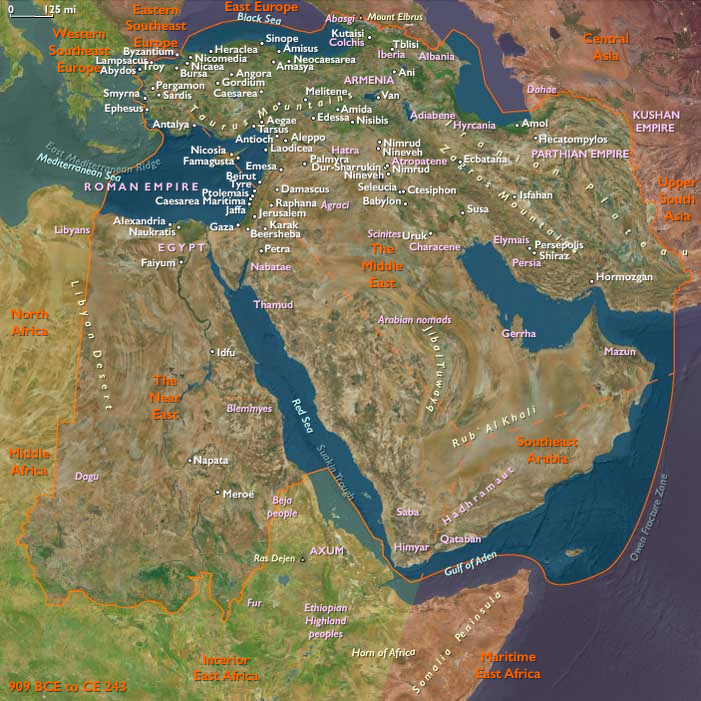
The Middle East: 165–154 BCE
The Maccabean Revolt and the Fragmentation of Seleucid Power
The era from 165 to 154 BCE witnesses profound political and religious upheaval in the Middle East, epitomized by the Maccabean Revolt, a pivotal event highlighting Jewish resistance to Greek cultural hegemony under the Seleucid Empire. Antiochus IV Epiphanes’ aggressive promotion of Hellenism reaches a climax with his desecration of the Temple in Jerusalem, erecting a statue of Zeus there in 167 BCE—an act seen as intolerable sacrilege by the Jewish population.
This incendiary act triggers the uprising in 165 BCE, initiated by Mattathias the Hasmonean, a rural Jewish priest from Modiin. Mattathias vehemently rejects Antiochus' decrees banning traditional Jewish religious practices, notably circumcision and Sabbath observance. When a fellow Jew attempts to sacrifice to a Greek idol under pressure from Seleucid representatives, Mattathias intervenes violently, killing the man. He flees into the wilderness of Judah with his five sons, beginning the armed resistance.
Following Mattathias’ death in 166 BCE, his son Judah Maccabee takes command, adopting guerrilla warfare tactics that prove highly effective against the Seleucid military. Judah’s forces earn the moniker "Maccabees," meaning "hammer," signifying their tenacious resistance and military prowess. The Maccabean campaign initially targets Hellenized Jews, forcibly reinstating Jewish law and religious traditions across rural areas.
In 164 BCE, after a series of successful battles, Judah Maccabee and his forces recapture Jerusalem, ritually cleanse the desecrated Temple, and restore traditional Jewish worship. This momentous event is commemorated by the Jewish festival of Hanukkah. Subsequently, Judah appoints his brother Jonathan Maccabee as high priest, marking a crucial political as well as religious victory.
The Seleucid response is formidable, dispatching a large army under commander Lysias to suppress the revolt. However, internal Seleucid crises following the death of Antiochus IV in 164 BCE distract Lysias, forcing him to negotiate rather than fight prolonged battles. Recognizing the futility of continued conflict, Lysias agrees to a political compromise, restoring religious freedom to the Jews and effectively granting a significant measure of autonomy.
This era further sees the accelerating fragmentation of Seleucid control, exemplified by the loss of strategic territories such as Commagene in Syria and Judea in Palestine. The Maccabean Revolt serves as a catalyst for broader political fragmentation, as local leaders throughout the region increasingly assert independence from Seleucid authority.
Thus, the period from 165 to 154 BCE signifies a pivotal moment in Middle Eastern history, characterized by the rise of Jewish self-governance under the Hasmonean dynasty, the erosion of Seleucid imperial cohesion, and the emergence of new regional powers that will shape the region’s political landscape for decades to come.
Jewish resistance to Greek cultural hegemony peaks during the reign of Antiochus IV (175-164), whose promotion of Hellenism culminates in his raising a statue to Zeus in the temple at Jerusalem.
This act sparks the Maccabean uprising beginning in 165.
The inexorable decline of the Seleucid Empire accelerates after the death of Antiochus IV with the loss of Commagene in Syria and of Judea in Palestine.
In the narrative of I Maccabees, a book written in Hebrew by a Jewish author after the restoration of an independent Jewish kingdom, a rural Jewish priest from Modiin, Mattathias the Hasmonean, sparks a revolt against the Seleucid Empire by refusing to worship the Greek gods after Antiochus IV issues his decrees forbidding Jewish religious practice.
Mattathias kills a Hellenistic Jew who steps forward to offer a sacrifice to an idol in Mattathias' place.
He and his five sons flee to the wilderness of Judah.
After Mattathias' death about one year later in 166 BCE, his son Judah Maccabee leads an army of Jewish dissidents against the Seleucid dynasty in guerrilla warfare, which at first is directed against Hellenized Jews, of whom there are many.
The Maccabees destroy pagan altars in the villages, circumcise boys and force Jews into outlawry.
The term Maccabees as used to describe the Jewish army is taken from the Hebrew word for "hammer".
The revolt itself involves many battles, in which the Maccabean forces gain notoriety among the Seleucid army for their use of guerrilla tactics.
After the victory, the Maccabees enter Jerusalem in triumph and ritually cleanse the Temple, reestablishing traditional Jewish worship there and installing Jonathan Maccabee as high priest.
A large Seleucid army is sent to quash the revolt, but returns to Syria on the death of Antiochus.
Its commander, Lysias, preoccupied with internal Seleucid affairs, agrees to a political compromise that restores religious freedom.
Near East (165–154 BCE): The Maccabean Revolt and Seleucid Decline
The era from 165 to 154 BCE in the Near East is marked by heightened Jewish resistance against Greek cultural hegemony under Seleucid rule. The aggressive Hellenization efforts of Seleucid king Antiochus IV Epiphanes, including the erection of a statue to Zeus within the Jerusalem Temple, trigger widespread Jewish unrest. This culminates in the Maccabean Revolt, which begins in earnest in 165 BCE.
The revolt is sparked by Mattathias the Hasmonean, a rural Jewish priest from Modiin, who defies Antiochus IV's decrees forbidding traditional Jewish practices. After Mattathias publicly kills a Hellenistic Jew who attempts to sacrifice to a pagan idol, he flees to the Judean wilderness with his five sons, igniting an armed rebellion. Upon Mattathias' death around 166 BCE, his son Judas Maccabee assumes leadership of the insurgency, leading effective guerrilla campaigns against both Seleucid forces and Hellenized Jews. The name "Maccabees," derived from the Hebrew word for "hammer," aptly symbolizes the fierce and relentless tactics employed by Judas's forces.
Judas Maccabee and his followers achieve significant victories, notably reclaiming and ritually cleansing the Jerusalem Temple, thereby restoring traditional Jewish worship. Jonathan Maccabee is installed as high priest. Although Seleucid commander Lysias attempts to suppress the revolt with a large military force, internal Seleucid political upheaval following Antiochus IV's death ultimately compels him to withdraw and reach a political compromise. This compromise restores religious freedoms to the Jews, marking a significant turning point in Jewish history.
The aftermath of Antiochus IV’s demise accelerates the weakening of the Seleucid Empire, characterized by the loss of regions such as Commagene in Syria and Judea in Palestine. This erosion of Seleucid power significantly reshapes the political landscape of the Near East.
Legacy of the Era
The Maccabean Revolt represents a critical juncture in Jewish history, laying the foundation for Jewish autonomy and cultural resilience against external pressures. The events of this period underscore the declining strength of the Seleucid Empire and the increasingly complex dynamics between Hellenistic rulers and local populations, setting the stage for future developments in the region.
Mithridates I of Parthia, taking advantage of Antiochus' western problems, had attacked from the east and seized the city of Herat in 167 BCE, disrupting the direct trade route to India and effectively splitting the Greek world in two.
Antiochus, recognizing the potential danger in the east but unwilling to give up control of Judea, had sent a commander named Lysias to deal with the Maccabees, while the King himself is to lead the main Seleucid army against the Parthians.
Setting out in 164 BCE on an expedition to the Arabian coast, he funds the city of Antioch on the Persian Gulf, where its mint is to serve the trade along the sea route between India and the district at the mouth of the great Mesopotamian rivers.
Near the end of the year, the fifty-one-year-old monarch of an illness at Tabae (or Gabae, probably present Isfahan) in Persis.
(Many believers see his death as a punishment for his attempt to loot the shrine of Nanaia in Elam, but this story seems to be baseless.
The numbers of claimants to the Seleucid throne following the death of Antiochus make a continuous Seleucid policy toward Palestine impossible, because each claimant feels the need to seek support wherever it might be found.
The Roman Senate still keeps Demetrius, son of Seleucus IV and the rightful heir to the throne, as hostage, refusing to release him because they consider it better to have Syria nominally ruled by a boy and his regent than the twenty-two-year-old Demetrius.
The general Lysias, who had been left in charge of Syria by Epiphanes, had collected another army at Antioch, and after the recapture of Beth-zur had been besieging Jerusalem when he learned of the approach of Philip, to whom Antiochus, on his deathbed, had entrusted the guardianship of the first son of Laodice IV and Antiochus III.
This prince, a younger cousin of Demetrius, is only nine years old when he succeeds to the kingship as Antiochus V. Lysias, returning to Syria to claim the regency, defeats Philip in 163 BCE; he is supported at Rome.
Timarchus, a Greek satrap of the Seleucid province of Media, becomes the more or less independen, in opposition to the general Lysias, who acts as steward for the infant king Antiochus V.
Timarchus has distinguished himself by defending Media against the emergent Parthians.
On his coins, Timarchus introduces the epithet "Great King" (Basileus Megas) which is the traditional Achaemenid title and may reflect an effort to gather support from the natives in a time when the Seleucid empire has lost ground in Iran.
He is inspired by the Bactrian king Eucratides the Great, who had assumed the same title a few years earlier.
The Syrians attempt to quell the Maccabean Revolt in Judaea at the outset of the reign of Antiochus V, but this ends in a weak compromise.
After a military victory in the Battle of Beth-Zecharia, and the killing of Eleazar, a brother of Judas Maccabaeus, the Syrian chancellor, Lysias is informed that Philip, (a confidant of Antiochus IV Epiphanes, who had accompanied this previous king to conquer Mesopotamia, and had been entrusted prior to the death of the king with the upbringing of Antiochus V), is returning to the capital with the other half of the Seleucid army.
Lysias feels threatened, and advises Antiochus V to offer peace to the Jews.
The Jews accept.
However, in order to ensure they will not rise against them soon again, the Syrian king and regent break their promise and tear down the walls of Jerusalem before leaving.
The Pharisees, a Jewish sect, emerge as a clearly defined party during the revolt of the Maccabees. (The name Pharisees is of uncertain origin; one suggestion renders it as "those separated," meaning separation from impurity and defilement.)
The Roman senate, on hearing that the Syrian kingdom is keeping more warships and elephants than allowed by the peace treaty of Apamea made in 188 BCE, send a Roman embassy to travel along the cities of Syria and attempt to cripple Seleucid military power by sinking the Syrians' warships and hamstringing their elephants.
Lysias dares do nothing to oppose the Romans, but his subservience has so enraged his Syrian subjects that the Roman envoy Gnaeus Octavius (consul of 165 BCE) is assassinated in Laodicea in 162 BCE).
The Hasideans trace their origins to the so-called Hasidim ha-Rishonim ("early pious men") of the fourth century BCE, members of Judean agricultural communities who followed the teachings of simple piety and brotherly love.
Rebelling against Hellenistic influences, the Hasideans emphasize a meticulous observance of their own traditions.
The apolitical Hasideans, satisfied with the victory of the Jewish faith, withdraw from further fighting, as the Jews have secured liberty of conscience and worship.
At the same time, the regular practice of pagan worship, beside the Jewish, has been established, and a Seleucid nominee is appointed high priest.
The seeds of fresh revolt thus laid, the war soon resumes.
Judas almost immediately again takes the field, at one point sending a six-member delegation to Rome to seek help.
Demetrius, having escaped from confinement in Rome with the help of the historian Polybius, is received in Syria as the true king.
Welcomed back on the Syrian throne in 161 BCE, he immediately kills Antiochus V and Lysias.
This may well have been the provocation that caused Timarchus to take the final step to independence and declare himself king.