Louis V, King of Western Francia
King of Western Francia
Years: 967 - 987
Louis V (c. 967 – 21 May 987) (French Louis le Fainéant, meaning "Louis The Lazy"), is the King of Western Francia from 986 until his early death.
The son of King Lothair and his wife Emma, a daughter of Lothair II of Italy, he is the last Carolingian monarch.
Louis is crowned in June of 979 but does not actually assume power until Lothair's death in 986.
Louis V is the last Carolingian King of Western Francia and reigns in Laon from March 2, 986 until his own death, at the age of 20, in 987.
It may be because he reigned for only one year that medieval biographers awarded him the title qui nihil fecit — "who did nothing".

Related Events
Filter results
Showing 5 events out of 5 total
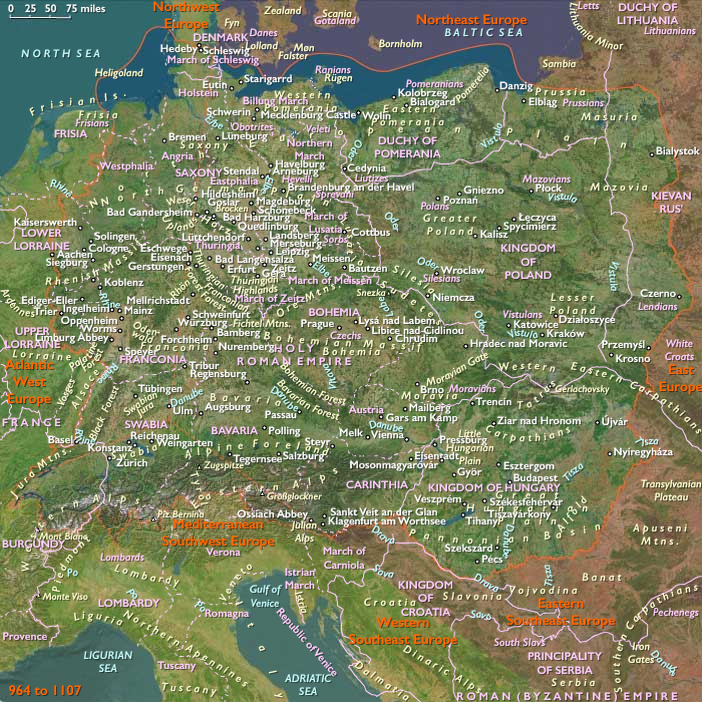
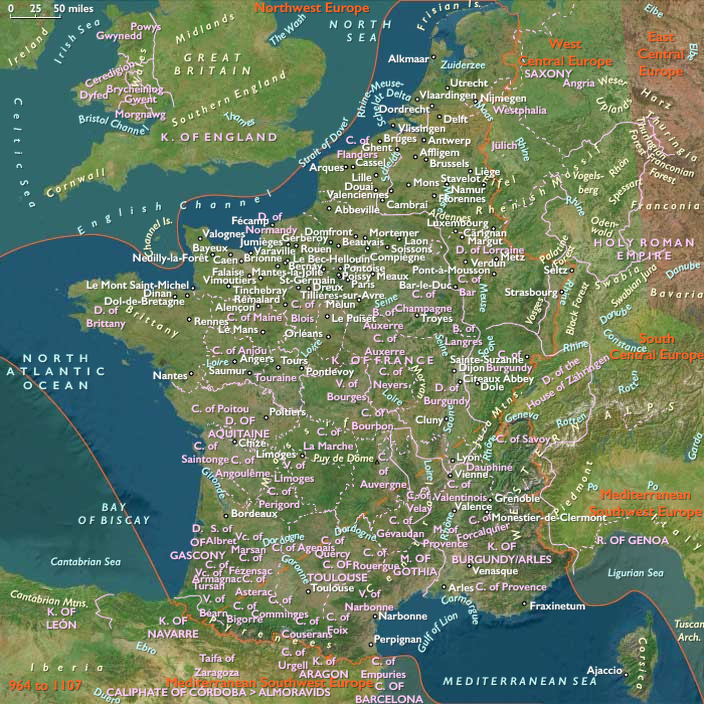
Atlantic West Europe (976–987): The Dawn of Capetian France and Emerging Feudal Orders
Between 976 and 987, Atlantic West Europe—encompassing the Low Countries, Normandy, Brittany, Aquitaine, Burgundy, central France, Alsace, and Franche-Comté—experienced pivotal shifts in power dynamics, marked by the end of Carolingian rule and the rise of the Capetian dynasty, coupled with continued regional autonomy and gradual stabilization.
Political and Military Developments
-
France: The Rise of the Capetian Dynasty
- Hugh Capet, Duke of the Franks and Count of Paris, solidified his control over northern France, culminating in his election as king in 987, ending Carolingian dominance and founding the Capetian dynasty.
- Louis V, the last Carolingian king, died in 987, marking a definitive end to Carolingian rule in West Francia.
-
Normandy: Consolidation under Richard I
- Richard I of Normandy (r. 942–996) strengthened the Duchy through political alliances, internal organization, and defensive military successes against external threats.
-
Aquitaine and Burgundy: Regional Independence
- William IV of Aquitaine (r. 963–990) continued to foster independence and prosperity, maintaining stability and encouraging regional autonomy.
- Otto-William became Count of Burgundy in 982, managing regional affairs with considerable independence from central royal authority.
-
Brittany: Stability and Local Autonomy
- Conan I (r. 990–992), building upon predecessors’ foundations, reinforced Breton autonomy amidst increasing influence from neighboring Normandy and the emerging Capetian France.
Economic and Social Developments
-
Growth of Feudal Structures
- The transition toward decentralized feudal systems accelerated, with powerful dukes and counts asserting greater control over their local domains.
- Economic stability emerged regionally, enabling modest urban and commercial growth, particularly in the Low Countries and Aquitaine.
-
Trade and Maritime Activity
- The Low Countries saw increasing maritime commerce, connecting northern European trade networks, particularly via Bruges and Ghent.
Cultural and Intellectual Developments
-
Monastic and Ecclesiastical Influence
- Benedictine monasteries, notably Cluny, wielded considerable cultural and spiritual influence, promoting monastic reform and ecclesiastical independence.
-
Intellectual Revival
- Modest intellectual revitalization occurred through monastic schools and scriptoria, preserving classical texts and theological scholarship.
Religious Developments
- Church Reform Movements
- The influence of Cluniac reforms expanded across the region, aiming to reduce secular interference in Church matters and elevating monastic discipline.
Legacy and Significance
The period 976–987 marked a significant turning point in Atlantic West Europe:
- Hugh Capet’s rise laid the groundwork for a long-lasting royal dynasty in France.
- Regional autonomy increased, with Normandy, Aquitaine, and Burgundy establishing distinct identities.
- The development of feudal structures provided stability that would shape medieval society for centuries.
- Cluniac reforms significantly influenced religious and cultural norms.
This era thus established foundations for medieval society’s social, political, and religious framework in the following centuries.
othair’s Final Invasion of Lotharingia and His Death (985)
In 985, seizing upon the political turmoil in the Holy Roman Empire following the death of Emperor Otto II (December 983) and the uncertain regency of his three-year-old son, Otto III, King Lothair of West Francia launched another invasion of Lotharingia. This campaign marked his final attempt to reclaim the region, which had remained under Ottonian control despite his previous wars.
The Invasion and Lothair’s Death
- With the empire in transition, Lothair saw an opportunity to challenge Ottonian authority and assert Carolingian claims over Lotharingia once more.
- His forces advanced into the contested borderlands, but before achieving any lasting gains, Lothair died unexpectedly at Laon during the campaign.
- His death in March 986 ended his dynastic ambitions, leaving his son, Louis V, to inherit the throne at a young age.
Aftermath: The Fall of the Carolingian Dynasty
Lothair’s death marked the beginning of the end for Carolingian rule in West Francia. His son, Louis V, proved to be an ineffectual ruler, reigning for only one year before his untimely death in 987. With no direct heirs, the Carolingian dynasty in West Francia collapsed, paving the way for Hugh Capet, Duke of the Franks, to claim the throne and establish the Capetian dynasty, which would rule France for centuries.
Although Lothair’s persistent ambitions in Lotharingia failed, his actions contributed to the long-term rivalry between France and the Holy Roman Empire, a struggle that would continue throughout the medieval period
Hugh Capet’s Rise to the French Throne and the End of the Carolingians (987)
In 987, the death of Louis V, the last Carolingian king of West Francia, ushered in a dynastic shift that would shape France for centuries. The French magnates, wary of continuing Carolingian rule, elected Hugh Capet, Count of Paris and Duke of the Franks, as king, formally marking the end of the Carolingian dynasty and the beginning of Capetian rule.
The Decline of Carolingian Power and the Rise of Hugh Capet
Hugh Capet had been a powerful noble for years, but his influence was limited by the fragmentation of the Capetian family’s holdings:
- He had already lost control of Anjou and Blois, key sections of the Capetian domain, to increasingly independent subordinate counts.
- Throughout the reign of Lothair (954–986), Capet had persistently intrigued against the Carolingian king, weakening royal authority.
When Lothair died in 986, his son, Louis V, inherited an already diminished and politically unstable realm. His sudden death in 987, without an heir, left the Carolingian succession in crisis.
Capet’s Election and the Carolingian Threat
Rather than recognizing the legitimate Carolingian claimant, Charles, Duke of Lower Lorraine (Lothair’s brother), the French nobles instead elected Hugh Capet as king in July 987. The decision reflected:
- The nobility’s distrust of Charles, who had sworn allegiance to the Holy Roman Emperor, making him an unacceptable candidate.
- The shift in power toward the great territorial lords, who saw Capet as a weaker, more manageable ruler than the independent-minded Carolingians.
Charles, however, did not concede defeat and contested Capet’s rule. His claim to the throne remained a serious challenge in the early years of Capetian rule.
The Capetian Nucleus: Île-de-France and the Struggle for Control
As king, Hugh Capet ruled over a shrunken French state, with his direct authority largely confined to Île-de-France, the small duchy centered on Paris, also called Francia.
- Unlike the Carolingians, who had ruled vast territories (even if indirectly), Hugh Capet’s power was limited by the autonomy of the great dukes and counts.
- His early reign was preoccupied with consolidating control over his immediate domain, laying the groundwork for what would eventually become the Kingdom of France.
Legacy: The Foundations of Capetian Rule
Despite its modest beginnings, Capetian rule would prove enduring, as the dynasty eventually extended its power beyond Île-de-France. The Capetian line maintained an unbroken succession for centuries, ensuring France’s gradual unification into a powerful medieval kingdom.
Hugh Capet’s election in 987 thus marked a decisive turning point in French history, as Carolingian legitimacy gave way to feudal kingship, with Paris as the political heart of the emerging French state.
Atlantic West Europe (988–999): Consolidation of Capetian Rule and Regional Dynamics
Between 988 and 999, Atlantic West Europe—including the Low Countries, Normandy, Brittany, Aquitaine, Burgundy, central France, Alsace, and Franche-Comté—saw the early consolidation of Capetian authority, continued growth in regional autonomy, and strengthening of ecclesiastical influence, all against the backdrop of increasing feudal decentralization.
Political and Military Developments
-
France: Capetian Consolidation
- Hugh Capet (r. 987–996) firmly established Capetian authority, securing his dynasty's succession by crowning his son Robert II as co-king in 987, thus beginning a hereditary monarchy.
- Robert II (the Pious, r. 996–1031) began his reign by reinforcing royal influence over the nobility, although central authority remained limited outside Île-de-France.
-
Normandy: Ducal Power and Stability
- Richard I of Normandy (r. 942–996) maintained internal cohesion and secured his Duchy's frontiers, preparing the path for the prosperous reign of his successor, Richard II (r. 996–1026).
-
Aquitaine and Burgundy: Local Autonomy
- William IV of Aquitaine (r. 963–990) and William V (r. 990–1030) managed their territories with significant independence, emphasizing stability and economic prosperity.
- Otto-William, Count of Burgundy, strengthened local control, maintaining effective autonomy and regional stability despite nominal loyalty to Capetian rule.
-
Brittany: Struggle for Internal Control
- Brittany experienced internal conflicts after Conan I’s death (992), complicating efforts to maintain regional autonomy against increasing external influences from Normandy and Capetian France.
Economic and Social Developments
-
Feudal Decentralization
- Feudalism deepened throughout the region, reinforcing the power of local counts and dukes who managed estates with minimal royal interference.
- Peasant populations increased in stability as agricultural techniques improved, supporting gradual demographic growth.
-
Commercial and Urban Development
- Maritime trade expanded significantly in the Low Countries, particularly in Bruges, which served as a burgeoning trade hub linking Northern and Southern Europe.
Cultural and Intellectual Developments
- Monastic Revival and Scholarship
- Cluniac monasteries expanded significantly, becoming major centers of intellectual activity, manuscript production, and theological study.
- Monastic scriptoria preserved ancient texts and produced religious literature that deeply influenced Western Christendom.
Religious Developments
- Expansion of Cluniac Reforms
- The influence of the Abbey of Cluny expanded widely, advocating for greater clerical independence from secular powers, and reforming ecclesiastical governance.
- These reforms reshaped religious practice and institutional autonomy across Atlantic West Europe.
Legacy and Significance
The era 988–999 was crucial for setting long-term regional patterns:
- The Capetian dynasty secured its hold on the French throne, laying the foundation for enduring stability.
- Regional rulers maintained substantial autonomy, shaping distinct political identities for Normandy, Aquitaine, Brittany, and Burgundy.
- The continued rise of feudalism shaped the socio-economic landscape for centuries to come.
- Cluniac reforms significantly impacted the religious and cultural life of the region, influencing European Christianity far beyond its borders.
Atlantic West Europe (1000–1011): Dynastic Crisis and the Struggle for Burgundy
Between 1000 and 1011, Atlantic West Europe—which includes the Low Countries, Brittany, Normandy, Aquitaine, Burgundy, central France, Alsace, and Franche-Comté—experienced significant dynastic turmoil, notably in Burgundy, alongside ongoing consolidation of feudal territories.
Political and Military Developments
-
Burgundy: Succession Crisis (1002)
Following the death of Henry the Venerable, Duke of Burgundy (r. 965–1002), a bitter dynastic conflict erupted between his nephew, King Robert the Pious of France, and his stepson and adopted heir, Otto-William, Count of Burgundy and Mâcon.- Robert the Pious asserted his claim based on royal overlordship and blood kinship, aiming to incorporate Burgundy firmly into the French sphere.
- Otto-William, backed by his son-in-law Landry, Count of Nevers, contested this claim, envisioning a unified Burgundy (combining both the duchy and county), potentially aligned with the Holy Roman Empire, which would have profoundly shifted regional geopolitics.
-
France: Capetian Consolidation
King Robert the Pious (r. 996–1031) sought to strengthen royal authority, but his reign was strained by noble revolts and the Burgundy conflict, limiting effective centralization elsewhere. -
Normandy and Aquitaine
Normandy enjoyed stability under Duke Richard II (r. 996–1026), consolidating territorial authority.
Aquitaine under William V (r. 995–1030) remained internally prosperous, although tensions persisted with neighboring feudal lords.
Religious and Cultural Developments
- Monastic Reform Movements
The Cluniac reform movement, emanating from Burgundy, continued to spread, reinforcing ecclesiastical authority and spiritual renewal across Western Europe.
Atlantic West Europe (1012–1023): Burgundy's Fate and the Capetian Settlement
Between 1012 and 1023, Atlantic West Europe witnessed the resolution of the Burgundian succession crisis, consolidating French influence in the region while definitively preventing the creation of a unified Burgundian state under imperial influence.
Political and Military Developments
-
Resolution of the Burgundian Conflict (1015)
After thirteen years of protracted and destructive warfare, Robert the Pious emerged victorious, securing the Duchy of Burgundy firmly within the Kingdom of France.- The territories west of the Saône, including the strategic city of Dijon, came under definitive Capetian control.
- Otto-William, retaining only the County of Burgundy (Franche-Comté) east of the Saône, saw his ambitions to unify the two Burgundies dashed, ensuring that the duchy would remain French and the county influenced more by the Holy Roman Empire.
-
Capetian Territorial Redistribution (1016–1032)
Initially, Robert the Pious incorporated the duchy directly into the French royal domain. However, acknowledging practical administrative challenges and family politics, Robert granted the territory to his younger son and namesake, Robert, around 1016.- The arrangement became definitive in 1032 under King Henry I (r. 1031–1060), formally recognizing his brother Robert as Duke of Burgundy, allowing the duchy to be passed down within the Capetian lineage while owing feudal allegiance to the French crown.
-
Normandy and Brittany
Duke Richard II continued his stable rule in Normandy, strengthening ties with England and Scandinavia. Brittany maintained internal stability under Geoffrey I (r. 992–1008) and Alan III (r. 1008–1040), emphasizing regional autonomy amid surrounding tensions.
Economic and Social Developments
- Trade and Urban Development
Despite regional conflict, urban economies—especially Dijon, Auxerre, Tours, and Orléans—continued to grow as agricultural surpluses expanded markets.
Religious and Cultural Developments
- Growth of Cluniac Influence
The Cluniac movement continued its spiritual and cultural expansion, profoundly influencing monastic life, church reform, and European spirituality from its Burgundian heartland.