News of Necker's dismissal reaches Paris in the afternoon of Sunday, July 12.
The Parisians generally presume that the dismissal marks the start of a coup by conservative elements.
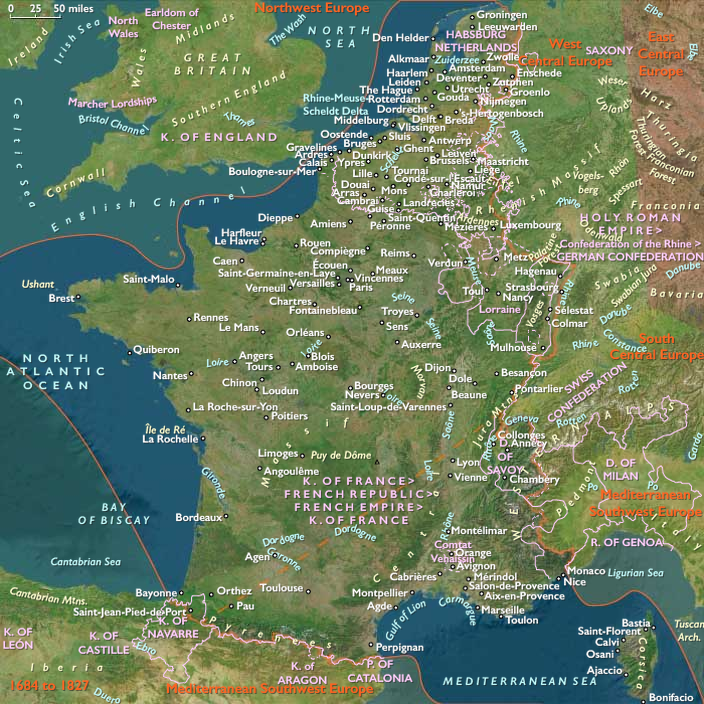
Liberal Parisians are further enraged by the fear that a concentration of Royal troops—brought in from frontier garrisons to Versailles, Sèvres, the Champ de Mars, and Saint-Denis—will attempt to shut down the National Constituent Assembly, which is meeting in Versailles.
Crowds gather throughout Paris, including more than ten thousand at the Palais-Royal.
The angry Parisian crowd, inflamed by a speech from journalist Camille Desmoulins, demonstrates against the King's decision to dismiss Minister Necker.
Desmoulins was born at Guise, Aisne, in Picardy.
His father, Jean Benoît Nicolas Desmoulins, is a rural lawyer and lieutenant-general of the bailliage of Guise.
Through the efforts of a friend, he had obtained a scholarship for the fourteen-year-old Camille to enter the Collège Louis-le-Grand in Paris.
Desmoulins had proved an exceptional student even among such notable contemporaries as Maximilien Robespierre and Louis-Marie Stanislas Fréron.
He had excelled in the study of Classical literature and politics, and gained a particular affinity for Cicero, Tacitus and Livy.
He had pursued law, and succeeded in gaining acceptance as an advocate of the parlement of Paris in 1785; however, his serious stammer and ferocious temper had proved severe obstacles to success in this arena.
Thus stymied, he had turned towards writing as an alternative outlet for his talents; his interest in public affairs had led him to a career as a political journalist.
In March 1789, Jean Benoît Nicolas Desmoulins had been nominated as deputy to the Estates-General from the bailliage of Guise; however, due to illness, he had failed to take his seat.
Camille Desmoulins, himself limited to the role of spectator at the procession of the Estates-General on May 5, 1789, had written a response to the event: Ode aux Etats Generaux.
The Comte de Mirabeau, a powerful political figure within the Estates-General who has positioned himself as a bridge between the aristocracy and the emerging reformist movement, had briefly enlisted Desmoulins to write for his newspaper at this time, strengthening Desmoulins' reputation as a journalist.
Owing to his difficulties in establishing a career as a lawyer, Desmoulins' position in Paris is a precarious one, and he often lives in poverty.
However, he had been greatly inspired and enthused by the current of political reform that surrounded the summoning of the Estates-General.
In letters to his father at the time, he had rhapsodized over the procession of deputies entering the Palace of Versailles, and criticized the events surrounding the closing of the Salle des Menus Plaisirs to the deputies who had declared themselves the National Assembly—events that led to the famous swearing of the Tennis Court Oath.
On July 12, spurred by the news of the politically unsettling dismissal of Necker, Desmoulins leaps onto a table outside the Cafe du Foy (one of many cafés in the garden of the Palais Royal frequented in large part by political dissidents) and delivers an impassioned call to arms.
Shedding his customary stammer in the excitement, he urges the volatile crowd to "take up arms and adopt cockades by which we may know each other", calling Necker's dismissal the tocsin of the St. Bartholomew of the patriots, a reference to the St. Batholomew's Day Massacre.
The stationing of a large number of troops in Paris, many foreign, has led Desmoulins and other political radicals to believe that a massacre of dissidents in the city is indeed imminent.
This is an idea that his audience also finds plausible and threatening, and they are quick to embrace Desmoulins and take up arms in riots that spread throughout Paris rapidly.
View Event