Louis I, Duke of Anjou
Duke of Anjou
Years: 1339 - 1384
Louis I (July 23, 1339 – September 20, 1384) is the second son of John II of France and the founder of the Angevin branch of the French royal house.
Bonne of Bohemia gives birth to him at the Château de Vincennes.
His father appoints him Count of Anjou and Count of Maine in 1356, then raises him to the title Duke of Anjou in 1360 and Duke of Touraine in 1370.
In 1382, as the adopted son of Joan I, he succeeds to the counties of Provence and Forcalquier.
He also inherits from her a claim to the kingdoms of Naples and Jerusalem.
He is already a veteran of the Hundred Years' War against the English when he leads an army into Italy to claim his Neapolitan inheritance.
He dies on the march and his claims and titles fall to his son and namesake, Louis II, who succeeds in ruling Naples for a time.

Related Events
Filter results
Showing 9 events out of 9 total
The Black Prince’s Chevauchée and the Lead-Up to the Battle of Poitiers (August–September 1356)
By 1356, after years of war, Edward III of England sought a diplomatic resolution, proposing that France permanently cede Aquitaine in exchange for peace. However, French King John II ("the Good") rejected the proposal, prompting Edward’s eldest son, Edward, Prince of Wales (later known as the Black Prince), to launch a massive chevauchée (scorched-earth raid) deep into central France.
The Chevauchée of August 1356: Raiding Across Central France
- On August 8, 1356, the Black Prince’s army began its devastating march northward from English-held Aquitaine, carrying out a chevauchée designed to weaken France’s economy, demoralize the population, and provoke the French army into battle.
- His fast-moving English and Gascon force, composed of mounted knights, men-at-arms, and archers, met little resistance and proceeded to burn numerous towns and villages to the ground, pillaging the countryside for supplies.
- The English lived off the land, creating havoc in French territories and stripping central France of valuable resources.
The Loire River and the Delay at Tours
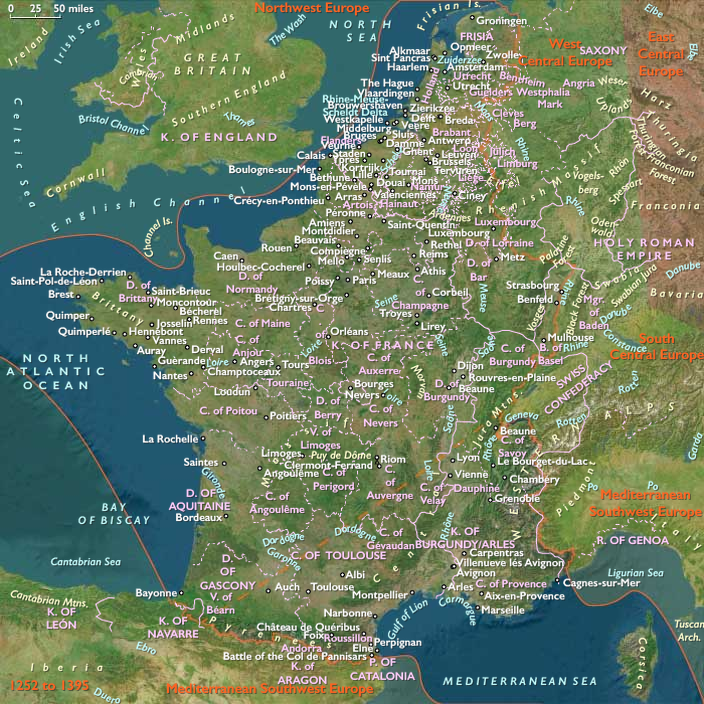
- By early September 1356, the Black Prince’s army reached the Loire River at Tours, a key crossing point in central France.
- He attempted to capture the castle and sack the town, but was unable to breach its defenses due to a heavy rainstorm, which prevented his troops from setting fires.
- This delay at Tours proved costly, as it allowed John II of France to close in with a large army, finally putting the English force in jeopardy.
John II’s Response: The Pursuit Begins
- King John II had been assembling a powerful army to intercept the English raiders and prevent their retreat back to Aquitaine.
- The delay at Tours gave him the time he needed to maneuver into position, forcing the Black Prince’s army into a dangerous situation.
- Now, instead of freely raiding French lands, Edward’s force had to plan a strategic retreat southward, knowing that a major confrontation was inevitable.
The Path to the Battle of Poitiers
- The Black Prince’s chevauchée had succeeded in devastating central France, but his army was now being pursued by a superior French force.
- This set the stage for the decisive Battle of Poitiers (September 19, 1356), one of the most significant English victories of the Hundred Years’ War, where John II would be captured, throwing France into crisis.
Edward’s brutal chevauchée of 1356, though initially an overwhelming success, ultimately led to the climactic confrontation at Poitiers, shaping the course of the Hundred Years’ War for years to come.
King John II’s Pursuit of the Black Prince and the Mobilization at Chartres (September 1356)
As the Black Prince’s army conducted its scorched-earth chevauchée through central France in August–September 1356, King John II of France abandoned his siege of Breteuil in Normandy to intercept the English forces before they could retreat back to English-held Aquitaine.
John II’s Strategic Mobilization at Chartres
- To increase the speed and mobility of his advancing army, John II gathered his forces at Chartres, north of Tours, where the English were stalled due to weather.
- He made the critical decision to dismiss approximately 15,000 to 20,000 lower-quality infantry, allowing his main force to move faster.
- This maneuver allowed him to close in on the Black Prince’s army, preventing them from escaping unchallenged.
French Tactical Adjustments and the Road to Poitiers
- By reducing the size of his army, John hoped to force the Black Prince into a decisive engagement before he could reach safety.
- With his elite knights, men-at-arms, and cavalry, John II prepared for a major confrontation with the English.
- His strategy set the stage for the Battle of Poitiers (September 19, 1356), a catastrophic defeat for the French, in which John II was captured by the English, leading to a national crisis in France.
Significance
- John’s decision to trim his forces for mobility was a bold but ultimately flawed maneuver, as the remaining troops would still suffer a crushing defeat at Poitiers.
- His attempt to cut off the Black Prince ultimately led to his own capture, worsening France’s position in the Hundred Years’ War.
King John II’s mobilization at Chartres and pursuit of the Black Prince was a decisive moment leading up to Poitiers, marking one of the most significant turning points of the Hundred Years’ War.
The Battle of Poitiers (September 19, 1356): A Decisive English Victory and the Capture of King John II
The Battle of Poitiers, fought on September 19, 1356, was one of the greatest English victories of the Hundred Years' War, resulting in the capture of the French king, John II ("the Good"), and his youngest son, Philip. The battle marked a major turning point in the war, leaving France leaderless and in chaos while Edward III of England and his son, the Black Prince, strengthened their control over large parts of the kingdom.
Negotiations Before the Battle: A Failed Attempt at Peace
- Confident of victory, John II commanded an army twice the size of the English force but hesitated to attack immediately.
- As the two armies faced off a few miles southeast of Poitiers, a papal legate attempted to broker a truce, carrying proposals between the two camps.
- There is debate over whether the Black Prince even wanted to fight, as he:
- Offered to surrender his heavily loaded wagon train, filled with loot from his chevauchée across France.
- Promised not to fight against France for seven years.
- Some sources claim he even offered to return Calais to the French Crown.
John II’s Counteroffer and the Collapse of Talks
- King John refused to accept these terms, demanding instead that:
- One hundred of the Prince’s best knights surrender as hostages.
- The Black Prince himself be taken prisoner.
- With neither side willing to compromise, negotiations collapsed, and both armies prepared for battle.
The Battle of Poitiers: English Longbows vs. French Chivalry
- John II adopted the English tactic of fighting dismounted, hoping that crossbowmen could weaken the English ranks.
- However, the English longbows devastated the French forces, riddling their crossbowmen and men-at-arms with arrows before they could close in for hand-to-hand combat.
- The French cavalry charges failed, and when the Black Prince counterattacked, the French army collapsed in total defeat.
The Flight of the Dauphin and the Capture of King John II
- John’s second son, Louis, fought under his older brother, Charles, the Dauphin, but their battalion hardly engaged in the fight.
- Seeing the battle turning against them, they fled the battlefield, avoiding capture but leaving their father to fight on alone.
- Though humiliating, their flight ensured the survival of the Valois dynasty, allowing Charles to rule as regent in his father’s absence.
The Final Stand of King John II
- John II fought bravely with a large battleaxe, but was ultimately surrounded.
- To prevent the enemy from easily identifying him, he and nineteen of his personal guard dressed identically, yet this failed to protect him.
- His helmet was knocked off, yet he continued fighting until surrounded.
The Moment of Surrender
- Denis de Morbecque, a French exile fighting for England, approached John and said:
- "Sire, I am a knight of Artois. Yield yourself to me and I will lead you to the Prince of Wales."
- John surrendered by handing over his glove, officially becoming an English prisoner.
Aftermath: John II’s Captivity in England
- That night, the Black Prince personally attended to King John, hosting him in a red silk tent in chivalric tradition.
- John was then taken to Bordeaux, and later to England, where he was held for ransom in London.
- The ransom was set at three million gold crowns, an enormous sum that would cripple France financially.
- While John remained in captivity, his son Charles (the Dauphin) ruled France as regent, struggling to maintain order in a leaderless kingdom.
- No known efforts were made by French nobles or peasants to rescue John, reflecting the disillusionment with his leadership.
Significance of the Battle of Poitiers
- The French army suffered a humiliating defeat, mirroring the disaster at Crécy (1346).
- The capture of King John II left France in chaos, leading to:
- Increased English control over France.
- The Estates General of 1357, where French nobles and commoners tried to exert more control over the monarchy.
- The Jacquerie Peasant Revolt of 1358, as taxes were raised to pay John’s ransom.
The Battle of Poitiers (1356) was one of the greatest English victories of the Hundred Years' War, securing the capture of the French king, deepening France’s political instability, and further demonstrating the dominance of English longbow tactics.
King John II’s Return to English Captivity (1362): A Matter of Honor
After being captured at the Battle of Poitiers (1356), King John II of France ("John the Good") was held captive in England under the terms of the Treaty of Brétigny (1360). His ransom was set at 3 million gold crowns, an immense sum that France struggled to pay.
To allow John to return to France and raise the funds, the English took hostages in his place, including:
- Two of his sons
- Several French princes and nobles
- Four prominent citizens from Paris
- Two citizens from each of the 19 principal towns of France
The Escape of Louis of Anjou and John II’s Response (1362)
- John II returned to France to organize ransom payments, leaving his son, Louis of Anjou, and other nobles as hostages in English-controlled Calais.
- In 1362, Louis of Anjou escaped captivity, violating the terms of the treaty.
- Feeling honor-bound to uphold his agreement with Edward III, John II voluntarily returned to England, despite having the opportunity to remain in France.
John II’s Final Captivity and Death
- John’s decision to return to English captivity was viewed as an extraordinary act of chivalry and personal integrity, reinforcing his reputation as "John the Good."
- However, his return did not lead to the full ransom payment, as France continued to struggle financially.
- John remained in England until his death on April 8, 1364, at Savoy Palace in London, without ever regaining his throne.
Impact and Legacy
- John’s return to captivity was rare among medieval monarchs, as most rulers would avoid imprisonment at all costs.
- His decision emphasized the chivalric code, but also weakened France, as his son, Charles V, had to take full control of a divided and war-torn kingdom.
- The financial burden of the ransom and ongoing war contributed to political instability and economic hardship in France.
King John II’s voluntary return to English captivity in 1362, following his son's escape, remains one of the most famous episodes of medieval kingship, illustrating the weight of honor in royal diplomacy, even at the cost of personal freedom.
John II’s Return to English Captivity and the Accession of Charles V (1363–1364)
After failing to raise the full ransom required for his release under the Treaty of Brétigny-Calais (1360), King John II of France ("John the Good") voluntarily returned to English captivity in 1363. He died in London on April 8, 1364, making him one of the few medieval monarchs to willingly surrender himself as a prisoner. His eldest son, Charles, aged 26, assumed the French throne as King Charles V, despite violating the terms of the Brétigny agreement.
John II’s Return to Captivity (1363)
- Under the Treaty of Brétigny, France had agreed to pay 3 million gold crowns to ransom John II, but the country struggled to meet the payments.
- To guarantee the installments, France had provided hostages, including John’s own son, Louis of Anjou.
- In 1362, Louis of Anjou escaped captivity, breaking the terms of the agreement.
- Feeling honor-bound to uphold his promise, John II voluntarily returned to England in 1363, a rare act of chivalric loyalty and personal sacrifice.
John II’s Death and the Accession of Charles V (April 1364)
- John II died in London on April 8, 1364, ending a tumultuous reign marked by French defeats, economic turmoil, and political instability.
- His son, Charles V, took the throne despite the fact that his accession violated the Brétigny agreement, which had:
- Effectively disinherited John’s heirs in exchange for peace.
- Required that England retain sovereignty over large French territories.
- Charles, now King of France, rejected the treaty’s conditions, setting the stage for the renewal of the Hundred Years’ War.
Significance of Charles V’s Accession
- Unlike his father, Charles V proved to be a shrewd and politically astute ruler, ushering in a period of French resurgence.
- His military and financial reforms, along with his reliance on commanders like Bertrand du Guesclin, allowed France to reverse many of the English territorial gains from the Treaty of Brétigny.
- The war would resume in 1369, marking the beginning of France’s recovery from its earlier defeats.
John II’s return to captivity in 1363 and his death in 1364 marked the end of a disastrous reign, but Charles V’s accession signaled the beginning of a more competent and strategic French leadership, setting France on a path toward reclaiming lost territories.
Political Struggles in France: The Rise of Olivier de Clisson as Leader of the Anti-Burgundian Party (1382)
By 1382, the French court was dominated by factional struggles, as the boy-king Charles VI was still too young to govern independently. His uncles, notably Philip the Bold of Burgundy, sought to control royal policy, while opposition forces, led by Louis, Duke of Anjou, attempted to counterbalance Burgundian influence. When Louis died in 1382, Olivier de Clisson, the Constable of France, emerged as the new leader of the anti-Burgundian faction, supported by northwestern nobility and military commanders.
Power Struggles at the French Court
- Philip the Bold of Burgundy attempted to assert dominance over France’s policies, securing his influence over the young Charles VI.
- Louis, Duke of Anjou, led an anti-Burgundian party, made up of:
- Royal officials who opposed Burgundian control.
- Military commanders who favored a more independent, centralized monarchy.
- Nobles from northwestern France, traditionally wary of Burgundian power.
Olivier de Clisson’s Rise as Anti-Burgundian Leader (1382)
- Upon Louis of Anjou’s death in 1382, leadership of the anti-Burgundian party fell to Olivier de Clisson, Constable of France.
- Clisson, a seasoned military leader, had strong backing from:
- French royal commanders, who had fought alongside him in Brittany and against the English.
- Nobles from Brittany, Normandy, and Anjou, regions historically skeptical of Burgundian dominance.
- His leadership shifted the opposition from a purely political struggle to one with strong military implications.
Impact and Legacy
- The power struggle between Burgundy and its opponents would continue for decades, eventually escalating into the Armagnac-Burgundian Civil War (1407–1435).
- Clisson’s leadership in the anti-Burgundian faction placed him at odds with Philip the Bold, leading to further conflicts at the French court.
- His control over the military gave the anti-Burgundian party a significant advantage, influencing future French campaigns against English and Burgundian interests.
The rise of Olivier de Clisson as leader of the anti-Burgundian party in 1382 marked a new phase in the internal power struggles of France, as the country drifted toward further factional conflicts that would shape its history well into the 15th century.
The Battle of Roosebeke (November 27, 1382): French Victory Over the Flemish Revolt
In 1382, King Charles VI of France intervened in Flanders to support his ally, Louis de Male, Count of Flanders, against a rebellion led by the city of Ghent. The Flemish rebels, led by Philip van Artevelde, sought to overthrow feudal rule, challenging both the Count of Flanders and French authority. The French response culminated in the Battle of Roosebeke (November 27, 1382), where Olivier de Clisson, as Constable of France, led the French royal army to a decisive and brutal victory.
The Flemish Revolt and French Intervention
- The Flemish cities, particularly Ghent, had long resisted feudal control, favoring municipal independence and trade autonomy.
- Philip van Artevelde, son of the famous Flemish leader Jacob van Artevelde, led the bourgeois militia against Louis de Male.
- Fearing the spread of urban revolts across France, Charles VI decided to intervene militarily.
The Battle of Roosebeke (November 27, 1382)
- Olivier de Clisson commanded the French royal army, which consisted of seasoned knights and men-at-arms.
- The Flemish forces, made up of militia fighters, artisans, and merchants, lacked professional military experience.
- Clisson used tactical superiority to crush the Flemish:
- He outmaneuvered the undisciplined militias, trapping them with cavalry charges and flanking attacks.
- The French forces encircled the Flemish, leading to a brutal massacre of 25,000 men.
- Philip van Artevelde was killed, and the rebellion collapsed as the French army sacked and looted the battlefield.
Aftermath and Consequences
- The crushing of the Ghent revolt reinforced feudal control in Flanders, ensuring Louis de Male’s continued rule.
- Olivier de Clisson’s victory solidified his position as one of France’s most capable military commanders.
- The massacre of 25,000 Flemish rebels sent a clear message against urban uprisings, though resistance in Flanders would continue in later years.
The Battle of Roosebeke (1382) was a defining moment in the conflict between feudal lords and urban autonomy, demonstrating the military dominance of France and the brutality of medieval warfare under the command of Olivier de Clisson.
The Revolt of the Maillotins (Harelle) and Charles VI’s Response (1382–1383)
The Flemish uprising of 1382, which had culminated in the Battle of Roosebeke, ignited secondary revolts in Paris, where citizens, emboldened by the unrest, rose up against royal taxation. This revolt, known as the Revolt of the Maillotins (or Harelle), broke out in March 1382, during King Charles VI’s absence while campaigning in Flanders.
However, upon Charles VI’s victorious return to Paris, the rebellion collapsed without a fight, and the king imposed financial penalties on the city’s wealthier citizens instead of unleashing violent repression.
Causes of the Maillotin Revolt (March 1382)
- The reinstatement of a tax that had been abolished by the previous king sparked popular outrage among the working and merchant classes of Paris.
- The Flemish rebellion inspired similar aspirations for autonomy in Paris, where the bourgeoisie saw an opportunity to resist feudal authority.
- With King Charles VI absent, supporting his troops in Flanders, the rebels believed that royal power was weakened and that they could press for reforms.
The Collapse of the Revolt and Charles VI’s Return to Paris
- Following his victory in Flanders (Battle of Roosebeke, November 1382), Charles VI marched back to Paris.
- The Parisian rebels, seeing the King’s triumph, lost confidence and did not resist his return.
- By February 1383, Charles VI, along with Constable Olivier de Clisson, confronted the city’s leadership.
Olivier de Clisson’s Ultimatum to the Rebels
- Clisson, addressing the citizens, declared:
"Corps and property, you are in case of forfeiture. See what you choose: justice or mercy."
- Facing a stark choice between harsh justice (executions and confiscations) or financial penalties, the Parisian bourgeoisie chose mercy—agreeing to pay a heavy fine based on individual wealth.
Royal Mercy and the Partial Forgiveness of Fines
- Despite initial heavy financial penalties, Charles VI’s entourage eventually reduced the total sum demanded.
- This magnanimous gesture helped restore order while reinforcing the authority of the monarchy.
- The revolt’s failure marked a return to stronger royal control over Paris, ending municipal ambitions for greater autonomy.
Impact and Legacy
- The Maillotin Revolt (1382) was one of the last major urban uprisings in Paris before the 15th-century civil wars.
- The swift and calculated response from Charles VI and Olivier de Clisson demonstrated the effectiveness of royal authority, discouraging future revolts.
- The King’s decision to offer clemency in exchange for financial penalties reinforced the monarchy’s reliance on taxation rather than outright violence to maintain control.
The Parisian revolt of 1382, quelled in early 1383, reaffirmed Charles VI’s power, demonstrating that while urban unrest could challenge the monarchy, it could not yet overthrow it.
The War of the Eight Saints, carried on with spates of unprecedented cruelty to civilians, had drained the resources of Florence, though the city had ignored the interdict placed upon it by Pope Gregory, declared its churches open, and sold ecclesiastical property for one hundred thousand florins to finance the war.
Bologna had submitted to the Church in August 1377, and Florence had signed a treaty at Tivoli on July 28, 1378 at a cost of two hundred thousand florins indemnity extorted by Pope Urban VI for the restitution of church properties, receiving in return the papal favor and the lifting of the disregarded interdict.
Urban's erstwhile patroness, Queen Joan I of Naples, had deserted him in the late summer of 1378, in part because her former archbishop had become her feudal suzerain.
Urban had then lost sight of the larger issues and began to commit a series of errors.
Turning upon his powerful neighbor Joan, he had excommunicated her as an obstinate partisan of Antipope Clement, and had permitted a crusade to be preached against her.
Soon her enemy and cousin Charles of Durazzo, representing the Sicilian Angevin line, had been made sovereign over the Kingdom of Naples on June 1, 1381), and was crowned by Urban.
Joan's authority was declared forfeit, and Charles had murdered her in 1382.
In return, Charles had had to promise to hand over Capua, Caserta, Aversa, Nocera, and Amalfi to the pope's nephew.
Once ensconced at Naples, Charles had found his new kingdom invaded by Louis of Anjou and Amadeus VI of Savoy; hard-pressed, he had reneged on his promises.
In Rome, the Castel Sant'Angelo was besieged and taken, and Urban was forced to flee.
In the fall of 1383 he determined to Charles in person and go to Naples, where he had found himself virtually a prisoner.
After a first reconciliation, with the death of Louis (September 20, 1384), Charles had found himself freer to resist Urban's feudal pretensions, and relations had taken a turn for the worse.
Urban had been shut up in Nocera, from the walls of which he daily fulminates his anathemas against his besiegers, with bell, book and candle; a price is set on his head.
Rescued by two Neapolitan barons who had sided with Louis, Raimondello Orsini and Tommaso di Sanseverino, after six months of siege Urban succeeds in making his escape to Genoa with six galleys sent him by doge Antoniotto Adorno.
Several among his cardinals who had been shut up in Nocera with him and had followed him in Genoa determined to make a stand: they determine that a Pope, who by his incapacity or blind obstinacy, might be put in the charge of one of the cardinals.
Urban has them seized, tortured and put to death.