Ladislaus I of Hungary
King of Hungary
Years: 1040 - 1095
Ladislaus I or Ladislas I, also Saint Ladislaus or Saint Ladislas (c. 1040 – 29 July 1095) is King of Hungary from 1077 and King of Croatia from 1091.
He is the second son of King Béla I of Hungary who dies in 1063.
He and his elder brother, Géza conclude a treaty with their cousin, Solomon: they acknowledge Solomon's reign in exchange for receiving their father's former duchy which includes one third of the Kingdom of Hungary.
Ladislaus is an influential advisor of his brother who is proclaimed king against their cousin in 1074.
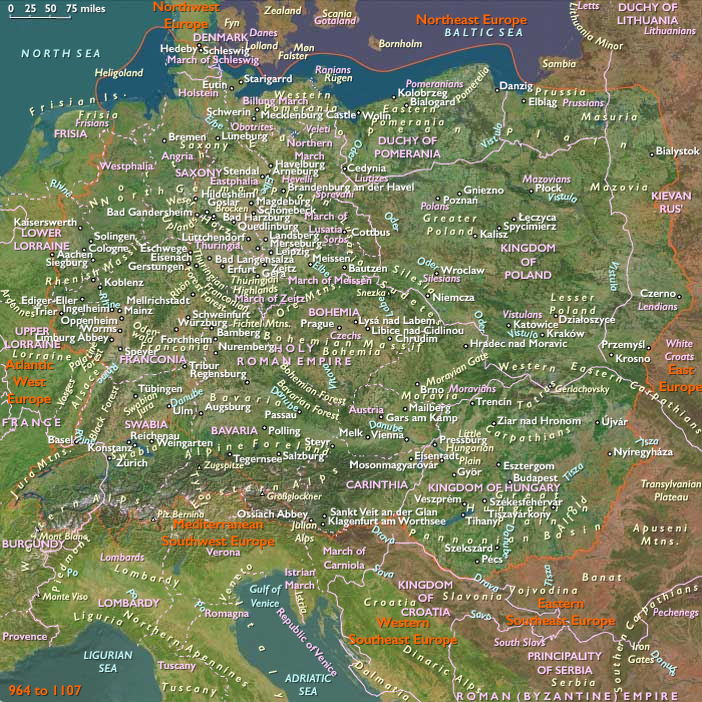
Ladislaus succeeds his brother in 1077, but Solomon is able to contest him from two fortresses—Moson and Pressburg (Bratislava, Slovakia)—in the western regions, for King Henry IV of Germany supports Solomon.
Ladislaus makes an alliance with the German monarch's opponents during the first phase of the Investiture Controversy.
Solomon abdicates and acknowledges Ladislaus's reign in 1081, but he conspires against the king and is imprisoned.
Ladislaus sets his dethroned cousin free on the occasion of the canonization of the first saints in Hungary—including, his distant relatives, King Stephen I and Duke Emeric—in 1085.
Following a series of civil wars, Ladislaus strengthens public safety by introducing severe legislation.
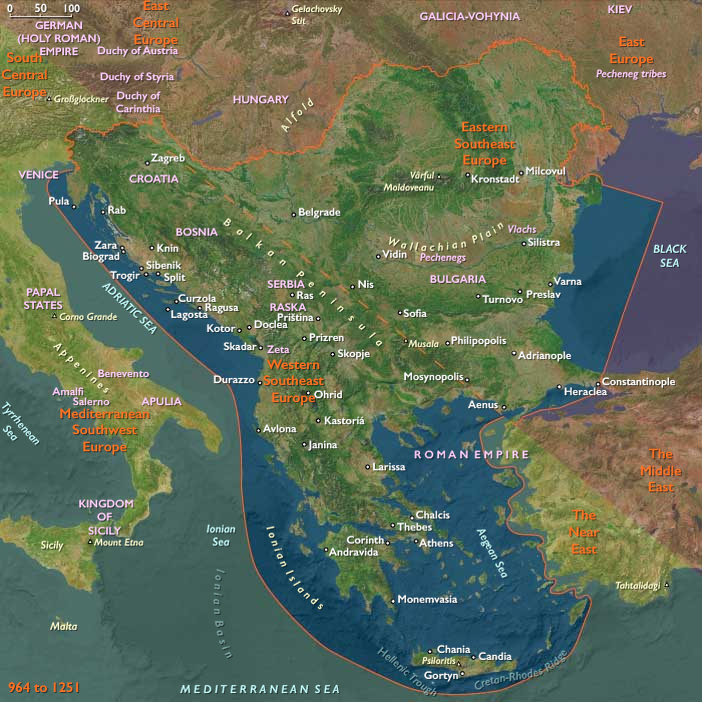
His occupation of Croatia in 1091 marks the beginning of a period of expansion of the medieval Kingdom of Hungary.
His victories over the Pechenegs and Cumans ensure the security of his kingdom's eastern borders for about 150 years.
He is canonized on 29 June 1192.
His legends depict him as a pious knight-king.
He is a popular saint in Hungary and in the neighboring countries where many churches are dedicated to him.
Related Events
Filter results
Showing 10 events out of 27 total
After the Great Schism of 1054 splits the Roman and Byzantine churches, Normans (probably with papal support) besiege imperial cities in Dalmatia.
In 1075 a papal legate crowns Dmitrije Zvonimir (1076-89) king of Croatia.
A faction of nobles contesting the succession after the death of Zvonimir offers the Croatian throne to King Laszlo I of Hungary.
In 1091 Laszlo accepts, and in 1094 he founds the Zagreb bishopric, which later becomes the ecclesiastical center of Croatia.
Another Hungarian king, Kalman, crushes opposition after the death of Laszlo and wins the crown of Dalmatia and Croatia in 1102.
The crowning of Kalman forges a link between the Croatian and Hungarian crowns that will last until the end of the First World War.
Croats have maintained for centuries that Croatia remained a sovereign state despite the voluntary union of the two crowns, but Hungarians claim that Hungary annexed Croatia outright in 1102.
In either case, Hungarian culture will permeate Croatia, the Croatian-Hungarian border will shift often, and at times Hungary will treat Croatia as a vassal state.
Croatia, however, has its own local governor, or ban; a privileged landowning nobility; and an assembly of nobles, the Sabor.
East Central Europe (1072–1083 CE): Hungarian Stability under Ladislaus I, Polish Royal Ambitions under Bolesław II, and Bohemian Alignment with the Holy Roman Empire
Between 1072 and 1083 CE, East Central Europe—encompassing modern-day Poland, Czechia, Slovakia, Hungary, and the eastern portions of Germany and Austria east of 10°E and north of the defined southeastern boundary—experienced significant developments in political consolidation, dynastic authority, and regional stability. In Hungary, King Ladislaus I restored political coherence after prolonged instability; Bolesław II "the Bold" continued to expand Poland’s territorial and royal ambitions; while Bohemia under Vratislaus II strengthened its strategic alignment with the Holy Roman Empire. These shifts significantly impacted regional power dynamics and set critical foundations for medieval governance and cultural identity.
Political and Military Developments
Hungarian Consolidation and Stability under Ladislaus I
-
Ladislaus I of Hungary (r. 1077–1095) decisively ended internal dynastic conflicts following the turbulent reigns of Solomon and Géza I. Ladislaus restored royal authority, strengthened military defenses, reorganized administration, and established law codes that firmly stabilized Hungary and enhanced royal prestige.
Polish Territorial and Royal Expansion under Bolesław II
-
Bolesław II "the Bold" of Poland continued territorial expansion into Ruthenia, significantly enlarging Poland’s sphere of influence. He successfully sought royal recognition, crowned as king in 1076, reinforcing Poland’s status as a significant European monarchy.
Bohemian Alignment and Autonomy under Vratislaus II
-
Duke Vratislaus II of Bohemia deepened Bohemia’s diplomatic alignment with the Holy Roman Empire, skillfully balancing imperial loyalty and local autonomy. His strategic diplomacy secured stability, and he later received royal recognition as the first King of Bohemia (in 1085, slightly beyond this era).
Imperial Influence and the Investiture Conflict
-
The Investiture Controversy (begun in 1075) profoundly impacted East Central Europe as Emperor Henry IV (r. 1056–1106) struggled with the papacy. Vratislaus II aligned closely with Henry, while Hungary and Poland navigated carefully between imperial and papal interests, impacting regional diplomacy and church-state relations.
Economic and Technological Developments
Economic Revival and Trade Expansion
-
Stability in Hungary under Ladislaus and Poland under Bolesław supported a vibrant revival of commerce. Regional trade networks expanded, notably along routes connecting the Baltic, Central Europe, and Byzantium, facilitating significant economic growth.
Urbanization and Fortifications
-
Key urban centers in Poland (Kraków, Gniezno), Hungary (Esztergom, Székesfehérvár), and Bohemia (Prague) further developed and fortified their infrastructure, bolstering administrative control, commerce, and defense capabilities.
Cultural and Artistic Developments
Hungarian Ecclesiastical and Cultural Flourishing under Ladislaus
-
Ladislaus I extensively patronized ecclesiastical institutions, monasteries, and churches, promoting cultural and religious revival. His reign saw the canonization of Stephen I (1083), enhancing Hungarian Christian identity and cultural prestige.
Polish Royal Patronage and Cultural Expansion
-
Bolesław II promoted cultural patronage, supporting ecclesiastical institutions, monasteries, and religious art. His coronation reinforced Poland’s royal and cultural identity, further integrating it into broader European Christian traditions.
Bohemian Cultural Development under Vratislaus II
-
Vratislaus II actively supported cultural growth, evident in cathedral expansions, monastic foundations, and manuscript production, significantly enriching Prague’s ecclesiastical and cultural life.
Settlement and Urban Development
Growth and Expansion of Polish Royal Centers
-
Kraków, Gniezno, and Poznań flourished under Bolesław II, expanding their urban structures and fortifications, becoming prominent administrative and economic centers.
Hungarian Urban and Administrative Development
-
Ladislaus I significantly developed Hungarian royal and ecclesiastical cities, notably Esztergom, Székesfehérvár, and Veszprém, consolidating Hungary’s administrative efficiency and urban prosperity.
Bohemian Urban Infrastructure
-
Under Vratislaus II, Prague and other Bohemian towns experienced ongoing urban growth, fortification, and enhanced administrative organization, strengthening Bohemia’s regional role and urban prosperity.
Social and Religious Developments
Consolidation of Christian Institutions
-
Christianity further deepened its dominant role in society across Hungary, Poland, and Bohemia. Ladislaus’s support of religious reform, Bolesław’s ecclesiastical patronage, and Vratislaus’s imperial-aligned religious policy significantly influenced regional religious institutions.
Strengthening Dynastic Authority
-
Dynastic and aristocratic structures became increasingly defined, reinforcing governance, social hierarchies, and royal authority. Ladislaus I in Hungary, Bolesław II in Poland, and Vratislaus II in Bohemia strengthened dynastic legitimacy and political cohesion.
Long-Term Consequences and Historical Significance
The era 1072–1083 CE proved transformative for East Central Europe. Hungarian stability under Ladislaus I, Poland’s royal expansion under Bolesław II, and Bohemia’s strengthened autonomy under Vratislaus II reshaped regional political alliances, cultural identities, and societal structures. These developments laid crucial foundations for enduring medieval kingdoms, significantly influencing East Central Europe’s historical trajectory for centuries to come.
Géza dies on April 15, 1077, and is buried in the cathedral of Vác, which he had erected in the honor of the Holy Virgin.
As his sons are still minors, his partisans proclaim Ladislaus king.
According to Gallus Anonymus, King Boleslaus II the Bold of Poland "drove out" Solomon "from Hungary with his forces, and placed" Ladislaus "on the throne"; he even called Ladislaus "his king" thereafter.
The Illuminated Chronicle emphasizes that Ladislaus "never placed the crown upon his head, for he desired a heavenly crown rather than the earthly crown of a mortal king", but all his coins depict him wearing a crown, suggesting that he was indeed crowned.
King Henry's IV act of contrition at the Walk to Canossa in 1077 had included also the Imperial recognition of Boleslaw II's royal title.
His new authority alongside with his pride, however, causes the Polish magnates to rebel, as they fear the monarchy is beginning to grow too powerful.
In 1077, Boleslaw II's had troops helped two pretenders to assume the throne: László, another son of Béla I, in Hungary, and again Iziaslav in Kiev.
In 1078, while returning from the latter campaign, the Polish troops had conquered Red Ruthenia.
In 1079, however, the conflict with the Polish nobles culminates into open revolt and Boleslaw is deposed and banished from the country.
The circumstances that led to the King's banishment hinge on the person of Bishop Stanislaus of Kraków, who had excommunicated the king for his infidelity.
From historical records, it appears that Bishop Stanislaus was involved with the barons' opposition movement, plotting to remove the King and to place his brother Wladyslaw Herman on the throne.
The conspiracy was uncovered by the king's men and Stanislaus was judged by both royal and ecclesiastical courts.
He was found guilty of treason—Gallus Anonymus uses the word "traditor" meaning traitor—and executed.
This act seems to have sparked the barons' rebellion against the King who was then deposed and forced to flee the country, together with his wife and son Mieszko.
Another version of the events which led to Boleslaw's demise was propagated by Master Wincenty Kadłubek, who, however, was writing nearly one hundred years after Gallus Anonymus and a century and a half after the actual affair.
According to this version, Boleslaw II on April 11, 1079 assaulted and then personally wielded the sword that murdered Bishop Stanislaus of Kraków during the celebration of a mass.
Though the bishop had privately and then publicly warned the king to repent of adultery and other vices, Boleslaw chose a course of action more characteristic of his nickname, "the Bold".
Wladyslaw Herman, as the second son, was not destined for the Polish throne.
However, due to the flight from Poland of his older brother Boleslaw II the Bold in 1079, he had been elevated to the rank of Duke of Poland.
Opinions vary on whether Wladyslaw played an active role in the plot to depose his brother or whether he was handed the authority simply because he was the most proper person, being the next in line in the absence of the king and his son Mieszko Boleslawowic.
In order to improve the relations between Poland and Bohemia, Wladyslaw marries Judith, the daughter of the Duke (and first King from 1085) Vratislaus II, in 1080.
After this, the foreign policy of the Duke will gravitate strongly towards appeasement of the Holy Roman Empire.
Boleslaw has found refuge at the court of King Ladislaus I of Hungary, a future saint, who also owes his crown to the deposed King.
However, according to Gallus Anonymus, Boleslaw II's atrocious conduct towards his Hungarian hosts caused his premature death in 1081 or 1082 at the hands of an assassin, probably by poisoning.
A popular legend holds that Boleslaw proceeded to Rome to beg forgiveness from Pope Gregory, who imposed on him to wander incognito as a mute repentant.
On a summer evening in 1082, he reached the Benedictine Abbey at Ossiach in Carinthia, where he was received and did all kind of hard work for nine years until he finally was reconciled in the Sacrament of Penance and died.
At the walls of Ossiach, there exists a tomb bearing the depiction of a horse and the inscription Rex Boleslaus Polonie occisor sancti Stanislai Epi Cracoviensis ("Boleslaw, King of Poland, murderer of Saint Stanislaus, Bishop of Kraków").
Instigated by Countess Karolina Lanckorońska, in 1960 the tomb was opened and indeed revealed male bones and the remains of a Polish knight's armor dating from the eleventh century.
East Central Europe (1084–1095 CE): Royal Elevation in Bohemia, Crisis in Poland under Władysław I, and Hungarian Prosperity under Ladislaus I
Between 1084 and 1095 CE, East Central Europe—encompassing modern-day Poland, Czechia, Slovakia, Hungary, and eastern regions of Germany and Austria east of 10°E and north of the defined southeastern boundary—experienced significant political realignments, dynastic transitions, and cultural transformations. Vratislaus II was elevated to the royal dignity as the first King of Bohemia, Poland faced severe internal strife and dynastic upheaval following the dramatic fall of Bolesław II, and Hungary flourished culturally and politically under the stable and prosperous reign of King Ladislaus I.
Political and Military Developments
Bohemia’s Royal Elevation under Vratislaus II
-
In 1085, Vratislaus II of Bohemia was elevated to royal status by Emperor Henry IV, becoming the first Bohemian ruler formally recognized as King. His enhanced prestige strengthened Bohemian autonomy and regional influence, aligning Bohemia closely with imperial interests.
Crisis and Dynastic Conflict in Poland
-
After the deposition of Bolesław II "the Bold" in 1079, Poland experienced deep internal crises under his brother Władysław I Herman (r. 1079–1102). Internal dynastic struggles and aristocratic factionalism severely weakened royal authority, causing political fragmentation and regional instability.
Hungarian Stability and Prosperity under Ladislaus I
-
King Ladislaus I (r. 1077–1095) solidified Hungary’s internal stability, expanded Hungarian territory into neighboring regions (notably Croatia), and fortified royal administration. His successful military campaigns, legal reforms, and patronage of the Church established Hungary as a leading European kingdom.
Imperial Influence and the Investiture Controversy
-
Ongoing conflicts between Emperor Henry IV and the papacy during the Investiture Controversy deeply influenced regional diplomacy. Vratislaus II remained closely aligned with imperial interests, while Hungary and Poland navigated the complex diplomatic tensions between imperial and papal allegiances.
Economic and Technological Developments
Hungarian Economic Prosperity and Trade Expansion
-
Under Ladislaus I, Hungary experienced significant economic growth, benefiting from increased trade along routes connecting the Adriatic, Byzantium, and Central Europe. Economic stability and prosperity supported urban expansion and fortification projects.
Bohemian and Polish Urban Developments
-
Despite internal crises in Poland, key cities like Kraków and Gniezno continued to develop economically and administratively. In Bohemia, Prague flourished under royal patronage, enhancing its economic vitality and urban infrastructure.
Cultural and Artistic Developments
Hungarian Cultural Flourishing under Ladislaus I
-
Ladislaus I’s extensive patronage promoted ecclesiastical art, monastic foundations, and the establishment of religious institutions, greatly enriching Hungarian cultural life. His reign witnessed significant architectural and artistic achievements, reflecting Hungary’s deepening integration into European culture.
Bohemian Cultural Prestige under Vratislaus II
-
Vratislaus II’s elevation to kingship enhanced Prague’s cultural and religious prestige, spurring artistic patronage, cathedral construction, and monastic expansions. The period saw notable manuscript illumination, ecclesiastical architecture, and cultural activity.
Polish Cultural Continuity amid Dynastic Instability
-
Despite political upheaval, Polish ecclesiastical institutions and monasteries maintained cultural continuity, preserving religious traditions and scholarship, thereby providing foundations for future cultural and political revival.
Settlement and Urban Development
Hungarian Urban Expansion and Infrastructure
-
Ladislaus I fostered significant urban growth and administrative developments in Esztergom, Székesfehérvár, and Veszprém, reinforcing royal and ecclesiastical centers vital for Hungary’s governance and cultural identity.
Bohemian Urban Enhancement
-
Prague under Vratislaus II expanded considerably, strengthening its administrative, economic, and ecclesiastical infrastructures, consolidating Bohemia’s regional importance.
Polish Urban Resilience and Recovery
-
Despite internal strife, Polish urban centers like Kraków and Gniezno remained resilient, continuing incremental urban and economic recovery, setting the stage for future stabilization.
Social and Religious Developments
Strengthening of Christian Institutions
-
Christianity further consolidated its dominant role, especially under Ladislaus I in Hungary and Vratislaus II in Bohemia. Ecclesiastical institutions deepened their societal influence, governance roles, and cultural authority.
Dynastic Authority and Aristocratic Power
-
Ladislaus I firmly re-established royal and dynastic authority in Hungary, setting enduring patterns of governance. Meanwhile, Poland’s weakened royal authority allowed aristocratic factions to gain power, shaping future political structures.
Long-Term Consequences and Historical Significance
The era 1084–1095 CE proved crucial in shaping East Central Europe’s medieval trajectory. Bohemia’s royal elevation strengthened Přemyslid authority, Hungary’s prosperity and stability under Ladislaus I reinforced its leading regional position, and Poland’s internal strife dramatically weakened royal power, altering its political course. These developments significantly reshaped regional alignments, cultural identities, and societal structures, leaving lasting impacts on the subsequent medieval history of East Central Europe.
The coronation of Vratislav II as King of Bohemia in 1085, and his alignment with Ladislaus I, King of Hungary, threatens the position of the Polish ruler, Prince Wladyslaw I Herman.
Therefore, this same year Wladyslaw I is forced to recall from Hungarian banishment the only son of Boleslaw II the Bold and a rightful heir to the Polish throne, Mieszko Boleslawowic.
Upon his return, young Bolesławowic accepts the overlordship of his uncle and gives up his hereditary claim to the crown of Poland in exchange for becoming first in line to succeed him.
In return, Prince Wladyslaw I Herman grants his nephew the district of Kraków.
The situation is further complicated for Wladyslaw I Herman by a lack of a legitimate male heir, as his first-born son Zbigniew comes from a union not recognized by the church.
With the return of Mieszko Boleslawowic to Poland, Wladylaw I normalizes his relations with the kingdom of Hungary as well as Kievan Rus (the marriage of Mieszko Boleslawowic to a Kievan princess will be arranged in 1088).
These actions allow Herman to strengthen his authority and alleviate further tensions in international affairs.
Lack of a legitimate heir had remained a concern for Wladyslaw I.
He and his wife Judith of Swabia had in 1085 sent rich gifts, among which was a life size statue of a child made of gold, to the Benedictine Sanctuary of Saint Giles in Saint-Gilles, Provence, begging for offspring.
The Polish envoys were led by the personal chaplain of Duchess Judith, Piotr.
By 1086, Boleslaw is born.
Three months after his birth, on December 25, his mother dies.
Following Boleslaw’s birth, the political climate in the country changes.
The position of Boleslaw as an heir to the throne is threatened by the presence of Mieszko Boleslawowic, who is already seventeen at the time and is furthermore, by agreement with Herman himself, the first in line to succeed.