Klemens von Metternich
Austrian politician and diplomat
Years: 1773 - 1859
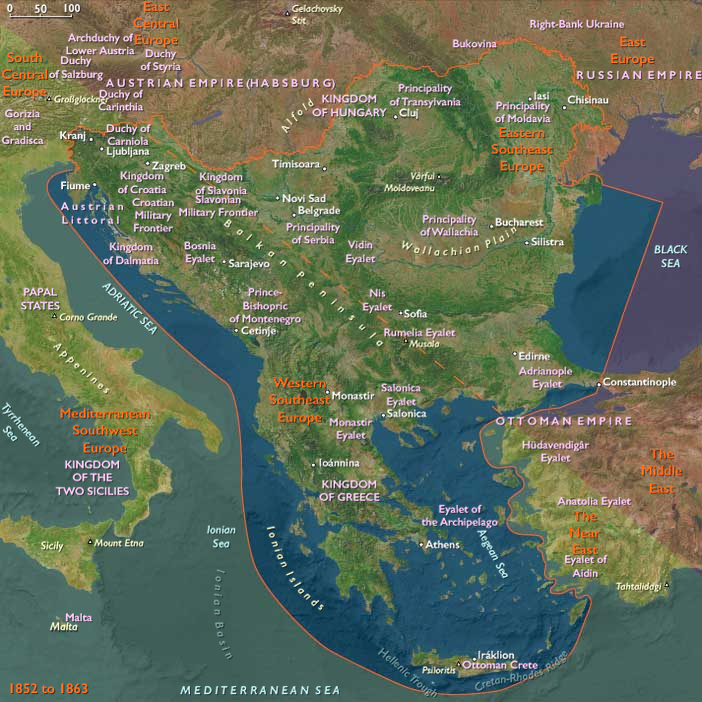
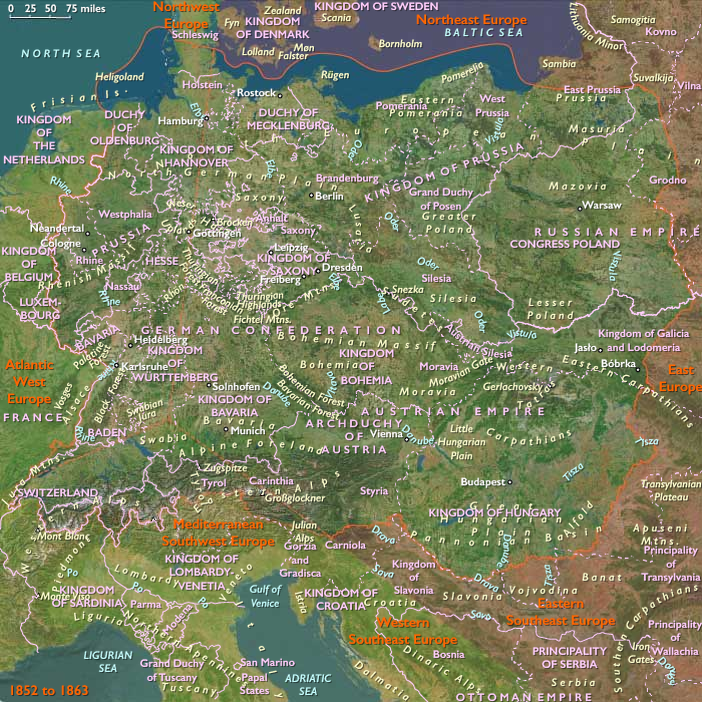
Prince Klemens Wenzel von Metternich (full name German: Klemens Wenzel Nepomuk Lothar, Fürst von Metternich-Winneburg zu Beilstein, anglicised as Clement Wenceslas Lothar von Metternich-Winneburg-Beilstein; 15 May 1773 – 11 June 1859) is an Austrian politician and statesman of Rhenish extraction and one of the most important diplomats of his era, serving as the Foreign Minister of the Holy Roman Empire and its successor state, the Austrian Empire, from 1809 until the liberal revolutions of 1848 force his resignation.
One of his first tasks is to engineer a détente with France that includes the marriage of Napoleon to the Austrian Arch-Duchess Marie Louise.
Soon after, however, he engineers Austria's entry into the War of the Sixth Coalition on the Allied side, signs the Treaty of Fontainebleau that sends Napoleon into exile and leads the Austrian delegation at the Congress of Vienna, which divides post-Napoleonic Europe between the major powers.
In recognition of his service to the Austrian Empire, he is raised to the title of Prince in October 1813.
Under his guidance, the "Metternich system" of international congresses continues for another decade as Austria aligns herself with Russia and, to a lesser extent, Prussia.
This marks the high point of Austria's diplomatic importance, and thereafter Metternich slowly slips back into the periphery of international diplomacy.
At home, Metternich also holds the post of Chancellor of State from 1821 until 1848, under both Francis II of Austria and his son Ferdinand I of Austria.
After a brief period of exile in London, Brighton and Brussels that lasts until 1851, he returns once more to the Viennese court, this time to offer only advice to Ferdinand's successor, Franz Josef.
Having outlived his generation of politicians, Metternich dies at the age of 86 in 1859.
Born into the House of Metternich in 1773 as the son of a diplomat, Metternich receives a good education at the universities of Strasbourg and Mainz.
He also helps during the coronation of Francis II in 1792 and that of his predecessor, Leopold II, in 1790.
After a brief trip to England, Metternich is named as the Austrian ambassador to the Netherlands; a short-lived post, since the country is brought under French control the next year.
He marries his first wife, Eleonore von Kaunitz, in 1795 and it does much to catapult him into Viennese society.
Despite having numerous affairs, he is devastated by her death in 1825.
He later remarries, wedding Baroness Antoinette Leykam in 1827 and, after her death in 1829, Countess Melanie Zichy-Ferraris in 1831.
She wil also predecaese him, by five years.
Before taking office as Foreign Minister, Metternich holds numerous smaller posts, including ambassadorial roles in the Kingdom of Saxony, the Kingdom of Prussia and Napoleonic France.
One of Metternich's sons, Richard von Metternich, is also a successful diplomat; many of Metternich's twelve other acknowledged children predecease him.
A traditional conservative, Metternich is keen to maintain the balance of power, in particular by resisting Russian territorial ambitions in Central Europe and over the lands of the Ottoman Empire.
He dislikes liberalism and works to prevent the breakup of the Austrian empire; for example, by forcibly crushing nationalist revolts in Austrian north Italy and the German states.
At home, he pursues a similar policy, using censorship and a wide ranging spy network to dampen down unrest.
Metternich has both been praised and heavily criticized for the policies he pursued.
His supporters point out that he presided over the "Age of Metternich", when international diplomacy helped prevent major wars in Europe.
His qualities as a diplomat have also been commended; some add that his achievements were all the better given the weakness of his negotiating position.
His decision to oppose Russian imperialism is also seen as a good one.
His detractors describe him as a bore who stuck to ill-thought-out conservative principles only out of vanity and a sense of infallibility.
They argue that he could have done much more in terms of securing Austria's future; instead, his 1817 proposals for administrative reform were largely rejected and, by opposing German nationalism, they find him responsible for ensuring it would be Prussia and not Austria that united it.
Other historians have argued that in fact he had far less power than this view suggests, and that his policies were only accepted when they agreed with the existing view of the Habsburg monarchy that ruled Austria.