December 8, 435, marks the beginning of the Ninth Baktun in Mesoamerica.
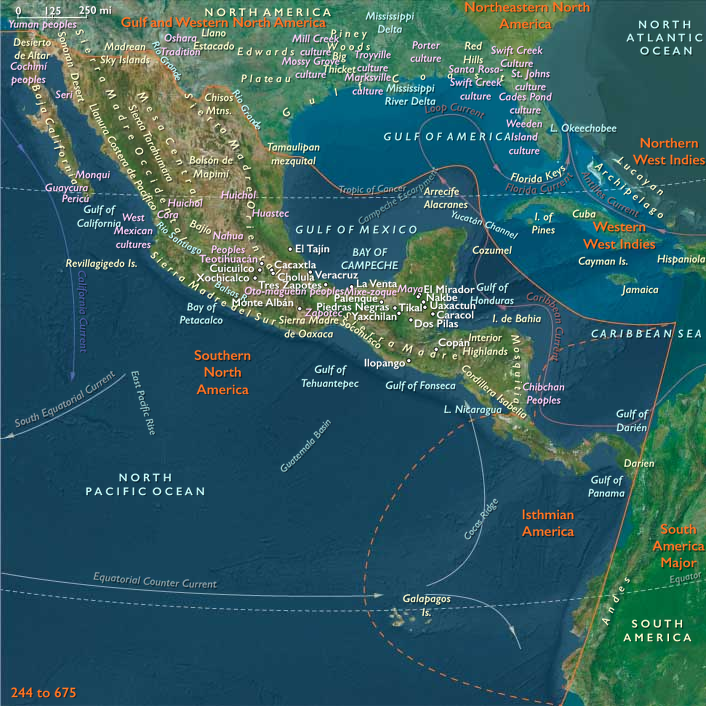
There is a change in political alliances just preceding the event when royal personages from the Mexican highland city of Teotihuacan consolidate power individually as Mayan kings.
Copán, in extreme western Honduras near the Guatemalan border, lies on the west bank of the Copán River, about thirty-five miles (fifty-six kilometers) west of the modern town of Santa Rosa de Copán.
Beginning as a small agricultural settlement about 1000 BCE, it had become an important Maya city during the Classic Period (roughly CE 250 to 900), and at its peak early in the ninth century it may have been home to as many as twenty thousand people.
A dynasty of at least sixteen kings rules Copán from about 426.
The motifs associated with the depiction of founding ruler K'inich Yax K'uk' Mo on Copan monuments have a distinct resemblance to imagery associated with the height of the Classic-era center of Teotihuacan in the distant northern central Mexican region, and have been interpreted as intending to suggest his origins and association with that prestigious civilization.
One of the most commonly cited motifs for this interpretation is Yax K'uk' Mo's 'goggle-eyed' headdress with which he is commonly depicted, seemingly an invocation of the northern central Mexican rain deity known as Tlaloc to later peoples such as the Aztecs.
His tomb is in the center of the Copán acropolis; he is buried with jade and shell jewelry, including his 'goggle-eyed' headress.
His image occupies the first position in the carving on Altar Q, showing the dynasty's king list.
His image is found in significant positions in other monuments of later rulers.
His skeleton exhibited a number of traumas including healed fractures of the arm, sternum, and shoulder which have been surmised to have resulted from ball court matches.
Analysis of strontium in the teeth of the skeleton indicates that the individual spent his early years near Tikal in the Petén Basin region and then at some point between Tikal and Copán, and the isotopic signature did not match with a Teotihuacan origin.
Chronologically and epigraphically, however, much evidence points to the general ascension of rulers who were sent into the lowland Maya region either as invaders or envoys from Teotihuacan during the late fourth century; particularly the widely known and powerful Yax Nuun Ayiin I of Tikal, son of Teotihuacan lord Spearthrower Owl.
The implication of this, regardless of K'inich Yax K'uk' Mo's physical point of geographic origin, is that later Copán rulers, in particular K'ak' Yipyaj Chan K'awiil and Yax Pasaj Chan Yopaat retrospectively sought to attribute Teotihuacano heritage to the 'founding' ruler of their dynasty as a means of legitimizing the dynastic claim.