Khālid ibn al-Walīd
Arab Muslim general
Years: 592 - 642
Khālid ibn al-Walīd (592–642) also known as Sayf Allāh al-Maslūl (the Drawn Sword of God), is a companion of the Islamic prophet Muhammad.
He is noted for his military tactics and prowess, commanding the forces of Medina under Muhammad and the forces of his immediate successors of the Rashidun Caliphate; Abu Bakr and Umar ibn Khattab.
It is under his military leadership that Arabia, for the first time in history, is united under a single political entity, the Caliphate.
Commanding the forces of the nascent Islamic State, Khalid is victorious in over a hundred battles, against the forces of the Byzantine-Roman Empire, Sassanid-Persian Empire, and their allies, in addition to other Arab tribes.
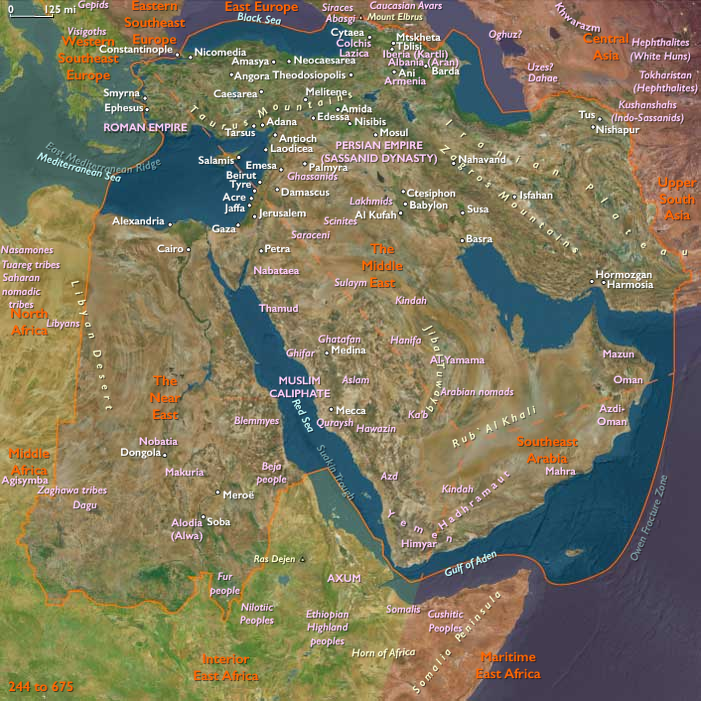
His strategic achievements include the conquest of Arabia, Persian Mesopotamia and Roman Syria within several years from 632 to 636.
He is also remembered for his decisive victories at Yamamah, Ullais, and Firaz, and his tactical successes at Walaja and Yarmouk.
Khalid ibn al-Walid (Khalid son of al-Walid, lit.
Immortal son of the Newborn) is from the Meccan tribe of Quraish, from a clan that initially opposes Muhammad.
He plays a vital role in the Meccan victory at the Battle of Uhud against the Muslims.
He converts to Islam, and joins Muhammad after the Treaty of Hudaybiyyah and participates in various expeditions for him, such as the Battle of Mu'tah.
It is the first battle between the Romans and the Muslims.
Khalid ibn Al-Walid reported that the fighting was so intense, that he used nine swords, which broke in the battle.
Khalid takes over after Zayd ibn Haritha, then Jafar ibn Abi Talib, then Abdullah ibn Rawahah are killed.
After Muhammad's death, he plays a key role in commanding Medinan forces for Abu Bakr in the Ridda wars, conquering central Arabia and subduing Arab tribes.
He captures the Sassanid Arab client Kingdom of Al-Hirah, and defeats the Sassanid Persian forces during his conquest of Iraq (Mesopotamia).
He is later transferred to the western front to capture Roman Syria and the Byzantine Arab client state of the Ghassanids.
Even though Umar later relieves him of high command, he nevertheless remains the effective leader of the forces arrayed against the Byzantines during the early stages of the Byzantine–Arab Wars.
Under his command, Damascus is captured in 634 and the key Arab victory against the Byzantine forces is achieved at the Battle of Yarmouk (636), which leads to the conquest of the Bilad al-Sham (Levant).
In 638, at the zenith of his career, he is dismissed from military services.