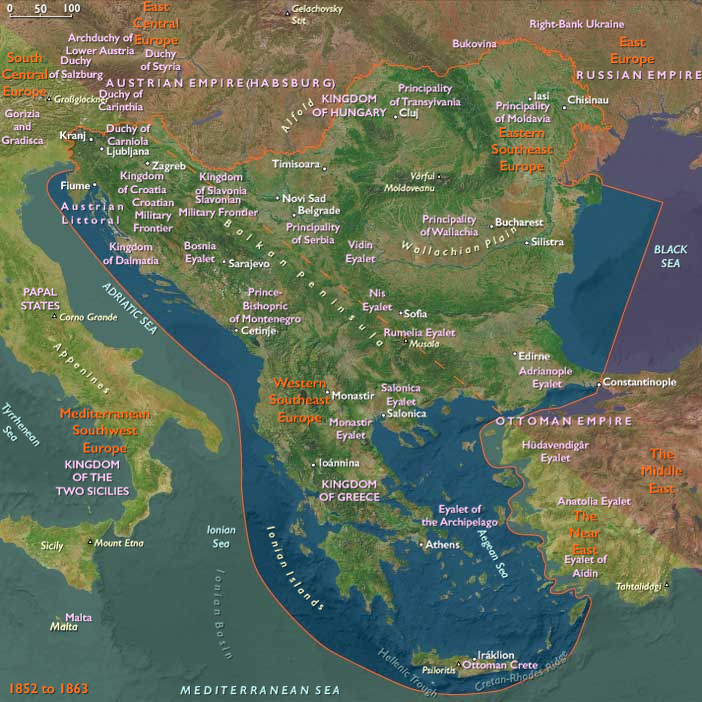
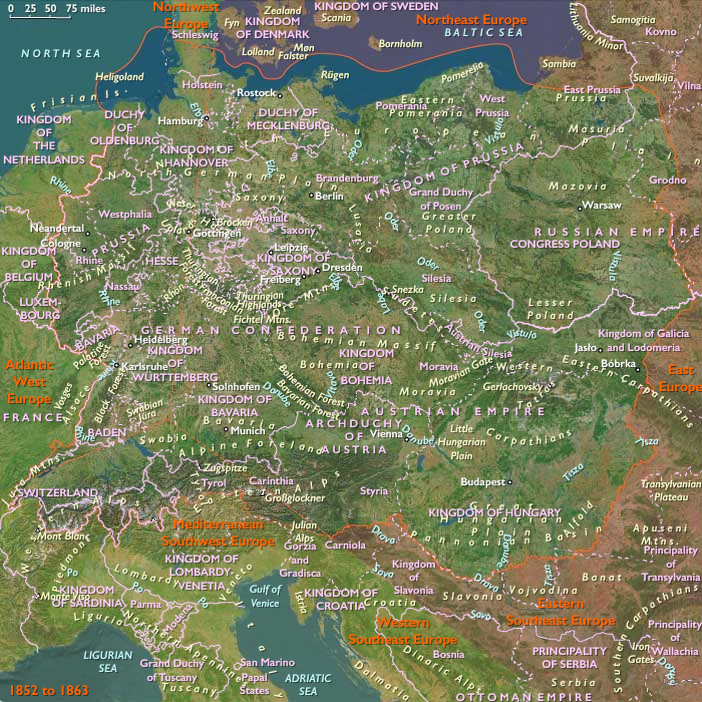
The "High Contracting Parties" of the Grand, or Holy, Alliance—Russia, Prussia, Austria, and Pope Pius VII of the Papal States of Italy—meet in Verona from October to December to ratify Article Six of the Congress of Vienna that had ended the Napoleonic Wars.
Alarmed by the events in Spain, the other European powers authorize France to intervene in the conflict and restore the rule of Ferdinand, with only Britain abstaining from that decision.
While the representatives of the United Kingdom and the European powers had at first, during the Congress of Vienna, acted largely in concert, the extent to which the concord epitomized in the expression the "Concert of Europe" had unraveled in seven years becomes apparent in the way in which the three main questions before this Congress are handled.
The instructions drawn up by the Marquess of Londonderry, as Castelreagh had become in 1821, for his own guidance, had been handed to Wellington by George Canning without alteration.
They define the United Kingdom's position towards the three questions which it is supposed will be discussed: the Turkish Question (currently surfacing in the Greek insurrection), the question of intervention in favor of the Bourbon royal power in Spain and the revolted Spanish colonies, and the Italian Question.
The matter of the Italian Question deals with the continued Austrian rule in Northern Italy.
Since the United Kingdom cannot undertake to support a system in which she has merely acquiesced, Wellington does not even formally present his credentials until the other Powers have disposed of the matter, a British minister (Castlereagh's half-brother and successor in the Londonderry title) attending merely to keep informed and to see that nothing is done inconsistent with the European system and the treaties.
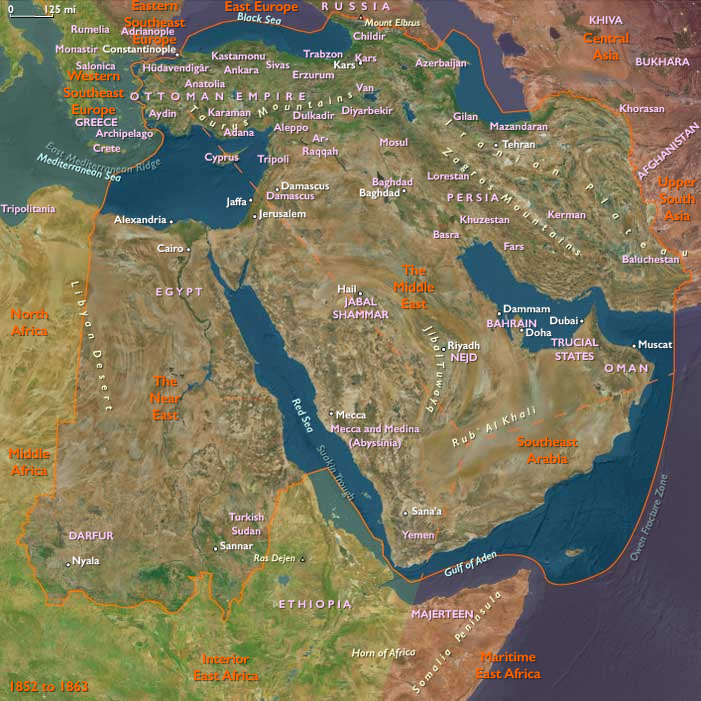
In the Greek Question, the probable raising of which had alone induced the British government to send a minister plenipotentiary to the Congress, Wellington has been instructed to suggest the eventual necessity for recognizing the belligerent rights of the Greeks, and, in the event of concerted intervention, to be careful not to commit the United Kingdom, beyond a supporting role.
As for Russia and Austria, the immediate problems arising out of the Greek Question had already been privately settled between the emperor Alexander and Metternich, to their mutual satisfaction, at the preliminary conferences held at Vienna in September.
When the plenipotentiaries meet in Verona, the only question raised is the Spanish Question, of the proposed French intervention in Spain, in which Wellington's instructions are to express the uncompromising opposition of the United Kingdom to the whole principle of intervention.