Karl Marx
German philosopher, economist, sociologist, historian, journalist, and revolutionary socialist
Years: 1818 - 1883
Karl Heinrich Marx (5 May 1818 – 14 March 1883) is a German philosopher, economist, sociologist, historian, journalist, and revolutionary socialist.
His ideas play a significant role in the development of social science and the socialist movement.
He publishes various books during his lifetime, with the most notable being The Communist Manifesto (1848) and Capital (1867–1894); some of his works are co-written with his friend and fellow German revolutionary socialist, Friedrich Engels.
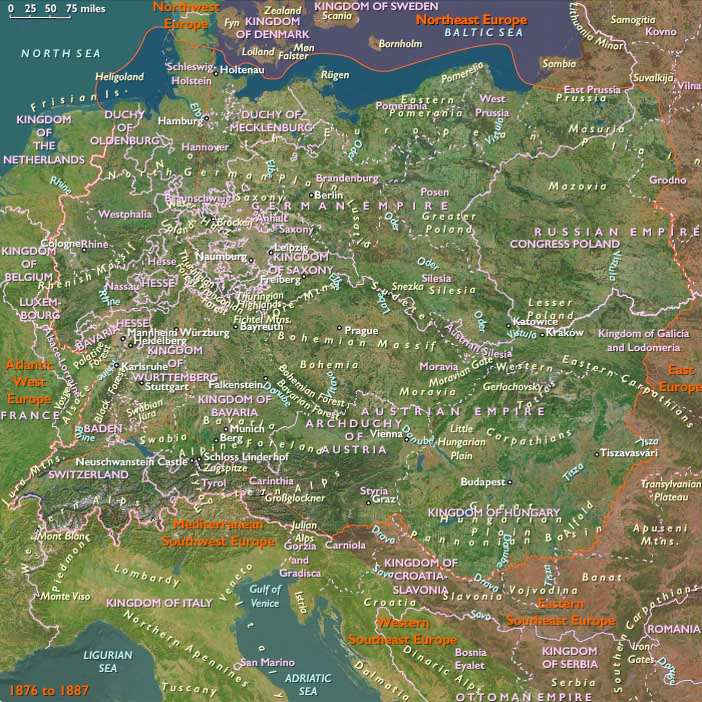
Born into a wealthy middle-class family in Trier (formerly in Prussian Rhineland, now called Rhineland-Palatinate), Marx studies at both the University of Bonn and the University of Berlin, where he becomes interested in the philosophical ideas of the Young Hegelians.
In 1836. he becomes engaged to Jenny von Westphalen, marrying her in 1843.
After his studies, he writes for a radical newspaper in Cologne, and begins to work out his theory of dialectical materialism.
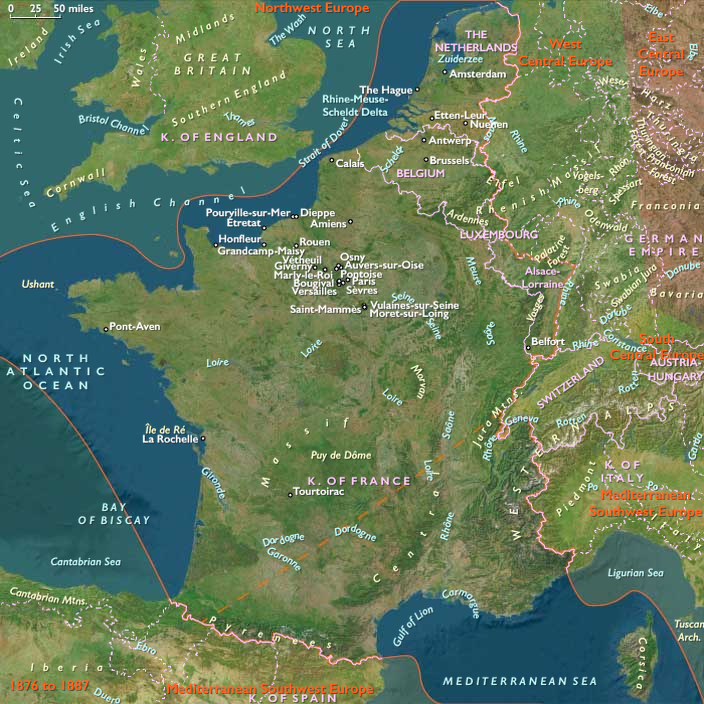
Moving to Paris in 1843, he begins writing for other radical newspapers.
He meets Engels in Paris, and the two men work together on a series of books.
Exiled to Brussels, he becomes a leading figure of the Communist League, before moving back to Cologne, where he founds his own newspaper.
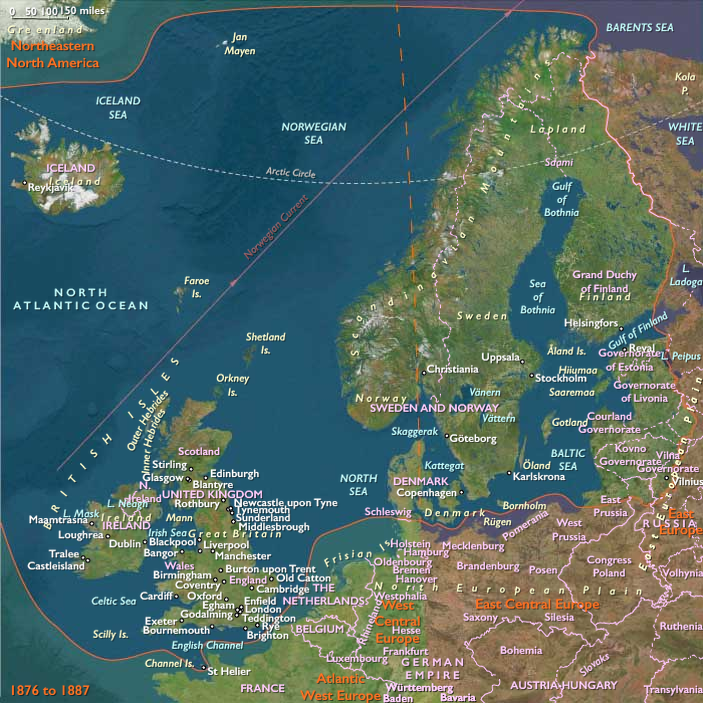
In 1849, he is exiled again and moves to London together with his wife and children.
In London, where the family is reduced to poverty, Marx continues writing and formulating his theories about the nature of society and how he believes it could be improved, and also campaigns for socialism—he becomes a significant figure in the International Workingmen's Association.
Marx's theories about society, economics and politics—collectively known as Marxism—hold that all societies progress through the dialectic of class struggle: a conflict between an ownership class which controls production and a lower class which produces the labor for goods.
Heavily critical of the current socioeconomic form of society, capitalism, he calls it the "dictatorship of the bourgeoisie", believing it to be run by the wealthy classes purely for their own benefit, and predicts that, like previous socioeconomic systems, it will inevitably produce internal tensions that will lead to its self-destruction and replacement by a new system, socialism.
He argues that under socialism society will be governed by the working class in what he calls the "dictatorship of the proletariat", the "workers state" or "workers' democracy".
He believes that socialism will, in its turn, eventually be replaced by a stateless, classless society called communism.
Along with believing in the inevitability of socialism and communism, Marx actively fights for the former's implementation, arguing that both social theorists and underprivileged people should carry out organized revolutionary action to topple capitalism and bring about socioeconomic change.
Revolutionary socialist governments espousing Marxist concepts take power in a variety of countries in the 20th century, leading to the formation of such socialist states as the Soviet Union in 1922 and the People's Republic of China in 1949.
Many labor unions and workers' parties worldwide are also influenced by Marxist ideas, while various theoretical variants, such as Leninism, Stalinism, Trotskyism, and Maoism, ware developed from them.
Marx is typically cited, with Émile Durkheim and Max Weber, as one of the three principal architects of modern social science.
Marx has been described as one of the most influential figures in human history.