Justin Martyr
Christian apologist
Years: 100 - 165
Justin Martyr, also known as just Saint Justin (CE 100–165), is an early Christian apologist, and is regarded as the foremost interpreter of the theory of the Logos in the 2nd century.
Most of his works are lost, but two apologies and a dialogue do survive.
He is considered a saint by the Roman Catholic Church and the Eastern Orthodox Church.

Related Events
Filter results
Showing 5 events out of 5 total
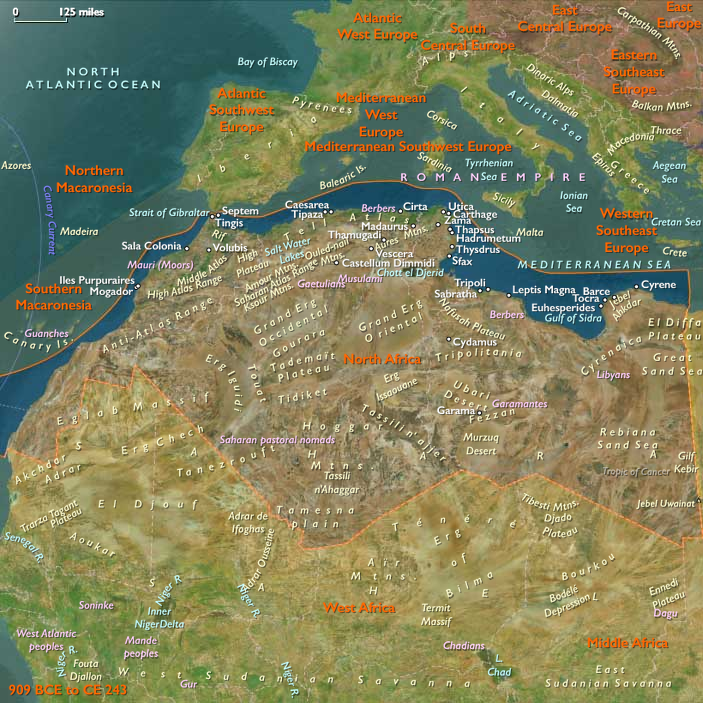
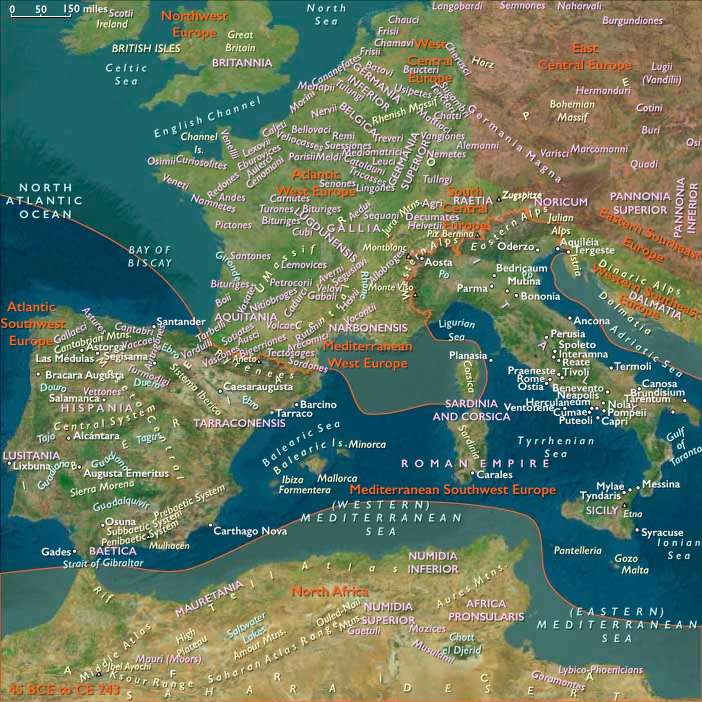
Mediterranean Southwest Europe (100–243 CE): Imperial Zenith, Cultural Flourishing, and Emerging Instability
The age 100–243 CE in Mediterranean Southwest Europe—covering Italy, southern and eastern Iberia, Andorra, and the islands of the Western Mediterranean except Corsica—marks the peak and initial decline of Roman imperial power. The period witnesses remarkable territorial expansion, significant cultural contributions from prominent Hispano-Roman figures, intense religious debates, and escalating internal tensions that culminate in political crisis.
Trajan’s Golden Age and Imperial Expansion (100–111 CE)
Under Emperor Trajan (r. 98–117 CE), the Roman Empire reaches its territorial zenith, encompassing nearly five million square kilometers. Trajan, born in Hispania to a colonial Roman family, significantly strengthens the empire through military campaigns, particularly the Dacian Wars, extensive infrastructure projects, and judicial reforms. The Hispano-Roman elite increasingly contribute to Roman society, with the region fully integrated into the imperial structure by the end of the first century CE.
Cultural Reflections and Societal Critiques (112–123 CE)
The satirist Juvenal critically assesses Roman society, immortalizing phrases such as "bread and circuses" and "who will watch the watchers?" His writings underscore cultural introspection and societal concerns during a period of relative stability and economic growth.
Architectural and Cultural Innovations under Hadrian (124–135 CE)
Emperor Hadrian (r. 117–138 CE), another Hispano-Roman, significantly transforms Rome’s architectural landscape, notably with the Pantheon and the Temple of Trajan. Hadrian’s urban reforms and infrastructural projects underline a period of sustained prosperity and cultural patronage.
Continued Stability under Antoninus Pius (136–147 CE)
Hadrian's successor, Antoninus Pius, maintains administrative efficiency, judicial fairness, and regional prosperity. Infrastructure and cultural activities continue robustly, ensuring prolonged stability and intellectual vibrancy.
Religious Debates and Christian Expansion (148–159 CE)
During Pope Anicetus’s pontificate, Rome becomes a significant center for Christian theological debates, exemplified by Polycarp’s visit and discussions on Paschal observances. This era solidifies Christianity’s role as an increasingly influential intellectual and religious presence within Roman society.
Marcus Aurelius and Philosophical Flourishing (160–171 CE)
Emperor Marcus Aurelius (r. 161–180 CE), also of Hispano-Roman descent, embodies Stoic philosophy, producing his reflective masterpiece, Meditations. Concurrently, Christian intellectuals, notably Justin Martyr and Tatian, actively engage with Greek philosophical traditions, deeply influencing Christian theology and apologetics.
Marcus Aurelius’s Military and Philosophical Leadership (172–183 CE)
Marcus Aurelius balances philosophical pursuits with military responsibilities, particularly during the Marcomannic Wars. Cultural and artistic expressions, exemplified by intricately carved Roman sarcophagi, continue to thrive despite external challenges.
Commodus’s Decline and Imperial Instability (184–195 CE)
Commodus's troubled reign drastically destabilizes Rome through extravagance and erratic governance. His assassination precipitates a period of political upheaval, starkly contrasting with previous imperial stability.
Severan Dynasty’s Restoration and Economic Revival (196–207 CE)
Septimius Severus restores stability, consolidating military strength, implementing administrative reforms, and revitalizing the economy. His reign fortifies imperial borders and fosters continued regional prosperity.
Caracalla’s Citizenship Reform and Internal Struggles (208–219 CE)
Emperor Caracalla’s Constitutio Antoniniana profoundly reshapes Roman society, granting citizenship to nearly all free inhabitants. Despite internal tensions and familial strife, infrastructure projects and economic stability persist.
From Chaos to Stability under Alexander Severus (220–231 CE)
The turbulent reign of Elagabalus yields to Alexander Severus, whose moderate governance and judicial reforms stabilize the empire temporarily. His efforts maintain economic vitality and cultural activity despite rising external threats.
Late Severan Instability and the Third Century Crisis (232–243 CE)
Alexander Severus’s later reign faces significant military pressures, culminating in his assassination in 235 CE, which triggers the prolonged "Crisis of the Third Century." This period reveals deep vulnerabilities within the imperial structure.
Legacy of the Age
The period from 100–243 CE represents the Roman Empire at its apex, characterized by territorial expansion, cultural and intellectual achievements, and extensive contributions from Hispano-Romans like Trajan, Hadrian, Marcus Aurelius, Seneca, Lucanus, and Martial. Despite eventual instability, the advancements in governance, citizenship rights, infrastructure, and intellectual life during this era significantly influence Roman society, laying enduring foundations for European cultural and historical development.
Mediterranean Southwest Europe (160–171 CE): Philosophical Engagements and Early Christian Debates
The era 160–171 CE in Mediterranean Southwest Europe is notable for significant philosophical and religious developments, marked by the influential reign of Marcus Aurelius, cultural advancements in art, and intense philosophical debates within the burgeoning Christian community.
Marcus Aurelius and Stoic Philosophy
During this period, Marcus Aurelius, already empowered as imperial heir and educated by prominent tutors in Rome and Athens, embraces Stoicism. His philosophical transition from rhetoric to Stoicism profoundly shapes his reign, emphasizing rational self-control, ethical reflection, and the pursuit of virtue, significantly influencing Roman intellectual and cultural life.
Artistic Innovations: Roman Sarcophagi
Artistic expression continues to flourish, notably through the sophisticated "Roman type" sarcophagi, exemplified by the Niobid Sarcophagus (ca. 160–170 CE). These sarcophagi, carved in high relief with intricate representations of mythological scenes, battles, and decorative garlands, underscore the cultural sophistication and artistic accomplishments of the era.
Justin Martyr and Christian Apologetics
The Samaritan Christian theologian Justin Martyr, well-versed in Stoic, Peripatetic, Pythagorean, and Platonic traditions, significantly contributes to Christian intellectual discourse. Justin emigrates to Rome during the reign of Antoninus Pius, where he establishes a philosophical school and authors influential treatises, notably his two Apologies, Dialogue with Trypho, and On the Resurrection.
In 165 CE, after public philosophical disputes, particularly with the cynic philosopher Crescens, Justin and six companions are tried by Junius Rusticus, the urban prefect, and subsequently executed. The martyrdom of Justin preserves crucial historical records of early Christian persecution and doctrinal defense.
Tatian’s Influence and Controversial Legacy
One of Justin’s prominent pupils, Tatian, an ethnic Assyrian who encounters Christianity in Rome, emerges as a significant yet controversial figure. Rejecting pagan practices and convinced by Old Testament writings, Tatian converts to Christianity and opens his own philosophical school in Rome.
Following Justin's martyrdom, Tatian becomes involved in theological controversies, notably espousing Encratitic (ascetic) views and reportedly associating with Gnostic leader Valentinius. His subsequent expulsion from the orthodox community prompts him to leave Rome. Later sources suggest Tatian establishes a school in Mesopotamia with notable influence across Syria, Cilicia, and Pisidia, although these accounts remain uncertain.
Tatian authors influential works, notably the Oratio ad Graecos, a discursive critique of paganism asserting Christianity's ancient and rational foundations. His Diatessaron, a harmonized narrative synthesizing the four canonical Gospels, becomes widely influential, especially in Syria during the third and fourth centuries.
Cultural Continuity and Intellectual Life
This period maintains robust cultural and intellectual vitality under Antoninus Pius and Marcus Aurelius. Literary, philosophical, and artistic endeavors flourish, demonstrating the era’s sophisticated engagement with diverse intellectual traditions and philosophical debates.
Economic Stability and Urban Infrastructure
Mediterranean Southwest Europe continues experiencing stable economic growth and urban development, supported by imperial patronage and sustained provincial integration. Continued investments in infrastructure, trade networks, and urban amenities enhance economic prosperity and administrative efficiency throughout the region.
Legacy of the Era
The era 160–171 CE is distinguished by significant philosophical engagements and vibrant religious debates within early Christianity. Marcus Aurelius’s embrace of Stoicism, the artistic advancements exemplified by Roman sarcophagi, and the intellectual contributions of figures such as Justin Martyr and Tatian profoundly influence Roman cultural and religious developments, leaving lasting legacies for subsequent generations.
The "Roman type" of sarcophagus used from about 100, exemplified by the Niobid Sarcophagus executed around 160-170, is carved in high relief, often with representations of garlands, battles, and mythological subjects.
Samaritan Christian theologian Justin, who had studied in different schools of philosophy—Stoic, Peripatetic, Pythagorean, and Platonic—before his conversion, undertakes to make a reasoned defense of Christianity to outsiders, emigrates to Rome during the reign of Antoninus Pius and opens a school of philosophy.
He reputedly writes a vast number of treatises, among them two Apologies, his Dialogue with Trypho the Jew (only these three survive intact), and On the Resurrection (which survives in fragments).
One of Justin’s pupils, Tatian, an ethnic Assyrian, had come to Rome, where he seems to have remained for some time, and seems here to have for the first time encountered Christianity.
According to his own representation, it was primarily his abhorrence of the pagan cults that led him to spend thought on religious problems.
By the Old Testament, he says, he became convinced of the unreasonableness of paganism and adopted the Christian religion.
It is the period when Christian philosophers competed with Greek sophists, and like Justin, he opens a Christian school in Rome.
It is not known how long he labors in Rome without being disturbed.
In the reign of Marcus Aurelius, after disputing with the cynic philosopher Crescens, Justin is denounced by the latter to the authorities, according to Tatian (Address to the Greeks 19) and Eusebius (HE IV 16.7-8).
Justin is tried together with six companions by Junius Rusticus, who is urban prefect from 163-167, and is beheaded, probably in 165.
The martyrdom of Justin preserves the court record.
Following the death of Justin, the life of Tatian is to some extent obscure.
Irenaeus remarks (Haer., I., xxvlii. 1, Ante-Nicene Fathers, i. 353) that after the death of Justin, he was expelled from the church for his Encratitic (ascetic) views (Eusebius claims he founded the Encratitic sect), as well as for being a follower of the gnostic leader Valentinius.
It is clear that Tatian left Rome, perhaps to reside for a while in either Greece or Alexandria.
Epiphanius relates that Tatian established a school in Mesopotamia, the influence of which extended to Antioch in Syria, and was felt in Cilicia and especially in Pisidia, but his assertion cannot be verified.
His Oratio ad Graecos (Address to the Greeks) tries to prove the worthlessness of paganism, and the reasonableness and high antiquity of Christianity.
It is not characterized by logical consecutiveness, but is discursive in its outlines.
However as early as Eusebius, Tatian was praised for his discussions of the antiquity of Moses and of Jewish legislation, and it was because of this chronological section that his Oratio was not generally condemned.
His other major work is the Diatessaron, a "harmony" or synthesis of the four New Testament Gospels into a combined narrative of the life of Jesus.
Ephrem the Syrian referred to it as the Evangelion da Mehallete ("The Gospel of the Mixed"), and it will practically be the only gospel text used in Syria during the third and fourth centuries.
Bethlehem, the site of the nativity of Jesus Christ according to the Gospels (Matthew 2; Luke 2), in CE 135 hosts a Roman garrison during the Bar Kochba Revolt.
Second-century Christian apologist Justin Martyr identifies the site of the Nativity as a manger in “a cave close to the village.”
Christians from this point on will accord the cave continuous veneration.
Mediterranean Southwest Europe (172–183 CE): Marcus Aurelius’s Reign and Continued Philosophical Influence
The era 172–183 CE in Mediterranean Southwest Europe continues under the philosophically-driven reign of Marcus Aurelius, witnessing significant military and political challenges alongside sustained intellectual and cultural dynamism.
Marcus Aurelius and the Marcomannic Wars
During this period, Emperor Marcus Aurelius devotes considerable attention to military affairs, notably the Marcomannic Wars (166–180 CE), a series of conflicts against Germanic tribes along Rome's northern borders. Despite his preference for philosophical contemplation, Aurelius demonstrates resilience and strategic skill in managing these prolonged military campaigns, safeguarding imperial stability.
Philosophical Reflections: Meditations
Throughout these turbulent years, Marcus Aurelius composes his philosophical masterpiece, Meditations. This introspective work embodies Stoic principles, emphasizing duty, rationality, and personal virtue in the face of adversity. The Meditations become influential beyond their era, profoundly shaping philosophical thought and ethical reflection in Roman society and beyond.
Continuing Artistic and Cultural Flourishing
Cultural and artistic vitality remains strong, highlighted by ongoing innovations in sculpture, architecture, and literature. Roman sarcophagi continue to be intricately crafted, exemplifying high-relief techniques depicting detailed mythological narratives and reinforcing the cultural sophistication of the period.
Early Christian Communities and Continued Debates
This era witnesses sustained growth and theological development within early Christian communities, marked by ongoing doctrinal debates and philosophical exchanges. Intellectual figures following in the footsteps of Justin Martyr and Tatian further elaborate Christian theology, addressing Roman philosophical traditions and religious controversies, and contributing to Christianity’s gradual expansion and intellectual integration.
Economic Resilience and Infrastructure Development
Mediterranean Southwest Europe maintains robust economic health, supported by consistent trade, stable governance, and sustained infrastructure development. Imperial patronage ensures the continued enhancement of roads, ports, aqueducts, and public facilities, facilitating economic prosperity and urban cohesion.
Legacy of Marcus Aurelius and Cultural Continuity
The era 172–183 CE solidifies Marcus Aurelius’s legacy as both a capable ruler and an influential philosopher-emperor. His thoughtful governance during military crises, combined with profound philosophical insights captured in the Meditations, reinforces the era’s intellectual and cultural strengths. This period leaves an enduring impact, influencing subsequent Roman imperial philosophy, ethics, and governance.