Justin I
Emperor of the Eastern Roman (Byzantine) Empire
Years: 450 - 527
Justin I (c. 450 – 1 August 527) was Byzantine Emperor from 518 to 527.
He rises through the ranks of the army and ultimately becomes its Emperor, in spite of the fact he is illiterate and almost 70 years old at the time of accession.
His reign is significant for the founding of the Justinian Dynasty that includes his eminent nephew Justinian I and for the enactment of laws that de-emphasize the influence of the old Roman nobility.
His consort is Empress Euphemia.




Related Events
Filter results
Showing 10 events out of 28 total
Anastasius’ removal of Zeno’s Isaurian clansmen from their powerful positions as imperial officials, coupled with the expulsion of Isaurian troops from Constantinople, spurs the bellicose Isaurians of the south central Anatolian highlands to revolt and invade western Anatolia in 492.
Anastasius declare war on the Isaurian supporters of Longinus, the brother of Zeno who was passed over in his succession in favor of Anastasius, and sends a mostly Gothic army against them.
The rebels are defeated by the Eastern Roman army under John the Scythian and John the Hunchback in the Battle of Cotyaeum (subordinate commanders including the future Justin I).
Eastern Southeast Europe (508–519 CE): Reinforced Stability and Anticipated Changes
Settlement and Migration Patterns
Stability and Urban Prosperity
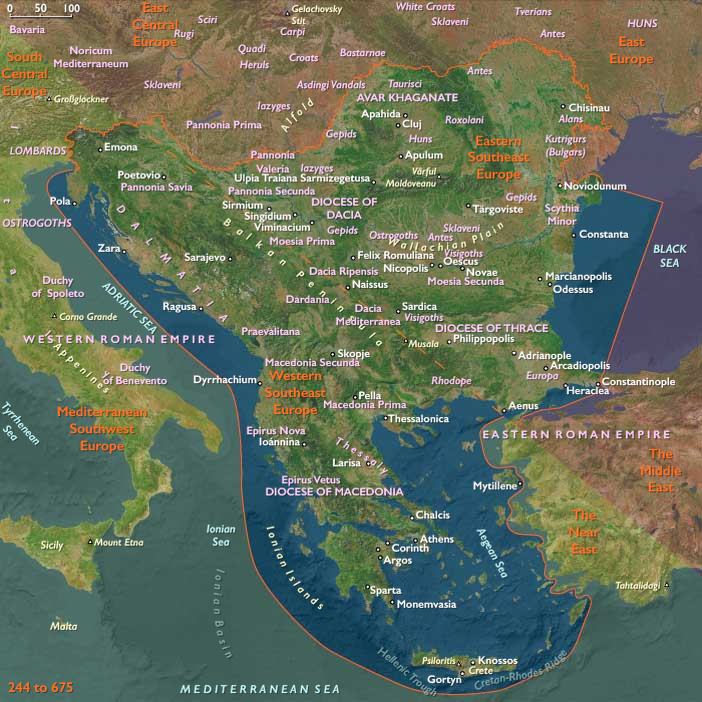
From 508 to 519 CE, Eastern Southeast Europe enjoyed continued stability and prosperity, facilitating sustained urban growth and infrastructural improvements. Major urban centers such as Constantinople and Philippopolis maintained their prominence, attracting stable and growing populations.
Ongoing Vigilance at Borders
Vigilance regarding migratory movements along regional frontiers increased during this period. Small-scale migrations persisted intermittently, prompting strategic settlement adaptations and cautious border management policies.
Economic and Technological Developments
Sustained Economic Resilience
Economic activities remained robust, driven by steady agricultural productivity, active trade routes, and effective urban economic management. Constantinople continued its crucial role as an economic nexus, ensuring sustained regional prosperity.
Defensive Technological Enhancements
Technological advancements continued to focus on military defense and infrastructure improvements. Enhanced fortifications, military logistics, and weaponry advancements reinforced regional security, safeguarding economic activities and urban centers.
Cultural and Artistic Developments
Continued Artistic and Cultural Vitality
Regional cultural life thrived, integrating classical traditions with Christian motifs in artistic production. Public monuments, religious buildings, and decorative arts enriched the cultural landscape, underscoring regional identity and heritage. Notably, the period saw significant artistic productions, including illuminated manuscripts such as the Ambrosian Iliad (Ilias Picta), produced in Constantinople between 493 and 508 CE.
Intellectual and Educational Continuity
Educational and scholarly institutions remained robust, actively preserving classical knowledge and adapting intellectual traditions to contemporary conditions. These institutions supported vibrant intellectual and cultural activities, ensuring continuity amidst changing social contexts.
Social and Religious Developments
Efficient Administrative Structures
Administrative structures further solidified, enhancing local governance efficiency, civic oversight, and regional coherence. These developments significantly contributed to sustained stability and effective management of emerging challenges.
Expanding Christian Influence
Christianity continued its deep integration within societal frameworks, significantly shaping social, cultural, and political dynamics. The expansion and reinforcement of religious institutions promoted societal cohesion and community resilience.
Vitalian's Rebellion
In 513 CE, Vitalian, an imperial general likely of mixed Roman and barbarian descent, rebelled against Emperor Anastasius I due to widespread discontent over fiscal austerity and the promotion of Miaphysitism. Quickly garnering support from large parts of the army and populace in Thrace, Vitalian posed a serious threat to Constantinople, forcing Anastasius to recant Miaphysitism in 515 CE. Vitalian’s rebellion ended following a decisive naval defeat, after which he retreated to Thrace until pardoned by the new emperor, Justin I, in 518 CE, marking a critical moment of religious and political tension.
Long-Term Consequences and Historical Significance
The period from 508 to 519 CE was characterized by reinforced regional stability, effective anticipation of migration pressures, sustained economic resilience, and cultural continuity. These developments shaped Eastern Southeast Europe's historical trajectory significantly, providing a stable platform for future regional growth and Byzantine prominence.
Vitalian, an imperial general probably of mixed Roman and barbarian descent, rebels in 513 against Emperor Anastasius I, whose fiscal stringency and promotion of Miaphysitism are widely unpopular, which allows Vitalian to quickly win over large parts of the army and the people of Thrace to his cause.
After scoring a series of victories over loyalist armies, Vitalian comes to threaten Constantinople itself, and forces Anastasius to officially recant his adoption of Miaphysitism in summer 515.
Soon after, however, as Anastasius fails to honor some of the terms of the agreement, Vitalian marches on Constantinople, only to be decisively defeated by Anastasius' admiral, Marinus.
Vitalian flees to his native Thrace and remains in hiding until Anastasius's death in 518.
As a staunch promoter of Chalcedonian orthodoxy, he is pardoned by the new emperor Justin I, who is is engaged in the negotiations with the Pope to end the Acacian Schism.
Anastasius dies in his late eighties on July 19, 518, leaving the imperial treasury richer by twenty-three million solidi or three hundred and twenty thousand pounds of gold.
He having died childless, without designating an heir, and without a reigning Augusta to supervise the election of a successor, the throne is up for grabs.
According to John Malalas, a Greek chronicler from Antioch, the powerful praepositus sacri cubiculi Amantius intends to elect to the throne a comes domesticorum, commander of an elite guard unit of the late Roman Empire, by the name of Theocritus.
Theocritus is an obscure individual, primarily mentioned by two authors: John Malalas and Marcellinus Comes.
Amantius hopes to secure the election for Theocritus by bribing Justin, the influential comes excubitorum (head of the imperial guards).
Justin is supposed to share the money with his troops.
Justin, born of Thraco-Roman peasant stock n a hamlet near Bederiana in Naissus (modern Niš, South Serbia), had been a swineherd in his youth.
Like his companions and members of his family (Zimarchus, Dityvistus, Boraides, Bigleniza, Sabatius, etc.), he bears a Thracian name.
As a teenager, he and two companions had fled from a barbaric invasion, taking refuge in Constantinople possessing nothing more than the ragged clothes on their backs and a sack of bread between them.
Justin soon joined the army, entered the palace guard and, because of his ability, had risen through the ranks to become a general and a patrician under Anastasius I, becoming the emperor's close confidant and acting possibly as regent.
He remains illiterate and has never learned to speak more than rudimentary Greek.
The events of the election are described in detail by Peter the Patrician, extracts of whose work survive in the tenth-century De Ceremoniis.
On the morning of the election, the Excubitors at first put forward the tribune John as a candidate.
He is raised on the shield in the Hippodrome of Constantinople.
But the Blues, an influential chariot racing faction, riot against this candidate.
The guardsmen of the Scholae Palatinae then attempt to proclaim their own candidate, but the Excubitors almost kill that unnamed man.
The Excubitors then allegedly put forward Flavius Petrus Sabbatius (later Justinian I), nephew of Justin, as their second candidate for the day, but he refuses the crown.
The Senate supposedly settled the matter by electing Justin himself.
Both Amantius and Theocritus are soon executed on a pretext, obviously eliminated by Justin for their role in the conspiracy.
Procopius briefly mentions: "Indeed, his power [Justin's] was not ten days old, before he slew Amantius, chief of the palace eunuchs, and several others, on no graver charge than that Amantius had made some rash remark about John, Archbishop of the city.
After this, he was the most feared of men."
Based on the account of Marcellinus, Amantius and his supporters were accused of being adherents of Manichaeism.
A combination of sources imply that Amantius and Theocritus had attempted to overthrow Justin, following his election.
If so, they were met with swift executions.
Justin, unlike his predecessor, is a champion of Christian orthodoxy.
Instrumental in ending the Acacian schism with Rome in 518-519, he persecutes the dissident Monophysites.
Justin’s nephew Petrus Sabbatius becomes his administrator and a power behind the throne.
Severus, patriarch of Antioch, is deposed by a synod on September 29, 518, for his monophysitism.
Paul the Jew, a Chalcedonian, is appointed to replace him.
Vitalian, once back in northern Thrace, had gone into hiding, while many of his erstwhile aides were captured and executed.
Nothing is known of him for the next three years, although a short remark by a chronicler seems to indicate that he resurfaced and led another armed rebellion during the last months of Anastasius's life.
Justin I, the new emperor, had quickly moved to strengthen his rule, dismissing a number of potential rivals or enemies.
At the same time, he had called upon Vitalian to come to Constantinople.
Upon his arrival, Vitalian is made magister militum in praesenti, named honorary consul, and soon after raised to the rank of patricius.
As a well-known champion of Chalcedonian orthodoxy, Vitalian is to play a role in the new regime's reaffirmation of the Chalcedonian doctrines and reconciliation with Rome.
He plays an active role in the negotiations with the Pope, and in 519, he is one of the prominent men who escorts a papal delegation into the capital.
On March 28, the Eastern and Western churches reconcile their differences, ending the Acacian Schism.
Eastern Southeast Europe (520–531 CE): Urban Development, Economic Continuity, and Administrative Efficiency
Settlement and Migration Patterns
Urban Development
From 520 to 531 CE, the Eastern Roman Empire’s urban centers in Southeast Europe exhibited a blend of stability and new initiatives under Emperor Justin I and the early reign of Justinian I. Constantinople remained a thriving metropolis, home to hundreds of thousands of inhabitants with continuous construction projects. Although the most renowned projects of Justinian, such as the Hagia Sophia, began slightly after this period, infrastructure like streets, forums, and aqueducts were meticulously maintained, preparing for future embellishments.
Provincial cities such as Philippopolis in Thrace and Serdica in Dacia Mediterranea also experienced sustained urban life, recovering from earlier invasions and benefiting from imperial fortification efforts. By the 520s, Philippopolis retained its ancient theater and forum, repurposed for contemporary use, alongside new church and basilica constructions, indicating thriving urban communities. Justinian’s early policies aimed at fortifying cities across the Balkans, especially in strategic regions such as Moesia and Scythia, underscoring a commitment to urban resilience and regional stability.
Emerging Migration Pressures
Despite urban stability, imperial defenses began to falter as Slavic groups intensified incursions across the Danube River, troubling Balkan provinces. These raids, beginning prominently in the 520s, marked early signs of significant demographic and security challenges.
Economic and Technological Developments
Economic Continuity
Despite conflicts on the empire’s frontiers, Eastern Southeast Europe maintained notable economic activity. Constantinople served as a vital economic nexus, sustaining agricultural provinces and regional trade networks through its enormous demand for grain, oil, and textiles. The capital’s strategic position ensured continued commerce via the Black Sea and Mediterranean routes.
Regional trade routes like the Via Diagonalis continued facilitating movement of goods and troops, supporting local economies in cities such as Philippopolis and Serdica. Monetary circulation persisted, evidenced by coinage from Emperors Justin I and Justinian, highlighting economic stability and continuity.
Technological and Defensive Enhancements
Technological progress primarily centered around military infrastructure, with ongoing enhancements to city walls, fortifications, and logistical frameworks. Such innovations safeguarded urban centers and critical economic activities, reflecting an adaptive approach to emerging threats.
Cultural and Artistic Developments
Artistic and Cultural Vitality
Cultural life flourished with artistic production continuing to integrate classical and Christian motifs. Public monuments, religious architecture, and decorative arts enriched the region’s cultural landscape, affirming regional identity and heritage.
Intellectual Preservation
Educational and scholarly institutions actively preserved classical and theological knowledge, maintaining intellectual vitality and adapting scholarship to contemporary contexts. This period’s educational continuity was pivotal for sustaining regional cultural and intellectual life.
Social and Religious Developments
Administrative Efficiency
The Eastern Roman administration operated efficiently through centralized bureaucracy and a network of provincial officials and military commanders. Cities played crucial administrative roles, with provincial capitals like Philippopolis housing governors and coordinating local governance and defense.
The efficient administrative structure, exemplified by Justinian’s early legal reforms leading to the first edition of the Corpus Juris Civilis (528–529 CE), facilitated effective governance, communication, and rapid response to regional challenges.
Expanding Christian Influence
Christianity deepened its societal integration, with ecclesiastical infrastructure expansion significantly shaping cultural and political dynamics. Bishops in cities like Serdica, Philippopolis, and Adrianople played vital roles, overseeing charitable activities, representing civic interests, and enhancing community cohesion.
Long-Term Consequences and Historical Significance
The period 520–531 CE laid critical groundwork for future regional growth, marked by urban stability, economic resilience, and administrative efficiency. These developments provided a robust platform for subsequent Byzantine prominence, despite looming challenges from emerging migration pressures and military threats.
Imperial defenses disintegrate: the Slavs are already crossing the Danube River and troubling the Balkan provinces, and Emperor Justin proves unable to repel them.
Emperor Justin I, a career soldier with little knowledge of statecraft, has wisely surrounded himself with trusted advisors.
The most prominent of these, of course, is his nephew Flavius Petrus Sabbatius, whom he adopts as his son and invests with the name Iustinianus (Justinian).
Justin’s sister Vigilantia (born about 455) had married one Sabbatius and had two children: Petrus Sabbatius Justinian and Vigilantia (born about 490), who had married Dulcissimus and had Praejecta (born about 520), married to the senator Areobindus and Justin II (born about 520).
Vitalian, the general and erstwhile rebel, becomes consul in 520 and is shortly later murdered, probably on the orders of Justinian.
Relying upon the accounts of the historian Procopius, it often has been said that Justinian ruled the Empire in his uncle's name during the reign of Justin; however, there is much evidence to the contrary.
The information from the Secret History of Procopius was published posthumously.
Critics of Procopius (whose work reveals a man seriously disillusioned with his rulers) have dismissed his work as a severely biased source, being vitriolic and pornographic, but without other sources, critics have been unable to discredit some of the assertions in the publication.
However, contrary to the secret history, Justinian was not named as successor until less than a year before Justin's death.
He spends thirty-seven hundred pounds of gold during a celebration in 520.
Justin's reign is noteworthy for the resolution of the Acacian Schism between the eastern and western branches of the Christian church.
As a devout Catholic, Justin endorses Rome's view on the question of the dual nature of Christ and the more general principle of Roman supremacy.
This temporary eastern deferral to the western church will not endure, however.
Pope Harmisdas dies in 523; John succeeds him.
While a deacon in Rome, John is known to have been a partisan of the Antipope Laurentius, for in a libellus written to Pope Symmachus in 506, John confessed his error in opposing him, condemned Peter of Altinum and Laurentius, and begged pardon of Symmachus.
He would then be the "Deacon John" who signed the acta (ecclesiastic publication) of the Roman synod of 499 and 502; the fact the Roman church only had seven deacons at the time makes identifying him with this person very likely.
He may also be the "Deacon John" to whom Boethius dedicated three of his five religious tractates, or treatises, written between 512 and 520.
John is very frail when he is elected to the papacy as Pope John I.
Despite his protests, Pope John is sent by the Arian King Theodoric to Constantinople to secure a moderation of a decree against the Arians, issued in 523, of Emperor Justin, ruler of the East.
Theodoric threatens that if John should fail in his mission, there would be reprisals against the orthodox, or non-Arian, Catholics in the West.
John proceeds to Constantinople with a considerable entourage: his religious companions include Bishop Ecclesius of Ravenna, Bishop Eusebius of Fanum Fortunae, and Sabinus of Campania His secular companions are the senators Flavius Theodorus, Inportunus, Agapitus, and the patrician Agapitus.