Justa Grata Honoria
older sister of the Western Roman Emperor Valentinian III
Years: 417 - 454
Justa Grata Honoria, commonly referred to during her lifetime as Honoria, is the older sister of the Western Roman Emperor Valentinian III — famous for her plea to Attila the Hun which leads to his claim for half of the western Empire.
Coins attest that she was granted the title of Augusta not long after the ascension of her brother in 426.
Related Events
Filter results
Showing 10 events out of 19 total
Justa Grata Honoria, older sister of Valentinian, becomes pregnant from an officer in her household.
The liaison shakes the foundations of the Western Roman Empire.
Circles in the court at Ravenna assume inevitably that Honoria is planning to raise her paramour to imperial rank and challenge her brother.
Valentinian orders his execution.
The Fragile Restoration of Roman Control in Gaul (c. 450 CE)
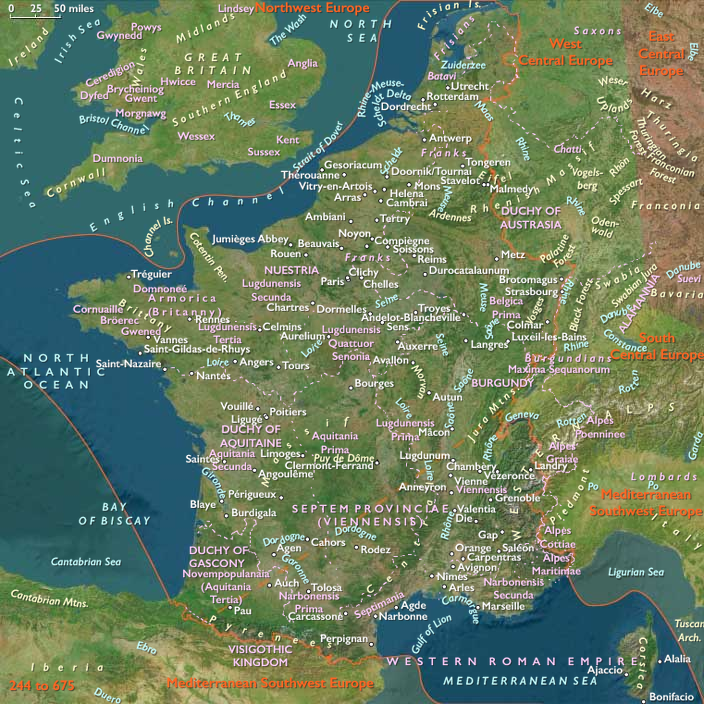
By 450 CE, Roman authority in Gaul has been partially restored, with much of the diocese nominally under imperial control. However, this recovery is tenuous at best, as the empire’s grip on its provinces beyond Italy continues to erode under the pressures of barbarian incursions and internal instability.
The Limits of Roman Control
- Armorica – Although technically part of the empire, Armorica (Brittany and western Gaul) is only nominally under Roman rule. Local populations and semi-independent military leaders operate with minimal oversight from Ravenna, maintaining a degree of autonomy.
- Foederati Settlements – Various Germanic tribes, having previously raided or fought against Rome, have been forcibly settled as foederati within imperial territory. They retain their own leaders and internal autonomy, but they are expected to defend their assigned regions in exchange for land and recognition.
- Gallia Belgica (Northern Gaul) – The territory between the Rhine (north of Xanten) and the Marne has been effectively abandoned to the Franks. Though there is no official Roman withdrawal, imperial forces no longer maintain direct control over the region.
The Line of Effective Roman Control
By 450, Rome’s effective authority in Gaul is limited to a southern and central core:
- A defensible line from Cologne to Amiens, extending to the coast at Boulogne.
- The Mediterranean coastline, which remains a vital lifeline for trade, supplies, and communication with Italy.
- A wide inland corridor, running upstream along the Loire, as far north as Amiens, and downstream along the Rhône, encompassing Aurelianum (Orléans), Auvergne, Provence, and Languedoc.
Growing Unrest Among Rome’s Foederati
Despite this partial restoration, Rome’s barbarian allies—who now hold significant portions of Gaul—are becoming increasingly restive:
- The Visigoths in Aquitania – Settled in Gallia Aquitania since 418 as foederati, the Visigoths under Theodoric I are growing increasingly defiant of Roman oversight. Their ambitions extend beyond their designated lands, and tensions with the empire are escalating toward open conflict.
- The Burgundians in Sapaudia – While less rebellious than the Visigoths, the Burgundians, settled in Sapaudia (modern Savoy) under Roman authority, are biding their time, waiting for the right opportunity to expand their power.
The Impending Collapse of Roman Gaul
Although Aetius’ military campaigns have briefly stabilized Gaul, the long-term outlook is grim. The empire’s reliance on foederati, coupled with its shrinking sphere of direct control, makes further territorial losses inevitable. Within a few decades, Gaul will slip beyond Rome’s grasp entirely, as barbarian kingdoms emerge from the remnants of imperial rule.
The treaty ending the war between Constantinople and the Huns is harsher than that of 443; the Eastern Romans have to evacuate a wide belt of territory south of the Danube, and the tribute payable by them is continued, though the rate is not known.
When Marcian abruptly cancels the subsidies to the Huns, the prospect of conquests in the West divert Attila from revenge.
When in 449 a Frankish ruler (name and location unknown) died, Aetius, master of soldiers and the real ruler of the West, had adopted the younger son to secure the Rhine Frontier, and the elder son had fled to the court of Attila.
Attila appears to be on friendly terms with Aetius and his motives for marching into Gaul have not been recorded.
He announces that his objective in the West is the kingdom of the Visigoths, centered on Tolosa (Toulouse), and that he has no quarrel with the Western emperor, Valentinian III.
The historian Jordanes states that Attila was enticed by gifts from the Vandals' king Genseric to wage war on the Visigoths.
At the same time, Genseric would attempt to sow strife between the Visigoths and the Western Roman Empire (Getica 36.184–6).
Other contemporary writers offer different motivations: Honoria, the troublesome sister of the emperor Valentinian III, had been married off to the loyal senator Herculanus a few years before, keeping her in respectable confinement.
In the spring of 450, she had sent a message, together with her engagement ring, to the Hunnic king asking for Attila's help in escaping her confinement.
Though Honoria may not have intended a proposal of marriage, Attila chose to interpret her message as such.
He had accepted, asking for half of the western Empire as dowry.
When Valentinian discovered the plan, only the influence of his mother Galla Placidia had persuaded him to exile, rather than kill, Honoria.
He also wrote to Attila strenuously denying the legitimacy of the supposed marriage proposal.
Attila had sent an emissary to Ravenna to proclaim that Honoria is innocent, that the proposal had been legitimate, and that he will come to claim what is rightfully his.

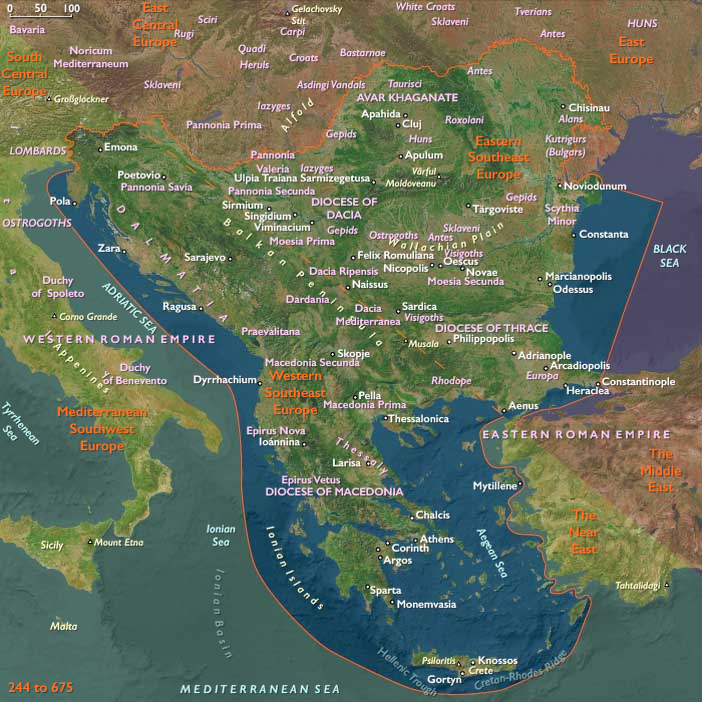
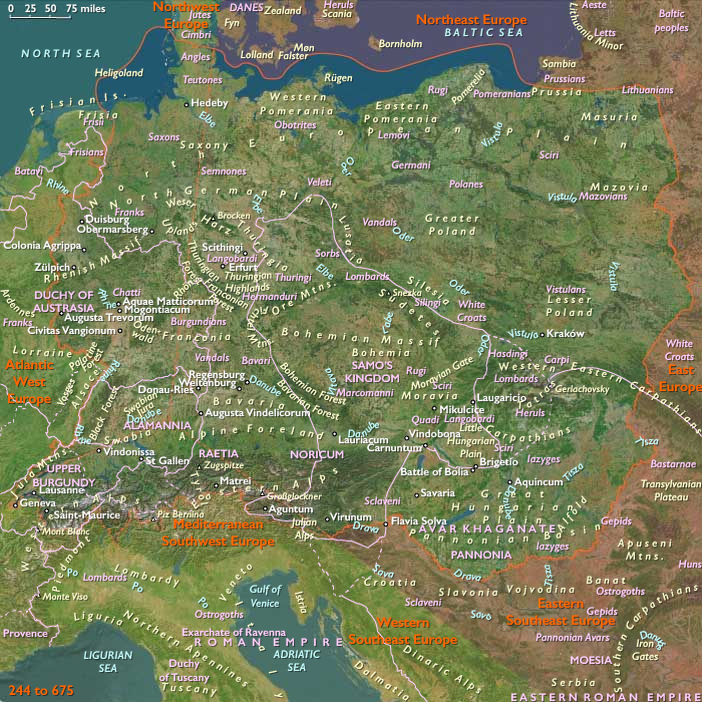
The Huns, led by Attila in 452, virtually destroy the city of Emona. Its remaining inhabitants flee the city; some of them made it to the coast of Istria.
Galla Placidia, ruler of the Western empire in the name of her weak son Valentinian III, had died at sixty on November 27, 450, clearing the way for Aetius to dominate the imperial government.
In response to the impending Hunnic invasion, Aetius musters in Gaul an army of Burgundians, Celts, Ripuarian and Salian Franks, and Visigoths under the command of the Visigoth king Theodoric I. Eudocia, daughter of emperor Valentinian III, marries Huneric in Ravenna.
The engagement serves to strengthen the alliance between the Western Roman Empire and the Vandal Kingdom.
The Cities Attacked by the Huns: Hagiographic Accounts
The devastation wrought by Attila’s invasion of Gaul in 451 CE can be traced not only through Roman historical records but also through hagiographic vitae—biographies of Christian saints and bishops written to commemorate their deeds. These accounts often blend historical events with miraculous elements, illustrating the religious and cultural impact of the Hunnic onslaught.
The Sack of Rheims and the Martyrdom of Bishop Nicasius
At Rheims, the Huns storm the city, slaughtering many of its inhabitants. According to tradition, Bishop Nicasius, rather than fleeing, chooses to face the invaders in his church, praying at the altar. He is beheaded before the altar, along with his sister Eutropia, his deacon Florens, and other clerics. His martyrdom is later commemorated in local Christian tradition, reinforcing the idea that the city, though ravaged, was spiritually defended.
The Supposed Miraculous Salvation of Tongeren and Paris
The city of Tongeren is said to have been spared due to the prayers of Bishop Servatus (Servatius), whose miraculous intervention allegedly turned Attila’s forces away. While there is no direct historical confirmation of this event, the legend highlights the fear and uncertainty gripping cities in northern Gaul as the Huns approached.
Similarly, ...
...Saint Genevieve of Paris is later credited with saving her city through her fervent prayers and leadership. She is said to have inspired the people of Paris to resist, while urging them to remain steadfast in their faith. Though it is unclear whether Attila’s forces actually reached Paris, the legend of Genevieve would later cement her status as the patron saint of the city.
Bishop Lupus of Troyes and the Meeting with Attila
One of the most famous hagiographic accounts involves Bishop Lupus of Troyes, who is said to have personally confronted Attila. According to legend, Lupus persuades Attila to spare the city, either through negotiation or divine intervention. Some versions claim that Attila took Lupus hostage, believing the bishop’s presence would protect him from divine retribution.
The Religious and Cultural Legacy of Attila’s Invasion
While these accounts contain miraculous embellishments, they offer valuable insights into how Christian communities perceived the Hunnic invasion. Many of these stories emphasize the power of faith, divine protection, and the role of bishops as both spiritual and civic leaders. Whether or not Attila’s forces physically attacked every city mentioned in these vitae, their widespread presence in hagiographic literature attests to the trauma left by the invasion and the enduring legacy of resistance—both physical and spiritual—in the memory of the late Roman world
The Siege of Aurelianum and Aetius' Counteroffensive (June 451 CE)
By June 451 CE, Attila the Hun marches on Aurelianum (modern Orléans), a key fortified city on the Loire River. As the Hunnic army approaches, the city's defenders—aware of the destruction wrought on Metz, Rheims, and other towns—shut the gates, forcing Attila to lay siege.
The Strategic Importance of Aurelianum
Aurelianum holds immense strategic value in the struggle for Gaul:
- It serves as a gateway to central and southern Gaul, controlling access to both Roman strongholds and Visigothic territories.
- Its defensive walls make it one of the most secure Gallo-Roman settlements, potentially slowing the Huns' advance.
- If Attila captures the city, it could allow him to cut off Roman and Visigothic forces from uniting.
Aetius Mobilizes in Response
Upon learning of Attila’s invasion, Flavius Aetius, the magister militum of the Western Roman Empire, moves quickly from Italy into Gaul. Recognizing that Rome cannot defeat the Huns alone, he secures a crucial alliance with Theodoric I, the Visigothic king based in Toulouse.
Together, the Roman-Visigothic coalition rallies additional forces, including:
- Burgundians
- Alans under King Sangiban (who held Orléans but was suspected of wavering in loyalty)
- Other Roman-allied federates
The Turning Point in the Campaign
As Aetius and Theodoric’s army advances, Attila faces the prospect of being trapped between the city's defenders and the approaching coalition forces. The siege of Aurelianum thus becomes a critical moment in the war—if Attila fails to take the city quickly, he risks being forced into open battle on unfavorable terms.
The decisive confrontation will soon unfold at the Battle of the Catalaunian Plains, where the fate of Roman Gaul will be determined.