John of Montfort
Duke of Brittany
Years: 1295 - 1345
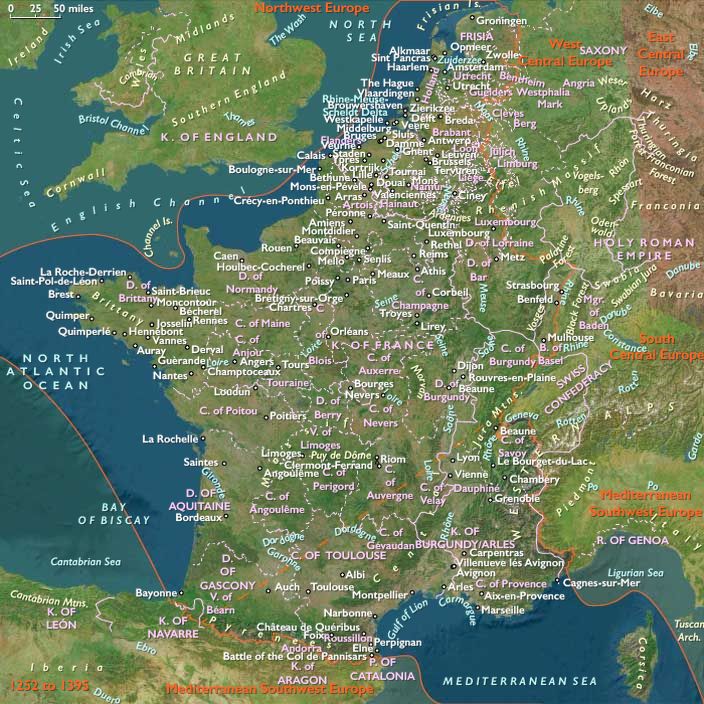
John of Montfort (in Breton Yann Moñforzh, in French Jean de Montfort) (1295 – September 16, 1345, Château d'Hennebont), is John IV, Duke of Brittany, and 6th Earl of Richmond from 1341 to his death.
He is the son of Arthur II, Duke of Brittany and his second wife, Yolande de Dreux.
He contests the inheritance of the Duchy of Brittany by his niece, Joan of Penthièvre, which leads to the War of the Breton Succession, which in turn evolves into being part of the Hundred Years' War between England and France.
John's patron in his quest is King Edward III of England.
He dies in 1345, nineteen years before the end of the war, and the victory of his son John V over Joan of Penthièvre and her husband, Charles of Blois.

Related Events
Filter results
Showing 10 events out of 20 total
The Breton War of Succession (1341–1364): A Proxy War in the Hundred Years’ War
The Breton War of Succession (1341–1364) was a prolonged dynastic conflict between the House of Blois and the House of Montfort over control of the Duchy of Brittany. Though a regional dispute, it became deeply entangled in the Hundred Years’ War, as both England and France backed rival claimants, turning Brittany into a crucial battleground in their broader struggle for dominance.
The Origins of the Conflict
The war began following the death of Duke John III of Brittany in 1341, who left no direct heir. Two factions emerged to claim the duchy:
- Charles of Blois, supported by his uncle, King Philip VI of France.
- John of Montfort, who sought assistance from Edward III of England, aligning his claim with England’s broader ambitions in France.
As a result, Brittany became a proxy war, with both sides investing significant military resources to secure control over the duchy.
Key Phases of the War
- Early Fighting (1341–1347): The conflict saw a mix of sieges, skirmishes, and naval engagements, with Charles of Blois gaining early support but John of Montfort securing English backing.
- The Siege of Hennebont (1342): Montfort’s widow, Jeanne de Flanders, famously defended Hennebont against French forces, rallying support until English reinforcements arrived.
- The Battle of La Roche-Derrien (1347): A major victory for the English-backed Montfort faction, leading to Charles of Blois’ capture.
- Renewed War (1356–1364): After Charles was released in 1356, the war reignited, culminating in the decisive Battle of Auray (1364), where he was killed and John IV of Montfort emerged victorious.
The Treaty of Guérande (1365)
The war officially ended with the Treaty of Guérande (1365), in which John IV of Montfort was recognized as Duke of Brittany, though he still owed fealty to the French Crown. While England’s ally had triumphed, the war further weakened Brittany, leaving it vulnerable to French influence in the decades to come.
Significance in the Hundred Years' War
The Breton War of Succession was more than a localized dynastic struggle—it was a critical theater in the early stages of the Hundred Years' War, forcing France and England to divert resources while shaping the balance of power in northwestern France. The war also demonstrated the importance of Breton ports and alliances, which would remain strategically significant for the duration of the Hundred Years’ War.
The ruinous expense of the war with France forces England’s Edward III to conclude a one year truce in 1341, thus provoking a crisis at home.
The war probably would have ended were it not for the death of the Duke of Brittany precipitating a succession dispute between the duke's half brother John of Montfort and Charles of Blois, nephew of Philip VI.
The Breton dukes have both a historical and ancestral connection to England and are also Earls of Richmond in Yorkshire.
The Breton Succession Crisis (1341) and the War of the Breton Succession
The death of Duke John III of Brittany in April 1341 triggered a succession dispute between his half-brother, John of Montfort, and his preferred heir, Joan of Penthièvre, who was married to Charles of Blois, a nephew of King Philip VI of France. This conflict marked the beginning of the War of the Breton Succession (1341–1365), a key theater in the Hundred Years' War.
The House of Dreux and the Inheritance Dispute
-
Duke Arthur II of Brittany had married twice:
- First to Mary of Limoges, with whom he had:
- John III (his heir, Duke of Brittany from 1312).
- Guy, Count of Penthièvre (father of Joan of Penthièvre).
- Second to Yolande of Dreux, with whom he had:
- John of Montfort, Count of Montfort-l'Amaury.
- First to Mary of Limoges, with whom he had:
-
John III strongly disliked the children of his father’s second marriage and spent much of his reign trying to annul the marriage and bastardize John of Montfort.
-
Failing to disinherit his half-brother, he designated his niece, Joan of Penthièvre, as his successor.
-
In 1337, Joan married Charles of Blois, linking her claim to the powerful House of Blois and the French Crown.
John III’s Death and the Immediate Crisis (April 1341)
- In 1340, John III unexpectedly reconciled with his half-brother, John of Montfort, and made a will appointing him as his heir.
- On his deathbed in April 1341, however, John III made no final, clear statement on the succession, saying only:
- "For God's sake leave me alone and do not trouble my spirit with such things."
- With no unambiguous decision, a succession crisis erupted immediately.
John of Montfort’s Swift Seizure of Power (1341)
-
John of Montfort knew that most of the Breton nobility supported Charles of Blois, largely because of his French royal connections.
-
To strengthen his claim, Montfort acted decisively:
- He took control of Nantes, the ducal capital.
- He seized the ducal treasury at Limoges, ensuring he had the financial resources for war.
-
Montfort’s quick actions gave him an early advantage, but his claim relied on English support, setting the stage for a protracted conflict between pro-French and pro-English factions in Brittany.
The Breton War of Succession and Its Broader Impact
- The dispute over Brittany became part of the larger Anglo-French struggle in the Hundred Years’ War (1337–1453).
- Philip VI of France supported Charles of Blois, while Edward III of England backed John of Montfort.
- This war lasted until 1365, shaping the political landscape of Brittany for decades.
John of Montfort’s decisive early moves in 1341 gave him a fighting chance in the succession war, but the conflict would be long and brutal, ultimately deciding whether Brittany remained under French influence or aligned with England.
The Breton Succession Crisis Escalates: French and English Involvement (1341–1342)
By mid-August 1341, John of Montfort had seized control of most of the Duchy of Brittany, including its three principal cities—Rennes, ...
...Vannes, and ...
...Nantes. Initially, the conflict had been an internal Breton dispute, but it soon became entangled in the larger Anglo-French conflict of the Hundred Years’ War (1337–1453).
The Truce Between England and France and the Looming Renewal of War
- The Hundred Years’ War had begun in 1337, but in 1341, a temporary truce between England and France delayed open hostilities.
- However, both sides expected the war to resume in June 1342, when the truce was set to expire.
- This political climate made Brittany’s internal war even more consequential, as both France and England had an interest in controlling the duchy.
Philip VI Intervenes: Charles of Blois Becomes the French Candidate
- When rumors reached Philip VI that John of Montfort had received English envoys, the French king quickly took direct action.
- Charles of Blois—already the preferred heir of the late Duke John III—was officially designated as the French-backed claimant.
- This turned the Breton Succession Crisis into a proxy war, making Brittany a key battleground in the wider Anglo-French struggle.
John of Montfort Aligns with Edward III of England
- Whatever Montfort’s initial intentions, Philip VI’s intervention forced him into an alliance with Edward III.
- By 1341, John of Montfort had little choice but to support Edward III’s claim to the French throne, aligning himself with the English cause.
- This alliance guaranteed English military support, setting the stage for an English-backed intervention in Brittany.
Implications for the War
- The Breton War of Succession (1341–1365) was now part of the larger Hundred Years’ War, with:
- Charles of Blois backed by France.
- John of Montfort supported by England.
- As the truce between England and France neared its expiration, both sides prepared for renewed hostilities, with Brittany as a key theater of conflict.
John of Montfort’s rapid conquest of Brittany in 1341 ensured that the Breton Succession Crisis would become a proxy war, further entangling France and England in one of the most protracted conflicts of medieval Europe.
The Siege of Champtoceaux and John of Montfort’s Failed Relief Attempt (October 1341)
In the early months of the Breton War of Succession (1341–1365), Charles of Blois, the French-backed claimant to the Duchy of Brittany, launched a military campaign to crush John of Montfort’s forces. His first target was Champtoceaux, a fortified castle guarding the Loire Valley, which Montfort had garrisoned as part of his defensive strategy in eastern Brittany.
The Strategic Situation: The Constraints of the Truce and the French Invasion
- Edward III of England, Montfort’s potential ally, was bound by a truce with France and could not take offensive action.
- However, Philip VI of France had no such restrictions against rebellious vassals, allowing him to support Charles of Blois militarily.
- By October 1341, Charles had assembled:
- 5,000 French soldiers.
- 2,000 Genoese mercenaries.
- A large but unrecorded number of Breton troops.
- The French army encamped at Angers in the Loire Valley before beginning its march toward Nantes, with Champtoceaux as its first objective.
The Siege of Champtoceaux Begins (October 10, 1341)
- Charles arrived at Champtoceaux on October 10 and began laying siege to the castle before the rest of his army could catch up.
- John of Montfort, realizing that the balance of power could shift rapidly in medieval dynastic struggles, saw his support eroding as the French advanced deeper into Brittany.
John of Montfort’s Desperate Relief Attempt at l’Humeau
- With his forces stretched thin across multiple garrisons, Montfort was only able to gather a small force from Nantes to attempt a relief of Champtoceaux.
- He halted at l’Humeau, a farmstead three miles from the castle, expecting to find supporters who could provide intelligence on Charles' position.
- Instead, he unexpectedly stumbled upon Charles of Blois himself, nearly overwhelming his personal bodyguard.
- Charles barricaded himself inside the tower of the farmhouse, successfully defending against Montfort’s repeated attacks for two days.
The Bloody Skirmishes and Montfort’s Retreat
- Meanwhile, the main French army continued advancing toward Nantes, causing chaos and alarm among Montfort’s supporters.
- As Montfort’s position became increasingly untenable, his forces were drawn into a series of confused and bloody skirmishes around the head of the French column.
- Despite his best efforts, Montfort’s smaller force was unable to halt the French advance.
John of Montfort’s Escape and the Fall of Champtoceaux (October 26, 1341)
- Realizing he was outmatched, Montfort abandoned the siege attempt and rode at full speed to Nantes, pursued by French cavalry.
- His defeat at Champtoceaux resulted in heavy losses among his supporters and mercenaries.
- With news of Montfort’s retreat spreading, Champtoceaux surrendered on October 26, 1341.
Consequences of the Battle
- The fall of Champtoceaux gave Charles of Blois a strong foothold in Brittany, significantly weakening Montfort’s territorial control.
- Montfort’s failed relief attempt cost him key supporters, forcing him into a defensive position in Nantes.
- With Edward III still unable to intervene militarily, Montfort’s situation grew increasingly desperate.
- This early victory for Charles of Blois reinforced French control in the opening phase of the Breton War of Succession, although Montfort would continue to resist with eventual English assistance.
John of Montfort’s defeat at Champtoceaux in October 1341 marked a significant setback, demonstrating the military strength of the French-backed forces and further entrenching the conflict into the broader Hundred Years’ War.
The Siege of Nantes (October 1341): John of Montfort’s Failing Resistance
Following his failed relief attempt at Champtoceaux, John of Montfort arrived in Nantes only to find the townsmen hostile, frustrated by the defeat and heavy losses suffered in the previous battle. His position in the city became precarious, and he was soon forced to agree to surrender if no relief arrived within a month.
Early Skirmishes and Growing Discontent
- In an effort to bolster morale, Montfort’s forces launched a series of sallies against the French besiegers in the days following his arrival.
- In response, the French army escalated its attacks on outlying forts, systematically tightening the noose around Nantes.
- Captured defenders were executed within sight of the city walls, a psychological tactic that further eroded Montfort’s support.
- The townsmen grew increasingly resentful, refusing to commit more men to Montfort’s attacks.
Final Defeat and the Collapse of Morale
- By the end of October 1341, a final Montfortist sally ended in disaster when John’s mercenaries deserted mid-battle, leaving the townsmen’s militia exposed to the superior French forces.
- The French army decisively annihilated the remaining Montfortist troops, marking a crushing blow to the city’s defenders.
- In an act of psychological warfare, the French executed some captured Montfortist soldiers, beheading them and hurling their heads into the town via catapult to intimidate the defenders.
Consequences of the Disaster at Nantes
- Montfort’s position had become untenable—his support among the townsmen was eroding, and his ability to resist the siege was collapsing.
- The morale in Nantes was shattered, making its eventual surrender inevitable.
- This defeat marked the final stage of Montfort’s early campaign, leaving him isolated and vulnerable to capture in the coming months.
The disastrous final sally at Nantes in late October 1341 sealed Montfort’s fate, pushing him closer to defeat and imprisonment, and allowing Charles of Blois to further consolidate his hold on Brittany.
The Surrender of Nantes and the Imprisonment of John of Montfort (November 2, 1341)
Following the disastrous defeat at Nantes, John of Montfort lost the last vestiges of support within the city. The irate city council, frustrated by his failures and unwilling to endure further losses, forced him to surrender on November 2, 1341.
John of Montfort’s Forced Capitulation
- After suffering multiple military setbacks, including the loss of Champtoceaux and the failed defense of Nantes, Montfort’s position was untenable.
- The Nantes city council, exhausted by the siege and angry at his leadership, compelled him to surrender.
- Recognizing the futility of further resistance, Montfort accepted the terms of surrender.
Safe Conduct and Betrayal
- Montfort was offered safe conduct to negotiate a settlement with Charles of Blois, his rival for the Duchy of Brittany.
- However, these negotiations proved fruitless, as neither side was willing to compromise on their claims.
- With no diplomatic resolution in sight, Montfort was arrested and imprisoned in the Louvre in Paris, under orders from Philip VI of France.
Consequences and Impact
- With Montfort imprisoned, his cause seemed lost, and Charles of Blois strengthened his control over Brittany.
- However, Montfort’s wife, Joan of Flanders, refused to accept defeat. She would later lead the resistance in his name, securing English military aid to continue the war.
- Montfort’s imprisonment did not end the Breton War of Succession (1341–1365), as England’s eventual involvement would transform Brittany into a key battleground in the Hundred Years’ War.
The fall of Nantes and the capture of John of Montfort in November 1341 marked a major turning point in the Breton War of Succession, but it was far from the end of the conflict, as Joan of Flanders and English intervention would soon shift the balance.