John of Avesnes
Count of Hainaut
Years: 1218 - 1257
John of Avesnes (1 May 1218 – 24 December 1257) is the count of Hainaut from 1246 to his death.
Born in Houffalize, he is the eldest son of Margaret II of Flanders by her first husband, Bouchard IV of Avesnes.
As the marriage of Margaret and Bouchard had been papally dissolved, he is considered illegitimate.

Related Events
Filter results
Showing 7 events out of 7 total
Feudal Struggles for Flanders and Hainaut: The Succession Crisis of Margaret II’s Children
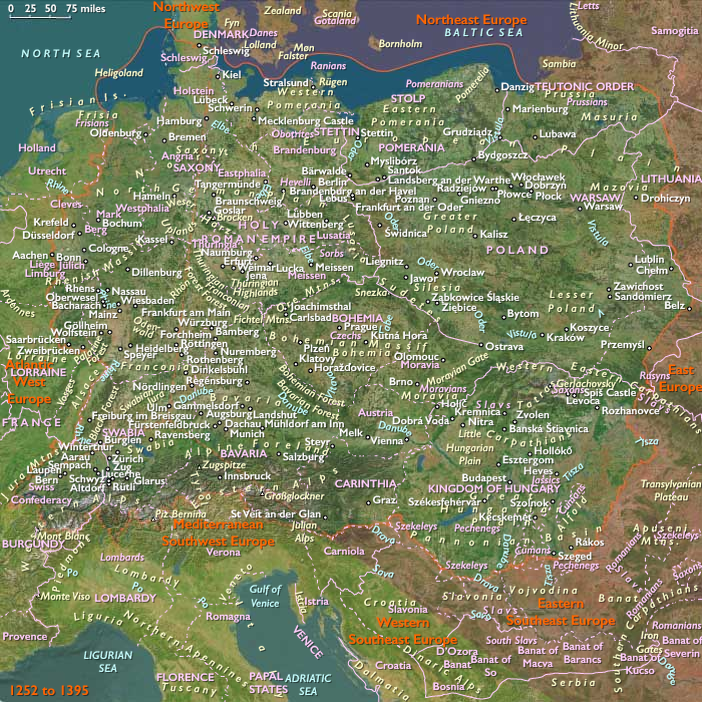
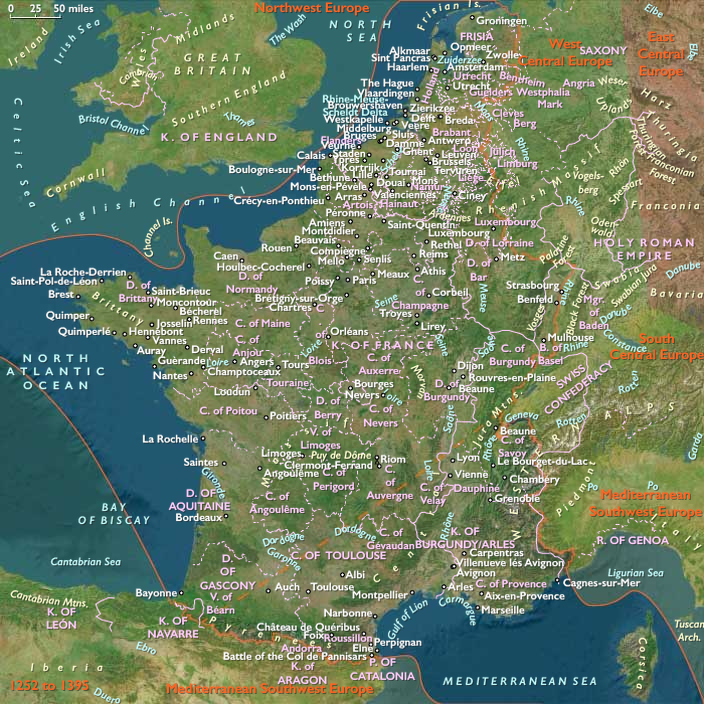
Following the reign of Margaret II, Countess of Flanders and Hainaut, a series of feudal conflicts erupted over the succession to her territories. The dispute centered on Flanders, a fief of the King of France, and Hainaut, a fief of the King of Germany (Holy Roman Emperor)—a division that complicated governance and fueled competing claims among her children.
Margaret’s sons, John of Avesnes and Guy of Dampierre, emerged as principal rivals. Their struggle reflected not only a dynastic dispute but also the broader geopolitical tensions between France and the Holy Roman Empire:
- John of Avesnes, aligned with the King of Germany, sought to secure Hainaut under Imperial protection.
- Guy of Dampierre, with French backing, claimed Flanders, reinforcing the county’s longstanding ties to the French Crown.
The succession crisis led to open conflicts, diplomatic interventions, and shifting allegiances that extended into the late 13th century, influencing the balance of power in the Low Countries. The resolution of this dispute played a key role in shaping the political fragmentation of the region, setting the stage for future clashes between Flanders and France, particularly during the reign of Philip IV of France.
The War of the Succession of Flanders and Hainaut: Dynastic Struggles and Royal Arbitration
The War of the Succession of Flanders and Hainaut stemmed from competing claims to the inheritance of Margaret II, Countess of Flanders and Hainaut. The conflict arose between the sons of her first husband, Bouchard of Avesnes—from whom her sister, Countess Joan of Flanders, had forced her to divorce—and those of her second husband, William II of Dampierre. The struggle, which combined dynastic, feudal, and geopolitical tensions, shaped the future of the Low Countries.
The first phase of the conflict erupted upon Margaret’s succession in 1244, pitting her sons John of Avesnes and William of Dampierre—half-brothers—against each other. Their contest for control of Flanders and Hainaut led to open warfare until King Louis IX of France, returning from the Seventh Crusade, intervened in 1246 to mediate a settlement.
Louis, despite lacking formal authority over Hainaut, issued a judgment dividing the inheritance:
- Hainaut was awarded to John of Avesnes, though the county was a fief of the Holy Roman Empire rather than the French Crown.
- Flanders, which was indeed a French fief, was granted to William of Dampierre.
Following the king’s ruling, Margaret transferred the government of Flanders to William in 1247 but retained personal control over Hainaut, refusing to relinquish it to John.
When William of Dampierre died in 1251, Flanders passed to his younger brother Guy, further complicating the dispute. Recognizing that his mother had no intention of handing over Hainaut, John of Avesnes revolted, launching an attack on his half-brother Guy. The war that followed intensified the power struggles within the region, drawing in external powers and shaping the broader political landscape of 13th-century Flanders and Hainaut.
William II of Holland: Anti-King and the Struggle for Zeeland
In 1247, the nineteen-year-old William II, Count of Holland, was elected King of Germany (anti-king) with the backing of Henry II, Duke of Brabant, and the Archbishop of Cologne. His election came in the wake of the excommunication of Emperor Frederick II, as part of the ongoing struggle between the Papacy and the Hohenstaufen dynasty.
To consolidate his rule, William had to secure Aachen, the traditional coronation site of German kings. After a five-month siege, he captured the city in 1248, allowing him to be formally crowned King of Germany. However, his authority remained contested, as many German princes continued to recognize the Hohenstaufen claimant, Conrad IV.
William strengthened his position with a politically advantageous marriage in 1252 to Elizabeth of Brunswick-Lüneburg, daughter of Otto the Child, Duke of Brunswick-Lüneburg. This alliance brought him nominal support from several northern German princes, though his actual power remained limited.
Beyond imperial politics, William was embroiled in a territorial conflict with Flanders over Zeeland, a strategically vital region controlling access to the Scheldt River and North Sea trade routes. As King of Germany, he asserted his authority by declaring himself Count of Zeeland. His claim led to direct military confrontation with the Flemish forces.
In July 1253, at the Battle of Westkapelle, William decisively defeated the Flemish army, strengthening his control over Zeeland. However, the conflict remained unresolved, leading to a ceasefire in 1254.
Despite his military success, William’s reign was precarious. His rule remained largely symbolic in Germany, as he struggled to assert true imperial authority. His eventual death in 1256, while campaigning against the West Frisians, cut short his efforts to consolidate power in both Germany and the Low Countries.
Charles of Anjou Thwarted in Sicily, Turns to Flanders (1253)
King Louis IX of France firmly forbade his brother, Charles of Anjou, from pursuing the papal offer of the Sicilian crown, recognizing the dangers of entangling the Capetian dynasty in the volatile politics of Italy. Louis, ever the pragmatist, sought to maintain Capetian neutrality in the struggle between the Papacy and the Holy Roman Empire, and he viewed Sicily as a distraction from his own broader crusading and reformist aims.
Denied his Sicilian ambitions, Charles turned his attention northward, entering the War of the Succession of Flanders and Hainaut on behalf of Margaret II of Flanders, who sought to uphold the claims of her Dampierre sons against her estranged eldest son, John of Avesnes, Count of Hainaut. By taking up Margaret’s cause, Charles inserted himself into one of the most complex dynastic conflicts in the Low Countries, reinforcing French influence in Flanders while positioning himself as an indispensable military leader.
Although initially a secondary theatre, this conflict allowed Charles to consolidate his reputation as a formidable political operator. His ambitions in Italy, however, remained unresolved, and he would later revive them—culminating in his eventual conquest of Sicily in 1266.
Charles of Anjou’s War with John of Avesnes and the Siege of Valenciennes (1253)
In 1253, Charles of Anjou, the younger brother of King Louis IX of France, engaged in a military conflict with John of Avesnes, Count of Hainaut. This struggle was part of the broader tensions between Capetian France and the independent feudal lords of the Low Countries, as Charles sought to expand French influence in Hainaut.
The Failed Siege of Valenciennes
- Charles led an attack on Valenciennes, a key stronghold in Hainaut, but despite his efforts, the city’s fortifications held strong, and he failed to take it.
- During the campaign, he narrowly avoided death in a skirmish, underscoring the risks of his military ambition.
Consequences and Aftermath
- The failed siege weakened Charles' position in the region and demonstrated the resilience of the Avesnes-controlled Hainaut against Capetian expansion.
- John of Avesnes successfully resisted French intervention, maintaining his authority over Hainaut, Holland, and Zeeland.
- This event marked an early check on Capetian ambitions in the Low Countries, though conflicts over French influence in the region would continue in subsequent generations.
The War for Hainaut and the Battle of Westkapelle (1253)
The conflict over Hainaut and Flanders continued after the failed French siege of Valenciennes, with John of Avesnes seeking allies to counter the Dampierre claims. John successfully convinced the German anti-king, William of Holland, to intervene by seizing Hainaut and Flemish territories within the Holy Roman Empire, escalating the war.
The Battle of Westkapelle (July 4, 1253)
- On July 4, 1253, John of Avesnes, reinforced by William of Holland, engaged the forces of Guy of Dampierre, son of Countess Margaret II of Flanders, at Westkapelle in Zeeland.
- The battle resulted in a brilliant victory for John and William, decisively defeating the Dampierre forces.
- As a result, Guy of Dampierre and his mother, Margaret, were forced to respect the division of lands previously determined by Louis IX of France, recognizing John’s right to Hainaut.
Margaret’s Continued Resistance and the Role of Charles of Anjou
Despite this military defeat, Margaret II of Flanders refused to concede defeat. Rather than formally recognizing John’s rule over Hainaut, she granted the county to Charles of Anjou, the ambitious brother of King Louis IX of France.
- This move prolonged the war, as Charles of Anjou now claimed Hainaut, challenging John’s victory.
- Charles, who had already sought to expand his influence beyond France, saw this as an opportunity to establish his power in the Low Countries.
- The conflict thus remained unresolved, continuing to shape the fragile political landscape of Flanders, Hainaut, and the Holy Roman Empire.
Long-Term Impact
The division of Flanders and Hainaut, while momentarily settled on the battlefield, remained a source of tension for decades. The rivalry between the Avesnes and Dampierre factions persisted, with external powers—including France, the Holy Roman Empire, and England—exploiting these divisions in their broader geopolitical struggles.
Louis IX’s Final Arbitration and the End of the War of the Succession of Flanders and Hainaut (1254)
Returning to France in April 1254 after his failed crusade in the Levant, King Louis IX reaffirmed his earlier arbitration in the War of the Succession of Flanders and Hainaut, effectively bringing the conflict to a close.
Louis IX’s Intervention
- Louis had previously ruled in 1246 that Hainaut should go to John of Avesnes and Flanders to Guy of Dampierre, but his decision had been contested by Countess Margaret II of Flanders, who later tried to grant Hainaut to Charles of Anjou, the French king’s younger brother.
- Upon his return to France, Louis IX intervened decisively, ordering Charles of Anjou to withdraw from the conflict and reaffirming John of Avesnes as the rightful Count of Hainaut.
The End of the Conflict
With Louis IX’s final ruling, the War of the Succession of Flanders and Hainaut came to an end:
- John of Avesnes was now secure in Hainaut, with royal backing ensuring his rule.
- Guy of Dampierre maintained control over Flanders, putting an end to Margaret’s efforts to overturn the division.
- The settlement prevented further Capetian entanglement in the Low Countries, reinforcing French stability while maintaining a balance of power between Flanders, Hainaut, and the Holy Roman Empire.
Legacy of the Settlement
Louis IX’s firm arbitration reinforced his reputation as a peacemaker and just ruler, establishing French influence over Flanders and Hainaut without direct conquest. His intervention ended the dynastic struggle but left lingering tensions between the Avesnes and Dampierre factions that would persist into the 14th century.