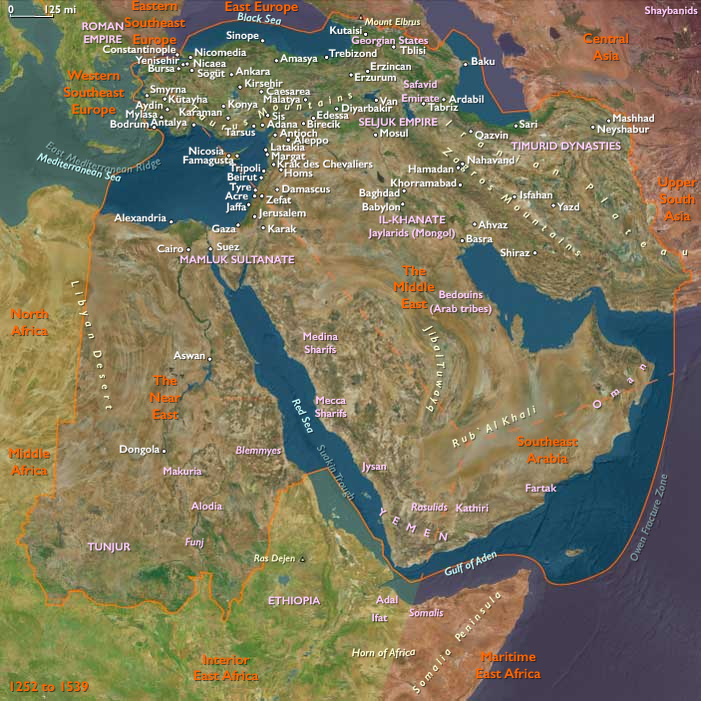
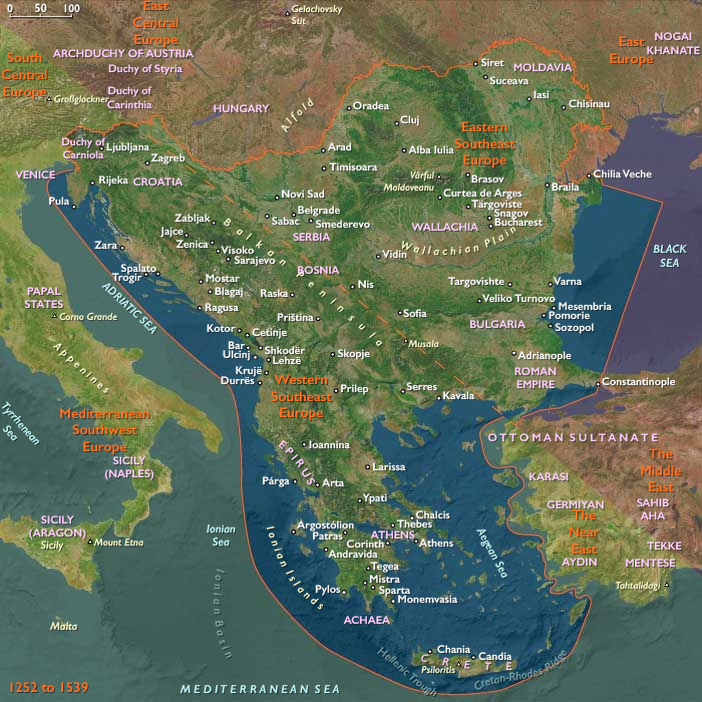
Trebizond, at the southeast corner of the Black Sea, is the capital of the last remnant of Greek empire.
Although subject to brief periods of domination by the neighboring Seljuq Turks, Mongols, and the Greeks of Nicaea or Constantinople, the Empire of Trebizond had been largely bypassed by both the Seljuqs and the Mongols because of its relative isolation, difficulties of access, and conflict among its enemies.
Its prosperity lies partly in export of its own products—silver, iron, alum, cloth, and black wine—and partly from taxes on transit trade to western Iran.
After the Fall of Constantinople to Mehmed II in 1453, Trebizond and the Morea were left as the last remnants of the Greek imperial tradition.
Mehmed II had immediately summoned Emperor John IV of Trebizond to pay tribute in Constantinople and imposed heavy tolls on Trapezuntine and Venetian shipping through the straits.
John had apparently failed to cooperate, and in 1456 the Sultan dispatched his governor of Amasya, Hizir Bey, to attack Trebizond by both land and sea.
According to the contemporary historian Laonikos Chalkokondyles of Athens, Hizir raided the countryside, even penetrating into the marketplace of Trebizond, capturing altogether about two thousand people.
The city, deserted due to plague, is likely to fall; John makes his submission and agrees to pay an annual tribute of two thousand gold pieces in return for the return the captives Hizir had taken.