John III of Portugal
King of Portugal and the Algarves
Years: 1502 - 1557
John III (or João III, Portuguese pronunciation: [ʒuˈɐ̃w̃]; 7 June 1502 – 11 June 1557), nicknamed o Piedoso ("the Pious"), is the fifteenth King of Portugal and the Algarves.
Born in Lisbon, he is the son of King Manuel I and his queen consort, Maria of Aragon (the third daughter of King Ferdinand II of Aragon and Queen Isabella I of Castile).
John succeeds his father in 1521, at the age of nineteen.
During his rule, Portuguese possessions are extended in Asia and in the New World through the Portuguese colonization of Brazil.
John III's policy of reinforcing Portugal's bases in India (such as Goa) secure Portugal's monopoly over the spice trade of cloves from the Moluccas and nutmeg from the Banda Islands, as a result of which John III has been called the "Grocer King".
On the eve of his death in 1557, the Portuguese empire spans almost 1 billion acres.
During his reign, the Portuguese become the first Europeans to make contact with both China, under the Ming Dynasty, and Japan, during the Muromachi period.
He abandons Muslim territories in North Africa in favor of trade with India and investment in Brazil.
In Europe, he improves relations with the Baltic region and the Rhineland, hoping that this will bolster Portuguese trade.
John is responsible for the evangelization of the Far East and Brazil, in part through the introduction of Jesuit missions there.
Both the Jesuits and the Portuguese Inquisition, introduced in 1536, are to become key institutions in Portugal and its Empire.
The Jesuits are particularly important for mediating Portuguese relations with native peoples and the Inquisition serves to spare Portugal the civil upheavals of religious warfare of the sort that occur in France and elsewhere in Europe during the 16th century.
In the final years of John's reign, Portugal's colony of Brazil is just beginning its rapid development as a producer of sugar that compensates for the gradual decline of revenues from Asia, a development that will continue during the reign of his grandson and successor, Sebastian, who becomes king upon John’s death, of apoplexy, in 1557.

Related Events
Filter results
Showing 10 events out of 54 total
The Portuguese continue after the death of Prince Henry to explore the coast of Africa, but without their earlier singleness of purpose.
A dispute has arisen among the military aristocracy over whether Portugal can best achieve its strategic objectives by conquering Morocco or by seeking a sea route to India.
Duarte had continued his father's Moroccan policy and had undertaken a military campaign against Tangiers but was unsuccessful. Afonso V orders several expeditionary forces to Morocco.
In 1458 he conquers Alcazarquivir; in 1471 he takes Arzila, followed by Tangiers and Larache.
Afonso's successors continue this policy of expansion in Morocco, especially Manuel I (r. 1495-1521), who conqueras Safim and Azamor.
The Moroccan empire is expensive because it keeps Portugal in a constant state of war; therefore, it is abandoned by João III (r. 1521-57), except for Ceuta and Tangiers.
The growth of Portuguese interests in the Americas is slow, the king being absorbed with establishing Portuguese hegemony in Asia.
In addition, the Treaty of Tordesillas of 1494, arranged by Pope Alexander VI, had divided the unexplored world between Spain and Portugal and forbids Portugal from exploring beyond a meridian drawn three hundred and seventy leagues (2,193 kilometers, 1,362 statute miles, or 1,184 nautical miles) west of the Cape Verde Islands.
In 1502 Fernão de Loronha is given a three-year commercial monopoly on dyewood in return for exploring three hundred leagues (about fifteen hundred kilometers) of the Brazilian coast each year.
During the last years of Manuel I's reign, the first colonists are sent to Brazil to establish a sugar industry.
Additional colonists are sent during the reign of Joao III, and, in 1530, Martim Afonso de Sousa is named major captain of Brazil and invested with the power to distribute land among captains or donatários, much as had been done in Madeira when it was colonized a century before.
These captaincies are large strips of land that extend from the coast into the interior.
The captains settle colonists in their respective captaincies and are required to provide them protection and justice.
Atlantic Southwest Europe (1516–1527 CE): Rise of Habsburg Spain, Portugal’s Imperial Zenith, and Renaissance Cultural Maturity
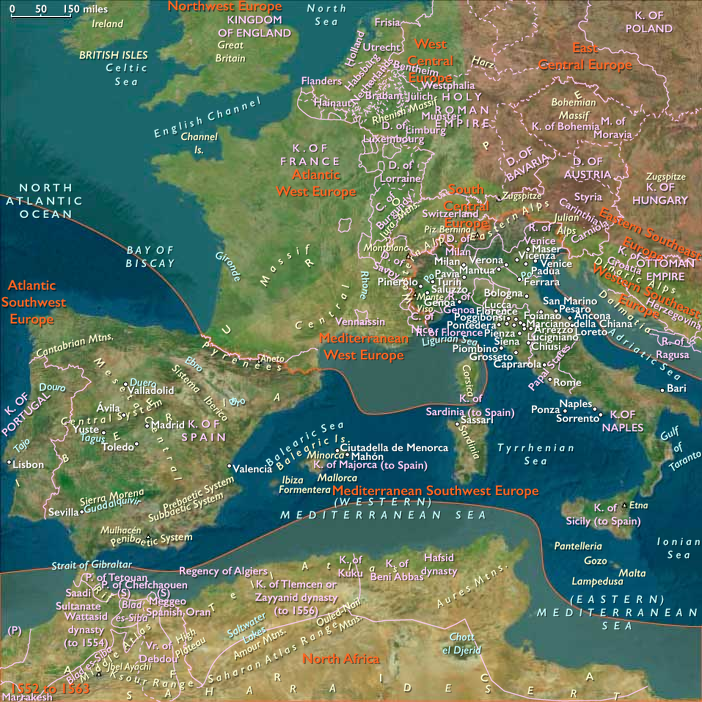
Between 1516 and 1527 CE, Atlantic Southwest Europe—including Galicia, northern and central Portugal, Asturias, Cantabria, and northern Spain south of the Franco-Spanish border (43.05548° N, 1.22924° W)—experienced profound transformations marked by the ascendancy of Habsburg power under Charles I of Spain (later Holy Roman Emperor Charles V), Portugal’s global maritime empire reaching its pinnacle under King Manuel I, and the full flowering of Renaissance humanism. These changes decisively shaped regional identities, global geopolitics, intellectual advancements, economic prosperity, and the cultural trajectory of the Iberian Peninsula.
Political and Military Developments
Ascendancy of Habsburg Spain under Charles V
Following Ferdinand II’s death (1516), the inheritance of his grandson, Charles I of Spain (1516–1556 CE)—who became Holy Roman Emperor Charles V in 1519—marked a decisive shift in regional governance. Charles unified Castile, Aragón, Naples, Sicily, the Netherlands, and extensive New World territories under a single Habsburg crown, dramatically reshaping Iberian political structures, centralizing administration, and elevating Spain as a preeminent European and global power.
Portugal’s Global Maritime Empire at its Peak
Under the later reign of King Manuel I (1495–1521 CE), Portugal decisively solidified global maritime dominance, expanding colonial holdings and trade networks across Africa, Asia, and Brazil. Following Manuel’s death, his son King João III (1521–1557 CE) continued to strengthen Portugal’s commercial and imperial stature. Portuguese dominance of Indian Ocean trade, fortified Asian coastal settlements, and American colonies significantly reinforced Lisbon’s economic prosperity and geopolitical influence.
Navarrese Integration and Resistance
Southern Navarre, annexed by Castile and Aragón in 1512, decisively integrated into Habsburg Spain under Charles I, though northern Navarre maintained tenuous independence under French protection. Resistance and political tensions persisted, shaping the distinctive regional identities of Basque communities and profoundly affecting Iberian political cohesion.
Economic Developments
Agricultural Stability and Regional Prosperity
Agricultural productivity decisively remained strong, sustained by diversified cultivation of grains, vineyards, olives, citrus fruits, and almonds, coupled with extensive livestock production. Mining activities—particularly gold and silver extraction in Galicia and Asturias—significantly supported economic resilience, demographic stability, and regional prosperity.
Portuguese Maritime Trade and Global Economic Dominance
Portugal decisively reached its global economic zenith under Manuel I and João III, maintaining extensive maritime trade networks linking Lisbon, Porto, Braga, and Coimbra with Asia, Africa, and America. Dominance of the spice trade, textiles, luxury commodities, and precious metals decisively reinforced Portugal’s economic prosperity and European commercial prominence. Galicia’s ports, especially A Coruña, benefitted economically from robust maritime trade activities.
Spanish-American Trade and Economic Expansion
Under Charles V, Spain decisively expanded economic prosperity through intensified trade and resource extraction from the Americas. Gold, silver, and agricultural products from American colonies significantly enhanced Iberian economic vitality, reshaping regional commerce and underpinning Spain’s ascent as a global economic power.
Cultural and Religious Developments
Portuguese Renaissance Maturity and Manueline Culture
Portugal’s cultural Renaissance decisively reached maturity under Manuel I and João III, prominently exemplified by lavish Manueline architecture, sophisticated scholarship, humanist literature, scientific advancements, and global exploration narratives. Portuguese intellectuals, artists, and scholars significantly influenced European Renaissance thought, contributing robustly to broader humanist developments.
Spanish Renaissance Flourishing under Charles V
Spain decisively entered its mature Renaissance phase under Charles V, with courtly patronage significantly promoting humanist scholarship, artistic creativity, educational reform, literary flourishing, and scientific inquiry. Intellectual exchanges with Italy, northern Europe, and Spanish America enriched Iberian cultural life, establishing Spain as a vibrant center of Renaissance intellectualism and artistic production.
Galician Cultural Prominence and Ecclesiastical Patronage
Galicia decisively maintained cultural prominence, bolstered by Santiago de Compostela’s ecclesiastical authority and pilgrimage traditions. Scholarship, manuscript preservation, artistic endeavors, and architectural projects flourished, reinforcing Galicia’s cultural identity, regional resilience, and international recognition.
Persistent Cultural Syncretism and Local Traditions
Orthodox Christianity consistently integrated indigenous Iberian and Celtic traditions, particularly in rural Galicia and northern Portugal. Persistent cultural syncretism decisively reinforced regional identities, social cohesion, and cultural resilience during rapid geopolitical and intellectual transformations.
Civic Identity and Governance
Portuguese Civic Unity and Imperial Ambitions
Portugal decisively reinforced civic unity, national identity, and governance stability under Manuel I and João III. Maritime exploration significantly shaped Portuguese collective ambitions, laying critical foundations for global empire-building, economic prosperity, and cultural prominence.
Spanish Civic Identity and Centralized Habsburg Governance
Under Charles V, Spanish civic identity decisively unified through centralized governance, administrative reform, and global ambitions. Habsburg imperial policies significantly reshaped Spanish political coherence, regional identity, and Renaissance intellectual and cultural vitality.
Navarrese Civic Identity and Regional Resistance
Navarre faced complex civic transformations, particularly in its southern territories under Spanish annexation. Basque communities preserved strong regional identities, distinct traditions, and local governance practices, fostering cultural resilience amid political integration.
Notable Regional Groups and Settlements
-
Portuguese: Reached decisive global maritime ascendancy, economic prosperity, and Renaissance cultural maturity under Manuel I and João III, significantly influencing Portugal’s historical trajectory and global prominence.
-
Spaniards (Castilians and Aragonese): Unified governance stability, territorial integrity, cultural renewal, and global ambitions under Charles V, significantly shaping Iberian political structures and Renaissance intellectual identity.
-
Galicians: Sustained vibrant economic resilience, cultural vitality, and ecclesiastical prominence, significantly reinforced by pilgrimage activity and maritime trade.
-
Basques (Navarre): Maintained distinctive regional identities, cultural resilience, and local governance despite political annexation, profoundly influencing northern Iberian political coherence.
Long-Term Significance and Legacy
Between 1516 and 1527 CE, Atlantic Southwest Europe:
-
Achieved the zenith of Portuguese maritime empire, global economic dominance, and Renaissance cultural flourishing, decisively establishing Portugal’s subsequent global influence and intellectual prominence.
-
Experienced decisive Habsburg political consolidation under Charles V, fundamentally transforming Iberian governance structures, regional identities, and cultural trajectory, laying critical foundations for Spain’s future global dominance.
-
Navigated political annexation and regional resistance in Navarre, significantly reshaping northern Iberian geopolitical balance and cultural identity.
-
Maintained agricultural stability, expanded global commerce, pilgrimage-driven economic vitality, and vibrant cultural innovation, profoundly influencing regional historical trajectories.
This transformative era decisively shaped regional identities, governance structures, economic continuity, cultural resilience, and intellectual foundations, profoundly influencing Atlantic Southwest Europe’s trajectory toward global prominence, Renaissance maturity, and sustained historical significance.
Atlantic Southwest Europe: Imperial Ambitions, Maritime Triumphs, and Renaissance Splendor (1516–1527)
The years 1516–1527 in Atlantic Southwest Europe were marked by sweeping political changes, vibrant maritime empires, and exceptional cultural flourishing. The accession of Charles I (later Holy Roman Emperor Charles V) unified Spanish territories under Habsburg rule, significantly impacting regional dynamics. Portugal, under King Manuel I and subsequently his son João III, further cemented its status as a global trading power. Meanwhile, Navarre’s independence diminished significantly under increasing Spanish control.
Political and Military Developments
-
Spain (Unified Habsburg Domains):
- Charles I (Charles V, 1516–1556) ascended the thrones of Castile, León, and Aragon in 1516, initiating an era of Habsburg dominance. His rule unified Spanish territories, intensifying centralization and consolidating royal authority throughout Castile, León, Galicia, and the Basque provinces.
- Charles’s imperial ambitions led to repeated confrontations with France, significantly influencing territorial control, particularly along the Pyrenean frontier, and shaping diplomatic relations in northern Navarre and Basque Country.
-
Portugal:
- Manuel I (d. 1521) continued the expansionist and prosperous reign begun in 1495, establishing a powerful global empire with possessions stretching from Africa to Asia.
- João III (r. 1521–1557) inherited an economically vibrant yet increasingly challenged empire, initiating greater centralization of royal authority, deepening the role of the Church, and intensifying involvement in global missionary activities.
-
Navarre:
- The Kingdom of Navarre, significantly weakened following Ferdinand’s invasion in 1512, lost nearly all territory south of the Pyrenees to Spain. Its remaining territories north of the mountains, around Pamplona, maintained limited autonomy under French influence, marking a decisive shift away from independence toward division between French and Spanish influence.
Economic and Maritime Expansion
-
Spanish Transatlantic Growth:
- Spain consolidated its American empire, establishing more permanent colonial governance structures and rapidly increasing shipments of gold and silver back to Europe. Atlantic trade through northern Spanish ports (Bilbao, Santander, San Sebastián) flourished, fueling regional economic prosperity.
-
Portugal’s Global Commercial Empire:
- Portugal maintained and expanded its dominance of the maritime spice trade, solidifying commercial outposts in India, East Africa, and Southeast Asia. Lisbon became a thriving international trading hub, receiving spices, precious stones, silk, and exotic goods.
- Increasing wealth from overseas commerce supported ambitious construction and urban development projects, transforming Portuguese cities and enhancing their cultural prominence.
-
Navarre’s Economic Realignment:
- Northern Navarre’s economic life became increasingly tied to France, while southern regions integrated more fully into Castile’s economic and administrative system, affecting trade patterns and local prosperity.
Cultural and Social Developments
-
Spanish Renaissance and Humanism:
- Spain experienced a vibrant cultural flowering, with royal patronage supporting artistic and literary projects. Humanist scholars flourished, producing influential works deeply influenced by the broader European Renaissance.
- Increasing religious uniformity under Charles V began influencing cultural and social norms, setting the stage for intensified religious orthodoxy in later periods.
-
Portuguese Manueline Style and Cultural Splendor:
- The artistic brilliance of the Portuguese Manueline period reached maturity, visible in iconic structures such as the completed Belém Tower (Torre de Belém) and the richly ornamented Jerónimos Monastery.
- João III’s court emphasized both cultural sophistication and religious orthodoxy, inviting numerous intellectuals, artists, and religious figures from across Europe.
-
Cultural Resilience in Navarre:
- Despite political pressures, Navarre preserved its distinctive Basque cultural identity, though increasingly under influence from neighboring Spanish and French traditions, reflected in local art, architecture, and language.
Significance and Legacy
Between 1516–1527, Atlantic Southwest Europe experienced transformative changes in governance, global trade dominance, and cultural expression. Habsburg Spain’s imperial ambition profoundly reshaped the region’s political landscape, consolidating Spain’s global power. Portugal's continued maritime prominence ensured lasting economic prosperity and cultural influence. The decisive weakening of Navarre’s independence marked a permanent geopolitical realignment, setting the stage for future tensions and cultural shifts. This period’s dynamic interplay of politics, economics, and culture established foundational patterns that would endure throughout the early modern era.
The Death of King Manuel I and the Ascension of John III (1521)
On December 13, 1521, King Manuel I of Portugal, known as "The Fortunate" (O Venturoso), died after a reign that had secured Portugal’s position as a global maritime empire. His nineteen-year-old son, John III, succeeded him, inheriting an empire at its height but also facing new challenges.
The Achievements of Manuel I ("The Fortunate")
-
Wealth from Global Trade
- The royal monopoly on trade with Africa and the East Indies brought immense wealth to the Portuguese Crown.
- Lisbon became the leading trade hub for Asian spices, gold from Africa, and luxury goods from across the empire.
-
Strengthening Royal Power
- Manuel attracted aristocrats to his court, reinforcing royal prestige.
- He expanded crown control over local administration, consolidating Portuguese governance.
-
Patronage of the Arts and Architecture
- Lisbon flourished under Manuel’s patronage, filled with new palaces, churches, and public buildings.
- The Manueline style, a blend of Gothic, Renaissance, and maritime motifs, reached its peak in buildings like:
- The Jerónimos Monastery
- The Belém Tower
-
Overseas Expansion
- Manuel’s reign saw Portuguese dominance in the Indian Ocean, with major conquests like:
- Goa (1510) – Established as Portugal’s capital in India.
- Malacca (1511) – Secured Portugal’s control over the spice trade.
- Hormuz (1515) – Strengthened Portugal’s hold on the Persian Gulf.
- Manuel’s reign saw Portuguese dominance in the Indian Ocean, with major conquests like:
The Ascension of John III (1521)
- At just nineteen years old, John III inherited a vast and wealthy empire.
- Unlike his father, John III would focus on consolidation rather than expansion, facing:
- Rising administrative costs of maintaining Portugal’s global territories.
- Religious tensions as Portugal strengthened its ties with the Catholic Church, eventually leading to the Portuguese Inquisition (1536).
Conclusion: A Golden Age at a Crossroads
King Manuel I’s death in 1521 marked the end of Portugal’s most glorious era of expansion. His son, John III, would inherit a powerful empire, but also face the challenges of managing and sustaining its vast territories. The transition from Manuel I’s expansionism to John III’s consolidation would define Portugal’s global standing for the rest of the 16th century.
Gil Vicente: The Father of Portuguese and Spanish Drama
Gil Vicente (c. 1465–1536/37) is regarded as the founder of Portuguese theater and a key figure in the early Spanish Golden Age of drama. His literary career began with courtly performances, but he later developed a sharp satirical voice, critiquing the clergy, nobility, and social customs of his time.
Education and Early Career
- It is assumed that Vicente studied at the University of Salamanca, initially focusing on law before abandoning it for literature.
- His first known work, O Monólogo do Vaqueiro ("Monologue of the Cowherd"), was written in Spanish and performed in the royal court of Portugal.
Courtly Beginnings: O Monólogo do Vaqueiro (1502)
- Commissioned to celebrate the birth of Prince John (later John III of Portugal), Vicente performed his first known play on June 8, 1502 before:
- King Manuel I and Queen Maria of Aragon.
- Eleanor of Viseu, widow of King John II.
- Beatriz of Portugal, Manuel I’s mother.
- The play was inspired by the Adoration of the Shepherds, featuring simple, rustic gifts offered to the newborn prince.
- The queen, Eleanor of Viseu, was so impressed that she requested an encore performance for Christmas.
- Instead of repeating his work, Vicente wrote a new play, Auto Pastoril Castelhano ("Castilian Pastoral Act"), marking his commitment to playwriting.
Rise as a Playwright and Court Entertainer
- Over the years, Queen Eleanor became Vicente’s greatest patron, influencing him to develop his talent further.
- He became the official playwright and event organizer of the Portuguese court, directing major royal festivities, including:
- The 1520 commemoration honoring Eleanor of Spain, the third wife of Manuel I.
The Satirist of Portuguese Society
- In 1521, with the death of Manuel I, Vicente began serving John III of Portugal.
- His elevated court status allowed him to satirize the clergy and nobility freely, making him one of Portugal’s first great social critics.
- His sharp wit is best displayed in his comedy Farsa de Inês Pereira (1523), which:
- Mocked women’s roles in marriage.
- Criticized corruption and hypocrisy among the elite.
Legacy: The Founder of Iberian Theater
- Vicente’s blend of Portuguese and Spanish influences made him a pioneer in both literary traditions.
- He is considered the bridge between medieval religious theater and Renaissance humanist drama.
- His works laid the foundation for later Spanish and Portuguese drama, influencing Lope de Vega, Cervantes, and Camões.
Conclusion: The Evolution from Court Performer to Social Critic
Gil Vicente’s career began in royal celebrations but evolved into sharp satire, making him one of the most important dramatists of the early Iberian Renaissance. His ability to both entertain and critique society secured his place as the father of Portuguese theater and a leading figure of Spanish drama.
Daniel Bomberg, the first Christian merchant to found a Hebrew printing press, prints a Hebrew Bible with commentaries by Rashi, Ibn Ezra, Kimchi, Geronides and Babylonian and Palestinian Talmuds for the first time.
By 1524, the old established Jewish families of Rome has come to terms with the trasmontani: newcomers from France and Germany, who had previously not been accepted into Jewish leadership in Italy.
Roman Jewish self-government is now shared by Italian, Sicilian, Spanish and German Jews.
Rome, especially during the reigns of the Medici popes Leo X and Clement VII, who, remain sympathetic toward the Jews.
Jewish political activist David Reubeni, described by the Shengold Jewish Encyclopedia as "half-mystic, half-adventurer, "claiming to be a messenger of the king of the Lost Tribes, appears before Clement and proposes a treaty between Jews and Christians against Muslims.
Reubeni states that he was born around 1490 in a place referred to variously as Ḥabor or Khaybar, which will be subsequently identified with a place of a similar name in central Arabia.
He relates that he had been sent by his brother, King Joseph, who rules the kingdom with seventy elders, who is seeking alliances against the Turks conquering the area for its great wealth.
He had left Khaibar on December 8, 1522, traveled ten days' journey until he reached the port of Jedda, crossed the Red Sea, then disembarked from his boat in the city of Suakim in the country of the blacks.
He then joined a camel caravan which took him northbound, following the Nile River along the Nubian desert in northern Sudan, during which time he had disguised his identity by dressing as a Muslim and claiming to be a descendant of Muhammad.
This was done out of a concern for his own safety while traveling in a predominately Muslim country.
He eventually reached Cairo (where his Jewish host was reluctant to receive him in his house because of his Muslim appearance), Gaza, Hebron (where he visited the tomb of the Patriarchs) and Jerusalem.
When he spoke to audiences of Jews, he told of large Jewish kingdoms in the east, possibly referring to the Jewish community at Cochin or Yemen.
The Portuguese had just conquered Goa.
Another version is that his true origin was at a port called Cranganore, along the Malabar Coast of India, where a large and well-organized Jewish community had lived for many centuries.
Reubeni had traveled in the Ottoman Empire in the spring of 1523 and to Venice by way of Alexandria in February 1524.
In Venice he had reported to Clement VII, claiming to represent a mission from the Jews of the east.
He attracts funding from a Jewish painter named Mose, and Felice, a Jewish merchant for travel to Rome.
The same month Reubeni enters the city while riding a white horse.
Reubeni obtains an audience with Cardinal Giles of Viterbo and Pope Clement VII.
To the latter he tells a tale of a Jewish kingdom ruled over by his brother Joseph Reubeni in Arabia, where the sons of Moses dwell near the Sambation River.
He brings letters from Portuguese captains confirming his statements.
The Portuguese minister, Miguel da Silva, reports to his court that Reubeni might be useful in obtaining allies.
The Portuguese are competing against Selim I, who had seized Egypt in 1521 and diverted the valuable spice trade.
David Reubeni envisions a grand alliance between three Christian kings and one Jewish kingdom: King Charles V of the Holy Roman Empire, the King of France, Prester John – the western alias given to the Emperor of Ethiopia, and the Jewish kingdom of Khaibar governed by Reubeni's brother.
The broader aim of this alliance is meant to provide the necessary force of men in arms to expel the Ottoman Turks from the Land of Israel, and to facilitate what Reubeni believes is the imminent redemption of the oppressed nation of Israel.
To achieve this objective, Reubeni needs to enlist the help of Pope Clement VII, and, therefore, he had set out for Rome.
In Rome, with the help of a Jewish friend, he lays out his detailed plans before the Pope, who says to him that he cannot personally get involved in helping to build such a coalition, but nevertheless refers David Reubeni to John III, the king of Portugal, who is directly related to King Charles by virtue of his marriage with his sister.
Acquiescing, David Reubeni then sets sail from Italy for Portugal, accompanied with a brief and letters of recommendation from the Pope to help facilitate his errand.
Vasco da Gama, setting out in April 1524 with a fleet of fourteen ships, had taken as his flagship the famous large carrack Santa Catarina do Monte Sinai on her last journey to India, along with two of his sons, Estêvão and Paulo.
After a troubled journey (four or five of the ships were lost en route), he had arrived in India in September.
Vasco da Gama had immediately invoked his high viceregent powers to impose a new order in Portuguese India, replacing all the old officials with his own appointments, but Gama had contracted malaria not long after arriving, and died in the city of Cochin on Christmas Eve in 1524, three months after his arrival.
As per royal instructions, da Gama is succeeded as governor of India by one the captains who had come with him, Henrique de Menezes (no relation to Duarte).
Vasco's sons Estêvão and Paulo immediately lose their posts and will join the returning fleet of early 1525 (along with the dismissed Duarte de Menezes and Luís de Menezes).
Vasco da Gama's body is first buried at St. Francis Church, which is located at Fort Kochi in the city of Kochi, but his remains will be returned to Portugal in 1539 and his body re-interred in Vidigueira in a casket decorated with gold and jewels.
Vasco da Gama’s Return as Viceroy of India (1524): Reforming Portuguese Strategy in Asia
After the death of King Manuel I in 1521, John III of Portugal undertook a major review of the Portuguese government overseas, aiming to shift strategy away from Manuel’s fixation on Arabia and toward countering the rising Spanish threat in the Maluku Islands (Spice Islands). To achieve this, Vasco da Gama was recalled from political obscurity and appointed Viceroy of Portuguese India in 1524, marking his return to power after two decades of political exile.
John III’s Shift in Strategy and the Fall of Duarte de Menezes
- John III distanced himself from the old Albuquerque faction, which had been influential under Manuel I but was now represented by Diogo Lopes de Sequeira.
- Duarte de Menezes, the then-governor of Portuguese India, was both corrupt and incompetent, drawing numerous complaints.
- Menezes had continued the Manueline focus on controlling Arabia and the Red Sea, which Vasco da Gama strongly opposed.
- Seeing the Spanish expansion in the Maluku Islands as the greater threat, Gama advised a shift in priorities toward Southeast Asia and the Indian Ocean spice trade.
Vasco da Gama Appointed Viceroy (February 1524)
- On February 1524, King John III officially appointed Vasco da Gama as the new Viceroy of Portuguese India, making him only the second Portuguese governor to receive this prestigious title (the first was Francisco de Almeida in 1505).
- Gama’s appointment was strategic, as his legendary status and past accomplishments were expected to restore order, stabilize Portuguese rule, and signal a new era of governance in India.
Family Appointments and Political Bargains
- Gama’s second son, Estêvão da Gama, was appointed "Capitão-mor do Mar da Índia", replacing Luís de Menezes as commander of the Indian Ocean fleet.
- As part of his return to favor, Gama secured a commitment from John III to appoint all his sons successively as Portuguese captains of Malacca, ensuring his family’s long-term influence in the empire.
Significance of Vasco da Gama’s Return to India
-
A Strategic Shift Away from Arabia
- Gama’s appointment marked the end of Portugal’s obsession with Arabia and the beginning of a more pragmatic focus on controlling the Indian Ocean spice trade.
-
A Purge of Corrupt Officials
- As viceroy, Gama was expected to clean up the corruption left by Duarte de Menezes, restoring discipline and efficiency in the Portuguese administration.
-
A Lasting Gama Dynasty in the East
- By securing his sons’ appointments in Malacca, Gama ensured that his family would maintain influence in Portuguese Asia even after his death.
Conclusion: Gama’s Final Mission
At age 64, Vasco da Gama’s return to power in 1524 was both a redemption and a final opportunity to shape the future of Portuguese India. However, his second governorship would be short-lived, as he would die in Cochin later that year, leaving behind a restructured Portuguese strategy and a lasting family legacy in the East.
David Reubeni’s Visit to Portugal and the Rise of Messianic Hopes (1525–1526)
In November 1525, David Reubeni, a mysterious Jewish traveler and diplomat, arrived at the court of King John III of Portugal in Almeirim. His mission was to secure Portuguese military aid for a Jewish campaign to reclaim the Holy Land, an ambitious and messianic vision that quickly attracted attention—and controversy.
David Reubeni’s Proposal to King John III
- Jewish communities privately raised funds to support Reubeni’s travels and negotiations.
- Reubeni requested military assistance from Portugal, claiming to represent a powerful Jewish kingdom in Arabia, ruled by his brother.
- King John III, initially intrigued, promised him:
- Eight ships and 4,000 cannons to aid in his mission.
- However, the king faced significant political and religious pressures, as Portugal was actively persecuting suspected Marranos (crypto-Jews) under the Inquisition.
- During negotiations, King John III temporarily halted his repression of conversos, a move that excited and emboldened Jewish and crypto-Jewish communities.
Reubeni’s Influence and the Emergence of Solomon Molcho
- Diego Pires, a noble converso youth, was deeply inspired by Reubeni’s presence.
- Under Reubeni’s influence, he abandoned Christianity and embraced Judaism, taking the name Solomon Molcho.
- Molcho began to preach messianic prophecies, attracting followers and raising concerns among the authorities.
Growing Jewish Activity and Official Backlash
- Jewish envoys from the Barbary States arrived at the Portuguese court to meet with Reubeni, further fueling excitement and suspicion.
- Some enthusiastic conversos staged an armed uprising near Badajoz, where they:
- Freed a converso woman from the Inquisition.
- Challenged Portuguese authorities, demonstrating their hope for Jewish deliverance.
- Alarmed by the growing unrest, Portuguese officials began to see Reubeni as a threat rather than an ally.
Consequences and Growing Suspicion
- Portuguese authorities became deeply concerned that Reubeni’s mission could destabilize the kingdom by inciting Marranos and conversos to rebellion.
- King John III, fearful of unrest and the Inquisition’s influence, withdrew his support for Reubeni.
- Reubeni’s mission, once a diplomatic possibility, now turned into a political liability.
Conclusion: A Mission That Shook Portugal’s Crypto-Jews
David Reubeni’s arrival in Portugal in 1525 sparked a wave of messianic enthusiasm among Jewish and converso communities, temporarily stalling Inquisitorial persecution. However, as unrest grew, the Portuguese monarchy turned against him, fearing that his mission posed a threat to the stability of the realm.
His journey, though ultimately unsuccessful, inspired Jewish resistance, led to the rise of Solomon Molcho, and demonstrated the fragile position of Portugal’s New Christians under John III’s reign.