John III, Duke of Brittany
Duke of Brittany
Years: 1286 - 1341
John III the Good (in Breton Yann III, in French Jean III; 8 March 1286 – 30 April 1341) is duke of Brittany, from 1312 to his death and 5th Earl of Richmond from 1334 to his death.
He is the son of Duke Arthur II and Mary of Limoges, his first wife.
John is strongly opposed to his father's second marriage to Yolande of Dreux, Queen of Scotland and attempts to contest its legality.

Related Events
Filter results
Showing 6 events out of 6 total
Atlantic West Europe (1312–1323): Royal Authority, Famine, and Regional Challenges
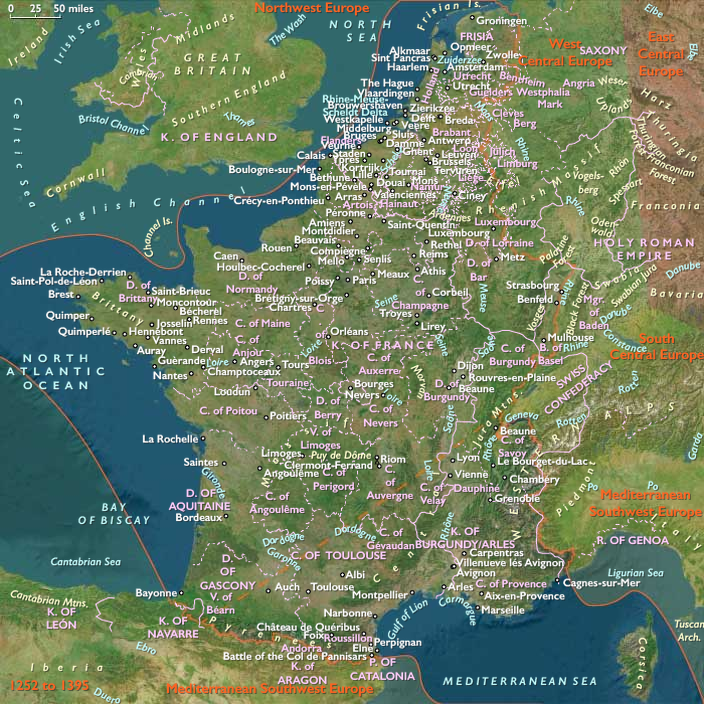
From 1312 to 1323, Atlantic West Europe, encompassing the Low Countries, Brittany, Normandy, Burgundy, Aquitaine, central France, Alsace, and Franche-Comté, grappled with severe agricultural crises, growing royal ambitions, and heightened regional tensions. The devastating Great Famine (1315–1317) deeply impacted society, economy, and political stability throughout the region.
Political and Military Developments
-
France: Capetian Centralization and Regional Resistance
- King Louis X (r. 1314–1316) and subsequently his successors, Philip V (r. 1316–1322) and Charles IV (r. 1322–1328), attempted to strengthen central royal authority despite succession uncertainties.
- Resistance to royal taxation and increasing centralization emerged from nobility and urban centers, complicating governance and highlighting regional autonomy.
-
Flanders and Brabant: Continued Urban Autonomy
- Flemish cities such as Ghent, Bruges, and Ypres asserted economic independence amid ongoing conflicts with local nobility and French royal authority.
- In 1323, Count Louis of Nevers succeeded in Flanders, reinforcing alliances with France and thus intensifying internal Flemish tensions.
-
Aquitaine and Gascony: Persistent Anglo-French Rivalry
- The English control of Aquitaine, especially in Bordeaux, remained a major source of Anglo-French friction, prompting continued political maneuvering and small-scale military confrontations.
-
Burgundy, Alsace, and Franche-Comté: Shifting Allegiances
- The Duchy of Burgundy managed to maintain substantial autonomy under the Capetian dynasty through careful diplomatic balancing.
- Alsace and Franche-Comté were contested territories, influenced by competing interests from French and imperial authorities.
-
Brittany and Normandy: Maintaining Autonomy
- Brittany, under Duke John III (r. 1312–1341), preserved its autonomy by navigating skillfully between English support and French influence.
- Normandy remained mostly stable under French control, though internal tensions persisted due to economic pressures from the Great Famine.
Economic and Social Developments
-
Great Famine (1315–1317): Social and Economic Devastation
- Severe weather led to crop failures, resulting in widespread starvation, population decline, and economic hardship across Atlantic West Europe.
- Rural and urban communities faced severe food shortages, leading to increased mortality, social unrest, and peasant revolts.
-
Economic Strain and Market Instability
- Trade and commerce suffered significantly due to declining productivity and disrupted trade networks, especially affecting Flemish cloth production and regional fairs in Champagne and Burgundy.
Cultural and Intellectual Developments
-
Universities and Scholasticism
- Despite crises, universities, notably Paris, continued their scholastic traditions, sustaining intellectual debate and theological discourse through scholars like William of Ockham.
-
Artistic and Architectural Continuity
- Gothic architectural projects continued, albeit at reduced scale and pace due to economic constraints. Notable progress occurred in Strasbourg and other urban centers.
Religious Developments
- Church Response to Crisis
- Monasteries and religious institutions provided essential aid during the famine, though their resources were strained.
- Mendicant orders, especially the Franciscans and Dominicans, expanded charitable activities in affected urban areas, strengthening their influence among the populace.
Legacy and Significance
The era of 1312–1323 profoundly impacted Atlantic West Europe through the devastation of the Great Famine and heightened regional tensions. Royal efforts to centralize authority faced strong opposition, shaping political dynamics in subsequent decades, while economic disruptions left lasting effects on trade and agriculture. These crises laid foundations for later socio-economic transformations and set the stage for more intense conflicts, including the impending Hundred Years’ War.
Atlantic West Europe (1324–1335): War, Crisis, and Social Transformation
Between 1324 and 1335, Atlantic West Europe—including the Low Countries, Brittany, Normandy, Burgundy, Aquitaine, central France, Alsace, and Franche-Comté—faced significant military confrontations, internal crises, economic challenges, and social transformations. This era marked intensified struggles over territorial sovereignty, devastating famines, and shifting political alliances that reshaped regional dynamics.
Political and Military Developments
-
France: Intensified Royal Control and Conflict
-
King Charles IV (the Fair, r. 1322–1328) continued centralizing royal power, but his death without a male heir in 1328 triggered the Capetian dynasty's end and initiated the Valois succession.
-
The accession of Philip VI (House of Valois, r. 1328–1350) intensified dynastic tensions with England, sparking the early conflicts that would lead to the Hundred Years’ War.
-
-
Aquitaine and Gascony: Anglo-French Tensions
-
Increasing disputes over English-held Aquitaine and Gascony escalated, contributing to the outbreak of war in 1337, driven by competing claims from Edward III of England and Philip VI of France.
-
-
Low Countries: Urban Autonomy and Resistance
-
Flemish cities, particularly Ghent and Bruges, continued to assert their economic and political independence, leading to sporadic conflicts with French royal and local noble authority.
-
-
Burgundy, Alsace, and Franche-Comté: Navigating Sovereignty
-
The Duchy of Burgundy, under Eudes IV (r. 1315–1350), maneuvered diplomatically between French royal interests and regional autonomy, consolidating power internally.
-
Alsace and Franche-Comté remained contested between imperial and French influence, strengthening local governance to maintain relative independence.
-
-
Brittany and Normandy: Struggles and Alliances
-
Brittany experienced internal power struggles among competing noble factions, impacting its relationship with France and England.
-
Normandy continued integration efforts into royal administration, balancing loyalty to the French crown with local autonomy.
-
Economic and Social Developments
-
Great Famine and Economic Decline
-
The Great Famine (1315–1322) severely impacted agriculture, resulting in widespread food shortages, rising mortality rates, and economic hardship persisting into this period.
-
Urban economies, particularly in Flemish cities, faced significant disruption, although recovery began slowly toward the end of the era.
-
-
Trade and Maritime Activities
-
Maritime trade remained vital despite disruptions, especially wine trade from Bordeaux and wool trade through Flemish ports like Bruges.
-
Trade networks experienced temporary instability due to ongoing conflicts and climatic challenges.
-
Cultural and Intellectual Developments
-
Continued Gothic Influence and Artistic Innovation
-
Gothic architecture flourished despite regional hardships, evident in continued construction and embellishments of cathedrals, including those at Amiens and Strasbourg.
-
-
University of Paris and Scholarly Output
-
The University of Paris maintained its intellectual prominence, advancing theological and philosophical scholarship despite broader societal instability.
-
Religious Developments
-
Growing Influence of Mendicant Orders
-
The Franciscans and Dominicans expanded their influence in urban areas, addressing social and spiritual needs exacerbated by famine and hardship.
-
-
Jewish Communities and Social Tensions
-
Jewish populations in the region faced heightened persecution, blamed for economic hardships and facing expulsions and violence in several locales.
-
Legacy and Significance
The era 1324–1335 significantly reshaped Atlantic West Europe, setting the stage for prolonged conflict in the Hundred Years’ War, revealing vulnerabilities in social and economic structures, and prompting shifts in governance and alliances. The challenges of famine and economic distress, combined with increasing political tensions, catalyzed profound transformations that would shape the region's trajectory in subsequent decades.
The Breton War of Succession (1341–1364): A Proxy War in the Hundred Years’ War
The Breton War of Succession (1341–1364) was a prolonged dynastic conflict between the House of Blois and the House of Montfort over control of the Duchy of Brittany. Though a regional dispute, it became deeply entangled in the Hundred Years’ War, as both England and France backed rival claimants, turning Brittany into a crucial battleground in their broader struggle for dominance.
The Origins of the Conflict
The war began following the death of Duke John III of Brittany in 1341, who left no direct heir. Two factions emerged to claim the duchy:
- Charles of Blois, supported by his uncle, King Philip VI of France.
- John of Montfort, who sought assistance from Edward III of England, aligning his claim with England’s broader ambitions in France.
As a result, Brittany became a proxy war, with both sides investing significant military resources to secure control over the duchy.
Key Phases of the War
- Early Fighting (1341–1347): The conflict saw a mix of sieges, skirmishes, and naval engagements, with Charles of Blois gaining early support but John of Montfort securing English backing.
- The Siege of Hennebont (1342): Montfort’s widow, Jeanne de Flanders, famously defended Hennebont against French forces, rallying support until English reinforcements arrived.
- The Battle of La Roche-Derrien (1347): A major victory for the English-backed Montfort faction, leading to Charles of Blois’ capture.
- Renewed War (1356–1364): After Charles was released in 1356, the war reignited, culminating in the decisive Battle of Auray (1364), where he was killed and John IV of Montfort emerged victorious.
The Treaty of Guérande (1365)
The war officially ended with the Treaty of Guérande (1365), in which John IV of Montfort was recognized as Duke of Brittany, though he still owed fealty to the French Crown. While England’s ally had triumphed, the war further weakened Brittany, leaving it vulnerable to French influence in the decades to come.
Significance in the Hundred Years' War
The Breton War of Succession was more than a localized dynastic struggle—it was a critical theater in the early stages of the Hundred Years' War, forcing France and England to divert resources while shaping the balance of power in northwestern France. The war also demonstrated the importance of Breton ports and alliances, which would remain strategically significant for the duration of the Hundred Years’ War.
The ruinous expense of the war with France forces England’s Edward III to conclude a one year truce in 1341, thus provoking a crisis at home.
The war probably would have ended were it not for the death of the Duke of Brittany precipitating a succession dispute between the duke's half brother John of Montfort and Charles of Blois, nephew of Philip VI.
The Breton dukes have both a historical and ancestral connection to England and are also Earls of Richmond in Yorkshire.
The Breton Succession Crisis (1341) and the War of the Breton Succession
The death of Duke John III of Brittany in April 1341 triggered a succession dispute between his half-brother, John of Montfort, and his preferred heir, Joan of Penthièvre, who was married to Charles of Blois, a nephew of King Philip VI of France. This conflict marked the beginning of the War of the Breton Succession (1341–1365), a key theater in the Hundred Years' War.
The House of Dreux and the Inheritance Dispute
-
Duke Arthur II of Brittany had married twice:
- First to Mary of Limoges, with whom he had:
- John III (his heir, Duke of Brittany from 1312).
- Guy, Count of Penthièvre (father of Joan of Penthièvre).
- Second to Yolande of Dreux, with whom he had:
- John of Montfort, Count of Montfort-l'Amaury.
- First to Mary of Limoges, with whom he had:
-
John III strongly disliked the children of his father’s second marriage and spent much of his reign trying to annul the marriage and bastardize John of Montfort.
-
Failing to disinherit his half-brother, he designated his niece, Joan of Penthièvre, as his successor.
-
In 1337, Joan married Charles of Blois, linking her claim to the powerful House of Blois and the French Crown.
John III’s Death and the Immediate Crisis (April 1341)
- In 1340, John III unexpectedly reconciled with his half-brother, John of Montfort, and made a will appointing him as his heir.
- On his deathbed in April 1341, however, John III made no final, clear statement on the succession, saying only:
- "For God's sake leave me alone and do not trouble my spirit with such things."
- With no unambiguous decision, a succession crisis erupted immediately.
John of Montfort’s Swift Seizure of Power (1341)
-
John of Montfort knew that most of the Breton nobility supported Charles of Blois, largely because of his French royal connections.
-
To strengthen his claim, Montfort acted decisively:
- He took control of Nantes, the ducal capital.
- He seized the ducal treasury at Limoges, ensuring he had the financial resources for war.
-
Montfort’s quick actions gave him an early advantage, but his claim relied on English support, setting the stage for a protracted conflict between pro-French and pro-English factions in Brittany.
The Breton War of Succession and Its Broader Impact
- The dispute over Brittany became part of the larger Anglo-French struggle in the Hundred Years’ War (1337–1453).
- Philip VI of France supported Charles of Blois, while Edward III of England backed John of Montfort.
- This war lasted until 1365, shaping the political landscape of Brittany for decades.
John of Montfort’s decisive early moves in 1341 gave him a fighting chance in the succession war, but the conflict would be long and brutal, ultimately deciding whether Brittany remained under French influence or aligned with England.