John II of Portugal
King of Portugal and the Algarves
Years: 1455 - 1495
John II (Portuguese: João II) March 1455 – October 25, 1495), the Perfect Prince (Portuguese: o Príncipe Perfeito), is the king of Portugal and the Algarves in 1477/1481–1495.
He is known for reestablishing the power of the Portuguese throne, reinvigorating its economy, and renewing its exploration of Africa and the Orient.
Related Events
Filter results
Showing 10 events out of 35 total
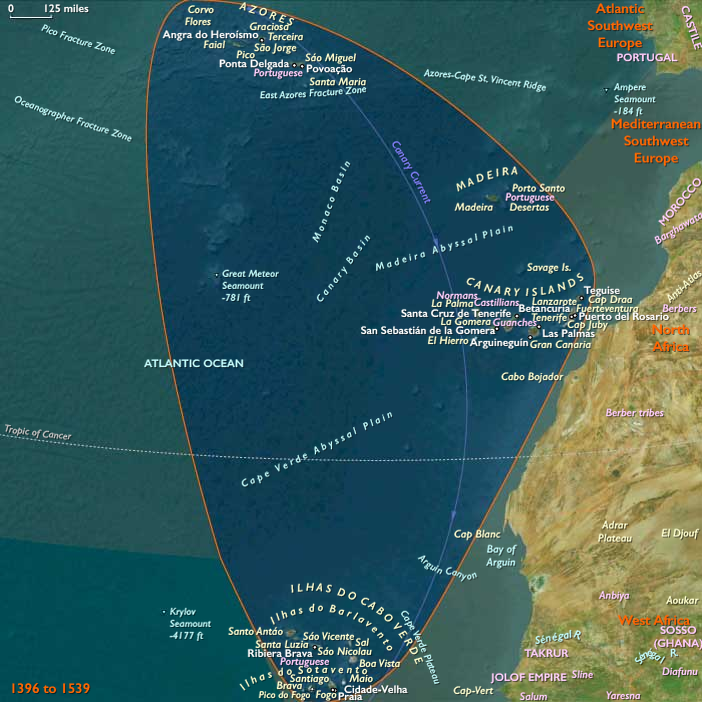
Portugal's crown during the reign of Joao II once again takes an active role in the search for a sea route to India.
In 1481 the king orders a fort constructed at Mina de Ouro to protect this potential source of wealth.
Diogo Cão sails farther down the African coast in the period 1482-84.
A new expedition in 1487 led by Bartolomeu Dias sails south beyond the tip of Africa and, after having lost sight of land for a month, turns north and makes landfall on a northeast-running coastline, which is named Terra dos Vaqueiros after the native herders and cows that are seen on shore.
Dias has rounded the Cape of Good Hope without seeing it and has proven that the Atlantic connects to the Indian Ocean.
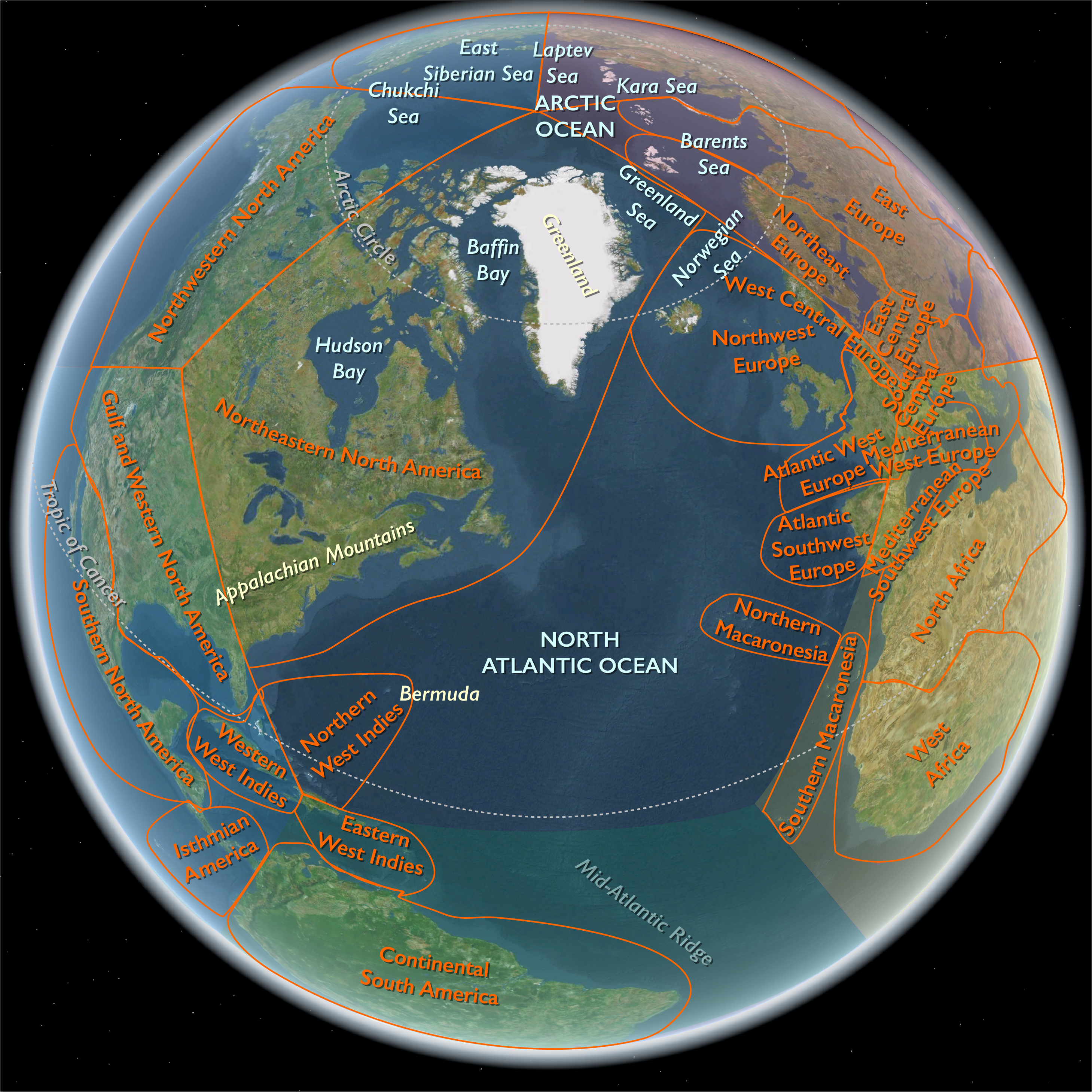
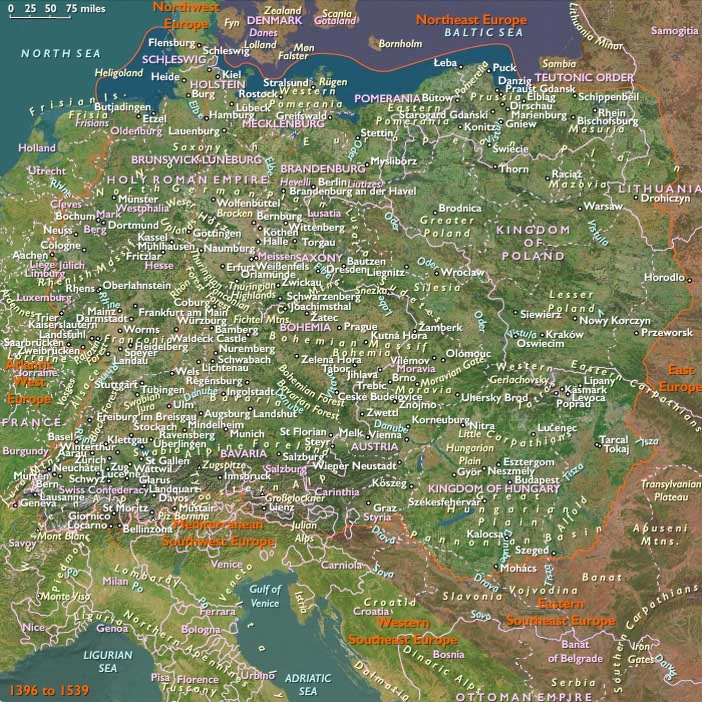
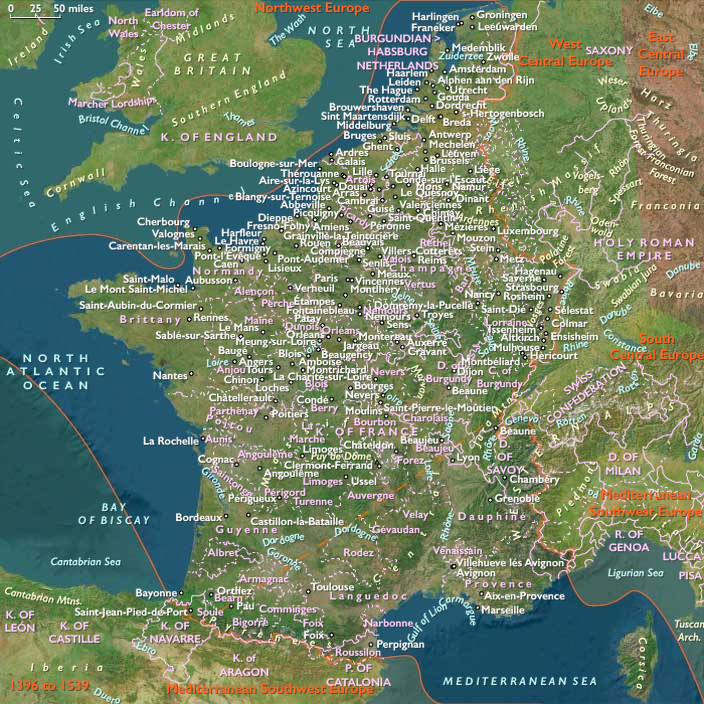
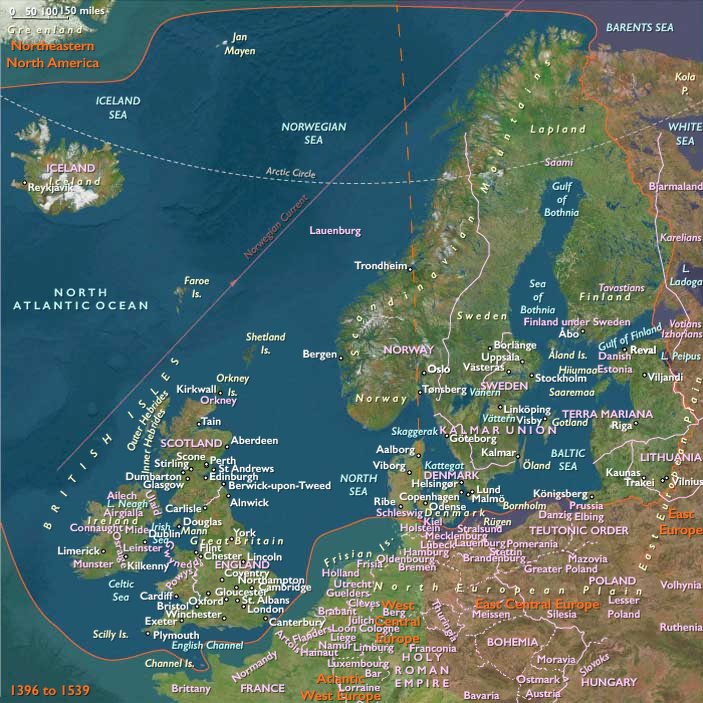
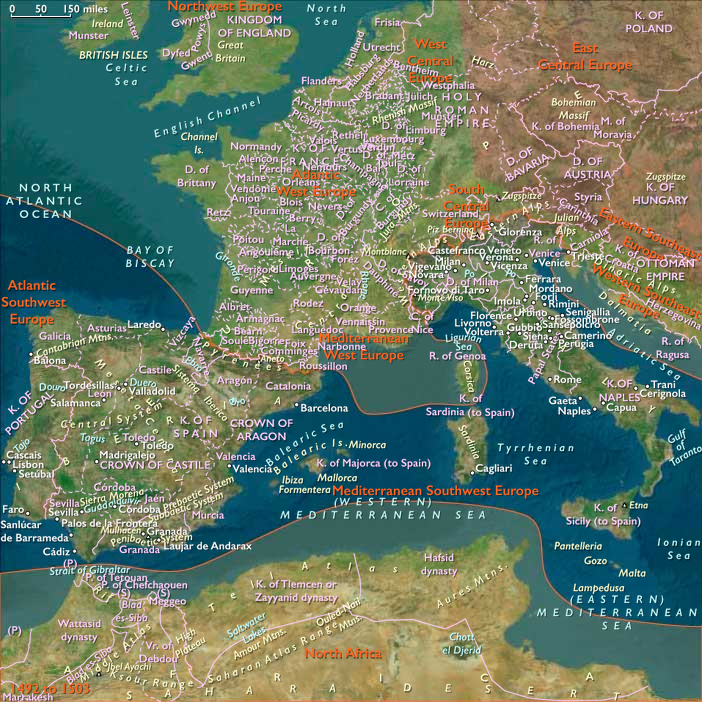
Atlantic Southwest Europe (1396–1539 CE): Estuaries, Shipyards, and the First Oceanic Empires
Geographic & Environmental Context
The subregion of Atlantic Southwest Europe includes continental Portugal and Spain’s Atlantic façade from the Gulf of Cádiz to the Bay of Biscay—the Tagus, Sado, Mondego, Douro, and Minho estuaries; Portugal’s Alentejo and Algarve coasts; Spain’s Guadalquivir–Cádiz seaboard; and the Cantabrian–Galician rías (A Coruña, Vigo, Gijón, Santander) and Basque capes (Bilbao–San Sebastián). These shorelines and river corridors bound maritime towns to grain-and-vine interiors and iron-rich uplands.
Climate & Environmental Shifts
The Little Ice Age brought cooler winters, stormier seas, and variable rains:
-
Iberian west & south coasts: more frequent Atlantic gales and bar shifts at estuary mouths (Douro, Tagus, Guadalquivir), alternately silting and scouring channels.
-
Northwest (Galicia–Asturias–Cantabria): heavy rainfall and rough seas; rich upwelling sustained fisheries.
-
Interior hinterlands: periodic droughts hit Alentejo and Andalusian cereal zones; frosts checked vines and olives in bad years; good years yielded ample wheat, wine, and oil.
Subsistence & Settlement
-
Rural belts: Wheat, rye, barley, olives, and vines; cork oak montado in Alentejo; gardens and orchards along river terraces.
-
Fisheries: Sardine and tunny on the Portuguese and Andalusian shelves; cod and whale began to matter for Basque fleets in the early 16th century. Saltworks (Aveiro, Setúbal, Cádiz) underwrote fish preservation and trade.
-
Ports & river towns: Lisbon (Tagus) and Porto (Douro); Seville and Cádiz (Guadalquivir–Cádiz); A Coruña–Vigo (rías), Santander, Bilbao and San Sebastián on the Bay of Biscay; Viana do Castelo, Figueira da Foz, Setúbal along Portugal’s coast. Urban workshops produced sails, rope, barrels, and victuals for ocean-going fleets.
Technology & Material Culture
-
Shipbuilding & navigation: The caravel (lateen rig, shoal-draft) matured on Portugal’s south coast; rounder naos carried freight across oceans. Magnetic compass, sternpost rudder, astrolabe, cross-staff, portolan charts, and toleta de marteloio tables improved blue-water navigation.
-
Maritime institutions: In Portugal, the Order of Christ’s revenues (successor to the Templars) and the crown’s Casa da Guiné and later Casa da Índia in Lisbon centralized Atlantic/Indian trade. Basque iron and timber supported Biscayan yards.
-
Urban & courtly arts: Manueline architecture (rope, coral, armillary motifs) crowned Lisbon/Belém; Mudéjar–Plateresque blended in Andalusia; guild crafts (textiles, leather, ceramics) supplied ships and cities.
Movement & Interaction Corridors
-
Estuary arteries: The Tagus, Douro, and Guadalquivir funneled grain, wine, oil, salt fish, and hides from interior plains to oceanic convoys; return flows brought spices, gold, and slaves by the early 1500s.
-
Atlantic lanes: Portugal’s Volta do Mar looped down the African coast and home via mid-ocean westerlies; Andalusian–Cantabrian coasting linked Biscay iron and salt fish to southern shipyards and markets.
-
Pilgrimage & fairs: Santiago de Compostela drew pilgrims through Galician ports; Lisbon and Seville fairs knit merchants from Italy, Flanders, and the Maghreb.
-
Imperial routes (first phase): After 1498, spice fleets sailed India–Lisbon; after 1492, Castilian fleets used the Guadalquivir–Seville corridor to the Caribbean.
Cultural & Symbolic Expressions
-
Religious life: Cathedrals and confraternities structured urban devotion; seafarers’ brotherhoods honored Our Lady of Good Voyage; shrines dotted headlands and capes (e.g., Cape St. Vincent).
-
Court and chronicle: Portuguese chronicles (Gomes Eanes de Zurara) celebrated exploration; Iberian courts patronized cartography and cosmography.
-
Communal identities: Fisher guilds, ship carpenters, ropewalkers, coopers, and salt-pan communities developed strong customs and saints’ days; Basque whalers forged distinctive sea rituals.
Environmental Adaptation & Resilience
-
Risk-spreading portfolios: Mixed farming (cereal–vine–olive), stock-raising, and salt-fish curing buffered bad harvests; riverine mills and terraces stabilized yields.
-
Harbor works: Jetties and dredging (Lisbon, Porto, Seville) fought bar siltation; salt granaries and fish warehouses bridged lean seasons.
-
Maritime provisioning: Biscayan and Portuguese fleets salted fish and whale meat; victualing yards stockpiled biscuit, wine, oil, and salted pork for oceanic voyages.
Technology & Power Shifts (Conflict Dynamics)
-
Iberian realignments: The Conquest of Ceuta (1415) opened Portugal’s North African gateway and Atlantic thrust; the War of the Castilian Succession (1475–1479)—including the Battle of Toro (1476)—ended with the Treaty of Alcáçovas (1479), fixing early Atlantic spheres between Castile and Portugal. The Treaty of Tordesillas (1494) divided extra-European worlds meridionally.
-
Oceanic breakout: Vasco da Gama’s voyage (1497–1499) linked the Tagus to India; Pedro Álvares Cabral (1500) reached Brazil; Portugal’s Estado da Índia took shape after the Battle of Diu (1509) and the Capture of Malacca (1511), routing Eastern spices to Lisbon.
-
Castile’s Atlantic: From 1492, Columbus’s voyages (out of Palos/Cádiz) opened Caribbean routes; Seville’s Casa de la Contratación (from 1503) regulated fleets.
-
Privateering & defense: Biscay–Galician coasts armed against English, Breton, and Norman raiders; corsair warfare flickered in the Bay of Biscay and off the Algarve.
Transition
By 1539 CE, Atlantic Southwest Europe had transformed from a cluster of estuarine towns into the launchpad of two oceanic empires. Lisbon and Seville–Cádiz rose as global entrepôts; Biscayan and Galician ports provisioned fleets and pioneered whaling and Atlantic cod. Inland cereals, vines, and olives still fed the system, but caravel and nao had redrawn horizons—binding Iberian estuaries to Africa, Asia, and the Americas, and setting the stage for a sixteenth century of maritime hegemony and imperial rivalry.
John II of Portugal (r. 1481–1495): The Subjugation of the Nobility and the Triumph of the Crown
When John II of Portugal ascended the throne in 1481, the House of Bragança and its noble allies had reached the height of their power, dominating the Portuguese state and rivaling the authority of the Crown. However, unlike his father, Afonso V, John II was a decisive and ruthless monarch who sought to reassert royal supremacy over the nobility, reshaping the political structure of Portugal for generations.
The Cortes of Évora (1481–1482): Strengthening Royal Power
- Upon taking the throne, John II convened a cortes at Évora, where he introduced sweeping reforms to weaken the power of the nobility.
- The nobles were forced to swear a new written oath, pledging to surrender any castles or towns they held from the Crown.
- Commoners complained about abuses by the nobility, including:
- Private justice (where noble lords acted as independent rulers in their territories).
- Corrupt tax collection practices that burdened the peasantry.
- In response, John II ordered an investigation into noble estates, requiring:
- All nobles to present their titles of privilege for review.
- Royal constables to inspect their territories for administrative abuses.
These measures were direct attacks on aristocratic privilege, setting the stage for conflict between the Crown and the nobility.
The Conspiracy of the Duke of Bragança and His Execution (1483–1484)
- Fernando II, Duke of Bragança, head of the most powerful noble house in Portugal, led a noble conspiracyagainst the king.
- He sought support from John II of Castile, planning to undermine John II’s rule.
- However, John II uncovered the treasonous correspondence, leading to:
- Fernando’s arrest and trial in Évora.
- A swift conviction for treason and his execution by beheading on June 29, 1484, in the main square of Évora.
- The king confiscated the Bragança estates, effectively dismantling their territorial power.
- Other conspirators were also executed, imprisoned, or forced into exile.
The Duke of Viseu’s Conspiracy and the Final Blow to the Nobility (1484–1485)
- A second plot emerged, this time led by Diogo, Duke of Viseu, another powerful noble with royal connections.
- The conspiracy was quickly discovered, and John II personally intervened to eliminate the threat.
- In Setúbal, the duke of Viseu was killed—possibly by the king’s own hand, in a direct demonstration of royal authority.
The Supremacy of the Crown Over the Nobility
With the House of Bragança crushed and the Duke of Viseu eliminated, John II had firmly established royal supremacy:
- The nobility’s independent power was destroyed, ensuring that no noble house could challenge the Crown again.
- Portugal transitioned into a centralized monarchy, with the king as the absolute ruler.
- The confiscation of noble lands allowed the Crown to expand its wealth and resources, strengthening Portugal’s imperial ambitions and exploration efforts.
John II’s brutal but effective policies laid the groundwork for Portugal’s golden age, ensuring that the kingdom remained a strong, centralized, and dominant power on the world stage.
Prince John of Portugal: A Rising Monarch and Leader of Exploration (1471–1474)
Prince John of Portugal (João, later King John II) was the son of King Afonso V and Isabella of Coimbra, born in Lisbon. From an early age, he was recognized for his strong will, resistance to political manipulation, and commitment to royal authority, traits that would later define his reign.
Military Experience in North Africa (1471)
- As a young prince, John accompanied his father, Afonso V, on military campaigns in North Africa.
- He was knighted after the conquest of Arzila in 1471, gaining firsthand experience in battle.
- His involvement in the Moroccan campaigns reinforced his sense of military discipline and leadership.
Marriage to Leonor of Viseu (1473)
- In 1473, he married Leonor of Viseu, his first cousin.
- This marriage strengthened his ties to the Portuguese nobility, as Leonor was from the House of Aviz-Beja, an important cadet branch of the royal family.
Unpopularity Among the Nobility
- Despite his royal bloodline and military achievements, Prince John was not well-liked among the nobility.
- His strong character and resistance to influence made him immune to noble manipulation, which alarmed the aristocracy, particularly Fernando II, Duke of Braganza.
- Many feared that, as king, he would curtail noble privileges and consolidate royal power, which eventually happened when he ascended the throne in 1481.
Appointed as Leader of Exploration (1474)
- Recognizing his son’s strategic mind, King Afonso V placed John in charge of Portugal’s overseas explorations in 1474.
- Under his supervision, Portuguese explorers:
- Expanded their reach along the West African coast, continuing Prince Henry the Navigator’s work.
- Strengthened Portugal’s control over trade routes, particularly those linked to gold, slaves, and spices.
- Laid the groundwork for Bartolomeu Dias’s historic rounding of the Cape of Good Hope (1488) and Vasco da Gama’s voyage to India (1498).
Legacy of His Early Years
- John's military discipline, political foresight, and opposition to noble power foreshadowed his ruthless and effective reign as John II (r. 1481–1495).
- His leadership in exploration ensured Portugal’s dominance in the Age of Discovery, setting the stage for its maritime empire.
- His future conflicts with the nobility, especially the House of Braganza, would reshape Portugal’s political structure in favor of the monarchy.
Prince John’s early experiences as a warrior, administrator, and strategist would define his rule as one of the most powerful and transformative kings of Portugal.
Afonso V’s Return to Portugal and the Brief Abdication Crisis (1477)
After his failure to gain French military support for his claim to the Castilian throne, Afonso V of Portugal decided to return home in October 1477. Upon his arrival, he discovered that his son, Prince John (future John II), had proclaimed himself king in his absence.
Afonso V’s Diplomatic Failure in France
- Following the defeat of Portuguese ambitions in Castile, Afonso V traveled to France in 1477 seeking aid from King Louis XI to revive his claim to the Castilian throne.
- Louis XI, known as "the Universal Spider" for his cunning diplomacy, refused to support Afonso, unwilling to engage in a prolonged Iberian conflict.
- Disheartened and politically isolated, Afonso abandoned his claim to Castile and decided to return to Portugal.
John II’s Self-Proclamation as King (1477)
- While Afonso V was abroad, Prince John took control of the kingdom, frustrated by his father’s failed war policies.
- John proclaimed himself king, taking advantage of his father’s absence to consolidate royal authority.
- However, unlike typical power struggles, this was not an outright coup—John’s actions were more of a precautionary measure to maintain stability in Portugal.
Afonso V’s Return and Reconciliation (October 1477)
- When Afonso V returned to Portugal, rather than resisting, John welcomed him back and immediately returned the crown to him.
- This peaceful transition avoided a potential civil conflict between father and son.
- However, Afonso V, exhausted by years of war and diplomacy, had lost his will to rule.
Afonso V’s Abdication and John II’s Final Ascension (1477–1481)
- In November 1477, just a month after his return, Afonso V announced his decision to retire to a monastery, though he remained nominally king.
- From that point onward, John II effectively ruled Portugal, preparing for his formal reign.
- In 1481, Afonso V died, and John II officially became King of Portugal, ushering in an era of strong royal centralization and maritime expansion.
Conclusion: A Peaceful Succession
- Unlike other father-son struggles for power in medieval Europe, the transition from Afonso V to John II was relatively smooth.
- John II’s temporary self-proclamation in 1477 reflected his ambition and desire to reform the monarchy, which he would later ruthlessly consolidate during his reign (1481–1495).
- Afonso V’s failed Castilian campaign and diplomatic setbacks marked the end of Portugal’s ambitions in Spain, allowing the kingdom to focus entirely on maritime exploration and trade expansion.
Thus, Afonso V’s peaceful transition of power to John II set the stage for Portugal’s golden age of exploration, led by a determined and authoritative new king.
The Portuguese navigator and explorer Diogo Cão is in 1484 ordered by King John II, as part of the search for a sea route to India and the Spice Islands, to advance south into undiscovered regions along the west coast of Africa.
While doing so, he is to choose some particularly salient points and claim them for Portugal by setting up on each a stone cross called padrão.
During his first voyage, thought to have taken place in 1482, he reached a place he called Monte Negro, now called Cabo de Santa Maria, roughly one hundred and fifty kilometers southwest of today’s Benguela, Angola.
During his second voyage, in 1484–1486, Cão reaches Cape Cross in January 1486, being the first European to visit this area.
During this voyage he proceeds about fourteen hundred kilometers farther than during the first one.
He is known to have erected two padrãos in the areas beyond his first voyage, one in Monte Negro, and the second at Cape Cross.
The current name of the place is derived from this padrão.
What can today be found at Cape Cross are two replicas of that first cross.
Bartolomeu Dias is a Knight of the royal court, superintendent of the royal warehouses, and sailing-master of the man-of-war, São Cristóvão (Saint Christopher).
King John II of Portugal appoints him, on October 10, 1487, to head an expedition to sail around the southern tip of Africa in the hope of finding a trade route to India.
Dias is also charged with searching for the lands ruled by Prester John, a fabled Christian priest and ruler.
Dias' ship São Cristóvão is piloted by Pêro de Alenquer.
A second caravel, the São Pantaleão, is commanded by João Infante and piloted by Álvaro Martins.
The expedition sails south along the West coast of Africa.
Extra provisions are picked up on the way at the Portuguese fortress of São Jorge de Mina on the Gold Coast.
After having sailed past Angola, Dias reaches the Golfo da Conceicão (Walvis Bay) by December.
Continuing south, he discovers first Angra dos Ilheus, being hit, then, by a violent storm.
Thirteen days later, from the open ocean, he searches the coast again to the east, discovering and using the westerly winds—the ocean gyre, but finding just ocean.
Having rounded the Cape of Good Hope at a considerable distance to the west and southwest, he turns towards the east, and taking advantage of the winds of Antarctica that blow strongly in the South Atlantic, he sails northeast.
After thirty days without seeing land, he enters what he names Aguada de São Brás (Bay of Saint Blaise)—later renamed Mossel Bay—on February 4, 1488.
Dias's expedition reaches its furthest point on March 12, 1488, when they anchor at Kwaaihoek, near the mouth of the Bushman's River, where a padrão—the Padrão de São Gregório—is erected before turning back.
Dias wants to continue sailing to India, but he is forced to turn back when his crew refuses to go further.
It is only on the return voyage that he actually discovers the Cape of Good Hope, in May 1488.
Dias names the promontory the Cape of Storms, but King John will soon rename it the Cape of Good Hope after the riches of Asia that begin flowing around it to Portugal.
King John II of Portugal, reviving the work of Henry the Navigator, sends out Diogo Cão in about midsummer 1482 to open up the African coast still further beyond the equator.
The mouth and estuary of the Congo are discovered (perhaps in August 1482) and marked by a Padrão, or stone pillar (still existing, but only in fragments), erected on Shark Point, attesting to the sovereignty of Portugal; the great river is also ascended for a short distance, and intercourse is opened with the natives of the Bakongo kingdom at the river’s mouth, the first such between Europeans and a major central African kingdom.
Cão then coasts down along the present Angola (Portuguese West Africa), and …
…erects a second pillar, probably marking the termination of this voyage, at Cape Saint Mary (the Monte Negro of these first visitors).
Trade between Elmina and Portugal has grown throughout the decade following the establishment of the trading post under Gomes.
In 1481, the recently crowned John II decides to build a fort on the coast in order to ensure the protection of this trade, which is once again held as a royal monopoly.
King John sends all of the materials needed to build the fort on nine caravels and two transport ships with six hundred soldiers and one hundred masons and carpenters.
The supplies, which include everything from heavy foundation stones to roof tiles, are sent, in pre-fitted form, along with provisions for six hundred men.
Under the command of Diogo de Azambuja, the fleet sets sail on December 12, 1481 and arrives at Elmina, in a village called Of Two Parts a little over a month later, on January 19, 1482.
Some historians note that Christopher Columbus was among those to make the voyage to the Gold Coast with this fleet.
Upon arrival, Azambuja contracts a Portuguese trader, who has lived at Elmina for some time, to arrange and interpret an official meeting with the local chief, Kwamin Ansah (interpreted from the Portuguese, "Caramansa").
Concealing his self-interest with elegant manners and friendliness, Azambuja tells the chief of the great advantages in building a fort, including protection from the very powerful king of Portugal.
During the meeting, Azambuja and Chief Kwamin Ansah both participate in a massive peace ritual that includes a feast, live musicians, and many participants, both Portuguese and native.
Chief Kwamin Ansah, while accepting Azambuja, as he has any other Portuguese trader who arrived on his coast, is wary of a permanent settlement.
However, with firm plans already in place, the Portuguese will not be deterred.
After offering gifts, making promises, and hinting at the consequences of noncompliance, the Portuguese finally receive Kwamin Ansah's reluctant agreement.
When construction begins the next morning, the chief’s reluctance is proved to be well-founded.
In order to build the fort in the most defensible position on the peninsula, the Portuguese have to demolish the homes of some of the villagers, who consent only after they had been compensated.
The Portuguese also try to quarry a nearby rock that the people of Elmina, who are animists, believe to be the home of the god of the nearby River Benya.
Prior to the demolition of the quarry and homes, Azambuja sends a Portuguese crew member, João Bernaldes, with gifts to deliver to Chief Kwamin Ansah and the villagers.
Azambuja sends brass basins, shawls, and other gifts in hopes of winning the goodwill of the villagers, so they will not be upset during the demolition of their homes and sacred rocks.
However, João Bernaldes does not deliver the gifts until after construction begins, by which time the villagers have become upset upon witnessing the demolition without forewarning or compensation.
In response to this, the local people forge an attack that results in several Portuguese deaths.
Finally, an understanding is reached, but continued opposition lead the Portuguese to burn the local village in retaliation.
Even in this tense atmosphere, the first story of the tower is completed after only twenty days; this is the result of having brought so much prefabricated building materials.
The remainder of the fort and an accompanying church are completed soon afterward, despite resistance.
The fort is the first prefabricated building of European origin to have been planned and executed in Sub-Saharan Africa.
Upon its completion, Elmina is established as a proper city.
Azambuja is named governor, and King João adds the title "Lord of Guinea" to his noble titles.
São Jorge da Mina takes on the military and economic importance that had previously been held by the Portuguese factory at Arguim Island on the southern edge of the Moorish world.