John I of Castile
King of the Crown of Castile
Years: 1358 - 1390
John I (Spanish: Juan I; August 24, 1358 – October 9, 1390) is King of the Crown of Castile from 1379 until 1390.
He is the son of Henry II and of his wife Juana Manuel of Castile.
He is the last Spanish monarch to receive a formal coronation.
Related Events
Filter results
Showing 10 events out of 30 total
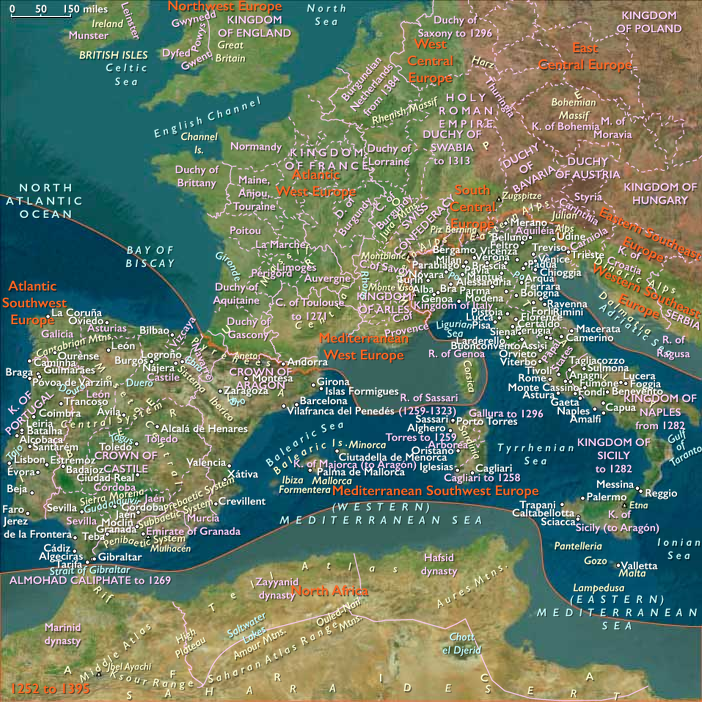
Atlantic Southwest Europe (1252 – 1395 CE): Wool, Iron, Wine, and the Atlantic Turn
Geographic and Environmental Context
Atlantic Southwest Europe includes Portugal’s Lisbon, Beira, Minho, Trás-os-Montes, and Spain’s Galicia, Asturias, Cantabria, Basque Country, Castile and León, northern Rioja, and northern Navarra.
-
Anchors: the Cantabrian coast (A Coruña–Gijón–Santander–Bilbao–San Sebastián), the Douro/Minho estuaries, and the Meseta–Cantabrian passes binding the plateau to Atlantic ports.
Climate and Environmental Shifts
-
Little Ice Age onset (~1300) brought cooler, wetter weather; stormier Bay of Biscay; good fisheries persisted.
-
Black Death (1348–1352) hit towns hard; ports recovered quickest via maritime trade.
Societies and Political Developments
-
Castile and León unified under Alfonso X (r. 1252–1284), then fractured and reconsolidated amid the Trastámara coup (Pedro I vs Enrique II, 1366–1369).
-
Portugal strengthened under Afonso III and Dinis (reforestation of Leiria for ship timber; University of Coimbra 1290), then defended independence in the Crisis of 1383–1385; João I and Aljubarrota (1385) sealed the Anglo-Portuguese alliance (Treaty of Windsor, 1386).
-
Navarre navigated between France and Castile; Basque towns (Bilbao, charter 1300; San Sebastián) grew as maritime communes.
Economy and Trade
-
Wool complex: Castilian wool—organized by the Mesta (founded 1273)—flowed through Burgos, León, and Cantabrian ports to Flanders and England.
-
Basque iron & shipbuilding: forges supplied anchors, nails, artillery shot; yards built cogs and naos for Atlantic service and whaling.
-
Wine & salt fish: Douro/Minho wines, Galician/Portuguese salt fish (cod, sardine) and tuna moved north; Lisbon/Porto emerged as major entrepôts.
-
Finance & law: municipal fueros, urban consulates, and English–Portuguese treaties stabilized credit, convoys, and tariffs.
Subsistence and Technology
-
Mixed Atlantic polyculture (rye/wheat, vines, chestnuts, cattle); stern-rudder hulls, improved rigging, magnetic compass and portolan practice diffused into Iberian waters.
Movement and Interaction Corridors
-
Sea: Lisbon ⇄ London/Bristol; Cantabria ⇄ Flanders; Galicia ⇄ Brittany; pilgrim sailings to Santiago.
-
Land: Meseta passes fed Burgos, León, Salamanca; Douro road/river linked Castile to Porto.
Belief and Symbolism
-
Cathedrals and monasteries in Santiago, León, Burgos, Salamanca; confraternities of sailors and merchants venerating St. James and St. Nicholas kept social cohesion in plague decades.
Adaptation and Resilience
-
Route redundancy (many ports, multiple passes), portfolio exports (wool–iron–wine–fish–salt), and crown–town compacts hedged risk from war, weather, and plague.
Long-Term Significance
By 1395, the Atlantic façade from Lisbon to San Sebastián had become a maritime-industrial platform: wool, iron, wine, and shipbuilding—backed by Portugal’s English alliance—set the stage for the 15th-century Atlantic turn and overseas exploration.
Philippa of Lancaster and the Anglo-Portuguese Alliance (1387–1430)
In 1387, Philippa of Lancaster, daughter of John of Gaunt, married King João I of Portugal, sealing the Anglo-Portuguese alliance, one of the longest-standing diplomatic alliances in history. Through this union, João and Philippa became the parents of a remarkable generation of princes, whom poet Luís de Camões would later call the "marvelous generation", responsible for leading Portugal into its golden age.
Philippa’s Influence: Education, Morality, and Commerce
Philippa brought to the Portuguese court the Anglo-Norman tradition of aristocratic education, ensuring her children received a rigorous intellectual and moral upbringing. She reformed the royal court, instilling strict standards of morality and discipline, shaping Portugal’s royal culture for generations.
Beyond courtly influence, Philippa also provided royal patronage for English commercial interests, fostering trade between Portugal and England. English merchants supplied cod and cloth, while Portuguese traders exported wine, cork, salt, and olive oil through English warehouses in Porto, strengthening economic ties between the two nations.
The "Marvelous Generation" and Their Achievements
Philippa’s sons were among the most accomplished figures in Portuguese history:
- Duarte (Edward I of Portugal) – A scholar-king, he authored moral treatises and ruled as King of Portugal from 1433 until his death in 1438.
- Pedro, Duke of Coimbra – A well-traveled intellectual, deeply interested in history and governance, who later served as regent of Portugal after Duarte’s death.
- Fernando, the Saint Prince – A crusader, he participated in the failed 1437 attack on Tangier, where he was captured and later died in captivity.
- Henrique (Prince Henry the Navigator) – Master of the Order of Avis, he became the driving force behind Portugal’s early voyages of discovery, laying the groundwork for the Age of Exploration.
Philippa’s Enduring Legacy
Philippa of Lancaster’s legacy extended beyond diplomacy; through her court reforms, patronage, and maternal influence, she shaped the cultural, political, and economic foundations of Portugal’s golden age. Her children’s military, intellectual, and exploratory achievements propelled Portugal to the forefront of European expansion and discovery in the 15th and 16th centuries.
Atlantic Southwest Europe (1372–1383 CE): Portuguese Dynastic Crisis, Castilian Stability under Henry II, and Navarrese Diplomatic Maneuvering
Between 1372 and 1383 CE, Atlantic Southwest Europe—including Galicia, northern and central Portugal, Asturias, Cantabria, and northern Spain south of the Franco-Spanish border (43.05548° N, 1.22924° W)—faced significant political transitions marked by a severe dynastic crisis in Portugal, strengthening governance in Castile, and diplomatic resilience in Navarre. Portugal, governed by King Ferdinand I (1367–1383 CE), faced growing internal tensions culminating in a succession crisis. Castile experienced renewed political stability and territorial consolidation under King Henry II (1369–1379 CE) and subsequently his son King John I (1379–1390 CE), firmly establishing the Trastámara dynasty. Navarre, under King Charles II "the Bad" (1349–1387 CE), continued skillful diplomatic maneuvers to maintain regional autonomy amidst shifting Iberian alliances.
Political and Military Developments
Portuguese Dynastic Crisis under Ferdinand I
Portugal entered a severe dynastic and political crisis during the late reign of King Ferdinand I, whose failure to produce a legitimate male heir triggered intense internal rivalries. His daughter, Beatrice, married King John I of Castile in 1383, sparking tensions over Portugal’s sovereignty and succession. This union precipitated political instability and set the stage for a subsequent crisis that would culminate after Ferdinand’s death, dramatically reshaping Portuguese governance and national identity.
Castilian Stability and Governance Consolidation under Henry II and John I
Following civil strife, Castile decisively stabilized and consolidated its governance structures under King Henry II, founder of the Trastámara dynasty. Henry II’s reign significantly reinforced royal authority, administrative coherence, and territorial integrity. His son and successor, John I, continued these policies, maintaining Castilian stability, governance efficiency, and strengthened regional identity.
Navarrese Diplomatic Prudence under Charles II
Navarre maintained careful diplomatic neutrality and regional autonomy under the prudent yet politically agile leadership of King Charles II "the Bad." His diplomatic maneuvers, balancing Castilian, French, and Aragonese interests, significantly preserved Navarre’s territorial integrity, internal governance stability, and northern Iberian geopolitical coherence.
Economic Developments
Continued Agricultural and Economic Recovery
The region’s agriculture and economy continued recovery from earlier demographic crises. Improved cultivation techniques (grains, olives, vineyards, citrus fruits, almonds), livestock husbandry, artisanal crafts, and renewed mining activities (gold and silver in Galicia and Asturias) decisively reinforced economic resilience and stability.
Expansion and Stabilization of Maritime Commerce
Portuguese ports (Lisbon, Porto, Braga, Coimbra) decisively expanded maritime commerce, solidifying robust trade networks with northern Europe (England, Flanders, Normandy, Brittany). Galicia, particularly A Coruña, maintained vigorous maritime trade, reinforcing regional economic prosperity and international commercial connections.
Pilgrimage and Economic Continuity
Pilgrimage routes to Santiago de Compostela remained economically vibrant, significantly sustaining hospitality industries, trade, artisanal commerce, infrastructure development, and cultural exchanges. Continued pilgrimage reinforced Galicia’s economic resilience, cultural prominence, and regional identity.
Cultural and Religious Developments
Portuguese Cultural Continuity Amid Political Tensions
Despite growing dynastic uncertainty, Portugal maintained cultural vitality and intellectual traditions. Royal patronage of scholarly and literary activities continued, sustaining Portuguese linguistic standardization, cultural identity, and educational initiatives through this politically turbulent period.
Galician Cultural Resilience and Ecclesiastical Patronage
Galicia retained cultural prominence, decisively supported by Santiago de Compostela’s pilgrimage economy and ecclesiastical patronage. Monastic communities and cathedral authorities continued scholarly initiatives, manuscript preservation, architectural projects, and educational institutions, profoundly shaping Galician cultural identity and international recognition.
Monastic and Ecclesiastical Influence
Monastic communities decisively maintained scholarly traditions, manuscript preservation, agricultural innovations, and educational reforms. Ecclesiastical authorities significantly influenced Iberian religious identity, liturgical uniformity, and regional cultural coherence amid political and dynastic uncertainties.
Persistent Cultural Syncretism and Local Traditions
Orthodox Christianity continued integrating indigenous Iberian and Celtic traditions, notably in rural Galicia and northern Portugal. This cultural syncretism significantly reinforced regional identities, social cohesion, and cultural resilience amid broader political transformations.
Civic Identity and Governance
Portuguese Governance Crisis and Civic Tensions
Portugal’s late reign of Ferdinand I saw escalating civic tensions resulting from dynastic uncertainties and the unpopular Castilian union through Beatrice’s marriage to King John I of Castile. Civic identities increasingly polarized, foreshadowing the imminent succession crisis and internal conflicts following Ferdinand’s death.
Castilian Governance Stability and Territorial Coherence
Castile achieved decisive governance stability, territorial integrity, and reinforced regional identity under Henry II and John I. Effective administrative reforms, consolidation of royal authority, and strengthened frontier security significantly solidified Castilian national coherence and governance stability.
Navarrese Regional Autonomy and Diplomatic Stability
Navarre decisively preserved regional autonomy, diplomatic neutrality, and governance stability under Charles II. Skillful diplomatic maneuvering significantly preserved territorial integrity, internal stability, and northern Iberian geopolitical coherence.
Notable Regional Groups and Settlements
-
Portuguese: Faced escalating internal tensions and dynastic uncertainty during Ferdinand I’s reign, significantly reshaping Portugal’s medieval governance trajectory and setting the stage for future national developments.
-
Castilians: Achieved significant governance stability, territorial integrity, and regional coherence under the Trastámara dynasty’s rule (Henry II and John I), decisively shaping Castile’s enduring medieval legacy.
-
Galicians: Retained economic vibrancy, cultural resilience, and international prominence, significantly reinforced by sustained pilgrimage activity, maritime commerce, and ecclesiastical patronage.
-
Basques (Navarre): Skillfully preserved regional autonomy, diplomatic neutrality, and stable governance under Charles II, significantly influencing northern Iberian geopolitical stability.
Long-Term Significance and Legacy
Between 1372 and 1383 CE, Atlantic Southwest Europe:
-
Entered a critical dynastic crisis in Portugal, significantly reshaping future governance structures, civic identities, and national trajectories following Ferdinand I’s reign.
-
Achieved decisive Castilian governance stability, territorial integrity, and strengthened regional identity under Henry II and John I, significantly influencing Iberian geopolitical stability.
-
Maintained Navarrese regional autonomy, diplomatic neutrality, and governance resilience under Charles II, decisively shaping northern Iberian political coherence.
-
Experienced sustained economic recovery, cultural resilience, and persistent governance structures despite political uncertainty, profoundly influencing the region’s enduring medieval legacy.
This pivotal era decisively influenced regional identities, governance stability, economic continuity, and cultural resilience, profoundly shaping Atlantic Southwest Europe’s historical trajectory.
The 1383–1385 Crisis: The Struggle for Portugal’s Throne
The death of King Fernando I of Portugal in 1383 triggered a succession crisis that threatened the independence of Portugal. His only heir, Beatriz of Portugal, was married to Juan I of Castile, raising fears that the Portuguese crown would fall under Castilian rule.
The Unpopular Regency of Leonor Teles
According to the marriage writ, until Beatriz and Juan I had a child, Portugal would be ruled by a regency under Fernando’s widow, Queen Leonor Teles. However, Leonor was deeply unpopular:
- She was a Castilian by birth, fueling Portuguese fears of Castilian dominance.
- Many believed she intended to surrender Portugal’s independence to Castile.
- Portuguese nobles and urban elites saw her rule as illegitimate and dangerous.
João of Avis and the Assassination of Count Andeiro (December 1383)
The most powerful rival to Leonor’s rule was João, Master of the Order of Avis, an illegitimate son of King Pedro I (r. 1357–1367) and a staunch defender of Portuguese independence.
- On December 6, 1383, João led a coup in Lisbon, storming the royal palace.
- He personally killed Count Andeiro, a Galician noble who had served as Fernando’s chancellor and was widely despised as a Castilian agent.
- With Count Andeiro dead, Queen Leonor fled to Alenquer, a town traditionally held by Portugal’s queens.
Juan I of Castile Invades (January 1384) and Leonor Abdicates
From Alenquer, Leonor Teles appealed to Juan I of Castile for military aid. In January 1384, the Castilian king invaded Portugal, intent on securing his wife's claim to the Portuguese throne.
However, Leonor’s position became untenable, and she was forced to abdicate as regent. After her removal, Juan I took direct control of the Castilian war effort.
João of Avis Proclaimed Defender of Portugal
In Lisbon, the people rejected Castilian rule and proclaimed João of Avis as "Governor and Defender of the Realm" (Regedor e Defensor do Reino). He quickly:
- Mobilized Portuguese forces to resist Castile.
- Sent an embassy to England to recruit soldiers and secure support, leveraging the Anglo-Portuguese allianceformalized in 1386.
This marked the beginning of the Portuguese Interregnum (1383–1385), culminating in João’s victory at the Battle of Aljubarrota (1385) and his ascension as King João I, securing Portugal’s independence from Castile and founding the House of Avis.
Henry II of Castile and León has for most of his reign had to fight off the attempts of John of Gaunt, a son of Edward III of England, to claim the Castilian throne in right of his second wife, Pedro's daughter.
At his death on May 29, 1379 at Santo Domingo de la Calzada, his twenty-one-year-old son by his wife Juana Manuel of Castile, daughter of Juan Manuel, Duke of Penafiel, head of a younger branch of the royal house of Castile, succeeds him as John I.
Portuguese monarch Ferdinand, following the death of Henry II of Castile in 1379, had renewed his alliance with England, whose forces had joined those of Ferdinand in a 1381 invasion of Castile.
This war having proved disastrous for Ferdinand, he concludes a peace at Badajoz in August, 1382.
The question of the marriage of his only surviving child, Princess Beatrice, is the major political issue of the day, since it will determine the future of the kingdom.
Several political factions lobby for possible husbands, which include English and French princes.
The king, who is dying, finally settles for his wife's first choice, King John I of Castile, thus to secure the ultimate union of the crowns.
…Portalegre, and …
...
- Évora.
...Estremoz, and ...
The 1383–1385 Crisis: Portugal’s Fight for Independence
The Third Fernandine War (1381–1382) marked Ferdinand I of Portugal’s last attempt—again with John of Gaunt’s support—to challenge Castilian authority. However, his campaign against King John I of Castile ended in another failure, and his dynastic strategy created deep divisions within Portugal.
The Marriage of Beatrice and the Threat to Portuguese Independence (1383)
- In May 1383, Beatrice of Portugal, Ferdinand’s only daughter and heir, was married to John I of Castile.
- This marriage effectively united Portugal and Castile under the Trastámara dynasty, leading to fears that Portugal would lose its independence.
- Many Portuguese nobles opposed this union, but they were divided between two rival pretenders:
- John of Portugal, son of Peter I and Inês de Castro, who lived in Castile.
- João, Grand Master of the Order of Aviz, an illegitimate son of Peter I by Teresa Lourenço, who was popular among the Portuguese nobility and middle class.
The Death of Ferdinand and the Regency of Leonor Teles (October 22, 1383)
- Ferdinand I died at the age of 38 on October 22, 1383, leaving no male heir.
- As per the marriage treaty, his widow, Leonor Teles de Meneses, assumed regency for Beatrice, ruling alongside her lover, João Fernandes de Andeiro, a Castilian count.
- This arrangement angered both the nobility and the lower classes, who saw it as a betrayal of Portugal’s sovereignty.
The 1383–1385 Crisis Begins: João of Aviz Takes Action
- In December 1383, João of Aviz led a group of conspirators and assassinated João Fernandes de Andeiro, marking the first act of open rebellion.
- With Nuno Álvares Pereira, a brilliant general, as his military commander, João took control of Lisbon, ...