The Succession of Artois and Its Integration with the House of Burgundy (1180–1330)
The County of Artois experienced several transfers of rule over the centuries, from a feudal county to Flemish control, then to France, and later into the hands of the House of Burgundy.
Artois Under French and Flemish Rule
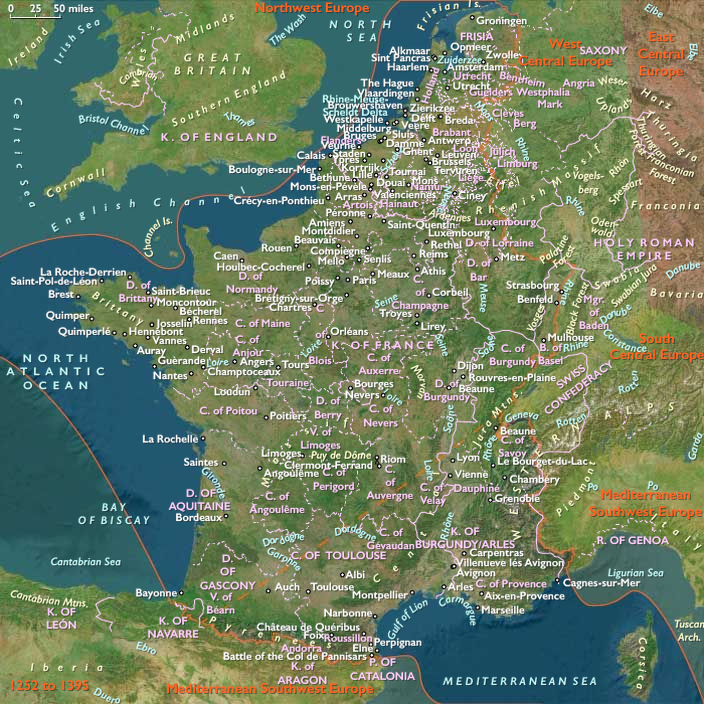
- Originally a feudal county, Artois was annexed by the County of Flanders before becoming part of France in 1180 as the dowry of Isabelle of Hainaut, a Flemish princess who married King Philip II of France.
- In 1237, King Louis VIII’s younger son, Robert I, was granted Artois, making it a separate county once more.
Succession Dispute After the Battle of the Golden Spurs (1302–1309)
- Count Robert II of Artois, grandson of Robert I, died at the Battle of the Golden Spurs (1302), leading to a succession crisis.
- His daughter, Mahaut of Artois, and his nephew, Robert III, contested the inheritance.
- Robert III’s claim was based on his father Philip, who had died after the Battle of Furnes in 1298, making him the male heir.
- However, the dispute was settled in favor of Mahaut, following the principle of proximity of blood, which favored direct descendants over collateral male relatives.
Artois and Franche-Comté Under the Anscarids (1315–1330)
- Upon Mahaut’s death in 1329, Artois passed to her daughter, Joan II of Artois, who had already inherited the County of Burgundy (Franche-Comté) in 1315 from her father, Otto IV of Burgundy.
- When Joan II died in 1330, she bequeathed both Artois and Franche-Comté to her eldest daughter, Joan III of Burgundy.
The Burgundian Connection: Joan III and Odo IV of Burgundy (1318–1330)
- Joan III of Artois and Burgundy had strengthened her territories by aligning with the ducal House of Burgundy, a cadet branch of the royal Capetians.
- She married Odo IV, Duke of Burgundy, in 1318, bringing Artois and Franche-Comté into Burgundian influence.
This dynastic alliance would pave the way for the later expansion of the Burgundian domains, eventually leading to the powerful Burgundian State of the 15th century, which played a crucial role in French and European politics.
Legacy
- The legal dispute over Artois (1302–1309) became one of the most famous inheritance cases in medieval France, influencing later succession laws.
- The union of Artois and Franche-Comté under Joan III strengthened Burgundian power and expanded Capetian cadet control in the Low Countries and eastern France.
- This consolidation set the stage for the later Burgundian expansion, which would challenge the authority of the French monarchy in the 14th and 15th centuries.
Through marriage and inheritance, Artois passed from French royal control to the emerging power of Burgundy, marking a key moment in the shifting political landscape of medieval France.