Jérôme Bonaparte
King of Westphalia
Years: 1784 - 1860
Jérôme-Napoléon Bonaparte (15 November 1784 – 24 June 1860) is the youngest brother of Napoleon I.
After 1848, when his nephew, Louis Napoleon, becomes President of the French Republic, he serves in several official roles, being created 1st Prince of Montfort and King of Westphalia, which he rules from 1807 until 1813.
Related Events
Filter results
Showing 10 events out of 27 total
Napoleon had assured the envoy that the Vistula River represents the natural borders between French and Russian influence in Europe.
On that basis, the two emperors had begun peace negotiations at the town of Tilsit after meeting on an iconic raft on the River Niemen.
The very first thing Alexander said to Napoleon was probably well-calibrated: "I hate the English as much as you do."
Napoleon had reportedly replied, "Then we have already made peace."
The two emperors spend several days reviewing each other's armies, passing out medals, and frequently talking about non-political subjects.
Although the negotiations at Tilsit feature plenty of pageantry and diplomatic niceties, they are not spared from ruthless politics.
Alexander faces pressure from his brother, Duke Constantine, to make peace with Napoleon.
Given the victory he had just achieved, the French emperor offers the Russians relatively lenient terms–demanding that Russia join the Continental System, withdraw its forces from Wallachia and Moldavia, and hand over the Ionian Islands to France.
By contrast, Napoleon dictates very harsh peace terms for Prussia, despite the ceaseless exhortations of Queen Louise.
He now appoints his young brother Jérôme as the new monarch of this kingdom.
Prussia's humiliating treatment at Tilsit causes a deep and bitter antagonism that will fester as the Napoleonic Era progresses.
Moreover, Alexander's pretensions at friendship with Napoleon lead the latter to seriously misjudge the true intentions of his Russian counterpart, who will violate numerous provisions of the treaty in the next few years.
Despite these problems, Tilsit at last gives Napoleon a respite from war and allows him to return to France, which he has not seen in over three hundred days.
His arrival will be greeted with huge celebrations in Paris.
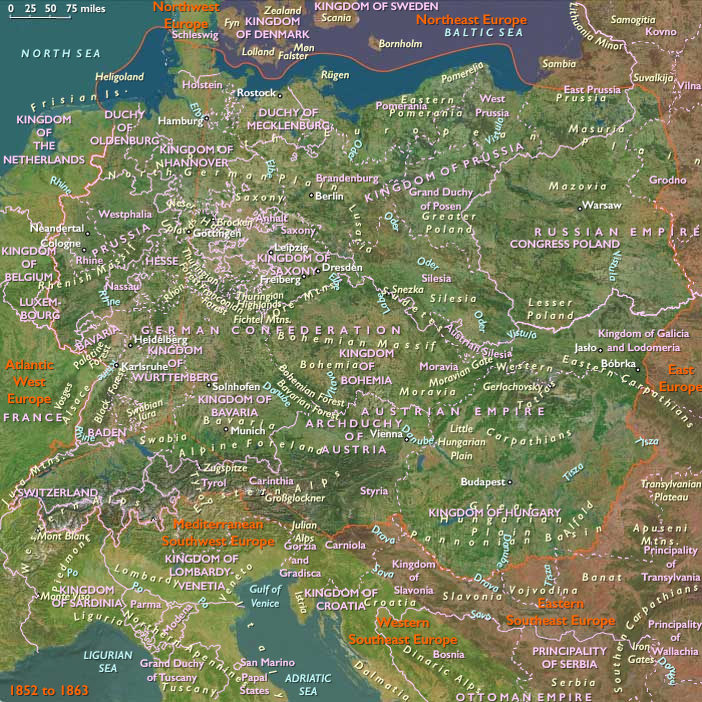
Napoleon gives to his brother Jérôme the Kingdom of Westphalia, created by merging territories ceded by the Kingdom of Prussia in the Peace of Tilsit, among them the Duchy of Magdeburg, the Brunswick-Luneburgian territories of Hanover and Wolfenbüttel, and the Electorate of Hesse.
The latter's capital Kassel then fulfills the same function for Westphalia, and the king keeps court at the palace of Wilhelmshöhe, renamed Napoleonshöhe.
The state is a member of the Confederation of the Rhine.
Intended as a Napoleonic "model state", a constitution is written and enacted by King Jérôme on December 7, 1807, the day after he had arrived in Kassel, making Westphalia the first monarchy in Germany with a modern-style constitution.
The constitution makes all male residents citizens of equal rights.
Thus serfs are liberated and Jews emancipated, and soccage—one of the feudal duties and hence land tenure forms in the feudal system—is abolished.
The Napoleonic code is enacted, doing away with guilds and providing for the right of free enterprise.
A metric system of weights and measures is introduced.
Just as before the conquest, freedom of expression remains curtailed and censorship is instituted.

Jérôme Bonaparte, made king of Westphalia by his brother Napoleon, grants citizenship to the Jews of his kingdom on December 1, 1808, an example followed by ...
...the Confederation of the Rhine.
After taking the capital, Dresden, and pushing back an army under the command of Napoleon's brother, Jérôme Bonaparte, the Austrians are effectively in control of all of Saxony, but by this time, the main Austrian force has already been defeated at Wagram and the armistice of Znaim has been agreed.
The Duke of Brunswick, however, refuses to be bound by the armistice and leads his corps on a fighting march right across Germany to the mouth of the River Weser, whence they will sail to England and enter British service.
The British force of over thirty-nine thousand, a larger army than that serving in the Iberian Peninsula, lands at Walcheren on July 30.
However, by this time the Austrians have already lost the war.
The Walcheren Campaign is characterized by little fighting but many casualties nevertheless, thanks to the popularly dubbed "Walcheren Fever".
Over four thousand British troops are lost, and the rest will withdraw on December 26, 1809.
Murat's reserve cavalry provides the vanguard with Napoleon the guard and Davout's 1st corps following behind.
Eugene's command will cross the Niemen further north at Piloy, and MacDonald crosses the same day.
Jerome's command won't complete its crossing at Grodno until the 28th.
Napoleon rushes towards Vilnius pushing the infantry forward in columns that suffered from heavy rain then stifling heat.
The central group will cross seventy miles (one hundred and ten kilometers) in two days.
Ney's III corps will march down the road to Sudervė with Oudinot marching on the other side of the Neris River in an operation attempting to catch General Wittgenstein's command between Ney, Oudinout and Macdonald's commands, but Macdonald's command is late in arriving to an objective too far away and the opportunity vanishes.
Jerome is tasked with tackling Bagration by marching to Grodno and Reynier's VII corps sent to Białystok in support.
The Russian headquarters had in fact been centered in Vilnius on June 24 and couriers had rushed news about the crossing of the Niemen to Barclay de Tolley.
Before the night had passed orders had been sent out to Bagration and Platov to take the offensive.
Alexander leaves Vilnius on June 26 and Barclay assumes overall command.
Although Barclay wants to give battle he assesses it as a hopeless situation and orders Vilnius's magazines burned and its bridge dismantled.
Wittgenstein moves his command to Perkele passing beyond Macdonald and Oudinot's operations with Wittgenstein's rear guard clashing with Oudinout's forward elements.
Doctorov on the Russian Left finds his command threatened by Phalen's III cavalry corps.
Bagration is ordered to Vileyka, which moves him towards Barclay, though the order's intent remains something of a mystery.