Jean-Marie Collot d'Herbois
French actor, dramatist, essayist, and revolutionary
Years: 1749 - 1796
Jean-Marie Collot d'Herbois (19 June 1749 – 8 June 1796) is a French actor, dramatist, essayist, and revolutionary.
He is a member of the Committee of Public Safety during the Reign of Terror and, while he saves Madame Tussaud from the Guillotine, he administers the execution of more than 2,000 people in the city of Lyon.

Related Events
Filter results
Showing 10 events out of 11 total
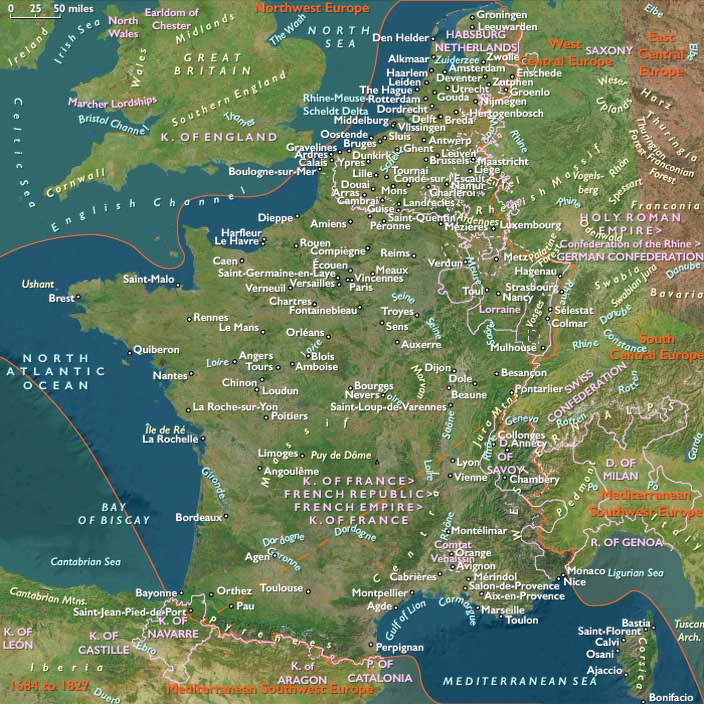
Fouché goes on to Lyon in November with Jean-Marie Collot d'Herbois to execute the reprisals of the Convention.
Lyon has revolted against the Convention and needs to be dealt with.
On November 23, Lyon is declared to be in a "state of revolutionary war" by Collot and Fouché.
The two men then form the Temporary Commission for Republican Surveillance.
Fouché inaugurates his mission with a festival notable for its obscene parody of religious rites.
Fouché and Collot then bring in "a contingent of almost two thousand of the Parisian Revolutionary Army" to begin their terrorizing.
"On 4 December, 60 men, chained together, were blasted with grapeshot on the paline de Brotteaux outside the city, and 211 more the following day.” (Hanson, P.R. (2003) The Jacobin Republic Under Fire. The Federalist Revolt in the French Revolution, p. 193).
"Grotesquely ineffective, these mitraillades result in heaps of mutilated, screaming, half-dead victims, who have to be finished off with sabers and musket fire by soldiers physically sickened at the task." (David Andress, The Terror: The Merciless War for Freedom in Revolutionary France (New York: Farrar, Straus and Giroux, 2005), 237.)
It is through events like this that make Fouché infamous as "The Executioner of Lyon."
Jean-Baptiste Jourdan, after refusing to carry out an impossible order, is hauled before the Committee of Public Safety on January 10, 1794.
Carnot presents Jourdan's arrest warrant, which is signed by Robespierre, Bertrand Barère, and Jean-Marie Collot d'Herbois.
Jourdan is saved from certain execution when an eyewitness, Representative-on-mission Ernest Joseph Duquesnoy, rises and contradicts Carnot's version of events at Wattignies.
Spared from arrest, Jourdan is nevertheless dismissed from the army and sent home.
The Commission is not happy with the methods used for killing the rebels, so soon after this "more normal firing squads supplemented the guillotine." (Schom, Alan (1997). "Fouche's Police". Napoleon Bonaparte. HarperCollins Publishers, New York. pp. 253–255).
These methods lead to the carrying out of "over 1800 executions in the coming months."
Fouché, claiming that "Terror, salutary terror, is now the order of the day here....We are causing much impure blood to flow, but it is our duty to do so, it is for humanity's sake," calls for the execution of 1,905 citizens.
As Napoleon's biographer Alan Schom has written: Alas, Fouché's enthusiasm had proved a little too effective, for when the blood from the mass executions in the center of Lyons gushed from severed heads and bodies into the streets, drenching the gutters of the Rue Lafont, the vile-smelling red flow nauseated the local residents, who irately complained to Fouché and demanded payment for damages.
Fouché, sensitive to their outcry, obliged them by ordering the executions moved out of the city to the Brotteaux field, along the Rhône.
From late 1793 into spring, 1794, every day "batch after batch of bankers, scholars, aristocrats, priests, nuns, and wealthy merchants and their wives, mistresses, and children" are taken from the city jails to Brotteaux field, tied to stakes, and dispatched by firing squads or mobs. (Schom)
Outwardly, his conduct is marked by the utmost rigor, and on his return to Paris early in April 1794, he thus characterizes his policy: "The blood of criminals fertilizes the soil of liberty and establishes power on sure foundations".
Robespierre has used his influence over the Jacobin Club to dominate the Commune of Paris through his followers.
Two of them, Jean-Baptiste Fleuriot-Lescot and Claude-François de Payan, are elected mayor and procurator of the Commune respectively.
Robespierre trieds to influence the army through his follower Louis de Saint-Just, whom he sends on a mission to the frontier.
On May 23, only one day after the attempted assassination of Collot d'Herbois, Robespierre's life was also in danger, as a young woman by the name of Cécile Renault had been arrested after having approached his place of residence with two small knives; she and forty others are executed in June.
At this point, the decree of 22 Prairial (also known as law of 22 Prairial) is introduced to the public without the consultation from the Committee of General Security, which in turn doubles the number of executions permitted by the Committee of Public Safety.
Georges Couthon, Robesbierre’s ally on the Committee, has introduced and carried the drastic law, under which the Tribunal becomes a simple court of condemnation without need of witnesses.
This law permits executions to be carried out even under simple suspicion of citizens thought to be counterrevolutionaries without extensive trials.
When Robespierre allows this law to be passed, the people of France begin to question him and the Committee because they are executing people for seemingly meaningless reasons, and also because they had passed a law without the help of the Committee of General Security.
This is part of the beginning of Robespierre's downfall.
Robespierre has struck down one by one the other prominent leaders of the revolution of both the right, (the Rolands and the Girondists), the ultra left (Jacques Hébert and the Herbertists), and the moderates (Georges Danton and his associates).
However, at the time of Robespierre's "Festival of the Supreme Being", Fouché had ventured to mock the theistic revival which Robespierre had then inaugurated.
A sharp exchange had taken place between them, and Robespierre tries to expel Fouché from the Jacobin Club on July 14, 1794.
At this time, expulsion from the club is tantamount to a death sentence.
Fouché, however, is working with his usual energy and plots Robespierre's overthrow from behind the scenes while in hiding in Paris.
Because Robespierre is losing his influence and because Fouché is under the protection of Barras, Fouché ultimately survives this expulsion.
Remaining ultraleftists (Collot d'Herbois, Billaud-Varenne) and moderates (Bourdon de l'Oise, Fréron), who had won the support of the nonaligned majority of the Convention (Marais), also opposes Robespierre's reign.
Fouché is reported to have worked furiously on Robespierre's overthrow.
As both a ruthless suppressor of Federalist rebellion and one of the proponents of Robespierre's overthrow, Fouché demonstrated the mercilessness that politics have taken on in France during the de-Christianization period.
Fouché is a dangerous critic of Robespierre, and his influence undoubtedly contributes to Robespierre's apparent nervous breakdown, which loosens his hold on Parisian politics and the Convention, and ultimately leads to his overthrow and execution.
Reports are coming into Paris about excesses committed by the envoys sent en-mission to the provinces, particularly Jean-Lambert Tallien in Bordeaux and Joseph Fouché in Lyons.
Robespierre has them recalled to Paris to account for their actions and then expels them from the Jacobins club.
However, they evade arrest.
Fouché spends the evenings moving house to house, warning members of the Convention that Robespierre is after them, while organizing a coup d'état.
Robespierre appears at the Convention on 26 July (8th Thermidor, year II, according to the Revolutionary calendar), and delivers a two-hour-long speech.
He defends himself against charges of dictatorship and tyranny, then proceeds to warn of a conspiracy against the Republic.
Robespierre implies that members of the Convention are a part of this conspiracy, though when pressed he refuses to provide any names.
The speech, however, alarms members, particularly given Fouché's warnings.
Those members who feel that Robespierre is alluding to them try to prevent the speech from being printed, and a bitter debate ensues until Barère forces an end to it.
Later that evening, Robespierre delivers the same speech again at the Jacobin Club, where it is very well received.
Saint-Just begins to give a speech in support of Robespierre the next day.
However, those who had seen him working on his speech the night before expect accusations to arise from it.
He has time to give only a small part of his speech before Jean-Lambert Tallien interrupts him.
While the accusations begin to pile up, Saint-Just remains uncharacteristically silent.
Robespierre then attempts to secure the tribunal to speak but his voice is shouted down.
Robespierre soon finds himself at a loss for words after one deputy calls for his arrest and another, Marc-Guillaume Alexis Vadier, gives a mocking impression of him.
When one deputy realizes Robespierre's inability to respond, the man shouts, "The blood of Danton chokes him!"
A faction within the National Convention including Jacobin revolutionary Paul Francois Jean Nicolas, Vicomte de Barras and military commissioner Lazare Nicolas Marguerite Carnot, topples Robespierre.
The Convention orders the arrest of Robespierre, his brother Augustin, Couthon, Saint-Just, François Hanriot and Le Bas.
Troops from the Commune, under General Coffinhal, arrive to free the prisoners and then march against the Convention itself.
The Convention responds by ordering troops of its own under Barras to be called out.
When the Commune's troops hear the news of this, order begins to break down, and Hanriot orders his remaining troops to withdraw to the Hôtel de Ville, where Robespierre and his supporters also gather.
The Convention declares them to be outlaws, meaning that upon verification the fugitives can be executed within twenty-four hours without a trial.
As the night goes on, the forces of the Commune desert the Hôtel de Ville and, at around two in the morning, those of the Convention under the command of Barras arrive there.
In order to avoid capture, Augustin Robespierre throws himself out of a window, only to break both of his legs; Couthon is found lying at the bottom of a staircase; Le Bas commits suicide; another radical shoots himself in the head.
Robespierre tries to kill himself with a pistol but manages only to shatter his lower jaw, although some eyewitnesses claim that Robespierre had been shot by Charles-André Merda.
Robespierre is moved to a table in the room of the Committee of Public Safety, where he awaits execution for the remainder of the night.
He lies on the table bleeding abundantly until a doctor is brought in to attempt to stop the bleeding from his jaw.
Robespierre's last recorded words may have been "Merci, monsieur," to a man that had given him a handkerchief for the blood on his face and clothing.
Later, Robespierre is held in the same containment chamber where Marie Antoinette, the wife of King Louis XVI, had been held.
The next day, July 28, 1794, Robespierre is guillotined without trial in the Place de la Révolution.
His brother Augustin, Couthon, Saint-Just, Hanriot and twelve other followers, among them the cobbler Simon, are also executed.
When clearing Robespierre's neck the executioner tears off the bandage that is holding his shattered jaw in place, producing an agonized scream until the fall of the blade silences him.
Together with those executed with him, he is buried in a common grave at the newly opened Errancis Cemetery (cimetière des Errancis) (March 1794 – April 1797) (near what is now the Place Prosper-Goubaux).
A plaque indicating the former site of the cimetière des Errancis is located at 97 rue de Monceau, Paris 75008.
Between 1844 and 1859 (probably in 1848), the remains of all those buried there will be moved to the Catacombs of Paris.
The reign of the standing Committee of Public Safety is ended.
New members are appointed the day after Robespierre's execution, and term limits are imposed (a quarter of the committee is to retire every three months); its powers will be reduced piece by piece.