Jean de Dunois
illegitimate son of Louis d'Orléans
Years: 1402 - 1468
John of Orléans, Count of Dunois (French better known as Jean d'Orléans, comte de Dunois, also known as John of Orléans and Bastard of Orléans) (23 November 1402 – 24 November 1468) is the illegitimate son of Louis d'Orléans (Duc d'Orléans 1372-1407) by Mariette d'Enghien.
The term "Bastard of Orléans" (bâtard d'Orléans) is the usual name for most of his career.
In his era this is a term of respect since it acknowledges him as a first cousin to the king and acting head of a cadet branch of the royal family during his half-brother's captivity.

Related Events
Filter results
Showing 10 events out of 16 total
The Siege of Orléans (1428–1429) and Joan of Arc’s Triumph
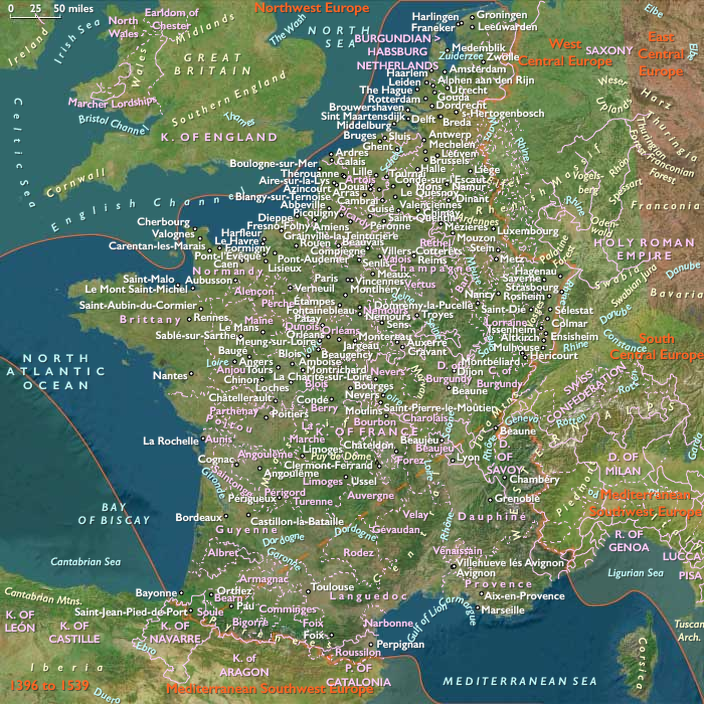
In 1428, John, Duke of Bedford, the English regent of France, ordered an unrelenting siege of Orléans, a key stronghold of the Dauphin Charles (the future Charles VII of France). At the time, Charles, Duke of Orléans, the city's rightful ruler, was a prisoner in England, leaving his territory vulnerable.
The French garrison held out for eight months, enduring continuous assaults and severe deprivation. However, in May 1429, the arrival of Joan of Arc, a deeply religious peasant girl claiming divine guidance, transformed the battle.
In just eight days, her forces lifted the siege, securing one of the most decisive victories in the Hundred Years’ War. This triumph earned her the legendary title “The Maid of Orléans.”
I. The English Siege and French Resistance (1428–1429)
- The English, led by Thomas Montacute, Earl of Salisbury, laid siege to Orléans in October 1428, aiming to cut off the Dauphin’s last major stronghold on the Loire River.
- The city's rightful ruler, Charles, Duke of Orléans, was a prisoner, weakening French morale.
- The French defenders, outnumbered and undersupplied, held out for eight months, hoping for reinforcements.
II. The Arrival of Joan of Arc (April–May 1429)
- In early 1429, Joan of Arc convinced Charles VII** that she was divinely chosen to save France.
- Granted command of an army, she marched to Orléans in April 1429, bringing fresh troops and renewed morale.
- On May 4, 1429, Joan led an attack on the English fortifications, and by May 8, the siege was broken.
- Her unexpected success shattered English confidence and turned the tide of the war in favor of Charles VII.
III. Jean de Dunois, “The Bastard of Orléans”
- Among Joan’s key commanders was Jean, Comte de Dunois, an illegitimate son of the murdered Louis, Duke of Orléans.
- A loyal supporter of the Dauphin, Dunois helped organize and execute the counteroffensive that drove out the English.
- His bravery at Orléans earned him the title “The Bastard of Orléans,” and he would go on to become one of Charles VII’s most important generals.
IV. Consequences: A Turning Point in the Hundred Years’ War
- The lifting of the siege marked the beginning of the French resurgence, shifting momentum away from English domination.
- Joan of Arc’s victory at Orléans revitalized French morale, paving the way for Charles VII’s coronation in Reims (1429).
- Dunois continued to play a key role in France’s military successes, ultimately helping to drive the English out of France.
The Siege of Orléans (1428–1429) was one of the most defining moments of the Hundred Years’ War, as Joan of Arc’s leadership and Dunois’ military prowess turned the tide in favor of the Dauphin Charles VII, ensuring the survival of the French monarchy.
Joan of Arc and the Lifting of the Siege of Orléans (April 29 – May 8, 1429)
On April 29, 1429, Joan of Arc arrived at Orléans, a city that had been under English siege for five months and was on the verge of collapse. Though Jean d’Orléans, Count of Dunois, initially excluded her from war councils, Joan’s presence and spiritual leadership soon became a turning point in the siege.
Within days of her arrival, the French forces, inspired by Joan, launched a series of offensives that culminated in the capture of Les Tourelles on May 7 and the complete retreat of the English on May 8. This unexpected victory transformed Joan’s reputation, convincing many that she was divinely sent to save France.
I. Joan’s Arrival and Initial Exclusion from Military Decisions
- Jean d’Orléans (the Bastard of Orléans), acting head of the ducal family, initially kept Joan out of military councils.
- Despite this, Joan was present at most discussions and battles, and many noble commanders followed her advice, believing it was divinely inspired.
- Joan later stated that she carried her banner in battle rather than wielding a sword, claiming she never killed anyone.
- Historians debate the extent of her direct military leadership, but agree that the army experienced unprecedented success during her time with it.
II. The French Counteroffensive Begins (May 4–7, 1429)
1. Capture of Saint-Loup (May 4, 1429)
- The Armagnacs launched their first major attack, seizing the English outpost at Saint-Loup, marking a decisive shift in the siege.
2. Capture of Les Augustins and Skirmishes (May 5–6, 1429)
- The French forces marched on Saint-Jean-le-Blanc, finding it deserted.
- English troops emerged but were driven back by a rapid cavalry charge.
- The Armagnacs attacked and captured Les Augustins, another key English fortification.
3. Assault on Les Tourelles (May 7, 1429)
- Les Tourelles, the main English stronghold on the south bank of the Loire, was the final obstacle to breaking the siege.
- During the battle, Joan was wounded by an arrow between her neck and shoulder, but returned later in the day to rally the troops.
- Her presence inspired the final assault, which overwhelmed the English defenders and secured the fortress.
III. The English Retreat and the End of the Siege (May 8, 1429)
- With Les Tourelles lost, the English forces retreated from Orléans on May 8.
- The siege was broken, marking the first major French victory in years.
IV. Joan’s Prophecy Fulfilled: A Divine Sign?
- At Chinon and Poitiers, Joan had declared she would provide a sign—her success at Orléans was widely seen as divine proof of her mission.
- Prominent clergy, including the Archbishop of Embrun and theologian Jean Gerson, wrote treatises in support of her after the victory.
- The lifting of the siege boosted Charles VII’s legitimacy and paved the way for his coronation at Reims.
V. Consequences and the Path to Reims
- The victory at Orléans marked a turning point in the Hundred Years’ War, as Joan’s leadership reinvigorated the French cause.
- Her next objective was to bring Charles VII to Reims for his long-delayed coronation, further strengthening his claim to the French throne.
The lifting of the Siege of Orléans (April–May 1429) was the defining moment in Joan of Arc’s early military career, fulfilling her prophecy and transforming the course of the Hundred Years’ War.
The Aftermath of Orléans: Joan of Arc’s Plan to Reclaim the Loire and Reach Reims (1429)
The unexpected French victory at Orléans (May 8, 1429) dramatically shifted the momentum of the Hundred Years’ War, leading to widespread calls for further offensive action.
Joan of Arc, capitalizing on her growing influence at court, successfully persuaded Charles VII to approve her bold strategy—recapturing key bridges along the Loire as a prelude to an advance on Reims for his long-awaited coronation.
This audacious plan was unexpected, as the English anticipated an attack on Paris or Normandy. Instead, Joan aimed directly at Reims, deep in enemy territory, demonstrating her confidence in divine guidance and her ability to inspire the French army.
I. Joan Gains Royal Approval for the Loire Campaign
- After Orléans, Joan pressed Charles VII to act quickly before English forces could regroup.
- She proposed a calculated strategy:
- Recapturing key Loire River bridges to secure a path toward Reims.
- Proceeding with Charles VII to Reims, where French kings had traditionally been crowned since 816.
- Charles VII agreed and granted her permission to accompany the army, under the command of Duke Jean II of Alençon.
II. A Bold and Unexpected Move
- Reims was deep in enemy-controlled territory, roughly twice as far away as Paris.
- The English and their Burgundian allies assumed Joan’s forces would strike at Paris or Normandy.
- Instead, her focus on Reims demonstrated her strategic vision, as securing the city would legitimize Charles VII’s rule and rally more French support.
III. Growing Support from French Commanders
- The Duke of Alençon fully embraced Joan’s strategic advice, working closely with her in planning the campaign.
- Other commanders, including Jean d’Orléans (the Bastard of Orléans), who had initially doubted her, now became her supporters after witnessing her effectiveness in battle.
IV. Consequences: The Path to Reims Begins
- With royal approval and growing support among the military, Joan’s army prepared for the Loire campaign, marking the beginning of one of the most remarkable military advances in the war.
- The success of this strategy would culminate in Charles VII’s coronation at Reims in July 1429, a moment that transformed the course of French history.
Joan of Arc’s plan to reclaim the Loire bridges and push toward Reims was a masterstroke, surprising the English, rallying the French, and setting the stage for Charles VII’s legitimacy as king.
The Loire Campaign: Joan of Arc’s Victories at Meung-sur-Loire and Beaugency (June 1429)
Following the lifting of the Siege of Orléans on May 8, 1429, Joan of Arc and the French forces launched a rapid offensive along the Loire River, securing key English-held strongholds as a prelude to advancing on Reims for Charles VII’s coronation.
As part of this successful campaign, Joan’s forces captured Meung-sur-Loire on June 15, 1429, and Beaugency on June 17, 1429, further weakening English control over the Loire region.
I. The Capture of Meung-sur-Loire (June 15, 1429)
- Meung-sur-Loire was a strategically important town, controlling a vital bridge over the Loire River.
- Joan and the French forces attacked the town on June 15, forcing the English garrison to retreat into the castle, which they were unable to defend for long.
- The French swiftly took control of the bridge, securing a key crossing point and tightening their grip on the Loire.
II. The Capture of Beaugency (June 17, 1429)
- Just two days later, Joan and her army laid siege to Beaugency, another fortified English position along the Loire.
- The English garrison, under Sir Richard Gough, attempted to hold out but found themselves cut off from reinforcements.
- After brief fighting, the English surrendered on June 17, further collapsing English resistance along the Loire.
III. The Strategic Impact of These Victories
- With Meung and Beaugency secured, the French had effectively reclaimed control of the Loire River.
- These victories paved the way for the decisive Battle of Patay (June 18, 1429), where the English would suffer a catastrophic defeat, marking the complete collapse of their Loire defenses.
- The French advance toward Reims now seemed inevitable, making Charles VII’s coronation a realistic possibility.
The captures of Meung-sur-Loire and Beaugency in mid-June 1429 were key steps in Joan of Arc’s successful Loire campaign, further shifting the momentum of the war in favor of the French and setting the stage for even greater victories.
The Battle of Patay (June 18, 1429): A Reverse Agincourt and a Crushing English Defeat
On June 18, 1429, after the fall of Meung-sur-Loire and Beaugency, the English army, realizing their precarious situation, withdrew from the Loire Valley and moved northward, attempting to regroup with reinforcements under Sir John Fastolf.
However, Joan of Arc, recognizing the opportunity for a decisive victory, urged the Armagnac forces to pursue the retreating English. The two armies clashed southwest of the village of Patay, resulting in a catastrophic English defeat that has often been compared to Agincourt in reverse.
I. The English Retreat and Fastolf’s Reinforcements
- After the loss of key strongholds in the Loire Valley, the English forces under John Talbot and Thomas Scales attempted to retreat northward.
- They intended to merge with an English reinforcement force led by Sir John Fastolf, hoping to regroup and launch a counterattack.
II. The French Pursuit and the Unexpected Encounter
- Joan of Arc and Duke Jean II of Alençon pressed for an immediate pursuit, determined to prevent the English from escaping.
- The French vanguard caught up with the English near Patay, where a small unit of English longbowmen had been stationed to block the road.
- Unlike previous battles such as Agincourt (1415) and Verneuil (1424), the English had no time to properly prepare their defensive stakes, which were crucial for neutralizing cavalry charges.
III. The Battle: A Devastating French Cavalry Charge
- The French cavalry, led by Étienne de Vignolles ("La Hire") and Jean Poton de Xaintrailles, charged the English archers before they could fully form their defensive positions.
- The English archers, caught off guard, were completely overrun, triggering a massive rout.
- With their frontline shattered, the main English army collapsed, leading to one of the most humiliating defeats of the war.
IV. Casualties and English Commanders Lost
- The French suffered minimal losses, while the English army was decimated.
- Several key English commanders were killed or captured, including:
- John Talbot, 1st Earl of Shrewsbury (captured).
- Sir Thomas Scales (captured).
- Sir Thomas Rempston (killed).
- Sir John Fastolf managed to escape with a small band of soldiers, but was blamed for the disaster and later humiliated by his fellow commanders in England.
V. Consequences: The Turning Point in the War
- The victory at Patay effectively ended English dominance in northern France, shifting the war fully in favor of Charles VII.
- The path to Reims was now open, allowing Charles VII to proceed with his coronation in July 1429.
- Joan of Arc’s reputation soared, as she had delivered on her promise of divine victory, further solidifying her status as the savior of France.
The Battle of Patay (1429) was a decisive reversal of English fortunes, mirroring Agincourt in reverse and marking the beginning of the French resurgence under Joan of Arc and Charles VII.
The March to Reims: The French Advance Under Joan of Arc (June–July 1429)
Following the decisive victory at Patay (June 18, 1429), Joan of Arc and the French army set out from Gien on June 29, beginning their bold march toward Reims, where Charles VII was to be crowned.
On July 3, the French forces secured the conditional surrender of Auxerre, a Burgundian-held city, further clearing the path toward Reims.
I. The Strategic Importance of the March
- Reims was the traditional site for the coronation of French kings, making its capture essential to legitimizing Charles VII’s rule.
- The Burgundians controlled much of the region, meaning that Joan’s army had to negotiate or fight their way through enemy-held territory.
- Rather than engaging in direct military confrontations, the French aimed to secure cities through diplomacy or intimidation, avoiding unnecessary bloodshed.
II. The Surrender of Auxerre (July 3, 1429)
- Auxerre, a key Burgundian stronghold, surrendered to the French on July 3, though under conditional terms.
- The city’s leaders negotiated their surrender, agreeing to recognize Charles VII as king, while retaining some autonomy.
- This victory demonstrated the growing influence of Joan of Arc and the weakening resolve of the Burgundian faction.
III. The French Army Advances Toward Reims
- With Auxerre secured, the French continued their march northward, meeting minimal resistance as several Burgundian-held cities surrendered without a fight.
- This momentum ensured that Charles VII’s coronation would soon become a reality, marking a major turning point in the Hundred Years’ War.
The fall of Auxerre on July 3, 1429, was a critical step in the French march toward Reims, as Joan of Arc’s army continued to reclaim territory and prepare for the ultimate goal—the coronation of Charles VII.
The Bloodless Surrender of Troyes and the March to Reims (July 1429)
As Joan of Arc and the French army advanced toward Reims in July 1429, most towns along the route surrendered without resistance, recognizing the rising legitimacy of Charles VII. The only exception was Troyes, the city where the infamous 1420 Treaty of Troyes had attempted to disinherit Charles VII in favor of the English.
Initially hesitant to surrender, Troyes was in for a surprise: a local religious movement had inadvertently prepared the city for the arrival of Joan’s army.
I. The French Advance and Minimal Resistance
- Following the surrender of Auxerre on July 3, 1429, Joan and the French army continued northward.
- Most towns along the route returned to French allegiance without a fight, recognizing that English and Burgundian forces were in retreat.
- Troyes, however, initially resisted, likely because of its symbolic connection to the treaty that had sought to make Henry VI the king of France.
II. The French Army’s Food Shortage
- By the time they reached Troyes, Joan’s army was running dangerously low on food.
- However, they were unexpectedly saved by a wandering friar, Brother Richard.
- Brother Richard had been preaching in Troyes about the end of the world, and he had convinced local residents to plant beans, which had an early harvest.
- The French army arrived just as the beans were ripening, solving the food crisis.
III. The Siege and Surrender of Troyes (July 1429)
- Joan’s forces besieged Troyes for four days, but no major battle took place.
- After witnessing Joan’s determination and the strength of the French army, the city capitulated without bloodshed.
- The Treaty of Troyes had sought to strip Charles VII of his birthright, but now the same city accepted his rule, a symbolic reversal of English fortunes.
IV. Consequences: The Path to Reims Opens
- With Troyes secured, Joan and Charles VII’s army were free to march to Reims, where his long-awaited coronation would take place.
- The lack of resistance along the route demonstrated the crumbling authority of the English and their Burgundian allies.
The bloodless surrender of Troyes in July 1429 further validated Joan’s mission and ensured that Charles VII would soon be crowned at Reims, marking a turning point in the Hundred Years’ War.
The Coronation of Charles VII at Reims and the Stalled March on Paris (July 1429)
On July 16, 1429, Joan of Arc and the French army arrived at Reims, where the city opened its gates without resistance, recognizing the momentum of the French cause. The following morning, July 17, Charles VII was crowned King of France, fulfilling Joan’s divine mission and marking a critical turning point in the Hundred Years’ War.
Despite this triumph, Joan and the Duke of Alençon urged an immediate march on Paris, but the royal court, preferring diplomacy, pursued negotiations with Philip the Good, Duke of Burgundy. However, Philip used the truce as a stalling tactic, allowing him to reinforce Paris in anticipation of a French attack.
I. The Coronation at Reims (July 17, 1429)
- Joan of Arc had long insisted that Charles VII must be crowned in Reims, the traditional site of French royal coronations since 816.
- With the city welcoming the French army, Charles VII’s long-delayed coronation took place on July 17, 1429.
- Joan stood beside Charles during the ceremony, signaling that her mission had been fulfilled and reinforcing the divine legitimacy of his reign.
II. Joan’s Urging for an Immediate March on Paris
- Fresh off their victory, Joan and the Duke of Alençon wanted to strike Paris without delay, taking advantage of English and Burgundian weakness.
- Paris, still held by the Anglo-Burgundian forces, was the true prize, as its capture would cement Charles VII’s rule.
- Joan believed that God’s favor was still with the French army, and that hesitation would allow their enemies to recover.
III. The Royal Court’s Truce with Burgundy and Philip the Good’s Deception
- Instead of pressing the advantage, Charles VII’s royal advisors sought negotiations with Philip the Good, Duke of Burgundy.
- A truce was arranged, theoretically aimed at preventing further conflict between Burgundy and France.
- However, Philip the Good used the truce as a ruse, deliberately delaying negotiations while reinforcing the defenses of Paris.
- By the time Charles VII was ready to march on Paris, the city was heavily fortified, making an attack far more difficult than it would have been immediately after Reims.
IV. Consequences: A Lost Opportunity
- The coronation at Reims was a major psychological and political victory, legitimizing Charles VII’s rule.
- However, the delay in attacking Paris allowed the Anglo-Burgundian forces to regroup, weakening the French momentum.
- Joan’s frustration with the royal court’s hesitation would soon lead to her greatest military disappointment—the failed attack on Paris in September 1429.
The coronation of Charles VII at Reims (July 17, 1429) marked the high point of Joan of Arc’s military career, but the truce with Burgundy proved to be a costly mistake, allowing the enemy to strengthen Paris while the French court hesitated.
The Standoff at Montépilloy and the Failed Assault on Paris (August–September 1429)
Following Charles VII’s coronation at Reims (July 17, 1429), the French army continued its campaign, marching through towns near Paris and accepting several peaceful surrenders. However, the much-anticipated attack on the French capital was stalled by political hesitation.
On August 15, 1429, the Duke of Bedford, leading an English force, confronted the French army at the Battle of Montépilloy in a standoff that did not develop into a full battle. After this, Joan of Arc pushed for an immediate attack on Paris, but royal advisors delayed, allowing the Anglo-Burgundian defenders time to fortify the city.
When the French assault on Paris finally occurred on September 8, 1429, Joan was wounded but remained in the inner trench until being carried to safety. However, the next morning, a royal order forced the army to withdraw, effectively abandoning the campaign. Many historians blame French Grand Chamberlain Georges de la Trémoillefor the political miscalculations that followed Charles VII’s coronation.
I. The Standoff at Montépilloy (August 15, 1429)
- The Duke of Bedford, leading the English forces, intercepted the French army near Montépilloy.
- The two armies faced off in a tense standoff, but no major engagement took place.
- The French forces remained in the field, but the lack of an immediate advance on Paris allowed the Anglo-Burgundians time to fortify the capital.
II. The Assault on Paris (September 8, 1429)
- Joan of Arc led the French attack on the heavily defended city.
- The French launched an assault on the St. Honoré gate, facing fierce resistance from the English and Burgundian garrison.
- Joan was wounded in the leg by a crossbow bolt, yet refused to leave the front lines, staying in Paris’s inner trench until she was forcibly carried to safety by one of the commanders.
III. The Unexpected French Retreat and Political Fallout
- The following morning (September 9), a royal order forced the army to withdraw, effectively abandoning the attack on Paris.
- Many historians blame Georges de la Trémoille, Charles VII’s Grand Chamberlain, for:
- Blocking further military efforts to take Paris.
- Persuading the king to negotiate rather than capitalize on French momentum.
- This political hesitation frustrated Joan, who had pushed for aggressive action and believed divine favor was still with the French army.
IV. Consequences: A Missed Opportunity
- The failed assault on Paris marked the beginning of Joan’s decline in influence at the French court.
- The English and Burgundians, now reinforced, solidified their hold on the city.
- Charles VII’s hesitation weakened the momentum of Joan’s campaign, signaling a shift from military victories to political maneuvering.
The Battle of Montépilloy (August 15) and the failed assault on Paris (September 8, 1429) represent a critical turning point, as political missteps by Charles VII’s advisors squandered the opportunity to retake the capital, leading to Joan’s diminishing role in French military affairs.