Jan van Eyck
Flemish painter
Years: 1394 - 1441
Jan van Eyck (or Johannes de Eyck) (Dutch pronunciation: [ˈjɑn vɑn ˈɛjk]) (before c. 1395 – before July 9, 1441) is a Flemish painter active in Bruges and considered one of the best Northern European painters of the 15th century.
There is a common misconception, which dates back to the sixteenth-century Vite of the Tuscan artist and biographer Giorgio Vasari, that Jan van Eyck invented oil painting.
Oil painting as a technique for painting wood statues and other objects is much older, and Theophilus (Roger of Helmarshausen?)
clearly gives instructions for oil-based painting in his treatise, On Divers Arts, written in 1125.
It is however true that the van Eyck brothers are among the earliest Early Netherlandish painters to use it for very detailed panel paintings, and that they achieve new and remarkable effects through the use of glazes, wet-on-wet and other techniques.
Thus, because of his early mastery of the technique, he was traditionally known as the "father of oil painting."
Jan van Eyck has often been linked as brother to painter and peer Hubert van Eyck, because both have been thought to originate from the same town, Maaseik in Limburg (Belgium).
Another brother, Lambert van Eyck, is mentioned in Burgundian court documents, and there is a conjecture that he too was a painter, and that he may have overseen the closing of Jan van Eyck's Bruges workshop.
Another significant, and rather younger, painter who worked in Southern France, Barthélemy van Eyck, is presumed to be a relation.
Related Events
Filter results
Showing 10 events out of 14 total
The Artistic Revolution of the International Renaissance
The International Renaissance was a period of unprecedented artistic innovation, fueled by scientific advancements in anatomy, optics, and perspective. Artists sought a new realism, emphasizing proportion, harmony, and the resolution of complex and conflicting elements. This movement was not confined to Italy but spanned across Europe and beyond, influencing Flemish, Byzantine, and Chinese art traditions.
I. The Italian Renaissance: Masters of Proportion and Perspective
Italy was the epicenter of Renaissance art, producing visionary painters, sculptors, and architects who redefined artistic expression:
- Fra Angelico – A Dominican friar who blended spiritual devotion with Renaissance realism, best known for his frescoes at the Convent of San Marco in Florence.
- Jacopo de' Barbari – One of the first Italian artists to experiment with engraving, blending Venetian and Northern Renaissance influences.
- Sandro Botticelli – Known for his mythological masterpieces, including The Birth of Venus and Primavera, where elegance and fluidity of line define his style.
- Leonardo da Vinci – A polymath who mastered anatomy, light, and shadow, producing iconic works like Mona Lisa and The Last Supper.
- Fra Filippo Lippi – A master of delicate expressions and graceful figures, influencing later Florentine painters.
- Masaccio – The first painter to use scientific perspective in frescoes, revolutionizing spatial depth in painting.
- Piero della Francesca – Famous for his mathematical approach to perspective, exemplified in The Flagellation of Christ.
- Piero and Antonio del Pollaiuolo – Masters of anatomical accuracy and dynamic movement, pioneering the study of the human body in action.
- Luca Signorelli – Created some of the most vivid and muscular human forms, particularly in his frescoes in Orvieto Cathedral.
- Andrea del Verrocchio – Teacher of Leonardo da Vinci, known for his sculptures and refined painting techniques.
II. The Flemish Renaissance: Masters of Light and Detail
The Flemish Renaissance artists focused on realism, meticulous detail, and mastery of oil painting, influencing later European art:
- Hieronymus Bosch – Created surreal, dreamlike imagery with complex allegories and moral narratives, seen in The Garden of Earthly Delights.
- Hugo van der Goes – Renowned for his expressive emotion and intense realism, particularly in The Portinari Altarpiece.
- Hans Memling – Specialized in portraits and religious compositions, combining graceful figures with luminous color.
- Jan and Hubert van Eyck – Innovators of oil painting, with Jan's Arnolfini Portrait demonstrating unmatched precision and use of light.
- Rogier van der Weyden – Master of pathos and human expression, particularly in The Descent from the Cross.
- Michael Wolgemut – A leading German painter and printmaker, influential as the teacher of Albrecht Dürer.
III. The Byzantine and Chinese Renaissance Masters
- Theophanes the Greek (Byzantium) – The most famous Byzantine painter of the period, known for his dynamic, expressive figures and influence on early Russian iconography.
- Shen Zhou and Wen Zhengming (China) – Masters of the Wu School, blending traditional Chinese landscape painting with poetic expression, emphasizing personal expression over strict realism.
IV. Bridging the Early and High Renaissance: Dürer and Michelangelo
- Albrecht Dürer (Germany) – Bridged Gothic tradition and Renaissance humanism, mastering woodcuts, engravings, and scientific perspective in works like Melencolia I.
- Michelangelo Buonarroti (Italy) – His career spanned the transition from the Early to High Renaissance, creating sculptures, paintings, and architectural marvels, such as the Sistine Chapel frescoes and David.
V. The Legacy of the Renaissance Masters
The International Renaissance was an era of unparalleled artistic achievement, shaped by scientific inquiry, humanistic ideals, and cross-cultural influences. Through innovations in light, color, and perspective, artists redefined realism and transformed the visual world, leaving a legacy that continues to inspire modern art.
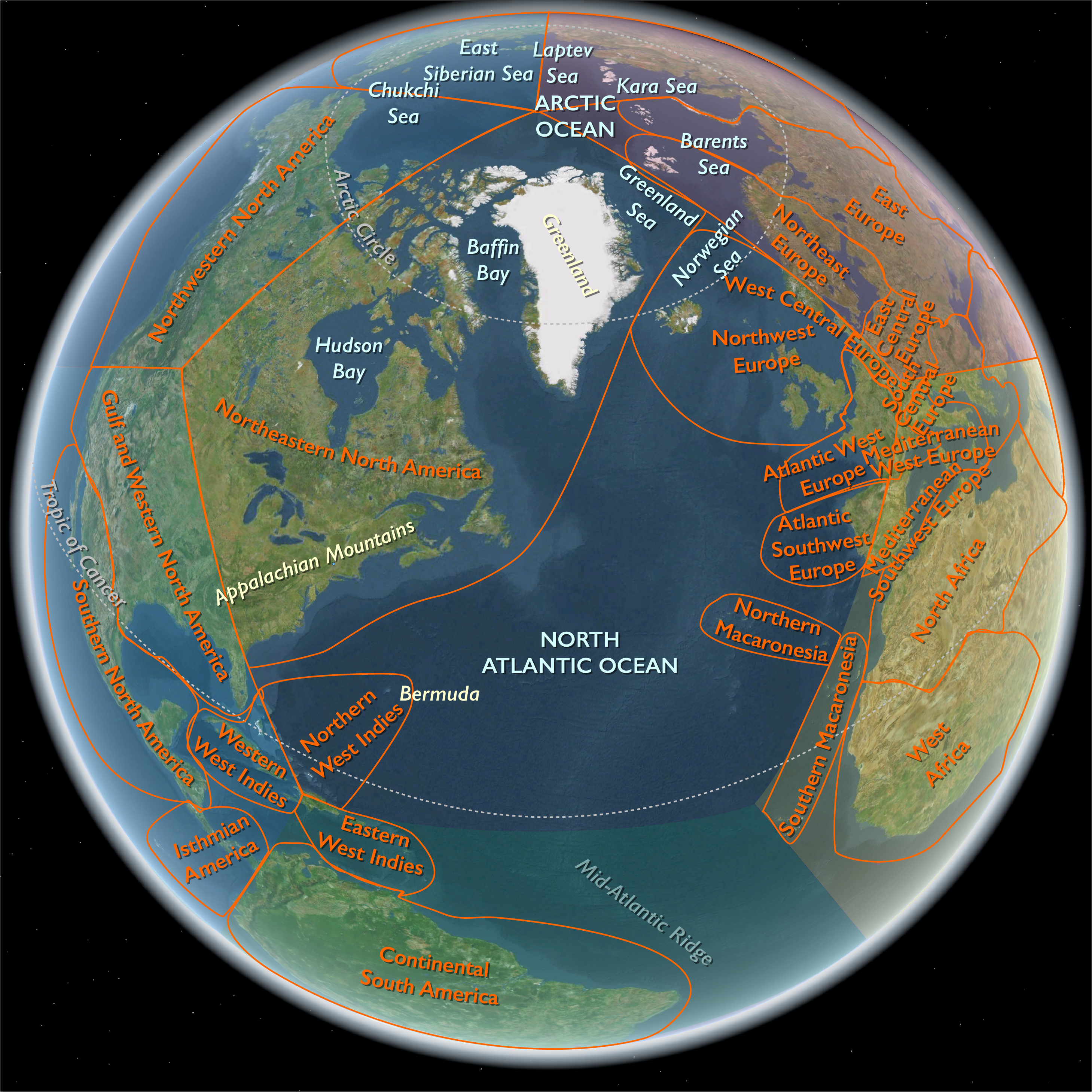
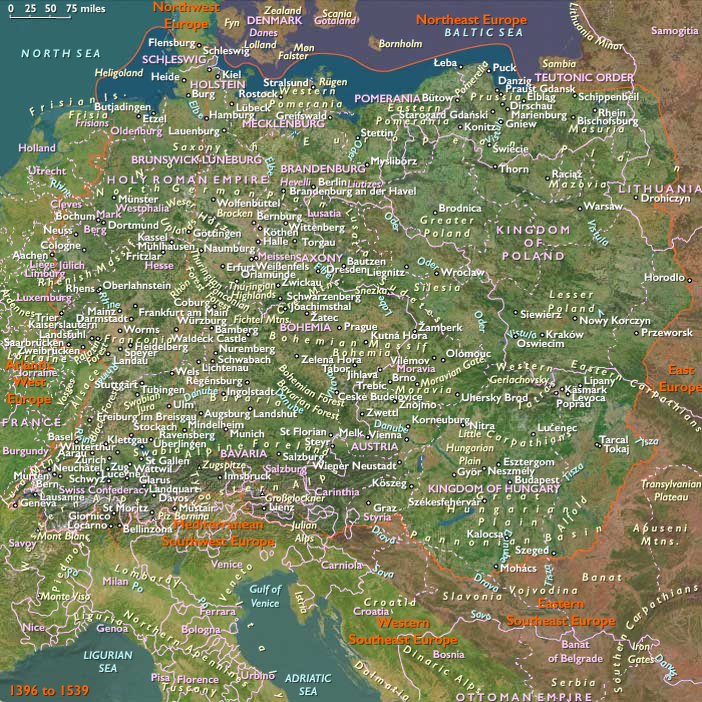
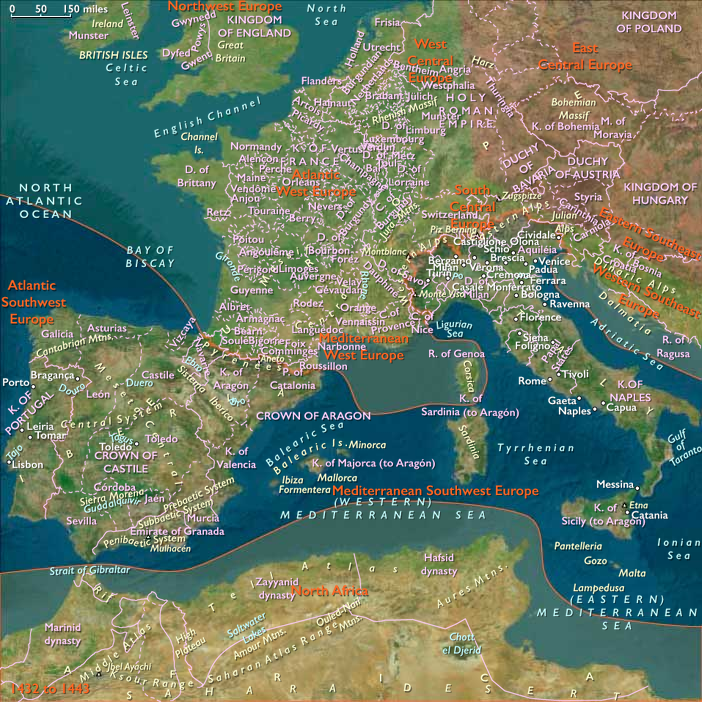
West Europe (1396–1539 CE)
Dynastic Struggles, Maritime Republics, and Reformation Currents
Geography & Environmental Context
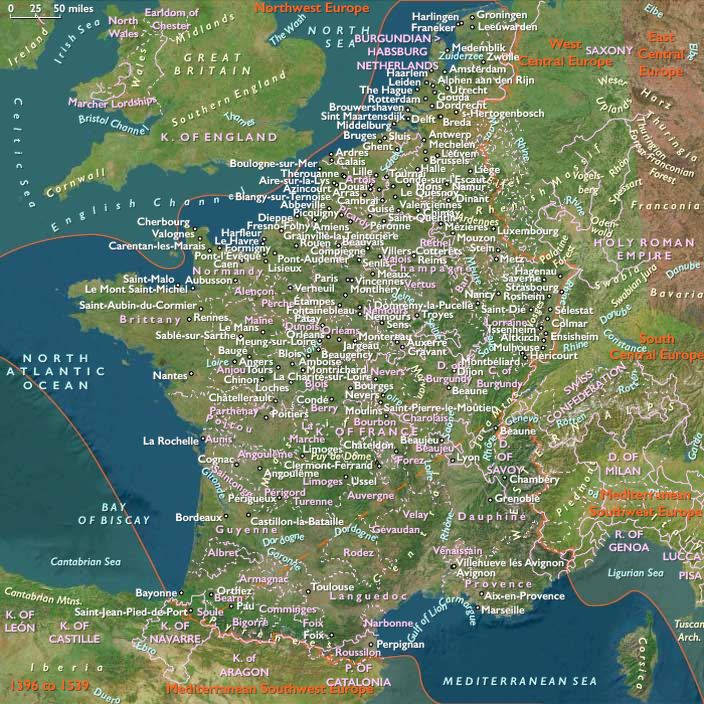
West Europe in this age bridged the Mediterranean and the Atlantic through two intertwined spheres.
Mediterranean West Europe encompassed southern France (Languedoc, Provence, the Rhône valley, the French Pyrenees), Monaco, and Corsica—a frontier of mountain uplands, terraced coasts, and river plains tied to Italian and Iberian seas.
Atlantic West Europe ran along the Atlantic and Channel coasts of France, the Loire Valley Burgundy, northern France (including Paris), and the Low Countries (Belgium, the Netherlands, Luxembourg)—fertile basins and estuaries linked to Europe’s commercial cores.
From Marseille and Nice to Antwerp, Rouen, and Bordeaux, ports, riverways, and passes bound inland grainlands to sealanes and mercantile emporia.
Climate & Environmental Shifts
The Little Ice Age brought cooler winters, late frosts, and erratic rains.
-
Languedoc–Provence & Corsica: Vine and olive belts suffered frost damage in severe winters; storms battered harbors.
-
Rhône & Loire valleys; Paris Basin; Burgundy: Alternating floods, droughts, and cold snaps reshaped grain and grape yields.
-
Low Countries & Channel coasts: North Sea surges and wetter fields demanded relentless dike upkeep; fisheries endured rougher seas yet remained staples.
Subsistence & Settlement
-
Mediterranean sphere: Mixed farming of wheat, barley, rye, and legumes in valleys; vines and olives on coastal terraces; chestnuts in Corsican uplands. Sheep–goat transhumance linked Pyrenean and island pastures to town markets. Marseille, Avignon, Montpellier, Nice, and Ajaccio thrived as fortified, trade-facing towns.
-
Atlantic sphere: Wheat, rye, oats, and barley dominated; Burgundy’s vineyards and the Loire’s orchards supported regional exchange; flax and hemp in Flanders; dairy and cattle in the Low Countries. Paris, Rouen, Dieppe, Bordeaux, Bruges, Antwerp, Ghent, and Brussels anchored urban craft and export economies. Fisheries for herring and cod—salted and barreled—fed towns and long-distance trade.
Technology & Material Culture
-
Agriculture: Three-field rotations; water- and windmills; hillside terracing across Provence and Corsica.
-
Shipbuilding & seamanship: Mediterranean galleys and Atlantic cogs evolved toward caravels and larger ocean-going hulls; coastal shipyards provisioned fleets from Marseille to Rouen and Antwerp.
-
Architecture: Flamboyant Gothic cathedrals in Narbonne and Montpellier; papal complexes at Avignon; Genoese towers on Corsica; Burgundian ducal palaces; Flemish belfries and town halls; early Renaissance idioms appeared in Loire châteaux.
-
Print & craft: Lyon, Paris, and Antwerp emerged as printing hubs; Flemish woolens and tapestries, Burgundian wines, and Parisian luxury metalwork set European tastes.
Movement & Interaction Corridors
-
Mediterranean sealanes: Marseille and Monaco linked to Genoa, Naples, and Barcelona; Corsica sat astride Italy–Iberia–Maghreb routes.
-
Rhône corridor: Carried salt, wine, and grain north to Lyon and beyond.
-
Atlantic & Channel arteries: Bruges (declining by 1500), Antwerp (rising), and Rouen tied northern Europe to Iberia and the Mediterranean; Bordeaux connected the Loire–Garonne basins to the ocean.
-
Overland networks: Burgundian roads knit Dijon and Brussels to the Empire and France; pilgrimage roads joined Roussillon, Provence, and the Loire to Santiago de Compostela and Rome.
Cultural & Symbolic Expressions
-
Catholic orthodoxy & humanism: Monastic houses and cathedrals structured devotion; Avignon’s papal legacy lingered. Lyon and Avignon sustained humanist circles; Montpellier’s medical school gained renown.
-
Burgundian court culture: Under the Valois dukes (Philip the Good, Charles the Bold), Dijon and Brussels patronized Jan van Eyck, Rogier van der Weyden, and civic pageantry.
-
French monarchy & Renaissance: Post–Hundred Years’ War recovery culminated in Francis I’s embrace of Italianate forms and royal patronage along the Loire.
-
Netherlandish art: Early Netherlandish painters pioneered oil technique; civic commissions in Ghent, Bruges, and Antwerp flourished. Troubadour legacies survived in lyric verse across Provence; confraternities staged processions and charity in town parishes.
Environmental Adaptation & Resilience
-
Diversified ecologies: Mixed cereals, vines, olives, flax, and livestock spread climatic risk.
-
Water & earth works: Terraces and dikes stabilized fragile slopes and polders; flood embankments guarded the Rhône, Loire, and Low Country coasts.
-
Storage & exchange: Communal barns, urban granaries, and salt trade mitigated shortfalls; guild aid, hospitals, and beguinages provided social buffers.
Technology & Power Shifts (Conflict Dynamics)
-
Hundred Years’ War (to 1453): Though major battles lay north, raids and instability touched Languedoc and Provence. French resurgence culminated in Joan of Arc’s campaigns (1429) and Castillon (1453).
-
Aragon–French rivalry: Roussillon oscillated between crowns; Pyrenean frontiers remained militarized.
-
Burgundian Wars (1474–1477): Charles the Bold fell at Nancy; his inheritance split—parts to France, the rest to the Habsburgs—reshaping Low Country sovereignty.
-
Italian Wars (1494–1559): Drew Provence and Corsica into Valois–Habsburg struggles; Fornovo (1495) and Pavia (1525, capture of Francis I) reverberated through Provençal ports.
-
Corsica: Fought over by Genoa and Aragon; Genoa reasserted control, fortifying coasts against Barbary corsairs.
-
Naval theaters: Mediterranean galley wars and Adriatic–Aegean rivalries impacted Marseille and Monaco; the Low Countries pivoted toward Habsburg naval finance and Atlantic networks.
Transition (to 1539 CE)
By 1539, West Europe stood as a frontier of empires and a laboratory of recovery and renaissance.
In the Mediterranean, France had consolidated Provence and Roussillon yet suffered reverses in Italy; Genoa controlled Corsica, bracing against French and Ottoman pressure; Marseille and Monaco thrived as naval–mercantile hubs under the shadow of corsair raids.
Across the Atlantic sphere, Burgundy was partitioned between Valois and Habsburg realms; the Low Countries emerged as Europe’s commercial heart, with Antwerp surpassing Bruges as entrepôt to Iberian spice and silver trades.
Humanism animated Lyon and Avignon; Gothic and early Renaissance forms stood side by side; confessional tensions gathered on the horizon.
Poised between the Mediterranean and the Atlantic, West Europe entered the mid-16th century as both battlefield and marketplace—its rivers and ports set to channel the coming storms of Reformation and Habsburg–Valois rivalry.
Atlantic West Europe (1396–1539 CE): Burgundian Prestige, French Recovery, and Netherlandish Flourishing
Geographic & Environmental Context
The subregion of Atlantic West Europe includes the Atlantic and Channel coasts of France, the Loire Valley, Burgundy, northern France (including Paris), and the Low Countries (Belgium, the Netherlands, Luxembourg). Anchors included the Channel ports (Calais, Rouen, Dieppe, Antwerp, Bruges, Amsterdam), the Loire valley (Orléans, Tours, Nantes), the Burgundian heartlands (Dijon, Beaune), and the Paris Basin. This zone blended coastal trade hubs, fertile river valleys, and political cores, linking France, England, and the Holy Roman Empire.
Climate & Environmental Shifts
The Little Ice Age imposed cooler winters and erratic harvests:
-
Paris Basin & Burgundy: Periodic frosts reduced wheat and grape harvests.
-
Loire valley: Vineyards and orchards remained productive in most decades but saw occasional setbacks from floods and cold snaps.
-
Low Countries: Waterlogged fields required dike maintenance; storm surges (notably 15th-century North Sea floods) devastated coastal settlements.
-
Atlantic coasts: Rough seas complicated fishing and shipping; herring and cod fisheries persisted, anchoring diets.
Subsistence & Settlement
-
Agriculture: Wheat, rye, oats, and barley; vineyards in Burgundy and the Loire; flax and hemp in Flanders; dairy and cattle in the Low Countries.
-
Fishing: Channel and North Sea fisheries for herring, cod, and flatfish; salted and barrelled for trade.
-
Urban centers: Paris as royal capital; Bruges, Antwerp, Ghent, and Brussels as mercantile and craft hubs; Rouen, Dieppe, and Bordeaux on the Atlantic coast.
-
Craft production: Flemish cloth, Burgundian wines, and Parisian luxury goods (illuminated manuscripts, metalwork).
Technology & Material Culture
-
Agrarian systems: Three-field rotation, water- and windmills, improved plows in northern France and the Low Countries.
-
Textiles: Flemish woolens, later outpaced by English cloth but still dominant; silk and luxury fabrics in Lyon by early 16th century.
-
Architecture: Gothic cathedrals (Rouen, Chartres), Burgundian ducal palaces, Flemish town halls, and belfries; early Renaissance style appeared in royal châteaux along the Loire.
-
Print: Presses in Paris, Lyon, Antwerp; humanist works circulated widely.
Movement & Interaction Corridors
-
Channel & Atlantic ports: Bruges (declining), Antwerp (rising after c.1500), and Rouen tied northern Europe to Iberia and the Mediterranean.
-
Loire River corridor: Linked Atlantic ports to Paris and Burgundy.
-
Burgundian roads: Connected Dijon and Brussels to the Empire and France.
-
Pilgrimage routes: To Chartres, Mont-Saint-Michel, and Santiago via Atlantic ports.
Cultural & Symbolic Expressions
-
Burgundian court culture: Centered at Dijon and Brussels under the Valois dukes (Philip the Good, Charles the Bold); patronized Jan van Eyck, Rogier van der Weyden, and courtly pageantry.
-
French monarchy: Reasserted authority after the Hundred Years’ War; patronage of the arts flourished under Francis I, who embraced the Renaissance.
-
Netherlandish art: Early Netherlandish painters pioneered oil painting; civic patronage in Ghent, Bruges, and Antwerp thrived.
-
Religious life: Catholic piety remained dominant; confraternities, processions, and urban guild altars structured devotion. Reformist murmurs appeared by early 16th century.
Environmental Adaptation & Resilience
-
Dike building & poldering: Secured farmland in the Low Countries; towns rebuilt after floods.
-
Diversification: Farmers planted grains, vines, flax, and maintained cattle to spread risk.
-
Grain storage & trade: Surpluses from fertile regions like Artois and Flanders mitigated poor harvests elsewhere.
-
Urban resilience: Guild charities, hospitals, and beguinages provided relief in lean years.
Technology & Power Shifts (Conflict Dynamics)
-
Hundred Years’ War (1337–1453): Culminated in Joan of Arc’s campaigns (1429) and the Battle of Castillon (1453), restoring French control of most territory.
-
Burgundian Wars (1474–1477): Charles the Bold fell at the Battle of Nancy (1477); his lands were split between France and the Habsburgs.
-
French monarchy: Consolidated Loire valley as a royal heartland; launched the Italian Wars (1494–1559)under Charles VIII, Louis XII, and Francis I, drawing Burgundy and French Atlantic ports into continental conflict.
-
Low Countries: Fell under Habsburg rule after the Burgundian inheritance (1477–1482); Antwerp rose as a Habsburg entrepôt, drawing Iberian spice and silver trades by 1500.
-
Franco-Imperial rivalry: Battle of Pavia (1525) saw Francis I captured by Charles V, marking Habsburg predominance; northern France became a frontier of war finance and recruitment.
Transition
By 1539 CE, Atlantic West Europe had shifted from Hundred Years’ War devastation to Renaissance resurgence and early global entanglement. France’s Loire valley glittered with Renaissance châteaux; Burgundy had been absorbed into Valois and Habsburg spheres; the Low Countries emerged as Europe’s commercial heart, with Antwerp surpassing Bruges. Coastal fisheries and Channel ports endured climatic strain, but shipping and finance tied the region ever more tightly to Iberian Atlantic empires. Rivalries between Valois France and Habsburg Spain–Netherlands shaped a region poised at the forefront of European conflict and global expansion.
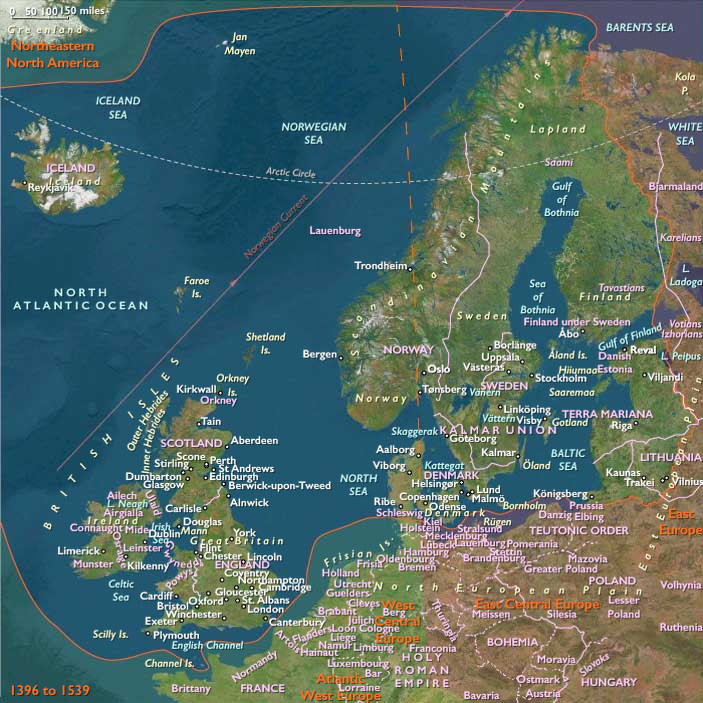
Northwest Europe (1396–1539 CE): North Sea Commons, Island Kingdoms, and Tudor Beginnings
Geographic & Environmental Context
The subregion of Northwest Europe includes the British–Irish archipelago, Iceland and the Faroes, and the ocean-facing rims of western Norway and western Denmark. Anchors span the North Atlantic fisheries (Iceland, Faroes, Shetland–Orkney), the North Sea littoral (Jutland, Yorkshire–East Anglia, Firths of Forth and Clyde), the Irish Sea and Channel approaches, and inland cores such as the Thames–Severn lowlands, Scottish Highlands/Islands, and Irish midlands. River corridors (Thames, Severn, Humber), firths, and sounds tied agrarian interiors to maritime trade, while the Norwegian fjords and Jutland bights faced wind-heavy seas.
Climate & Environmental Shifts
The Little Ice Age sharpened cold and storminess:
-
North Atlantic fringe (Iceland, Faroes, west Norway): longer sea-ice seasons and harsher gales; erratic cod/herring runs shaped fishing booms and busts.
-
Britain & Ireland: cooler winters, wet summers in some decades; harvest failures recurred locally; severe storms and surges disrupted coasts.
-
Jutland & North Sea: shifting bars and storm surges altered havens; dunes advanced on exposed shores.
Despite volatility, fisheries and mixed husbandry buffered many communities.
Subsistence & Settlement
-
Lowland farms (England, eastern Ireland, Jutland): wheat, rye, barley, oats; cattle, sheep, and dairying; open-field systems persisted in much of England, while enclosed demesnes and pastures spread unevenly.
-
Uplands & isles (Scotland, Wales, west Ireland, Norway): oats, barley, stock-rearing, and transhumant dairying; peat fuel; kelp and shore-gathering in island economies.
-
Iceland & Faroes: subsistence grain marginal; livelihoods centered on cod, dried fish, seabirds, sheep, and trade with Bergen–Hanse merchants.
-
Towns & ports: London (Thames) surged as a staple market; York, Bristol, Dublin, Cork, Edinburgh/Leith, Aberdeen, Bergen, and Aalborg tied hinterlands to sea lanes.
Technology & Material Culture
-
Maritime craft: clinker-built hulks and cogs gave way to round-hulled naos and early caravels; North Sea sailing rigs adapted to shoals and tides; Icelandic and Norse open boats remained crucial.
-
Arms & fortification: English longbow remained decisive into the mid-15th century; early handguns and field guns appeared; castles evolved toward gun-forts and, in Scotland/Ireland, tower houses.
-
Print & craft: William Caxton introduced printing to England (1476); cloth finishing (East Anglia, Yorkshire), tin/lead (Cornwall), and shipwrighting expanded.
-
Architecture & art: Perpendicular Gothic in England; late medieval parish art in Ireland; stave-church legacies and stone churches in west Norway; bardic manuscripts in Gaelic lands; saga copying continued in Icelandic scriptoria.
Movement & Interaction Corridors
-
North Sea/Irish Sea lanes: carried wool, cloth, salt fish (herring, cod), wine, salt, and iron; London, Hull, and east-coast ports linked to Hanseatic towns and Bergen’s fish market.
-
Atlantic ventures: Bristol merchants probed western waters; John Cabot’s voyage (1497) opened English awareness of Newfoundland’s cod banks.
-
Fjord & Jutland coasts: Bergen–Hanse convoy cycles and Jutland’s cattle/grain exports sustained Norway–Denmark’s Atlantic rim.
-
Isles networks: Birlinn and galley traffic knit Hebrides, Islay, Kintyre, Man, and Ulster; inter-island lordships balanced sea power and kin ties.
Cultural & Symbolic Expressions
-
Monarchy & law: English common law courts stabilized after civil war; Scottish kings balanced Highland/Lowland blocs; Gaelic lordships in Ireland maintained Brehon law and bardic patronage alongside the English Pale.
-
Language & letters: Middle English matured into Tudor English; Scots literature flourished (Dunbar, Henryson); Gaelic poetry remained courtly and genealogical; Icelandic annals and sagas preserved memory.
-
Devotion & reform: Late medieval piety—guild altars, pilgrimages (St. Andrews, Walsingham, St. David’s)—coexisted with early humanism; by the 1530s, England’s break with Rome began to reorder ritual and property.
Environmental Adaptation & Resilience
-
Mixed portfolios: grain–livestock rotations, dairying, and woodland management hedged climatic risk; parish granaries and seigneurial stores mitigated famine.
-
Fisheries & curing: salt fish, stockfish, and barrelled herring stabilized caloric intake and trade; salt-pan and coopers’ crafts were critical.
-
Field systems & enclosure: commons and open fields balanced with piecemeal enclosure to protect flocks and improve yields; drainage in fens and dike work on exposed coasts guarded arable.
-
Island adaptations: peat, driftwood, and turf for fuel; drying sheds and fish lofts; seasonal transhumance to shielings.
Technology & Power Shifts (Conflict Dynamics)
-
Hundred Years’ War (to 1453): English chevauchées faded after Joan of Arc’s campaigns (1429); defeat at Castillon (1453) ended English rule in France, redirecting power struggles homeward.
-
Wars of the Roses (1455–1487): Yorkist–Lancastrian civil war saw set-piece battles—Towton (1461), Tewkesbury (1471)—culminating in Tudor victory at Bosworth Field (1485); Henry VII stabilized crown finances and order.
-
Anglo-Scottish warpoints: Border raids persisted; Scotland’s defeat at Flodden (1513) killed James IV, reshaping regency politics.
-
Ireland: Tudor authority remained thin beyond the Pale; Gaelic confederacies and earldoms contested royal initiatives; intermittent wars foreshadowed later Tudor conquest.
-
Scandinavia: Denmark–Norway ruled the Atlantic rim; Bergen’s Hanse links endured; the Count’s Feud (1534–1536) in Denmark–Norway (closing years of this age) ushered in the Lutheran Reformation and tighter royal control.
-
Sea conflict: Privateering and piracy flickered in the Channel and North Sea; naval gunnery began to matter in convoy defense.
Transition
By 1539 CE, Northwest Europe had shifted from external continental wars to internal consolidation and oceanic horizons. England emerged under the Tudors with an embryonic navy and a royal church; Scotland balanced Franco-Scottish ties after Flodden; Ireland’s patchwork lordships and the Pale foreshadowed Tudor campaigns; Denmark–Norway steered the North Atlantic trades toward Lutheran monarchy; Iceland and the Faroes remained fishing outposts within this orbit. Fisheries, wool–cloth trades, and mixed husbandry underwrote resilience in a stormier climate, while printing and court centralization set the stage for later religious and imperial transformations.
Atlantic West Europe: Consolidation and Conflict (1396–1407)
The period from 1396 to 1407 inaugurates the Upper Late Medieval Age in Atlantic West Europe, a region comprising northern France, the Low Countries (including the Flemish cities of Ghent, Bruges, and Antwerp), and the Loire Valley. This era is characterized by ongoing dynastic struggles, economic shifts, artistic innovation, and foundational changes in political alliances.
Political and Military Developments
The early 15th century sees sustained tensions and shifting alliances, notably influenced by the ongoing Hundred Years' War (1337–1453). England and France continue their intermittent conflicts, with Atlantic West Europe often at the center of confrontation. In 1396, a temporary truce stabilizes the region, allowing both sides to consolidate resources. However, the peace remains fragile, leading eventually to renewed hostilities.
Internal conflicts mark this era as well, including rivalries among noble houses that exacerbate regional instability. Northern France witnesses struggles between Burgundian and Armagnac factions, deeply dividing the French aristocracy and laying the groundwork for future civil unrest.
Economic Developments
Atlantic West Europe's economic life remains dominated by thriving trade networks centered in Flemish cities like Bruges and Ghent, which serve as major hubs for international commerce. Woolen textiles maintain their centrality in the regional economy, although competition and disputes with English merchants over wool supply lead to trade disruptions. Bruges solidifies its role as the leading commercial center, facilitating extensive trade with Italian and Hanseatic merchants. Meanwhile, artisanal guilds in these prosperous cities grow more powerful and assertive in their local influence.
Cultural and Artistic Trends
Culturally, the region continues to develop its artistic reputation, exemplified by the early works of the Flemish Primitive painters, who build foundations for later masters like Jan van Eyck. Artistic patronage from the Burgundian court supports an atmosphere of experimentation, laying the groundwork for the stylistic innovations soon to transform European art.
Literary culture flourishes as well, with increased emphasis on vernacular works in French and Dutch, reflecting a growing sense of regional identity distinct from classical Latin traditions.
Technological and Societal Changes
The turn of the 15th century witnesses advances in maritime technology, driven by an increased desire for oceanic exploration and commerce. Shipbuilding techniques improve steadily in response to growing trade demands and competition, particularly from rising maritime powers in Iberia. Societal structures experience modest changes, as urban elites in trading cities begin to consolidate power, increasing tension with traditional feudal aristocracies.
Long-term Consequences and Significance
The era from 1396 to 1407 proves formative for Atlantic West Europe, setting a trajectory marked by intensified regional tensions, burgeoning economic power, and burgeoning cultural prestige. While temporary truces provide brief stability, underlying political fragmentation remains unresolved, presaging intensified conflicts and transformations in the following decades.
This period, therefore, lays essential foundations for the region’s complex future, marking the start of a critical transitional age in Atlantic West Europe's evolution through the Upper Late Medieval period.
Atlantic West Europe: Dynastic Struggles and Shifting Alliances (1420–1431)
The period 1420–1431 of the Upper Late Medieval Age (1396–1539) in Atlantic West Europe is dominated by intensified warfare, shifting political alliances, and deepening economic disruption. Yet, amid these crises, cultural and technological innovation continue, reflecting both resilience and adaptation within the region.
Political and Military Developments
The years 1420–1431 witness some of the most severe phases of the Hundred Years' War and the ongoing Armagnac–Burgundian Civil War. The Treaty of Troyes (1420) drastically alters the political landscape, designating Henry V of England as heir to the French crown, and effectively disinheriting the Dauphin Charles (later Charles VII). This agreement escalates conflict, solidifying English dominance over northern France, including Paris. The pivotal event is the rise of Joan of Arc (1429), whose intervention at the Siege of Orléans significantly shifts momentum back to the French side. Joan’s capture (1430) and subsequent execution (1431) by pro-English authorities further inflame the conflict but also galvanize French national sentiment.
Economic Developments
Continuous warfare severely disrupts economic stability, with trade routes frequently obstructed and agricultural productivity hampered by conflict. Nevertheless, the Atlantic coastal cities—particularly Bruges, Ghent, and increasingly, Antwerp—adapt to wartime conditions by diversifying trade and strengthening their local markets. Efforts to circumvent the economic impact of war lead merchants to seek alternate trade networks, notably deepening relations with Italian city-states and northern German towns within the Hanseatic League.
Cultural and Artistic Trends
Despite political turmoil, the region experiences significant cultural growth. Burgundian patronage remains robust, further enriching court life and stimulating artistic innovations. Flemish masters, such as Jan van Eyck, elevate panel painting to new artistic heights, exemplified by masterpieces like the Ghent Altarpiece (1432, begun earlier), which introduces unprecedented realism and technical mastery. Simultaneously, literary culture continues to flourish, with notable advances in chronicles and historical writing, capturing the era's complex political narratives.
Technological and Societal Changes
Technological innovation in this period centers primarily around warfare, including advancements in artillery and fortifications. Such military developments significantly alter siege warfare strategies. Meanwhile, society grows increasingly stratified between urban elites—who consolidate wealth and political influence—and rural populations who disproportionately bear the hardships of prolonged conflict. Yet, the struggles also encourage the growth of civic governance in cities such as Ghent and Bruges, further solidifying urban autonomy.
Long-term Consequences and Significance
This era solidifies critical shifts in the power dynamics of Atlantic West Europe. Joan of Arc’s brief yet impactful intervention dramatically reorients French national identity and morale, while English ambitions reach their territorial high point before beginning a gradual decline. The cultural and artistic achievements of the Burgundian Netherlands, exemplified by Jan van Eyck, set the stage for a flourishing Flemish Renaissance.
Ultimately, 1420–1431 underscores Atlantic West Europe's resilience amid profound dynastic and military struggles, laying foundations for future political, cultural, and economic recovery and advancement.
Jan van Eyck: Court Painter to Philip the Good and His Diplomatic Role (1425–1441)
Jan van Eyck (c. 1390–1441), one of the most influential painters of the Northern Renaissance, had an illustrious career that saw him serve two major ducal courts. He first worked for John III of Bavaria-Straubing in The Hague (1422–1424), where he was exposed to the court’s rich artistic culture. After John’s death in 1425, van Eyck entered the service of Philip the Good, Duke of Burgundy, where he became court painter and valet de chambre.
Van Eyck’s position under Philip the Good extended beyond painting, as he was entrusted with diplomatic missions, including the Burgundian marriage negotiations with Isabella of Portugal (1428–1429).
I. Early Career: The Hague and the Court of John III of Bavaria (1422–1424)
- Van Eyck’s earliest documented employment was in The Hague, where he worked for John III of Bavaria-Straubing.
- John III was a patron of the arts, and van Eyck was likely exposed to courtly and manuscript illumination traditions, influencing his detailed style and mastery of oil painting.
- Following John’s death in 1425, van Eyck entered the service of Philip the Good, Duke of Burgundy.
II. Court Painter to Philip the Good (1425–1441)
- Van Eyck initially resided in Lille for a year before settling in Bruges, where he would live until his death in 1441.
- He held the prestigious title of valet de chambre, indicating that his role extended beyond painting into court service and diplomacy.
- He was sent on several missions by Philip, though the exact nature of some of these assignments remains unclear.
III. Diplomatic Role: The Portuguese Marriage Delegation (1428–1429)
- In 1428–1429, van Eyck accompanied a Burgundian delegation to Portugal to negotiate Philip’s marriage to Isabella of Portugal.
- He painted two portraits of Isabella as part of the negotiations, allowing Philip to see his prospective bride before committing to the marriage.
- Philip married Isabella in 1430, marking a successful conclusion to the mission.
IV. Legacy and Influence
- Van Eyck’s work at the Burgundian court elevated the status of painters, proving that artists could hold prestigious courtly positions beyond just painting commissions.
- His attention to detail, mastery of oil painting, and use of light and perspective revolutionized Northern European art.
- His diplomatic role illustrated the increasing importance of artists in courtly and political affairs, bridging art and statecraft.
Jan van Eyck’s service to Philip the Good was more than just artistic—he played a key role in court diplomacy, particularly in the Burgundian-Portuguese marriage negotiations of 1428–1429, while pioneering new artistic techniques that defined the Northern Renaissance.
Atlantic West Europe: From Conflict to Consolidation (1432–1443)
The era 1432–1443 in Atlantic West Europe during the Upper Late Medieval Age (1396–1539) marks a significant transition from intense dynastic and territorial conflicts toward gradual political consolidation, economic stabilization, and cultural flourishing. While warfare remains ever-present, this decade witnesses crucial shifts toward internal strengthening and strategic realignments.
Political and Military Developments
Following the execution of Joan of Arc (1431), French fortunes in the Hundred Years' War undergo a remarkable turnaround. Under Charles VII, France embarks on the reconquest of territories previously lost to England, most notably capturing Paris in 1436. The English position weakens further with internal divisions, culminating in power struggles among English nobility. In parallel, the Treaty of Arras (1435) ends the destructive civil war between Armagnacs and Burgundians, aligning Burgundy more closely with France and isolating England diplomatically. This treaty represents a major diplomatic victory for France, fundamentally altering the power dynamics within the region.
Economic Developments
Economic recovery gradually takes root during this period, driven largely by stabilization in regions less affected by active combat. Bruges, Ghent, and Antwerp continue to reassert themselves as hubs of commerce, with the cloth and textile trade expanding significantly. Maritime trade benefits from improved naval security, despite occasional piracy and warfare disrupting commerce. The regional economy shifts increasingly toward specialization, and cities leverage their strategic positions on trade routes to bolster prosperity.
Cultural and Artistic Trends
Cultural life thrives in this comparatively peaceful decade. The Burgundian court at cities like Dijon, Bruges, and Ghent becomes renowned for its artistic and intellectual patronage. Jan van Eyck, whose masterpiece, the Ghent Altarpiece (completed 1432), exemplifies unprecedented realism and detail, dominates artistic innovation. His techniques spread widely across Europe, solidifying Flanders’ position as the epicenter of Northern Renaissance art. Literature and manuscript illumination flourish under ducal patronage, highlighting the cultural resilience of the period.
Technological and Societal Changes
Technological innovation continues apace, particularly in military and maritime fields. Improvements in artillery technology, influenced by earlier warfare experiences, lead to advancements in fortification designs and siege techniques. In society, urban centers grow stronger, with guilds and merchant associations gaining influence, laying foundations for stronger municipal governance. Rural areas, however, recover more slowly, still bearing the economic scars of recent decades of conflict.
Long-term Consequences and Significance
This period (1432–1443) represents a critical turning point. Politically, the Treaty of Arras establishes lasting peace between Burgundy and France, realigning power balances and diminishing English continental ambitions. Economically, the era’s stabilization lays groundwork for future prosperity, particularly in the increasingly dominant cities of the Low Countries. Culturally, the influence of the Burgundian court shapes artistic and intellectual developments, defining an enduring cultural legacy that significantly impacts subsequent European art.
Overall, this decade bridges an era of conflict and territorial upheaval to one of political consolidation, economic revival, and cultural innovation, setting the trajectory for Atlantic West Europe's emergence as a pivotal region in the coming Renaissance age.
The Ghent Altarpiece (1432): A Masterpiece by Hubert and Jan van Eyck
The Ghent Altarpiece, a monumental polyptych consisting of twenty panels, was executed in 1432 for the Church of St. Bavo in Ghent. The altarpiece bears an incomplete Latin inscription, naming Hubert and Jan van Eyck as its artists, though the precise role of Hubert remains debated among scholars.
This groundbreaking work of early Netherlandish painting is one of Jan van Eyck’s first major commissions and remains one of the most famous and controversial altarpieces in art history.
I. The Attribution Controversy: The Role of Hubert and Jan van Eyck
- The Latin inscription on the altarpiece suggests that Hubert van Eyck began the work and that Jan completed it after his brother’s death on September 18, 1426.
- However, scholarly opinions differ:
- One theory holds that Hubert was Jan’s older brother and an accomplished painter who laid out the composition, while Jan finished the painting.
- Another theory suggests that Hubert was not Jan’s brother and was instead a sculptor, possibly responsible for designing an elaborate frame for the altar rather than contributing to the painting.
- The varying scale and style among the panels have fueled debates over whether different artists worked on the piece.
II. The Exterior Panels: Grisaille and Portraits
- The exterior panels depict:
- The donor, Jodocus Vijdt, and his wife, kneeling in prayer.
- Saint John the Baptist and Saint John the Evangelist in grisaille, a technique that uses shades of gray to mimic sculpture.
- Above them, an Annunciation scene, demonstrating Jan van Eyck’s mastery of perspective and light.
III. The Interior: The Adoration of the Holy Lamb
- When opened, the altarpiece reveals a vivid, multi-panel composition, culminating in the central interior panel, The Adoration of the Holy Lamb.
- This panel is dominated by a radiant scene of the Lamb of God, symbolizing Christ’s sacrifice, surrounded by angels, saints, and clergy in a lush, highly detailed landscape.
- The altarpiece’s interior is known for its stunning color, realism, and intricate symbolism, showcasing Jan van Eyck’s groundbreaking use of oil paint.
IV. Legacy and Artistic Significance
- The Ghent Altarpiece is considered one of the greatest masterpieces of Northern Renaissance art.
- It demonstrates Jan van Eyck’s unparalleled skill in realism, light, and texture, solidifying his role as a pioneer of oil painting.
- The altarpiece has survived wars, thefts, and restorations, including a notorious theft in 1934, making it one of the most studied and admired works in Western art history.
The Ghent Altarpiece (1432) remains a defining work of early Netherlandish painting, not only for its technical brilliance and rich symbolism but also for the enduring mystery of its attribution and creation.
The Chaperon in Jan van Eyck’s Probable Self-Portrait (1433)
In Jan van Eyck’s probable self-portrait, Portrait of a Man in a Red Turban (1433), the artist wears a chaperon, a fashionable and highly versatile headwear style of the 15th century.
In this painting, van Eyck ties the cornette and patte together on top of the head, creating a flamboyant turban-like effect, a style commonly seen among wealthy individuals and professionals of the time.
I. Structure of the Chaperon in the Portrait
-
The chaperon evolved from a hooded cloak into a more elaborate headdress, typically composed of three parts:
- Bourrelet – A padded, ring-like structure that sits around the head.
- Cornette – A long trailing tail of fabric, originally designed to drape over the shoulder.
- Patte – A decorative flap or liripipe, which could be adjusted for different styling.
-
In van Eyck’s portrait:
- The cornette is wound around the bourrelet, leaving just a patch of the bourrelet visible (right of center).
- This wrapped style creates a turban-like silhouette, which could feature a short tail hanging at the rear.
- The arrangement was both fashionable and practical, making it suitable for a painter at work.
II. Symbolism and Function of the Chaperon
- By 1433, the chaperon had become a symbol of status and profession, worn by nobles, merchants, and scholars.
- The dramatic folds and structured appearance suggest wealth and refinement, reinforcing van Eyck’s social standing as a court painter.
- Its practical function for a painter:
- The wrapped design could prevent dust or paint from getting into the wearer’s hair.
- It could also shield the head from studio drafts and paint fumes.
III. The Chaperon as a Marker of Van Eyck’s Identity
- The self-portrait showcases van Eyck’s mastery of realism, particularly in the rendering of the chaperon’s intricate folds and texture.
- His signature use of light and shadow gives the fabric depth and volume, making it a striking element of the composition.
- This stylized headdress might reflect van Eyck’s personal fashion preferences, or it could serve as a visual symbol of his status as a sophisticated artist.
IV. Conclusion: A Fashion Statement and Practical Headwear
Jan van Eyck’s chaperon in his 1433 self-portrait is both a bold fashion statement and a functional choice for a working painter. The wrapped cornette and patte create a turban-like shape, a stylistic flourish that highlights the luxurious draping techniques of the period.
This striking headwear not only exemplifies van Eyck’s skill in painting fabric but also reinforces his social and artistic identity within the Burgundian court.