James V, King of Scots
King of Scots
Years: 1512 - 1542
James V (10 April 1512 – 14 December 1542) is King of Scots from 9 September 1513 until his premature death at the age of 30, which follows the Scottish defeat at the Battle of Solway Moss.
His only surviving legitimate child, Mary, Queen of Scots, succeeds him to the throne when just six or seven days old.

Related Events
Filter results
Showing 10 events out of 28 total
James, the son of King James IV of Scotland and his queen Margaret Tudor, a daughter of Henry VII of England, is the only legitimate child of his father to survive infancy.
He was born on April 10, 1512, at Linlithgow Palace, Linlithgowshire and christened the next day, receiving the titles Duke of Rothesay and Prince and Great Steward of Scotland.
He becomes king at just seventeen months old when his father is killed at the Battle of Flodden Field.
James is crowned on September 21, 1513, in the Chapel Royal at Stirling Castle.
Sir David Lindsay (or Lyndsay) of the Mount, a poet and dramatist active in court life, will be appointed guardian of the infant King James V in October.
Gawin Douglas, the leading, poet produces an outstanding translation of Vergil's Aeneid.
Among the earliest translations of the Aeneid into a dialect of English, the work adheres closely to the Latin original.
In the evocative passages describing storms and the sea, Douglas makes good use of the great range of words available to him, capturing the joy and brightness of Vergil’s phrasing.
His original prologues to each book of the Aeneid are rich in fine literary criticism, autobiography, and nature description.
The Douglas family assumes a pivotal role in Scotland’s public affairs during the minority of James V. Three weeks after the Battle of Flodden, Gavin Douglas, still Provost of St Giles, had been admitted a burgess of Edinburgh.
His father, the "Great Earl," is the civil provost of the capital.
The Scottish nation is beginning its painful recovery, and Angus has won appointment as one of the councilors of Margaret Tudor the queen regent; but he dies soon afterwards at the end of October 1513 in Wigtownshire, where he had gone as justiciar.
His two eldest sons having perished on Flodden Field, the succession falls to Gavin's nephew, Archibald Douglas, 6th Earl of Angus.
Regents will rule Scotland during the childhood of James V: first his mother, until she remarries in 1514 to the pro-English Archibald Douglas, 6th Earl of Angus, then John Stewart, 2nd Duke of Albany, who is next in line to the throne after James and his younger brother, the posthumously born Alexander Stewart, Duke of Ross.
Other regents include Robert Maxwell, 5th Lord Maxwell, a member of the Council of Regency who is also bestowed as Regent of Arran, the largest island in the Firth of Clyde.
A power struggle ensues among factions controlled by Albany, Angus, and Margaret.
The marriage of the young Earl of Angus to James IV's widow on August 6, 1514 does much to identify the Douglases with the English party in Scotland, as against the French party led by the Duke of Albany, and incidentally to determine the political career of his uncle Gavin.
During the first weeks of the queen's sorrow after the battle, Gavin, with one or two colleagues of the council, acts as personal adviser, and it may be taken for granted that he supports the pretensions of the young earl.
His own hopes of preferment have been strengthened by the death of many of the higher clergy at Flodden.
The first outcome for Gavin from the new family connection was his appointment to the Abbacy of Aberbrothwick by the Queen Regent, as Margaret Tudor was before her marriage, probably in June 1514.
Soon after the marriage of Angus to Margaret she nominates him Archbishop of St Andrews, in succession to William Elphinstone, archbishop-designate.
But John Hepburn, prior of St Andrews, having obtained the vote of the chapter, expels him, and is himself in turn expelled by Andrew Forman, Bishop of Moray, who has been nominated by the pope.
In the interval, Douglas's rights in Aberbrothwick have been transferred to James Beaton, Archbishop of Glasgow, and he is now without title or temporality.
The breach between the Queen's party and Albany's has widened, and the queen's advisers have begun an intrigue with England, to the end that the royal widow and her young son should be removed to Henry's court.
In these deliberations Gavin Douglas takes an active part, and for this reason stimulates the opposition that successfully thwarts his preferment.
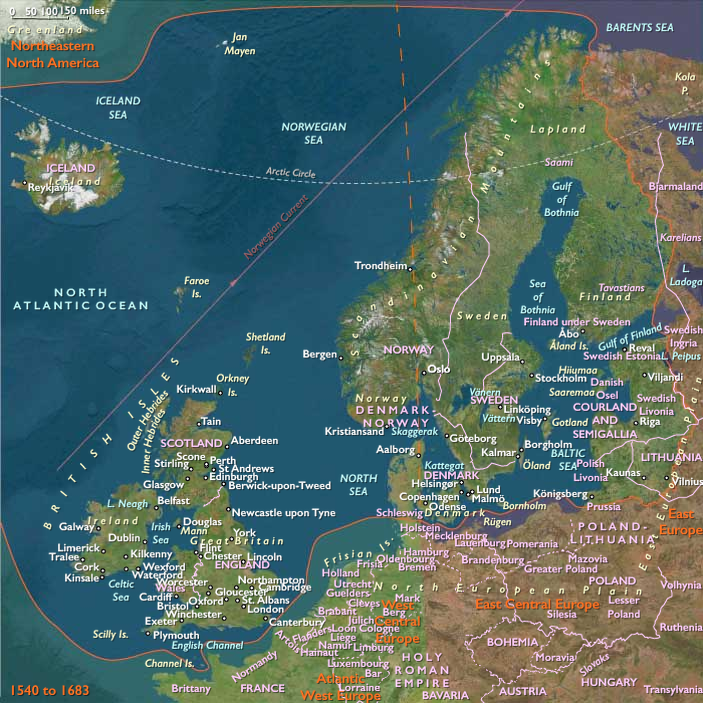
Northwest Europe (1516–1527 CE): Reformation Sparks, Diplomatic Shifts, and Cultural Renaissance
England: Early Reign of Henry VIII and Humanist Influence
Under Henry VIII, England continued to evolve both politically and culturally. Henry's dynamic personality and aspirations for continental influence led to shifting alliances and occasional military engagement, notably the diplomatic summit known as the Field of the Cloth of Gold with Francis I of France in 1520. At home, humanism further penetrated intellectual circles, prominently through Thomas More, whose seminal work, Utopia (1516), critiqued contemporary society and governance, becoming a cornerstone of Renaissance humanist literature. More, alongside scholars like John Colet and the Dutch humanist Desiderius Erasmus, continued advocating ecclesiastical reform and educational renewal.
Scotland: Regency Challenges and Diplomatic Maneuvers
Scotland, during the minority of James V, navigated significant political instability, managed primarily by regents including John Stewart, Duke of Albany. Scotland maintained cautious diplomacy, maneuvering between English and French interests. Cultural life continued to flourish, influenced by ongoing Renaissance currents from continental Europe and England.
Ireland: Increasing English Pressure and Gaelic Resistance
English attempts to exert stronger control in Ireland intensified, particularly under the governance of Thomas Howard, Earl of Surrey. Yet, the Gaelic lordships demonstrated notable resilience. The enduring dominance of Gaelic culture and adherence to traditional Brehon Law persisted despite incremental English encroachment, particularly beyond The Pale. This period witnessed sustained autonomy among powerful families like the O'Neills and the Fitzgeralds, who continued to resist comprehensive English hegemony.
Scandinavia: End of the Kalmar Union and Rise of Gustav Vasa
The Kalmar Union underwent dramatic collapse as Christian II's rule faced growing opposition. The Stockholm Bloodbath of 1520, Christian II’s notorious execution of numerous Swedish nobles, precipitated rebellion led by Gustav Eriksson (Vasa). Gustav successfully expelled Danish forces, and in 1523 became Gustav I, King of Sweden, dissolving the Kalmar Union and establishing Swedish independence. Concurrently, Denmark and Norway underwent turbulent political reconfigurations, marking a significant shift toward centralized monarchical authority and foreshadowing broader Protestant reforms.
Iceland: Economic Struggles and Literary Preservation
Iceland endured ongoing economic hardships and isolation but maintained vibrant literary activity. Scribes continued diligently copying manuscripts of sagas, poetry, and historical accounts, effectively safeguarding Iceland's rich literary heritage. The cultural resilience demonstrated by the meticulous preservation of texts helped sustain Icelandic identity during challenging times.
Cultural and Intellectual Renaissance
Northwest Europe experienced a deepening cultural and intellectual renaissance. In England, humanist thought profoundly influenced intellectual discourse and educational reform. Meanwhile, the works of poets such as John Skelton and emerging playwrights contributed to evolving literary expression. Architectural projects, notably the continued development of Magdalen College, Oxford, and the increasingly ornate Tudor style, showcased ongoing artistic and architectural innovation.
Prelude to Religious Reformation
The era was crucially marked by escalating religious dissent and critical evaluation of traditional Church authority. In 1517, Martin Luther's posting of the Ninety-five Theses in Wittenberg significantly impacted intellectual circles across Northwest Europe. Although England and Scotland remained officially Catholic, Luther’s ideas rapidly gained adherents among scholars and the wider populace, laying the groundwork for imminent religious transformation.
Maritime Ventures and Early Colonial Ambitions
Maritime exploration persisted, driven by commercial interests and growing imperial aspirations. Although substantial colonial establishments were not yet undertaken, exploratory voyages and trade expeditions continued to encourage England's nascent ambitions for overseas expansion.
Legacy of the Era
By 1527 CE, Northwest Europe stood on the cusp of profound religious, political, and cultural shifts. The period's humanist intellectual ferment, shifting diplomatic alliances, and emerging national identities set the stage for decisive transformations in the decades ahead, reshaping the historical trajectory of the region significantly.
John Stewart, Duke of Albany, had been called to assume the regency (or guardianship) in 1514 when the infant king's mother, Dowager Queen Margaret, had married again to the Scottish noble, Archibald Douglas, 6th Earl of Angus, who leads his own faction in Scotland and is opposed by other factions.
Albany has utilized the Scottish nobility’s innate distrust of Margaret.
After two years' of this uneasy situation, Margaret has to flee to England in 1516 (Albany besieges the queen at Stirling and gets possession of the royal children) and Albany thus succeeds in making himself the sole regent for James V.
The fragmentary and quarrelsome politics of Scotland will overthrow and restore Albany's powers several times over the next eight years.
The earl of Angus later in 1516 makes his peace with Albany.
The Treaty of Rouen and the Renewal of the Franco-Scottish "Auld Alliance" (August 26, 1517)
Between 1517 and 1520, John Stewart, Duke of Albany, Scotland's regent, resided predominantly in France, managing Scotland’s affairs remotely through trusted lieutenants, most notably Antoine d'Arces, sieur de la Bastie. This arrangement was a strategic consequence of Albany's strong personal and political ties to France, and it shaped Scotland’s political trajectory during the regency period.
Context and Key Figures
John Stewart, Duke of Albany, had assumed the Scottish regency during the minority of King James V, following the death of James IV at Flodden in 1513. Albany, a cousin to the young king, had close familial and political connections to France, reflecting the long-standing alliance between the two kingdoms, popularly known as the "Auld Alliance."His frequent absences from Scotland and residence in France underscored the enduring political and diplomatic influence France wielded over Scottish affairs.
In Albany’s absence, governance on the ground was conducted through a network of deputies, prominently led by the French-born Antoine d'Arces, Sieur de la Bastie, whose role underlined the heavy French influence in Scotland’s internal politics at the time.
The Treaty of Rouen (August 1517)
On August 26, 1517, Albany formalized these Franco-Scottish ties through the Treaty of Rouen, signed with Charles IV, Duke of Alençon, a senior figure in the French royal family. This treaty effectively renewed the traditional alliance between France and Scotland, which had been a cornerstone of both nations’ foreign policies for centuries, primarily directed against England’s geopolitical influence.
A significant clause within the treaty was France’s promise of a royal bride for the young James V, further strengthening dynastic connections between the kingdoms and securing ongoing French influence in Scotland.
The Scottish poet and diplomat, Gavin Douglas, Bishop of Dunkeld, played a critical role in negotiating the treaty, underscoring Scotland’s recognition of the importance of literary and cultural diplomacy alongside military and political alliances.
Political and Diplomatic Implications
The Treaty of Rouen reiterated the strategic alignment of Scotland with France, bolstering Scottish security against potential English aggression while simultaneously serving French interests in maintaining a strong diplomatic foothold on England’s northern border. However, Albany’s frequent absences and reliance on deputies such as la Bastie eventually exposed vulnerabilities within the Scottish regency government, complicating internal stability.
Long-Term Consequences and Legacy
Albany’s sojourn in France and the subsequent Treaty of Rouen had substantial long-term implications. The enduring strength of the Auld Alliance kept Scotland closely tied to French political, cultural, and military spheres, shaping the kingdom’s international relationships through much of the sixteenth century. At the same time, it highlighted the challenges faced by a regency government conducted from afar, eventually contributing to tensions within Scottish nobility and influencing domestic politics.
Ultimately, the treaty demonstrated the complexity of Scotland’s geopolitical position in early modern Europe, balancing internal governance with external alliances, a delicate equilibrium significantly impacted by Albany’s decisions during this period.
James V, now twelve years old, dismisses his Regents in the autumn of 1524 and is proclaimed an adult ruler by his mother.
Several new court servants are appointed including a trumpeter, Henry Rudeman.
Angus, the young king's stepfather, had taken custody of James in 1525 and will hold him as a virtual prisoner for three years, exercising power on his behalf.
There are several attempts made to free the young King—one is made by Walter Scott of Branxholme and Buccleuch, who ambushes the King's forces on July 25, 1526, at the battle of Melrose, and is routed off the field.
Another attempt later this year at the battle of Linlithgow Bridge on September 4 fails again to relieve the young King James from the clutches of Angus.
Margaret had persuaded the Earl of Lennox and Cardinal Beaton to support her cause.
Lennox has raised an army over ten thousand and marches on Edinburgh from his base in Stirling.
By this time Archibald Douglas has won the support of James Hamilton, 1st Earl of Arran and the latter is sent to try to delay the march by mustering the people of Linlithgow and the surrounding area.
Arran arranges his force of twenty-five hundred men on the strategically important Pace Hill overlooking Linlithgow and the River Avon.
Lennox, seeing the strength of this defensive position, has to rethink his plans.
Lennox intends to outflank and defeat Arran before Douglas can arrive from Edinburgh with reinforcements.
Downstream from the town, the river is impassable, but his scouts find a ford a mile upstream, at Manuel Convent.
Lennox forces a crossing there and advances on Arran’s flank.
However, Arran sees the threat and places his troops facing south along the ridge of Pace Hill.
Lennox’s attack is across the Avon, over boggy ground and finally uphill, but he very nearly succeeds in dislodging Arran’s outnumbered men.
However, time runs out for Lennox as Douglas reinforcements arrive, followed by the reluctant King James.
Many of the Lennox men are killed either on the ridge or along the banks of the river Avon.
The Earl of Glencairn is captured and Lennox himself is wounded.
Lennox surrenders to his opponents but is subsequently murdered by James Hamilton of Finnart.
The location of Lennox’s murder is commemorated with a cairn that stands at the entrance to the Kettilstoun estate.
Lennox is succeeded by his son Matthew Stewart, 4th Earl of Lennox, the father of Henry Stewart, Lord Darnley and grandfather of James VI of Scotland.