James II of Scotland
King of Scots
Years: 1430 - 1460
James II (16 October 1430 – 3 August 1460), who reigned as king of Scots from 1437 on, is the son of James I and Joan Beaufort.
Nothing is known of his early life, but by his first birthday his only brother, Alexander, who is also older, has died, thus making James the heir apparent and Duke of Rothesay.
Curiously, James holds no other titles while Duke of Rothesay.
On February 21, 437, James I is assassinated and the six-year-old Duke of Rothesay immediately succeeds him as James II.
In 1449, nineteen-year-old James marries fifteen-year-old Mary of Guelders, daughter of the Duke of Gelderland.
She has numerous royal ancestors such as John II of France and John of Bohemia.
She bears him seven children, six of whom survive into adulthood.
Subsequently, the relations between Flanders and Scotland improve.
James's nickname, Fiery Face, referredsto a conspicuous vermilion birthmark on his face which appears to have been deemed by contemporaries an outward sign of a fiery temper.
James is a politic and singularly successful king.
He is popular with the commoners, with whom, like most of the Stewarts, he socializes often, both in times of peace and war.
His legislation has a markedly popular character.
He does not appear to have inherited his father's taste for literature, which is "inherited" by at least two of his sisters; but the foundation of the university of Glasgow during his reign, by Bishop Turnbull, shows that he encouraged learning; and there are also traces of his endowments to St. Salvator's, the new college of Archbishop Kennedy at St Andrews.
He possesses much of his father's restless energy.
However, his murder of the Earl of Douglas leaves a stain on his reign.

Related Events
Filter results
Showing 10 events out of 18 total
Matters come to a head on February 21, 1437, when a group of assassins led by Sir Robert Graham accosts the forty-three-year-old King James at the Dominican Friars Preachers Monastery in Perth.
He makes an unsuccessful attempt to escape his assailants through a sewer but, three days previously, he had had the other end of the drain blocked up because of its connection to the tennis court outside: balls were habitually lost in it.
Following the monarch’s murder, his seven-year-old son succeeds him as James II under a regency led by the lieutenant-general of the realm, Archibald Douglas, 5th Earl of Douglas, a family notorious for its attempts to control the Scottish throne.
No general uprising follows the murder, and the king's widow quickly has the conspirators captured and put to death.
The following month sees a wave of executions of those who were alleged to have participated in the plot.
The authorities execute, among others, James's uncle, Walter Stewart, 1st Earl of Atholl, who had aspired to win the crown for himself, and Atholl's grandson, Robert Stewart, Master of Atholl—both of them descended from Robert II's second marriage.
Following the assassination of King James in 1437, Perth loses its centuries-long status as the Scottish capital.
Power in Scotland, after the death of the regent Douglas in 1439, and with a general lack of high-status earls because of deaths, forfeiture or youth, becomes shared uneasily between William, 1st Lord Crichton, Lord Chancellor of Scotland, and Sir Alexander Livingston of Callendar, who has possession of the young king as the warden of the stronghold of Stirling Castle.
A dynastic feud now erupts over possession of the Scottish crown.
William Douglas, the eldest son of Archibald Douglas and Eupheme Graham, had become 6th Earl of Douglas on his father’s death and married Janet Lindsay, daughter of David Lindsay, 3rd Earl of Crawford.
Crichton and Livingston, together with James Douglas the Gross, Earl of Avondale, conspire to break the power of the late Earl's family, and in November 1440 summon William and his younger brother David to Edinburgh Castle.
The so-called 'Black Dinner' that ensues sees the two boys summarily beheaded on trumped up charges, in the presence of the young King.
The family estates are divided between Avondale, who is the son of the third earl (Archibald the Grim) and Margaret, the sixth earl's sister.
Commentators tend to place the blame for the Black Dinner at the feet of Crichton, Livingston and particularly Avondale, as Douglas's death brings him the earldom of Douglas (as 7th earl of Douglas), and the position of the most powerful magnate in Scotland.
Northwest Europe (1444–1455 CE): Dynastic Tensions and Cultural Advances
England: Growing Tensions and Prelude to Civil War
The reign of Henry VI became increasingly fraught, characterized by worsening political instability and the deterioration of English holdings in France. Losses such as Normandy in 1450 deepened discontent among nobles and commoners alike, contributing to internal strife. Henry VI, England’s Lancastrian king, proved ineffectual and unstable as he matured, prompting those dissatisfied with government by his favorites to rally around Richard, Duke of York, head of the rival House of York. Armed clashes had occurred previously between supporters of Henry and Richard, but the first open fighting broke out in 1455, marking the onset of the Wars of the Roses.
Scotland: Stability and Cultural Growth
Following the reforms initiated by James I, Scotland enjoyed relative stability under his successor, James II. James II, ascending to the throne as a child in 1437, gradually consolidated his rule throughout the 1440s and early 1450s. His reign saw the continued growth of royal authority, further weakening the power of the nobility. Cultural activities flourished, reflecting broader European influences and enhancing the country's literary and artistic heritage.
Ireland: Gaelic Autonomy and Cultural Flourishing
Gaelic lordships continued to assert their dominance across Ireland, maintaining their autonomy and cultural identity against limited English authority. The O’Neill and O’Brien clans solidified their regional power bases, and Irish literary traditions thrived, marked by vibrant poetry and annalistic writing that preserved and celebrated Gaelic heritage. English control remained limited primarily to The Pale, with attempts at expansion encountering persistent resistance.
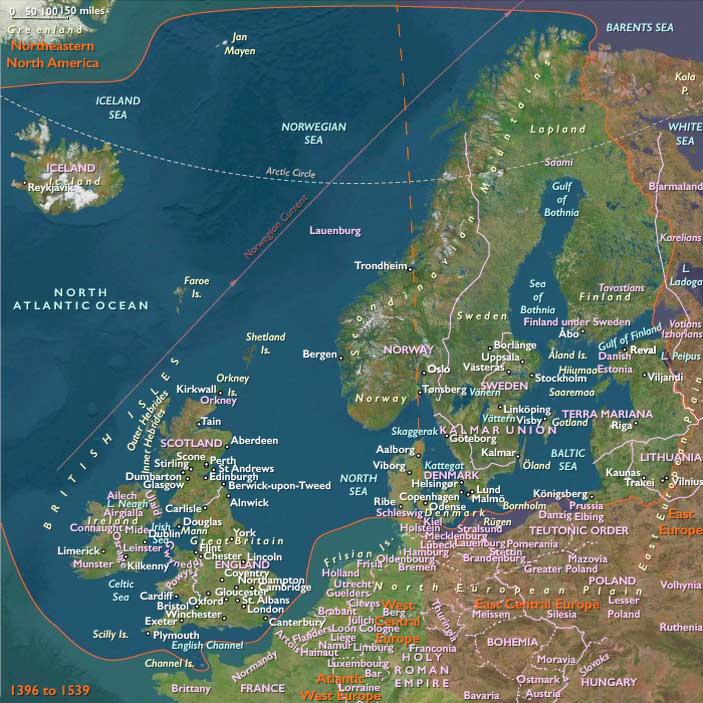
Scandinavia: Instability within the Kalmar Union
The Kalmar Union, under King Eric of Pomerania and later under King Christopher of Bavaria and then Christian I, experienced persistent internal tensions. Sweden's dissatisfaction with union policies increased, sparking periodic revolts and political unrest. Despite these ongoing challenges, the union persisted, albeit tenuously, through diplomatic maneuvers and fragile agreements.
Iceland: Literary and Cultural Vigor
Within the broader Scandinavian political context, Iceland maintained its cultural vitality. The island continued to produce significant literary works, particularly historical sagas and chronicles that documented its rich past and preserved its distinct identity. Icelandic literature served not only as historical records but also as symbols of cultural pride and resilience in a changing political landscape.
Cultural and Artistic Developments
The period witnessed significant cultural developments across Northwest Europe. Architectural advancements, notably at York Minster, continued to exemplify the evolving Perpendicular Gothic style. The innovative compositions of John Dunstaple and contemporaries continued to shape European music, spreading harmonically rich practices centered around intervals of thirds and sixths. These artistic achievements highlighted the region's continued intellectual vibrancy amid political uncertainty.
Legacy of the Era
By 1455 CE, Northwest Europe stood on the brink of transformative upheaval. England faced imminent civil war, Scotland enjoyed strengthened central authority and cultural growth, Ireland continued its robust Gaelic traditions, and the Kalmar Union grappled with internal dissent. These complex dynamics were balanced by impressive cultural advances, showcasing the region's resilience and creativity during this turbulent period.
Northwest Europe (1444–1455 CE): Dynastic Tensions and Cultural Advances
England: Growing Tensions and Prelude to Civil War
The reign of Henry VI became increasingly fraught, characterized by worsening political instability and the deterioration of English holdings in France. Losses such as Normandy in 1450 deepened discontent among nobles and commoners alike, contributing to internal strife. Henry VI, England’s Lancastrian king, proved ineffectual and unstable as he matured, prompting those dissatisfied with government by his favorites to rally around Richard, Duke of York, head of the rival House of York. Armed clashes had occurred previously between supporters of Henry and Richard, but the first open fighting broke out in 1455, marking the onset of the Wars of the Roses.
Scotland: Stability and Cultural Growth
Following the reforms initiated by James I, Scotland enjoyed relative stability under his successor, James II. James II, ascending to the throne as a child in 1437, gradually consolidated his rule throughout the 1440s and early 1450s. His reign saw the continued growth of royal authority, further weakening the power of the nobility. Cultural activities flourished, reflecting broader European influences and enhancing the country's literary and artistic heritage.
Ireland: Gaelic Autonomy and Cultural Flourishing
Gaelic lordships continued to assert their dominance across Ireland, maintaining their autonomy and cultural identity against limited English authority. The O’Neill and O’Brien clans solidified their regional power bases, and Irish literary traditions thrived, marked by vibrant poetry and annalistic writing that preserved and celebrated Gaelic heritage. English control remained limited primarily to The Pale, with attempts at expansion encountering persistent resistance.
Scandinavia: Instability within the Kalmar Union
The Kalmar Union, under King Eric of Pomerania and later under King Christopher of Bavaria and then Christian I, experienced persistent internal tensions. Sweden's dissatisfaction with union policies increased, sparking periodic revolts and political unrest. Despite these ongoing challenges, the union persisted, albeit tenuously, through diplomatic maneuvers and fragile agreements.
Iceland: Literary and Cultural Vigor
Within the broader Scandinavian political context, Iceland maintained its cultural vitality. The island continued to produce significant literary works, particularly historical sagas and chronicles that documented its rich past and preserved its distinct identity. Icelandic literature served not only as historical records but also as symbols of cultural pride and resilience in a changing political landscape.
Cultural and Artistic Developments
The period witnessed significant cultural developments across Northwest Europe. Architectural advancements, notably at York Minster, continued to exemplify the evolving Perpendicular Gothic style. The innovative compositions of John Dunstaple and contemporaries continued to shape European music, spreading harmonically rich practices centered around intervals of thirds and sixths. These artistic achievements highlighted the region's continued intellectual vibrancy amid political uncertainty.
Legacy of the Era
By 1455 CE, Northwest Europe stood on the brink of transformative upheaval. England faced imminent civil war, Scotland enjoyed strengthened central authority and cultural growth, Ireland continued its robust Gaelic traditions, and the Kalmar Union grappled with internal dissent. These complex dynamics were balanced by impressive cultural advances, showcasing the region's resilience and creativity during this turbulent period.
The University of Glasgow is established in 1451, on the model of the University of Bologna,by a charter or papal bull from Pope Nicholas V, at the suggestion of King James II, giving Bishop William Turnbull permission to add the university to the city's cathedral.
It is the second-oldest university in Scotland, and the fourth-oldest in the English-speaking world.
The power of the Black Douglases, lost after the execution of the 6th Earl, has been restored by the 8th Earl, who has recovered the lordships of Wigtown, Wigtownshire, Galloway and Bothwell by marriage (by papal dispensation) to his cousin, Margaret Douglas, Fair Maid of Galloway (daughter of the 5th Earl).
He was soon high in favor with James II, and had procured the disgrace of Sir William Crichton, presumed murderer of his kinsman the 6th Earl, by an alliance with his rival, Sir Alexander Livingston of Callendar.
James II had reached adulthood in 1449, yet in many ways his "active kingship" has differed little from his minority.
The Douglases had used his coming of age as a way to throw the Livingstons out of the shared government, as the young had king taken revenge for the brief arrest of his mother (a means to remove her from political influence) that had occurred in 1439.
Douglas and Crichton had continued to dominate political power, and the king's ability to rule without them remains arguably limited.
James has not acquiesced with this situation without argument, however, and between 1451 and 1455 he will struggle to free himself from the power of the Douglases.
James II had raided the Douglas lands in 1452 during the Earl’s absence on a pilgrimage to Rome.
Despite this, their relations seemed outwardly friendly.
However, in 1452, the king sends one of Douglas's friends, Sir William Lauder of Haltoun, with an invitation to Douglas to come to Stirling Castle under a safe-conduct, in itself, however, a proof of strained relations.
Jameson February 22 there demands the dissolution of a league into which Douglas has entered with Alexander Lindsay, the 'Tiger' earl of Crawford, and John of Islay.
Upon Douglas's refusal, the king murders him with his own hands, stabbing him twenty-sixtimes, and his body is thrown out of a window.
Since Douglas dies without issue, his titles pass to his brother James.
He denounces his brother's murderers and takes up arms against the king, and he and his brothers attack Stirling, driving a horse through the town with the safe conduct given to William attached to its tail.
He is forced to back down when some allies desert him.
James Douglas has obtained a papal dispensation to marry his brother's widow, Margaret Douglas, Fair Maid of Galloway, in order to keep the family estates together. (It is not entirely clear that this marriage ever took place, but it was certainly planned.)
He is involved in intrigues with the English court, and in 1455 rebels against James II once more, seizing Inverness.
Meanwhile another branch of the Douglas family, known as the Red Douglases, has risen into importance, and George Douglas, 4th Earl of Angus, great-grandson of the first earl of Douglas, takes sides with the king against the Earl of Douglas.
Douglas, again deserted by his chief allies, flees to England, and his three younger brothers, Hugh Douglas, Earl of Ormonde, Archibald Douglas, Earl of Moray, and John Douglas, Lord of Balvenie, are defeated on May 12 at the Battle of Arkinholm, near Langholm on the Esk, possibly by Angus.
Moray is killed, Ormonde taken prisoner and executed, and Balvenie escapes to England.
Their last stronghold, Threave Castle in Galloway, falls.
James Douglas is attainted in 1455, and his lands and estates are forfeit to the crown.
The lands of the Douglases are divided among their rivals, the lordship of Douglas falling to the Red Douglas 4th earl of Angus.
The Scottish Parliament under James II forbids football and golf and ordains the wearing of specific colors by the common people: gray and white for work; red, green and light blue for holidays.
Northwest Europe (1456–1467 CE): Conflicts and Cultural Developments
England: Escalating Civil War
The Wars of the Roses intensified significantly, with major battles shaping the political landscape. The Yorkist victory at the Battle of Towton in 1461, the largest and bloodiest encounter of the conflict, led to the deposition of the Lancastrian king Henry VI and the crowning of Edward IV as king. Despite Edward's initial triumph, Lancastrian resistance persisted, leading to ongoing instability. The civil war had resumed in 1459, driven largely by Henry VI's queen, Margaret of Anjou, who inspired renewed conflict. Richard, Duke of York, initially became Protector but was dissuaded from claiming the throne outright. By the end of 1460, Richard was killed in battle, paving the way for Edward IV's proclamation as king in early 1461.
Scotland: Consolidation and Cultural Flourishing
In Scotland, James III (1460–1488) assumed power as a minor following the sudden death of his father, James II, in 1460. A regency council initially governed, with significant influence wielded by powerful nobles. Despite political challenges, James III’s reign witnessed the flourishing of Scottish art and architecture, with increased patronage contributing to cultural advancements and closer diplomatic ties to the European mainland.
Ireland: Gaelic Revival and English Constraints
Ireland continued to experience Gaelic resurgence, limiting English control strictly to The Pale. Prominent Gaelic families such as the Fitzgeralds, O'Briens, and O’Neills expanded their territories and influence, while simultaneously resisting English attempts at consolidation. Irish culture, law, and poetry experienced significant growth, reinforcing traditional Gaelic identity.
Scandinavia: Tensions in the Kalmar Union
The Kalmar Union faced ongoing internal tensions, particularly during the reign of Christian I (1448–1481). Sweden continued to push against Danish domination, and while armed rebellions were sporadic, political discontent persisted. Christian I maintained fragile control over the union through diplomacy and occasional military action, but unity remained tenuous.
Iceland: Literary Preservation
Iceland preserved its unique cultural heritage despite political integration into the Kalmar Union. Icelanders continued to produce and maintain their literary traditions, ensuring the survival of sagas, annals, and poetic forms. These efforts strengthened Icelandic identity, maintaining a vibrant cultural continuity amid broader Nordic political instability.
Cultural and Artistic Evolution
Throughout Northwest Europe, artistic and cultural developments continued to flourish. The English composer John Dunstaple maintained his prominence, influencing musical practices with innovative harmonies. Architectural projects progressed, including the ongoing construction and embellishment of York Minster in the increasingly prevalent Perpendicular Gothic style. Social changes, including new individuals rising to positions of power from various parts of society, also contributed to linguistic evolution in England.
Legacy of the Era
By 1467 CE, Northwest Europe was deeply influenced by intense political rivalries and remarkable cultural growth. England remained embroiled in civil conflict despite Edward IV's reign, Scotland navigated the challenges of minority kingship with cultural advancement, Ireland saw a strengthened Gaelic identity, and Scandinavia continued to grapple with internal divisions. These developments left an enduring imprint on the region, shaping political and cultural trajectories in subsequent decades.