Huguenot immigrants to the American territories had in 1678 founded New Paltz, New York, where is now located the oldest street in the current United States of America with the original stone houses.
German immigrant Jacob Leisler, who had arrived as a mercenary in the English army and risen to become one of the colony's wealthiest merchants, acts as an agent for a group of Huguenots in New York, purchasing the land upon which they will settle.
John Pell, lord of Pelham Manor—a feudal domain with its own civil and criminal courts—officially deeds to Leisler sixty-one hundred acres (twenty-five square kilometers) under warrant from William III.
In addition to the purchase money, Leisler and his heirs and assigns are to yield and pay unto John Pell and his heirs and assigns (Lords of the Pelham Manor) one 'Fat Calf' yearly as acknowledgment of their feudal obligation to the Manor.
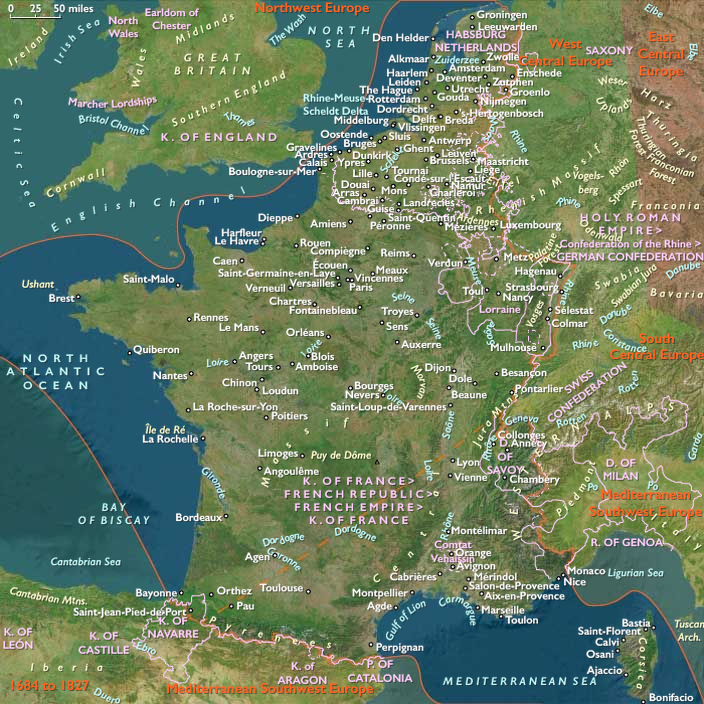
In 1689, a particularly large group of Huguenot manufacturers, artisans, and craftsmen, comprising some thirty-three families, name this settlement Nouvelle-Rochelle, after La Rochelle, France, the homeland of many of the settlers.